In two passages, Jesus taught how to pray — Matthew 6 and Luke 11 — with a model prayer. Both those are the same. The New Testament references Jesus praying many times, but actual recorded prayers of His are very few: a couple of thanks (Matthew 11:25-26, John 11:41-42), very brief cries on the cross (Luke 23:34, 46, Matthew 27:46), ones about His troubles around His death (John 12:27-28, Matthew 26:36-46), and then the one and only one long one — John 17. In the one long prayer in John 17, He prays essentially for six things in that prayer:
- For Himself (Glorification): Jesus asks to be glorified by the Father so that he may glorify Him.
- For His Disciples and Future Believers (Unity): He prays that they may be one, even as the Father and He were one.
- For His Disciples (Joy): He prays that his followers would have his joy filled within them.
- For His Disciples (Sanctification): He asks that they be sanctified (consecrated) in the truth, which is God’s Word.
- For His Disciples (Protection from Evil): He asks the Father to protect/keep them while they are in the world, also safe from the evil one, rather than being taken out of the world.
- For Future Believers (Heavenly Presence): He requests that all believers may eventually be with him to see his glory.
Jesus and Unity
One could say Jesus prayed for one main thing, which is unity. I would challenge anyone to look at everything in the New Testament on unity as a basis for understanding Jesus’ prayer for unity. Consider it all together.
Through the years of reading everything I could on John 17, I found many variations of the interpretation of the unity Jesus prayed for. I don’t believe Jesus would contradict the rest of the New Testament on unity, which are the words of Christ to dwell in us richly. He gave those words to the human authors through the Holy Spirit. I write about the unity for which Jesus prayed in our book, A Pure Church, in my chapter on John 17 and unity.
John 17 Unity, the Only Unity in the Bible
In my opinion, most of what I read and hear about unity today conforms to a wrong presupposition about the church. Instead of taking the right and biblical view of unity in the New Testament, men conform the Bible to their presupposed view of unity. By doing so, they twist the unity passages. From that, they get a wrong view of unity. Yes, I believe I have a biblical view of unity that comes only from the Bible. Here is the appropriate and applicable section of John 17, verses 16-22:
16 They are not of the world, even as I am not of the world. 17 Sanctify them through thy truth: thy word is truth. 18 As thou hast sent me into the world, even so have I also sent them into the world. 19 And for their sakes I sanctify myself, that they also might be sanctified through the truth. 20 Neither pray I for these alone, but for them also which shall believe on me through their word; 21 That they all may be one; as thou, Father, art in me, and I in thee, that they also may be one in us: that the world may believe that thou hast sent me. 22 And the glory which thou gavest me I have given them; that they may be one, even as we are one:
How does Jesus describe the unity for which He prays? One, it is not of the world. Two, it is sanctified through the truth, which is the Word of God. Three, it is unity like the Father and the Son have. Those three explanations are very defining and helpful for understanding. It is good to look at those and then compare them to what the rest of the New Testament says and see that this and those passages agree. Ironically, there is unity between Jesus and the Apostles on unity.
The Unity Jesus Prayed For
A truth about Jesus’ prayer is that God the Father would absolutely surely answer Jesus’ prayer. That unity for which He prayed must exist right now. I believe the very unity for which He prayed does exist, despite our not finding it easy to see it in this world. A vast majority of people in the world, including professing Christians, I’ve found, do not want an answer to that prayer. They may want “unity,” but it is definitely the same thing that Jesus prayed for. They settle on the false unity that they would rather have for various reasons instead of what He prayed for.
Unity is a favorite subject of mine mainly because I can see from John 17 that it was a favorite subject of Jesus. For that reason, I have already written a lot on this subject too. Besides in the book I edited and our church published, A Pure Church, where I write almost all the chapters on unity, I’ve written here many articles (including these — one, two, three, four, five, six, seven, eight, nine, ten, and more). Because of my great interest, I gave serious interest to a recent G3 conference on that subject, and I started in listening to a sermon from it by David de Bruyn, a Baptist pastor from South Africa.
False Unity, A Recent Example
I have greatly respected David de Bruyn for many years for a number of different reasons and rejoice in the truth he believes and preaches. He titled his sermon or session: Christian Fellowship: The Tribal and the True. I was excited to hear it and wanted so much to like it. Don’t get me wrong — there were things I liked about it. Overall, however, I was greatly disappointed, mainly because he used a text for the sermon that he actually did not preach. It had some very good material, but like many others through the years, he conformed the passage to his already settled ideas on unity.
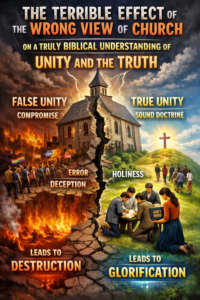
Most that mess up biblical unity do so, I believe, because of their wrong view of the church. Jesus’ prayer in John 17 is answered in a true, pure church. It really does occur in one of His churches, which is what we should expect. The church is the designed means by which Jesus’ prayer can be and is answered. It is possible to have unity outside of the church, but far more unlikely and for obvious, scriptural reasons. I had so many problems with de Bruyn’s sermon that it would be hard to break it all down, but I want to use it as an illustration of the point of this post.
2 and 3 John
De Bruyn launched from 2 and 3 John for his presentation on unity. I had heard his view before many times, which imitated exact verbiage and explanation of the teaching of Kevin Bauder. Bauder is longtime professor and head of Central Baptist Theological Seminary. Probably De Bruyn’s mainly evangelical audience at G3 were unfamiliar with the Bauder language on unity, so it likely was novel to them. For Bauder and then De Bruyn, the boundary of unity is the gospel and the center or core is the Word of God. Then De Bruyn leaned into a bit of the Albert Mohler triage idea within the boundary of the gospel.
Pastor de Bruyn used 2 John for “the true” part of his sermon and 3 John for “the tribal” aspect. He said that the teaching of 2 John represents a variation on a gospel issue, like Paul in Galatians and 1 Corinthians 15. That is the boundary for fellowship, he said. Then on 3 John, he used Diotrephes as an example of the tribal. Some of what he said was surely true, but he read a lot into 3 John to get his understanding of the tribal. De Bruyn was teaching that the gospel is the only basis of Christian fellowship. He did not give suitable proof for this proposition.
A Triage Approach
I think de Bruyn would criticize what I’m writing by saying that in the last part of the sermon, he laid out his triage. He talked about a pastor within the gospel boundary he would have coffee with only. Then he provided his triage: those a little closer to his doctrine could fill his pulpit, others even closer to his beliefs he would invite to evangelize, and then finally only people almost identical to him would he support as missionaries. He quotes Richard Baxter from A Reformed Pastor as a basis of his view of unity:
Take heed of mistaking your party for the church of Christ and censuring others as schismatics because they differ from you in smaller matters. There are many thousands who hold the head though they differ in lesser things. . . But if any man overthrow the foundation, if he deny the Lord that bought us, here we can have no fellowship.
I’m sure the Puritans struggled with unity in their context within and around the Church of England, especially with their ecclesiology. These men had to figure out a way to stay together despite their differences.
All the Truth Is the Boundary in the Church
From 2 John do we really get a teaching that says the gospel only is the boundary for Christian unity? For sure, the gospel matters a lot on the subject of unity. I don’t disagree at all with that. I am troubled with the amount of false gospel preaching and teaching that does not separate evangelicals and professing fundamentalists. De Bruyn can rightly say that the gospel is “a boundary,” but not “the boundary,” based on 2 John.
The disunity caused by Diotrephes is an issue, which Jesus, Paul, and John do confront in the New Testament. He is an example of a schismatic or factious person that Paul calls a heretic in Titus 3. From what was Diotrephes casting people out? Was it a G3 style organization? Was it a mission board, a convention, or a preaching conference? Diotrephes practiced an extreme, ungodly, and unbiblical form of separation in the church. He cast people out of the church. One man is not the pillar and ground of the truth. He abused his authority and stood as an example of a heretic parallel with what Paul wrote in Titus 3:9-11.
The Context of a Single Church
The context of 3 John and Diotrephes is a single church. Principles of unity and separation surely matter, but 3 John isn’t saying anything about Diotrephes using too strict of a triage for his kind of separation. It doesn’t say anything about not kicking people out of a church for minor or tertiary matters or non-essentials. This is all just made up. I contend that evangelicalism is in great trouble today because of this kind of teaching, because when you make the gospel the boundary for fellowship, you disobey scripture and you get an impure church.
In 1 Corinthians 12:25, the Apostle Paul writes: “That there should be no schism in the body.” No schism in the body. None. What is “the body”? Two verses later, Paul writes: “Now ye are the body of Christ, and members in particular.” In so writing, Paul excludes himself from “the body.” “The body” is a church, not all believers, the family of God, or the kingdom of God. In 1 Corinthians 1:10 Paul defined unity for a body or a church, same thing:
Now I beseech you, brethren, by the name of our Lord Jesus Christ, that ye all speak the same thing, and that there be no divisions among you; but that ye be perfectly joined together in the same mind and in the same judgment.
Striving for a False View of Unity in Something Different Than a Church
What Paul wrote under inspiration is different than what G3 and David de Bruyn taught in his sermon. It contradicts what he said and they say. What is a small matter? God killed Ananias and Saphira for lying about an offering given in Acts 5. That wasn’t a gospel matter and God killed them for it. G3 and others are striving for a false view of unity. I applaud that they would support, I believe, even though I didn’t hear it all from de Bruyn, for some kind of separation. They are reintroducing that, it seems, to an evangelical audience, who I do not think will like it, which is why they camouflage it so much.
2 John is not the best place to go for a definition of unity. I agree with what John taught, totally. Completely. We should keep those kinds of false teachers out of the church. De Bruyn gave the impression from 3 John that if you might separate over other things besides the gospel, you were tribal and a Diotrephes. He and they may protest that, but it is true. I’m asking them to consider it. Because I don’t agree with them, they could easily call me a Diotrephes, which would give them reasons to marginalize me and what these passages teach.
John 17 in Agreement with 1 Corinthians 1:10
The kind of unity that Jesus prayed in John 17 is in agreement with Paul in 1 Corinthians 1:10. It certainly does not contradict John in 2 and 3 John. If someone tries to find that in a universal church or a mystical body, he won’t find it. That is the chief reason, G3 and others have to hold a different, unscriptural view of unity. There is the unity Jesus prayed for and it is in the institution He started, the church, which is local only. Ekklesia is an assembly. His assembly (“my church”) has church discipline, the Lord’s Table, the pastor, and then books and letters written to it. Those all give the basis for unity in the body.
You can have the unity for which Jesus prayed in John 17, and it is only in His churches. If you want to open this up wider to get a bigger coalition, you will have to turn it into the twisting and perverting that occurs in these passages, such as de Bruyn did. I don’t think men like these are fine with the church alone. It’s too small for them. They want something bigger and are willing to massacre the passages and the biblical doctrine of unity to get it. As a result, in many churches today, they accept same sex marriage. They don’t uphold male and female roles.
Wrong View of Church a Basis for Disunity
I love de Bruyn and Aniol. Having coffee with them is fine. It isn’t fellowship to sit and discuss doctrine with them. I do that all the time and try to do it multiple times a week with different people.
Again, I ask you to listen to this carefully. The wrong view of the church or the body results in this dumbing down of unity and fellowship to something Jesus did not pray for (Kevin Bauder writes about it here). He wants His unity, the kind He has with the Father, which is sanctified by the truth — all of it.
More to Come
You said: ” I contend that evangelicalism is in great trouble today because of this kind of teaching, because when you make the gospel the boundary for fellowship, you disobey scripture and you get an impure church.”
Well said, Brother. I, too, have read some of Bro. de Bruyn’s writings and was helped thereby. I think he is genuinely trying to get it right. I wonder if he ever studied the Bible specifically to see if local only ecclesiology is there. I have found that LO ecclesiolgy does not get a hearing-usually not at all.
Thank you for writing.
Thanks E.T. Not saying him, but most like him will call the local only position, “Landmarkism,” or “The Trail of Blood.” I haven’t heard that from him, but I would think he has heard of local only ecclesiology.