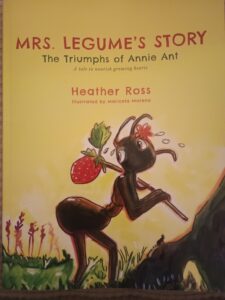
 Day unto day utters speech, and how? God’s creation, growing plants, insects, and men and women working in fields all over the world. When Heather Ross makes her debut in the children’s picture book genre with her Mrs. Legume’s Story: The Triumph of Annie Ant, she enters a valuable space in the current landscape of Christian children’s literature. She distinguishes herself with a narrative-driven, allegorical approach, whose plot follows a moral arch. Just as Psalm 19 suggests that nature has a voice that goes through all the earth, the garden in Ross’s story acts as a classroom to reveal the character of the Creator without the need for a loud sermon.
The first six verses of Psalm 19 aren’t just about beauty; they’re about order. The circuit of the sun and the firmament speak to a world that is structured and reliable. So Mrs. Legume’s life is built on these very reliable rhythms. A sense of cosmic security flows from the beautiful art and sentences — the seed grows, the rain falls, and the sun rises — all of which perfectly illustrate the knowledge that night upon day upon night and day reveal.
The author’s narrative draws inspiration from and provokes obedience to Proverbs 6:6 (“Go to the ant . . . .consider her ways”), highlighting how small, faithful actions matter because God sees them. The book’s unhurried pace makes it perfect for cozy parent-child reading sessions. Mrs. Legume’s storytelling voice feels warm and inviting, like a beloved grandmother passing on wisdom. Themes of working honestly, trying your best, perseverance, and remembering that God is here — even in solitude, each shine through Ross’s writing without feeling heavy-handed. It also gently teaches that choices have consequences and diligence leads to readiness and quiet triumph.
Full-color illustrations by Maricela Moreno bring the vibrant garden world of Ross to life. Her adorable insect characters and lush backyard scenes will invite lingering imaginations and extra conversation. Their beauty supports the story and will aid younger readers to visualize the contrast between Annie Ant’s careful preparation and Chris Cricket’s carefree summer. From my own experience, I can say that the book will satisfy anywhere between ages three to eight with the latter turning their own pages and reading them on their own.
Mrs. Legume’s Story follows in the spirit of wholesome, vintage-style storytelling, mirroring the work of Beatrix Potter or Alison Uttley. By using a talking pea plant — Mrs. Legume — as a wise elder mentor figure, Ross taps into a classical tradition. This fits perfectly for families who prefer a moral lesson, which the tale weaves into the beauty of the natural world and reflects on the everyday circumstances and values of an agrarian life.
A “Let’s Talk About It” section with discussion questions and an activity prompt adds extra value for families, classrooms, or Sunday school settings. This will give any parent, but especially Christian ones, a serious resource by intentionally stepping away from the frantic, high-stimulation pace of modern children’s media. It functions as a “living book,” terminology often used in classical education to describe literature that treats a child’s mind with respect rather than merely entertaining it. Parents looking for character-building stories rooted in scripture will appreciate its wholesome tone and the way it celebrates humble faithfulness over flashier pursuits.
You will want this book for your young children, grandchildren, nieces, and nephews. It would be a great birthday or Christmas gift by a fine, new Christian author.