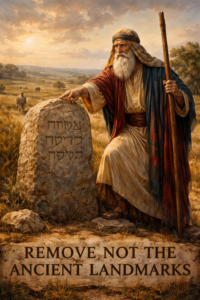
Remove Not the Ancient Landmark
I wrote this title tongue in cheek and for an illustrative purpose. The most ancient interpretation of a passage is an originalist one. Originalist is as far back, as ancient, as one can get. You can’t go any further back in history than the original. That means that something that arose after something was written is not original. I direct you to look at Proverbs 22:28 from which the title of this post comes:
Remove not the ancient landmark, which thy fathers have set.
An ancient landmark was the original landmark on property, providing the boundaries for a property. We still have some kind of physical markers, corner markers as such, which show the boundaries between one property and another. People hire surveyors to make sure that these have not been moved. An easy way to take property would be to move the marker and then maybe after moving it, building a fence to separate a neighbor’s property from yours.
Boundaries for Property
Boundaries for a property can move. Someone can sell a portion of his property. As a property owner, someone may decide he doesn’t need that property any more or that he needs the money more, so he sells it to the next door neighbor.
Jewish rabbis and scholars interpret Proverbs 22:28—”Remove not the ancient landmark, which thy fathers have set”—primarily as a strict prohibition against altering established property boundaries, rooted in biblical law (Deuteronomy 19:14, 27:17). The “ancient landmark” refers to physical stones or markers defining land ownership. Moving them is considered a form of theft and a serious crime against one’s neighbor.
Because the land of Israel was allocated by divine mandate, altering boundaries is seen as a transgression against God, who appointed the land to families and tribes. In the land of Israel, this is especially severe because the original land divisions were seen as a divine covenantal trust established by God for each tribe and family. It serves as a warning against using deceit, or “sneaky” methods to increase one’s own wealth at the expense of another. The Talmud (Bava Batra 88b) connects this verse to defrauding the poor, noting that boundary stones often protected the small inheritances of those with little power.
Literal, Not Allegorical
The original understanding of Proverbs 22:28 was literal, and the metaphorical interpretations developed as the cultural context of the biblical world shifted. The metaphorical or allegorical application—using the “boundary stone” to represent spiritual traditions or religious doctrines—emerged later. This might seem as innocent and understandable, but it is also the way that someone could take any passage and then twist it into his own meaning. Traditions that surpassed actual scripture arose out of adding these types of meaning to a passage. Perhaps the traditions were good, but they weren’t actual scripture, like adding to Sabbath observance.
In modern times, Proverbs 22:28 is frequently used metaphorically by religious leaders to warn against shifting “theologically boundaries,” such as changing foundational doctrines or moral standards. Someone could in fact steal someone’s property because Proverbs 22:28 doesn’t relate to what it was intended. The thing it was meant to forbid is no longer forbidden, because the primary understanding becomes an allegorical one. Do you see the irony in this? This is someone taking what God said and removing the actual meaning from what he said for a subjective one, contributing then toward doing this wherever he wants in and with scripture.
Some Basis for Illustration Only
Is there any basis of another application of Proverbs 22:28? It means one thing, but could someone apply it in more than one way? I believe so. Here’s how. God and His governing authority — to whom He gave power — sets down boundary markers to protect property rights. He prohibits the moving of those, because He gave mankind property rights, also explicit in the command, “Thou shalt not steal.” There are laws instituted by God, set down in stone, one could say, that should not be moved with the same precedence of property rights protected by boundary markers.
Just like someone can’t wiggle out of violating a boundary law with property, he cannot find some other way to do what he wants in violation of other laws of God. God laid down those boundaries through His controlling legal authority. These are powers that came and come from God. Just like God has the authority to prohibit one set of boundaries, He can indict, apprehend, and convict for the violation of something else He laid down as law. The Pharisees would take God’s law during second temple Judaism and abrogate it by their own traditions. By doing so, they elevated their opinions above God’s Word.
At the most, the variation in application of a Proverbs 22:28 is illustrative. It does not change the meaning of the words. The words are still actual physical landmarks. Removing them is a real physical moving of a boundary marker. Proverbs 22:28 deals with stealing. That’s what it targets. It doesn’t mean that someone has established an authoritative style of preaching that includes a certain volume, intonation, accent, and forcefulness; therefore, preaching differently than that removes an ancient established landmark of preaching style.
Not for Allegorization
As I provided this further application of Proverbs 22:28, I was not changing its original meaning. I’m simply applying it in a different, albeit legitimate way. That does not mean that someone can use passages for their own purposes now, because of the use of Proverbs 22:28. Yet, that’s what I see done now not only with Proverbs 22:28, but also other passages. Maybe someone uses the change in meaning for a good purpose, one that results in better behavior by more people. Does that justify twisting the meaning of passages? The Pharisees in Jesus’ day would say, “Yes.” They did that with a lot of passages, as exposed by Jesus too.
Certain phrases or clauses or short statements in scripture are easier to manipulate for one’s own purpose or message than others. A proverb like Proverbs 22:28 is one of those easier ones, but there are many like this. Someone can also use very long stories to do this. Narratives in both the Old and the New Testament become convenient crafts to form sermonic material to push one’s own desired message from scripture. The device is allegorization, spiritualization, or metaphor.
The early purveyors of twisting scripture used allegory. The patristic, Origen, considered even the father of allegorical interpretation, did this. Roman Catholic theologians, fond of conforming the Bible to Greek philosophy, used this same means. A lot of Roman Catholic doctrine could be read into scripture, employing this same method. Even on Proverbs 22:28, Jerome (c. 347–420 AD) famously applied the “ancient landmarks” to heresy, arguing that shifting these “stones” was equivalent to distorting the gospel or apostolic doctrine. I’m talking about Jerome, who translated the Latin Vulgate, the Roman Catholic Bible for centuries. That sounds familiar, doesn’t it?
More Recent Iterations of Proverbs 22:28
In my lifetime, I’ve heard Proverbs 22:28 used to justify not changing certain more recent manmade methodologies as if they were instituted by God Himself. The ones preaching think they were. They also many times say that God told them. That’s how they received these ancient things, that is directly from the Holy Spirit. “Remove not the ancient landmark” is equal very often to “Give me that old time religion.”
“Give Me That Old Time Religion” is a spiritual first published by singing “evangelist” Charles Tillman in 1891, adapted from camp meetings. It was heavily influenced by Methodist “holiness” traditions and Pentecostalism. “Old- time religion” and modern, revivalist, feeling-oriented spirituality share a focus on personal, emotional experience rather than doctrine. It refers to an approach structurally the ancestor of modern revivalism, which accelerates an immediate, individualistic, and emotional experience of the divine.
Roots of “Old Time Religion”
The roots of modern emotional spirituality can be traced back further to the 18th-century, Wesleyan, and later 19th-century frontier revivals, like those led by Charles Finney, which challenged a formal and intellectualized Calvinism. Old-time religion isn’t in fact that old as related to history, but traces back to the deliberate use of techniques to create an atmosphere conducive to a spiritual encounter—rather than relying solely on traditional liturgy. It was actually modern within the historical context of modernism, which focus is on a “personal, inner relationship” with God, often detached from the historic church and its practices.
When the song was written there was in fact more of a focus on repentance, the blood of Jesus, holiness, and a “narrow way” gospel. In that way, our church and myself as its leader are old and “old-time religion.” Newer revivalist spirituality inherited the feeling and vibe of old time religion, which tends to be more “me-generation” focused, emphasizing emotional highs, healing, and personal empowerment rather than repentance. In essence, modern, feeling-oriented spirituality is a continuation of the “revival” element of old-time religion, but with the doctrinal, self-denying, and communal aspects often stripped away in favor of immediate, personal experience.
How Old Is Old?
How old is old time religion? Very often it is since the Civil War in the United States. I’m old and that’s even older than me. Someone instituted something in the mid to late 19th century and when someone questions it, he’s trying to remove the ancient landmarks. It gets worse than that. Certain church growth methods began in the 1950s and 1960s. Those are old methods now. When someone stops using them, he is removing the ancient landmark.
Certain principles of fundamentalism are scriptural. I would defend them. However, some of them, maybe even quite a few of them, arose just as a part of fiundamentalism in the early twentieth century. That’s again, older than me, but it doesn’t go back to a premodern period. At some point, churches stopped singing out of the Psalter. Why? It didn’t fit into revivalist liturgy with its rhythms and feelings. People turned singing out of a Psalter, the actual Psalms, into a dead tradition of sorts. They stopped singing Psalms. Worship became more of a whooping it up, especially caused by a hoe-down or honky-tonk style of piano playing.
Return to Originalism, Truly Old
Revivalist worship isn’t older than Psalm singing. Psalm singing is reverent and sober and premodern. God wants to hear Psalms. He wants to hear them even if modern people, trained under a revivalist sentiment, don’t want to sing them and don’t like them. According to an allegorical interpretation of Proverbs 22:28, didn’t these revivalists remove the ancient landmark? And in that sense, are they even true proponents of actual revival, which is why someone should use the terminology, “revivalist.” How far back does a true iteration of old-time religion actually go?
What I’m writing in defense of an originalist meaning of Proverbs 22:28 and any passage of scripture, I mean to point out the flaws of using allegory and subjective interpretation to hijack what God said and change the nature of true worship. None of that is good. It isn’t ancient in the true meaning of Proverbs 22:28.
Excellent work, and I’m glad if I provoked it.
Thou didst. It was a good thought, and I didn’t know about the recent controversy until the one on old time religion on Facebook.
Fantastic read, brother! Much needed
Thanks Brandon Vaughan!
Kent, if (as you show) “remove not the ancient landmark” means “don’t move old boundary markers between properties,” why does the KJV say “remove” instead of “move”?
Hi Mark! Thanks for dropping by. The Hebrew verb is sug, which is in the Hiphil imperfect, 2nd person, a command. In the Hiphil, sug is “to displace.” If you get a thesaurus and look up, “displace,” it means, “remove from the normal place,” or “uproot,” “dislocate,” etc. In other words, in the Hiphil, “remove” is good.
I don’t think these revivalists, whether Baptist, Pentecostal, Methodist, Wesleyan, or Charismatic, are finding a problem with the word “remove,” as they are with their loose construction of scripture. It comes probably for two major reasons: (1) The history of allegorizing scripture, which finds its way to them through various means, and (2) their view of the ministry of the Holy Spirit is that He will bring to them this unique method of interpretation by giving them that message through a special unction. I don’t know how that fits with, perhaps what you are implying, their thinking that people are attempting to eliminate the old standards completely due to the word, “remove,” in the English. I don’t see it. Their view is “compromise,” which fits with displacing, uprooting, or removing from the normal place.”
More than you think maybe, I appreciate direct interaction like this. We’ve hardly had it and I don’t think that’s because of me. Have a good day!
Kent, I don’t know if you know where I’m going with this question or not, but I don’t think you answered the question I asked. Might I try again?
I asked one hundred KJV-Only pastors what “remove” in “remove not the ancient landmark” meant. You can see all the results at kjbstudyproject.com. I have a PDF that gives their verbatim replies. A significant number of pastors did understand what Prov 22:28 meant—they understood it as you and I (and Prov 23:10–11) did. But some did not. Why did a significant number of these pastors speak of erasing or eradicating the landmark instead of moving it?
They were asked, “What does ‘remove’ mean in the verse, ‘Remove not the ancient landmark, which thy fathers have set’?” These are actual responses from 14 of them:
• Respondent 040: “Tear down, take away, forget.”
• Respondent 042: “I would say to take away.”
• Respondent 046: “Take away, tear down, remove, let go.”
• Respondent 049: “To dismiss.”
• Respondent 061: “To break it down or take it away.”
• Respondent 063: “To take away that which has been clearly identified in the past.”
• Respondent 065: “To displace it, to erase it, to eradicate it.”
• Respondent 071: “To do away, to destroy.”
• Respondent 080: “To erase a boundary marker, to erase a memorial.”
• Respondent 082: “To take it away.”
• Respondent 091: “To erase a boundary marker, to erase a memorial.”
• Respondent 092: “It means to take it away.”
• Respondent 094: “To erase a memorial. A landmark is where something marks a property or an occurrence; something we need to be reminded of and we’re not supposed to do away with.”
• Respondent 095: “To take it away.”
Kent, where did these men get this misunderstanding? The passage clearly forbids moving landmarks, and yet they understood it to be forbidding *getting rid of* or *destroying* landmarks. Why didn’t they get this right? What led them to this error?
And why, in your explanation, did you use the word “move” instead of “remove”? If you had used the KJV word, you would have said this:
“An ancient landmark was the original landmark on property, providing the boundaries for a property. We still have some kind of physical markers, corner markers as such, which show the boundaries between one property and another. People hire surveyors to make sure that these have not been removed. An easy way to take property would be to remove the marker and then maybe after removing it, building a fence to separate a neighbor’s property from yours.”
Why didn’t you say that? Why didn’t you use the Bible word? I know this sounds like a taunt, but it isn’t; it’s a serious question: Did you change the Bible?
Hi Mark,
Thanks for coming back! It’s a pleasant development. I am very open to the idea that I did not answer your question. Your question was: “why does the KJV say “remove” instead of “move”?” My answer was: “The Hebrew verb is sug, which is in the Hiphil imperfect, 2nd person, a command. In the Hiphil, sug is “to displace.” If you get a thesaurus and look up, “displace,” it means, “remove from the normal place,” or “uproot,” “dislocate,” etc. In other words, in the Hiphil, “remove” is good.” I’m happy to hear exactly how that didn’t answer your question. Maybe I could add, the KJV translators who translated the OT Hebrew knew the Hebrew language well, so they knew sug in the Hiphil meant “remove”
For instance, in the Niphal, it is to “turn away.” Jeremiah 46:5 and Zephaniah 1:6 use sug in the Niphal and in both cases, they translated it that way.
Keil and Delitzch translated it: “Remove not the perpetual landmark, Which thy ancestors have set up.” They comment: “the boundary mark set up from ancient times, the removal of which were a double transgression, because it is rendered sacred by its antiquity.”
I really am not searching here to find something to back up the KJV translation, because I’m interested in what the word means. I think it is very possible that the actual meaning in the context is like Keil and Delitsch, that someone removed the boundary. I don’t have a problem translating it, “Move,” but again, my post was about allegorizing such passages, and mainly because revivalist fundamentalists use the passage in a spiritualized way.
This truly is not a gotcha moment, Mark. I don’t take, what I call, an English preservationist view. It doesn’t bother me to change the English word. The King James translators themselves changed English words. A good example of that is in 1 Corinthians 13:8 where they translate katargeo, “shall fail” the first time and then “shall vanish away” the second time. You would think that it was two different Greek words. Should the translation in Proverbs 22:28 be changed to “move.” I think every major modern English translation translates it, “Remove,” and I’m guessing its because of the meaning of sug in the Hiphil. Translating it “move” is not “changing the Bible,” such as “Move not the ancient landmark.” That’s not changing the Bible. Maybe you’ve got me mixed up with someone else.
You are really into this issue, updating the English translation. It would be good for you not to keep thinking that not wanting an update is just trying to stoke you or we’re being dishonest or things like that. Have a great day!!
Kent, I am willing to accept your answer to my initial question as a good-faith answer. I see now what you are saying there.
I do disagree, because what you’ve done is looked up the Hiphil in the Hebrew (HALOT does say “displace”) and then looked in an English thesaurus to find synonyms of that English word. What that gets you is synonyms of a gloss, not the meaning of *sug* at Prov 22:28. You could just as well say, by that logic, that the word in Prov 22:28 could be translated “derange,” “defenestrate,” or “cashier”—all of which are synonyms of “displace” in my *Oxford American Writer’s Thesaurus*. The fact that “displace” can, in some contexts, be a synonym of “remove” (this much I happily grant) does not make “remove” a suitable translation of *sug* into contemporary English at Prov 22:28.
I do *not* think that “remove” is a suitable gloss or translation of that word at Prov 22:28. I think it is misleading, and that at the 14 KJV-Only pastors I quoted to you were in fact misled by it. And yet I think the KJV translators made no error, that their choice was perfectly defensible, that I very likely would have done exactly what they did if I were in their shoes. I also think that what Keil and Deilitszch said was fine and defensible. I think language has changed.
I’m doing my best to treat you as honest, Kent. Now I ask you to return the favor. Please answer the questions I asked in my second comment, the one quoting 14 KJV-Only pastors:
Where did these men get this misunderstanding? The passage clearly forbids moving landmarks, and yet they understood it to be forbidding *getting rid of* or *destroying* landmarks. Why didn’t they get this right? What led them to this error?
And why, in your explanation, did you use the word “move” instead of “remove”?
Brother, do you not see a distinction (in contemporary English) between “moving” a boundary marker and “removing” it?
Mark, This is a lot of writing. Thanks!
I’ve got to let you know: I really want to give-in to you in some way, because it seems that signals to you that your audience is listening. I think I’ve done that in many different ways. For you, it seems it must end with a campaign for an English update. Do you see how that could be potentially disrespectful to what we believe about this?
Hmmm, I’m willing to have an unbiased judge come in here on the “gloss,” because I wasn’t going for anything, just being honest or your words, “in good faith.” The meaning of “displace” meaning, “remove,” seems to fit. I’m having a hard time following your defense here, because I was going for words with the same meaning. Derange? Your examples seem a stretch, because uproot, dislocate, and remove are in the scope of sug with the Hiphil. Could you have a blind spot to this stuff? “Remove” does bring into the translation the historical or cultural context. It is something I see, that the proper word would include, essentially the tribal allotments. Those were the ancient landmarks, which would require removal, not just scooting a short distance. Anyway, I can be wrong — I just think I’m right in my thoughts about this. “Remove” brings a greater range of meaning and also includes the type of markers they used, hence, the displacing, removing.
I’m very good with your digging into whether I answered your questions. Regarding the group of KJV guys that took your quiz, it would not have taken much to understand the real meaning of Prov 22:28. The concept is all over the OT. How did they miss it? I’m not sure any update would have solved their problem, which is more related to the widely used interpretational tool of “God telling them” what it meant. I’ve heard enough “preaching” through the years. Many men have not been trained. At all. And it is more reflective of that. I think you know what I’m saying. You hear what they preach from a passage not difficult at all and they botch it up. They aren’t even looking for what the passage means, using that last word in its true sense. They are looking for what it “means,” that is, this spiritualized understanding. Three guys could “preach” three totally different meanings and every one of them get equally loud shouts and Amens.
Often when writing on the blog, the words I use come from what I imagine. I see someone moving a stone marker. It’s not my considering at all about how potentially to update a word or whether people will get messed up in their thinking because of the need of an overhaul. Again, remove has a greater range of meaning in fitting with stealing an entire tribal allotment or the field of a poor tribe member.
Mark, if I was updating the KJV, I would update words. I believe we can update words or there wouldn’t be a Defined KJV.
Move and remove are slightly different. I could see someone going down a different path if they understood “remove” as “eliminated,” like picking it up and throwing it away.
Kent and Mark, I’m a third-party, and I think I can be objective on the “gloss” question.
When we look for a suitable word for a translation from one language to another, we have to be consistent.
For instance, the word “rana” in Spanish means “frog” in English. But in English, “frog” can also mean “decorative button.” However, “button” would be a mistranslation of the Spanish word “rana,” because “rana” is never used in Spanish for that meaning.
In the same way, “sug” doesn’t carry the same meaning as all of the English words meaning “displace.” Mark is saying “defenestrate” while being a synonym for “displace” would be incorrect, and absurdly so.
This statement, though, is very good: “ Move and remove are slightly different. I could see someone going down a different path if they understood “remove” as “eliminated,” like picking it up and throwing it away.”
This seems to be Mark’s whole point. And to the third party observer, it looks like you’ve found common ground.
Hi Caleb!
I appreciate your desire to be objective, which I think I was being. Being objective again, I could quibble with one point in your comment. I’m not sure your example works on “frog,” because let’s say you have this sentence: He was cold, so he reached up to fasten his frog on his jacket. I’m sure someone reading in English would wonder why I used the word, frog, because 99.99999 percent would think “frog” is the amphibious creature. They would know from the context what I was saying though. However, the context makes a difference. If I said, derange the ancient landmark, that wouldn’t fit, would it? However, if I said, uproot the ancient landmark, displace it, or remove the ancient landmark, that would work, don’t you think?
Yes, I was deferring to the possibility of Mark that when a KJV pastor thinks the word “remove” means “destroy,” he’s saying that someone eliminated the landmark. However, I think that has come from allegorizing that passage like it so often is. People see the landmark as a old standard kept by revivalist fundamentalists, and removing it means doing away with it. Any revivalist fundamentalist know he’s heard something like that dozens or more times through his life, often starting when he was a small child.
One thing I would be concerned about though is a point Thomas Ross makes below, that is, “The Dictionary of Classical Hebrew, translated in 1993 and the years afterwards, defines the word “remove” in the Hiphil as “remove.”” Maybe that’s why the KJV, NKJV, NIV, NASV, etc. all translate sug in the Hiphil, “remove.” They think it means that. In other words, there is something more than just moving a boundary found in the meaning. If you move a boundary marker, you have in fact removed it. It’s not marking the boundary there anymore. It’s an entirely new boundary, the old one removed. This is me being honest about this issue, not trying to hold onto a KJV word. Let’s see if we can really be objective here, all of us. 😀
Dear Dr. Ward,
The Dictionary of Classical Hebrew, translated in 1993 and the years afterwards, defines the word “remove” in the Hiphil as “remove.” Do you disagree with these Hebrew scholars, or are you not aware of / do not use DCH? Thanks.
It is possible that the KJV translators meant “remove” in the sense of “get rid of.” It’s also possible that they had in mind “move slightly.” It’s *also* possible that they used a word—”remove”—that had the perfect ambiguity they felt was needed for Prov 22:28, a word that could mean either thing. On balance, I think they meant “move slightly,” because I think they were good exegetes who knew what was in view—as Prov 23:10 makes clear.
I acknowledge that the relevant OED entry for “remove” does not mark this sense as obsolete:
“To transfer or move (a person or thing) from one place to another; to change the place or situation of something.”
But I think contemporary English tends to require a little more in the way of contextual clues for us to understand “remove” to mean this. The verse would have to say, “Remove not the ancient landmark to a nearby place.” I think most contemporary English speakers, like me my whole life, will take “remove” in “Remove not the ancient landmark” to mean “get rid of” or “destroy.” And I don’t think that’s what the passage meant (especially because of Prov 23:10-11).
Empirically speaking, a significant number of lifelong KJV readers, KJV-Only pastors no less, thought “remove” meant “get rid of.” Yes, it’s possible that their overall misinterpretation of this passage played a role in their misunderstanding of “remove.” But it’s more likely, I think, that the influence went the other way: they read “remove” and believed that it meant “get rid of,” because that’s what “remove” means in a context like that one in our English. A simple change—I would call it a translation—from “remove” to “move” would likely solve that problem. I believe that “move” is what the KJV translators meant, that “remove” in that English in a context like that one meant “move.”
I think the contemporary English translations that still use “remove” are wrong, that they are preserving famous, traditional, indelible (apparently!) KJV wording without due consideration for what the phrase then comes to mean.
Kent, you should read Words on the Move by John McWhorter if you haven’t already. I just don’t see language change as a regular feature of your thinking when it comes to these matters.
Dear Dr. Ward,
In your survey with the “Textual Confidence Collective,” you defined the Hebrew word in Proverbs 22:28 as, in part, “to move a short distance.” However, nothing whatsoever in any standard modern Hebrew lexicon states that the Hiphil of sûg̱ means “to move a short distance.” What is your source for the “short” part? It is not in the Hebrew lexicon your survey cites—HALOT. It is not in any Hebrew lexical source known to me.
Is it possible that the definition that your survey says is correct—letter c—is actually simply wrong?
Indeed, a study of the uses of sûg̱ seems to clearly indicate that the idea that it involves moving only a “short” distance, or a small amount, is severely inaccurate. In Proverbs 23:10, “remove not the old landmark” is explicated by “enter not into the fields of the fatherless.” One does not steal a plurality of the “fields” of others by moving a boundary stone only a short distance. In many other instances where sûg̱ appears, the idea of only a small movement does not make any sense. Those who worship idols are not only “turned back” (sûg̱) a short distance, but are “greatly ashamed” (Isaiah 42:17). Transgressors who are “departing [sûg̱] away from our God” are not moving only a short distance as they engage in “lying against the LORD … speaking oppression and revolt, conceiving and uttering from the heart words of falsehood” (Isaiah 59:13), with the result that “judgment is turned away (sûg̱) backward, and justice standeth afar off” (Isaiah 59:14). When the enemies of God, the Messiah, and King David are “driven backward (sûg̱) and put to shame” (Psalm 40:14), they do not receive only a small amount of Divine judgment. An examination of the uses of sûg̱ in the Old Testament reveals that your claim in your survey that the word involves movement only a short distance is just completely wrong.
Could you explain this, please? Thank you.
Dear Dr. Ward,
I’m wondering if you think that modern versions such as the following are also archaic and need to be set aside, based on this verse:
Do not remove the ancient landmark which your fathers have set. (NKJV)
Do not remove the ancient landmark that your ancestors set up. (NRSV)
Do not remove an ancient boundary marker which your ancestors made. (LEB)
Remove not the ancient landmark which your fathers have set. (RSV)
Never remove the ancient boundary stone that your ancestors set up. (NCB)
Remove not the ancient landmark which thy fathers have set. (Darby)
Remove not the ancient landmark, which thy fathers have set. (ASV)
Remove not a border of olden times, That thy fathers have made. (YLT)
Thank you.
Dear Dr. Ward,
One final question. Your survey question’s claim that only “today” does “remove” mean “eliminate or get rid of” seems to be egregiously inaccurate, as the electronic Oxford English Dictionary lists examples of remove meaning “eliminate … to get rid of” from AD 1405 onward.
Oxford English Dictionary, s.v. “remove (v.), sense 6.b,” September 2024, https://doi.org/10.1093/OED/1822269375.
Could you explain this? Thank you.
Thanks for stopping by. I look forward to hearing your answers to these questions, and hope you are spiritually strengthened by what you find on the What is Truth? blog here.
Dear Dr. Ward,
Thank you for replying to my comment, and for taking the time to respond. I appreciate it!
I don’t follow your point from Proverbs 23:10-11. If one steals entire fields from the fatherless by removing their landmarks, it looks like the boundary markers are not only being moved “slightly,” but far enough to dispossess the fatherless of entire fields. I like being able to make the best arguments (steelman) both sides of a position, but I don’t think I can effectively present whatever your point is from Prov 23:10-11 at this point.
Regardless of Proverbs 23:10-11, would you agree that if a standard Hebrew lexicon defines the word in Proverbs 22:28 as “remove” when it is in the Hiphil, and this lexicon was written in 1993, it is very hard to argue that “remove” is a “false friend” where “remove” is not an accurate translation for this Hebrew word, that at best it is a place where you make a different exegetical decision than does the KJV?
Are you sure that all the modern English versions utilizing “remove” in Proverbs 22:28 are just slavishly following the KJV, rather than the Hebrew scholars who worked on those versions actually thinking–like DCH–that the word actually means “remove”? The LXX translates the Hebrew word with a verb that means “carry off.” It looks like if the real sense is only “move slightly” that the misunderstanding that it means “remove” has existed for a very, very long time, going back at least to the LXX translators, and continuing up until 1993, at least. Here is an older and a more modern translation of the LXX:
Remove not the old landmarks, which thy fathers placed. (Brenton LXX)
Do not remove ancient borders which your fathers set up. (NETS LXX)
I point out that DCH actually even lists Prov 22:28 as meaning “remove”:
a. remove, move back, … Pr 22.28 23.10 …
so “remove” is not only in the semantic domain of the word, but the lexicographers–at the end of the 20th century–said it meant “remove.”
NIDOTTE also defines the Hebrew word here as “remove.”
I’m guessing that you were not able to check DCH and NIDOTTE before you made your “false friend” video on this word. Is that correct? I hope you are too honest to just check these standard lexica and then ignore them. That would be far worse than making an (I trust) honest mistake.
If you wish to say that “remove” is an inferior translation and you like “move” for exegetical reasons, that is one thing. But it seems like it would be very hard to say it is a “false friend” when the idea of “remove” has existed from the LXX until the 20th century, and I don’t see how you can use this verse to prove the KJV is too archaic unless you also argue that the NRSV is too archaic, and so is the NKJV. Nor can we use what random pastors who use the KJV said about it when asked about it off the cuff, unless we also have a control group where we asked random pastors who use the NRSV and NKJV what the word meant and see how many of them were correct.
I actually think “move” would be unclear, and “remove” is superior, because “move” could mean that it might be a sin to even touch the boundary stone and have it tremble slightly. Maybe sitting on it, and having it slightly move back and forth a bit, would be wrong, or maybe clearing out a tree root underneath it in your field would be wrong, or moving it to build a fence nearby and then putting it back would be wrong. So, IMO, “remove” is actually a superior translation. Of course, I am biased in favor of the KJV, although I think I have very good grounds for that bias.
I have not found anything whatsoever in any standard modern Hebrew lexicon that states that the Hiphil of sûg̱ means “to move a short distance.” What is your source for the “short” part? It is not in the Hebrew lexicon your survey cites—HALOT. It is not in any Hebrew lexical source known to me. Is it an exegetical decision that you made, based on what you think is going on in Proverbs 23:10-11, rather than a claim sourced in the Hebrew language itself?
Thanks again for your reply. I look forward to considering what you say in response to this as well. I trust that both of us genuinely want people to understand the Bible.
By the way, Dr. Ward, if you don’t want to do a debate, I would also be willing to interview you on your English argument. I have interviewed recently the Majority Text scholar Wilbur Pickering; Frank Pavone, the head of Priests for Life; the anti-inerrancy but very scholarly defender of the resurrection of Christ, Mike Licona; and the KJV numerology advocate Jordan Peterson (some of those are still getting edited and are not live on my channel yet), so you would not have to somehow be identifying with me to get interviewed. I obviously do not identify with many things that these gentlemen believe, and would be (happily surprised, but I sadly highly doubt it) if Mr. Pavone, for example, was born again. Some interviews with people who do Christian mutual funds and ETFs are on the docket. So it is quite an eclectic group. Please reach out at https://faithsaves.net/contact-us/ or at https://sfbaptist.church/contact/ and specify you want to reach me if you are interested (I don’t know your email address). If you don’t hear back, please try the other contact form, as on occasion they have gone wonky and have failed to work properly. My hand is open to you. Thank you.
Dear Dr. Ward,
Here is a video on this that deals with your argument on “remove” for 27 minutes:
https://www.youtube.com/watch?v=2dQZqFwCsnc&list=PLo8hPX0f2leZjuZwp9AXzsLvs4POkOUDA&index=7
also, if you ever change your mind about being unwilling to even read my critique of your work, viewing it as unworthy of being read, but only of being skimmed, please check out this:
https://faithsaves.net/Mark-Ward/
for the section on the word “remove.”
Thank you.
This was an enjoyable read. What a potent introduction especially.
If I may add my personal experience. I’ve heard a lot of preachers preach true and right things from passages that didn’t have anything to do with the true, right thing they were preaching. It makes the preaching feel wrong, even though the point they’re making is right.
I heard a message recently from Jeremiah 3 encouraging Christians not to be “cold-hearted” in which it was stated that “only Christians can backslide.” At least for me, I thought it should’ve been awkward when he read the verse that says “she [backsliding Israel] defiled the land, and committed adultery with stones and with stocks.” However, it didn’t seem to phase the preacher or congregation one bit to say that that was representative of backsliding Christians. This was at an independent Baptist church closely connected with a Baptist Bible College with many faculty in attendance.
He also said that no one would have known that Lot was saved, so I turned to 2 Peter 2:7-8 and showed it to my wife. Once again, I didn’t see anyone in the church bat an eye at that type of statement, rather there seemed to be a spirit of agreement.
I think this is a really important piece of writing. I also appreciate your willingness to say something negative about revivalism.
Thanks bro!
It looks like Dr. Ward either has no answers to my questions or is not going to provide them. That is too bad.
I just point out as well that if Dr. Ward wants to objectively gauge misunderstanding of Prov 22:28, he would also do a survey of a hundred pastors who use modern versions with the word “remove” in Prov 22:28 (NRSV, etc.) and see how they understood the passage, and then 100 pastors with modern versions that use “move.” It is biased to only look at KJVO pastors and see if thy have correct answers while not applying the same standard to pastors who use modern versions as control group.
Correction–after I wrote these, he did reply. I am thankful that he decided to reply. Thanks, Dr. Ward!
By the way, if someone reads Words on the Move by John McWhorter, he will discover that Mark Ward is employing a different definition of “false friend” than Dr. McWhorter does. I discuss the difference in my analysis of Ward’s arguments, which, sadly, Ward has stated in writing on this blog that he is not willing to even read carefully, only skim.
If Dr. Ward does not reply to my second set of questions, it may be because it is very hard for him to admit that he never bothered to check the Dictionary of Classical Hebrew and the New International Dictionary of Old Testament Theology and Exegesis–standard Hebrew resources, which he could have checked in around 10 minutes or less–which define the word in Proverbs 22:28 as “remove” in modern English, and that he never bothered to check the LXX, before producing videos, creating an organization called the Textual Confidence Collective, bothering KJVO pastors, and telling countless thousands of people that “remove” is a hidden archaism that means one should reject the KJV for a modern Bible like the NKJV or NRSV (oh, wait, those also say “remove”–so maybe not those modern versions). I am sure it can be very hard to admit that 20 minutes of work should have been done first.
It may also be hard to admit that it was a very foolish decision for him to determine to not even read, but only skim, my critique of his work, as there again he could easily have found this information out, but, sadly, he appeared to be unaware of it even when he commented originally on this post.
It may be easier to make personal attacks on me as an “extremist” whom God will judge (as Dr. Ward has done repeatedly) than to eat humble pie here. Besides, EVERYONE knows the KJV is too archaic, so whether the arguments to get there are valid or not may not be as important. Right?