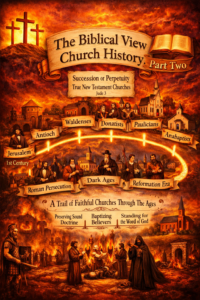
 Someone should believe true New Testament church perpetuity based upon biblical presuppositions. God promised He would keep or preserve both His Words and His church. Both of those relate to authority of God on earth and how He works in the world. Jesus rules through the church as the Head of it, but which one is it? Man also lives by every Word of God, which assumes we know what those are. The preservation of the Lord’s words and His church affect authority and then what exactly to do and how to do it. All these matter.
Interconnection of the Lord’s Churches and His Words
If the church is the pillar and ground of the truth or the means by which God preserved His Words, this either assumes or necessitates the existence of a true church to keep His Words. The two — His church and His Words — are interconnected. Even though scripture has authority over the church, the Word gives the means and authority for the church to preserve not just His Words, but also the faith once delivered unto the saints. From the church came the canonicity of scripture. God used a true church to canonize His Words.
The proof of a true church comes from the Words with certainty God preserved. To know what that church is, a true believer looks to the preserved Words of God for the criteria. What distinguishes true churches? In a fundamental way, a church cannot, so will not, be a state church. That eliminates Roman Catholicism from the possibility of being a church. That’s not all. No state church, Roman Catholic or Protestant, are true churches. This one criteria automatically eliminates both of those. How? The church in the Bible is not a state church.
Also a true church will preach a true gospel, requiring true conversion or salvation of its individual members. It will practice only scriptural ordinances and the observance of those in a biblical manner alone. A true church will limit itself to only New Testament officers. Even though a true church can have and has had traditions, scripture is the final, and, therefore, sole authority of and for a true church. The veracity of a true church comes from the Bible alone.
Biblical Expectations
Since the Bible teaches the perpetuity of a true church, a true believer will expect that. In other words, a true believer presupposes the perpetuity of a true church. It doesn’t matter if he can find historical proof for that, because historical proof is not the authority of a true believer. Scriptural presuppositions provide the only or final basis for judging historical true New Testament church succession or perpetuity. Because true churches were often nomadic and lacked central archives, their history was written in the blood of martyrs rather than the ink of state-sponsored scribes. J.M. Pendleton argued in Distinctive Principles of Baptists (1882):
The true church was for ages a ‘church in the wilderness,’ and its history is to be sought, not in the records of the dominant and persecuting hierarchies, but in the scanty and often distorted accounts given by its enemies.
Challenge of Absence of Ancient Writings as Evidence
Roman Catholic and various state powers systematically destroyed the writings of so-called “heretics,” as G.H. Orchard noted in A Concise History of Foreign Baptists (1855), that the victors write the history:
The archives of the Inquisition, and the records of the courts of Europe, are the sources from which we must gather the history of the Baptists. . . . for their own books were committed to the flames as soon as discovered.
J.M. Cramp echoed this in Baptist History (1868), explaining that the lack of internal primary sources was a result of “the scorched earth policy of the Papacy.” He maintained that if the Baptists of the 12th century had left behind a library, they would have been captured and burned even sooner.
Baptist polity itself — the belief in the autonomy of the local church — contributes to the lack of a denominational history. Unlike Roman Catholicism, which maintained a centralized bureaucracy, Baptists operated as independent cells. J.R. Graves argued in Old Landmarkism (1880) that because there was no “Baptist Pope” or central headquarters, there was no central repository for records. He posited that the “succession” was never intended to be a legalistic chain of documents, but a spiritual and organic continuity of local congregations.
Known by Different Names
Another reason for the lack of “Baptist” material is the claim that the true church was always called by different, often pejorative, names. Thomas Armitage explained in A History of the Baptists (1887) that the name “Baptist” is relatively modern, but the people are ancient:
They were called Novatians, Donatists, Paulicians, Petrobrusians, and Henricians. . . . they were called by the names of their leaders or their locations, but they were all of one faith.
Consequently, a historian looking for the word “Baptist” in the 10th century will find nothing even though the principles of those groups are identical to modern Baptist polity.
Key Differences from Catholic Apostolic Succession
Difference #1
Catholic apostolic succession is a personal and sacramental succession of bishops, and through them, priests, who receive apostolic authority and grace via ordination. Baptist perpetuity is a congregational and doctrinal continuity of churches, assemblies of immersed believers, or the biblical faith and practices they uphold. Baptists reject the idea of a special clerical office or hierarchy transmitting grace. The apostles’ unique office ended with their deaths, and the Great Commission was given to the church, not to a succession of bishops.
Difference #2
In mechanism and structure, Catholicism requires an episcopal, bishop-led, visible, hierarchical chain with ordination by laying on of hands in communion with the Pope or valid bishops. Baptist views emphasize independent, autonomous churches that plant new churches through scriptural baptism and organization. There is no central authority, no pope, and no requirement for an unbroken clerical pedigree. Authority resides in the New Testament and the congregation, not in a transmitted apostolic lineage.
Difference #3
In view of church history and the true New Testament church, Catholicism sees the Roman Catholics (and their bishops) as the direct, visible continuation of the apostolic church. Baptist perpetuity sees the true churches as the often-persecuted dissenting minority outside both the Catholic and Protestant state churches. These ancient congregations are said to have preserved primitive Christianity while the “official” church drifted into infant baptism, hierarchy, and other errors. The Trail of Blood famously depicts this as a bloody “trail” of martyrdom for these proto-Baptist groups.
Difference #4
Regarding theological purpose and basis, so-called Roman Catholic apostolic succession guarantees the validity of sacraments and the unity of one visible Church. Baptist perpetuity demonstrates that Christ kept His promise of a perpetual true church — not a denomination, but assemblies with NT faith and practice. It also argues that Baptists are not a 17th-century Protestant sect, but represent the original Christianity that never needed reformation because it never totally apostatized.
Difference #5
Baptists have not believed in apostolic succession, but instead affirm church perpetuity. Catholic apostolic succession is about hierarchical clerical authority passed person-to-person from the apostles. Baptist perpetuity and succession are about the continuous existence and doctrinal fidelity of independent New Testament churches. One is top-down and sacramental; the other is bottom-up, congregational, and focused on regenerate believers obeying Scripture. These are fundamentally different ecclesiologies.
In the polemical environment of the 19th and early 20th centuries, proponents of Baptist perpetuity faced the frequent charge that their view was simply a “Baptist version” of Roman Catholic or Anglican Apostolic Succession. J. R. Graves addresses this directly in Old Landmarkism: What is It? (1880):
The ‘Apostolic Succession’ of the Catholics and Episcopalians is a succession of officers, a grace transmitted from hand to hand. . . . But Baptist perpetuity is a succession of churches, the continuation of the visible kingdom of Christ by the reproduction of local, independent bodies holding the same faith.
To the Baptist, grace is not “tapped” from a Bishop’s finger; it is found in the local body’s adherence to the New Testament pattern.
Nature of the Chain: Sacramental vs. Scriptural
Apostolic Succession is sacramental, implying that the validity of a sacrament depends on the pedigree of the administrator. Baptist perpetuity is covenantal, meaning validity depends on the church’s identity as a scriptural bride of Christ. J.M. Pendleton argued in Distinctive Principles of Baptists (1882) that the comparison is a smear because Baptists reject the “magic” of the priesthood:
We do not believe in a ‘priesthood’ that conveys grace. We believe in the perpetuity of the truth. If a church ceases to hold the truth, it ceases to be a church, regardless of its lineage. Romanism claims the succession remains even if the truth is lost; Baptists claim the succession is the preservation of the truth.
Direction of Power: Top-Down vs. Bottom-Up
Historians like G.H. Orchard pointed out that the smear of apostolic succession ignores the direction of ecclesiastical power. Apostolic Succession is a hierarchy where the “Mother Church” authorizes the children. Baptist perpetuity describes a “trail of blood” where independent, “unauthorized” groups (by worldly standards) remained faithful to Christ. As S.H. Ford wrote in The Origin of Baptists (1860):
The Romanist seeks a pedigree of lords and princes in the Church; the Baptist seeks a lineage of the persecuted and the despised. . . . To call this ‘Apostolic Succession’ is to confuse the oppressor with the oppressed.
Summary of Why the Comparison is False
The following table highlights why 19th-century Baptists viewed the comparison as a “mere pejorative”:
| Feature | Apostolic Succession (Catholic/Anglican) | Baptist Perpetuity (Landmark/Successionist) |
| Focus | The Person (The Bishop) | The People (The Local Congregation) |
| Transmission | Manual: Laying on of hands. | Moral: Keeping the ordinances and doctrines. |
| Visibility | Political: Recognized by the world/state. | Spiritual: Often “in the wilderness” or hidden. |
| Validity | Depends on Lineage. | Depends on Loyalty to the New Testament. |
The Smear of Legalism
Early 20th-century defenders like J.W. Porter in The World’s Debt to the Baptists (1914) argued that the “Successionist” label was used by liberals to make Baptists look legalistic. He contended that expecting Christ to keep His promise (Matthew 16:18) isn’t “High Churchism” — it is simply faith in the Word of God.
To say that the Church has existed in every age is not to claim a ‘popish succession,’ but to assert that Christ is a King who has never been without a kingdom.
Exceptional material! Thanks for putting it together.
Jim
Bro. Brandenburg,
Here’s that quote from Armitage that I mentioned in a comment on the preceding article you posted:
“In that introductory chapter, Armitage dealt with the question: ‘HAVE WE A VISIBLE SUCCESSION OF BAPTIST CHURCHES DOWN FROM THE APOSTLES?’ Armitage went on to answer this question in the negative. He did not stop with a denial of a visible succession, however, but followed up with these compelling words:
‘I. THAT CHRIST NEVER ESTABLISHED A LAW OF CHRISTIAN PRIMOGENI- TURE BY WHICH HE ENDOWED LOCAL CHURCHES WITH THE EXCLUSIVE POWER OF MORAL REGENERATION, MAKING IT NECESSARY FOR ONE CHURCH TO BE THE MOTHER OF ANOTHER, IN REGULAR SUCCESSION, AND WITHOUT WHICH THEY COULD NOT BE LEGITIMATE CHURCHES. Those who organized the churches in apostolic times went forth simply with the lines of doctrine and order in their hands, and formed new churches without the authority or even knowledge of other churches.'”
This is an excerpt from a book I am writing: THE PRACTICE OF BAPTIST SUCCESSION: HELP OR HINDRANCE?
Thanks for writing. J. Barger
Hello Brother Barger,
I don’t have a problem with spiritual kinship, tbe position of Armitage. I was taught that view where I went to college. Maranatha Baptist Bible College, while I was there, reprinted Armitage in two volumes. We used J. T. Christian’s two volumes for Baptist History class. We had many Challenge Press Baptist books in the bookstore. Dr. Weeks, the Baptist history instructor, had the largest private collection of Baptist books in the world. When it comes to succession, my agreement depends on the definition. I mentioned to you that Spurgeon said he believed in succession. I don’t believe J. R. Graves was chain link. I am interested in reading your book when you’re done.
Please feel free to clean up that gap in “PRIMOGENITURE.” The spacing changed when I submitted the comment. JB
Armitage’s weaker view on church succession works for him, because he believes in a universal “church.” J. T. Christian’s stronger position of actual succession befits those who believe in a local-only church position. That is my view of it, at least. Thanks for the post.
It’s been 40 or so years since I read Armitage. I didn’t remember he was universal church. Thanks for that info. How I have understood “spiritual kinship” is the following: True NT churches, Baptists, yet known by different names, existed in all ages with modern Baptists their doctrinal and spiritual heirs (hence kinship), and not by an unbroken organizational line. It prioritizes this kinship, not genealogical proof. My belief is that there is succession of true New Testament churches and this is presuppositional. I can’t prove it historically, but I believe it. I’ve understood the kinship view to accept their non-stop existence, something short of succession. If this is wrong, how is it?
Dear Bro Brandenburg,
Thanks for that comment. Some of these terms, as they are not specifically in the Bible, can be defined in a way that is just fine or in a way that is not.
Since baptism is a church ordinance, an unbaptized person cannot be a church member or baptize someone else. So by a good and necessary consequence there is an actual succession of baptized persons and churches (Matt 28:18-20; 1 Cor 12:13). But that doesn’t mean that we need to trace every link of a chain back and if we can’t find out what happened in AD 765 the actual succession must have failed. At least in my examination, the necessity of tracing succession link by link all the way back is almost always a straw man, not an actual position held by any Baptist advocate of any Baptist view of the church. It is kind of like “a Baptist Brider thinks only Baptists are going to heaven” (after which no sources follow of anyone who actually says this).
If someone wants to call an actual succession that does not need to be traced spiritual kinship, that’s fine. I think that at least at the old Maranatha Baptist Bible College the way that “spiritual kinship” (viewed as good) was distinguished from “Landmarkism” (viewed as bad) was more a straw-man of the Landmarkers to help keep the universal church people happy (“no, we aren’t like those bad Landmark Baptists over there”), which has been promoted by a certain sincere KJV advocate that used to teach at the old Maranatha with whom I think both of us are familiar but neither of us has any desire to attack, and who has many good positions, but here could have been a bit more careful.
Thanks again for the post!
I do believe the NT teaches “church perpetuity,” Mt 16:18, Mt 28:20. The best definition of a “scriptural” church of which I am aware is given by Dewayne Hoppert: “A local, visible assembly of saved scripturally baptized believers, called out and covenanted together to give glory to God through obedience to His Word” (Free, a Fresh Look at Basic Bible Teachings). As I understand the Lord’s words, there will always be at least one local assembly in the world which He recognizes as His own until He returns. Does church perpetuity require a link-by-link succession, in which a “mother” church authorizes a group of scripturally qualified believers to become an assembly? Can one “church” (assembly) really begin another? Can one church transfer the Comforter to another? If one answers these questions in the affirmative, where in the NT does he find support for his answers? Also, I find interesting the contrasts between the Corinth church and what we learn of the Ephesus church from the Lord’s message to it in Revelation 2. An informed, local church Baptist with solid convictions would not join the Corinth church; yet despite all the problems it had, Paul addressed it as “the church of God which is at Corinth” (1 Cor 1:2). The same Baptist probably would have no problem with the orthodox Ephesus church. Ephesus had “the truth” nailed down. They “stood for the truth,” but this church lacked love, and primarily their love for Jesus had cooled. They loved “contending” for “the truth” more than they loved Jesus. It was to this doctrinally observant church, not the “loose” church, that Jesus issued the threat of removing the assistance of the Comforter (Rev 2:5). In the event a church like Ephesus loses the assistance of “the One called alongside to assist,” what would this look like? Probably like not a few churches we see today: lacking spiritual power. I know this all can go in multiple directions. Yes, one must look at the teachings and practices of a church. These matter, and not the name on the sign out front of the building. Yet I cannot ultimately say a church that has some teachings and practices which I identify as unscriptural is not a church of Jesus Christ (though some are so far off from Scripture I am pretty confident they cannot be churches of the Lord). My decision is whether or not I think the Lord would have me be a part of a church that has some wrong teachings and practices. Bottom line: How does one ultimately know the church of his membership is “scriptural”? By faith.
Thank you for writing. What you write is thought provoking.
Thanks Bro Barger!
I would have questions about what you wrote. (1) Does true New Testament baptism require a proper administrator? Can anyone just baptize anyone and authority doesn’t matter? I believe scripture does speak on this subject. (2) Do true New Testament churches have authority from God? Is church authority necessary? I believe scripture does speak to this subject. (3) Is there or is there not a model, template, or paradigm of a church sending, having the authority to send, in scripture for the beginning of a church, which also relates to the authority to baptize? I believe scripture does speak to this subject.
I might not join a particular church because of its doctrine and practice, but based on Revelation 2 and 3 and those seven churches there, that doesn’t mean a church I wouldn’t join isn’t a church.
Thanks!
Thank you, Brother Brandenburg,
I do believe the NT teaches baptism requires a proper administrator. I believe the NT teaches that the Lord authorized scriptural churches to administer heaven’s baptism. NT churches are authorized by God to teach His Word, make disciples and baptize them, and discipline their own members. I find interesting the order of the sending out of Barnabas and Saul from Antioch church, Acts 13:1-4. A careful reading reveals that the Holy Spirit called those men to special service, assigned their field of service and sent them out. The Spirit called the church to recognize those men’s call and into cooperation with Himself and the missionaries. The church didn’t send them (vs 3 the verb translated “sent” should read “released” them. Do I believe the Lord’s legitimate kingdom representatives are scriptural assemblies? Yes. I do think that the idea of church authority has at times been taken to extreme. I believe that the administrator of one’s baptism matters. The Lord works through His churches. I know all this goes beyond what can be discussed here. Thanks again. I appreciate your commitment to the truth of God’s Word. I also say of myself that I am not on the threshold of knowledge.
Dear Bro Barger,
Can you clarify why you think Acts 13:3 should not read “sent them away”? Definition #3 in the standard Greek lexicon BDAG for this verb is “send away, dismiss,” and there seems to be very strong lexical support for this being an important part of the semantic domain of the verb in question.
Thank you.