I have at least one more post (number 9) in the series, “Textual Variants, Preservation of Scripture, and the Westminster Assembly” (parts one, two, three, four, five, six, seven, and eight), one more part for the two part series, “Making Heaven Crowded By Diminishing Biblical Gospel Expectations” (part one), at least one more post in the long series, “Steps in the Right Process for Belief Change” (parts one, two, three, four, five, six, seven, and eight), and I’m guessing several more in the also lengthy series, “Drawing the Line on Masculinity: Getting a Male Role Back” (parts one, two, three, four, five, and six).
******************************************
The Lord Jesus Christ said the following in His Sermon on the Mount in Matthew 7:21:
Not every one that saith unto me, Lord, Lord, shall enter into the kingdom of heaven; but he that doeth the will of my Father which is in heaven.
That gave me trouble growing up as a child. Does it contradict salvation by grace alone through faith alone? To get to heaven, it seems according to the verse, someone must do the will of the Father which is in heaven. That sounds like works to me. Similarly, consider among other places from the Apostle Paul, what he writes in Colossians 1:22b-23a:
to present you holy and unblameable and unreproveable in his sight: 23 If ye continue in the faith grounded and settled, and be not moved away from the hope of the gospel
Okay, so Jesus only presents someone “holy and unblameable and unreproveable” before the Father at the judgment, “if” he “continues in the faith grounded and settled” and “not moved away from the hope of the gospel”? That’s how it reads, and several other places read the same way.
The “conditional security” crowd, which rejects eternal security, latches on to these types or categories of passages and says, “No, you’ve got to do good works or keep doing them for you to go to heaven when you die.” Is that true? They read like that. I don’t remember hearing these passages preached when I was a child, but the usual revivalist independent Baptist would call those “discipleship passages,” something like that. They don’t relate to salvation, yet they seem like it when you read them. I’m not attempting to scare you — just the opposite.
Two Aspects in the Gospel Presentation
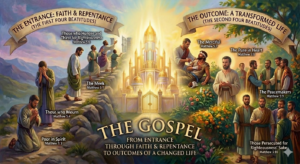
In the biblical plan of salvation as presented by Jesus and the Apostles, they preached at least two aspects in their gospel presentation, which included what I call (1) entrance requirements, and (2) expected outcomes. I ask you to please get those two thoughts in your brain and keep them there. I repeat: (1) entrance requirements, and (2) expected outcomes. What I’m writing is not new. It’s just another way of explaining it in order to help you understand what Jesus and the Apostles are saying.
When someone proceeds to the entrance requirements for salvation, Jesus and the Apostles included also, the expected outcomes. This is easy to see at the beginning of the Sermon on the Mount with what people call, the Beatitudes. There are eight of those and the first four are entrance requirements, while the second four, split right down the middle, are expected outcomes. You can see the difference between the first four and the second four:
First Four: Entrance Requirements
Poor In Spirit
Mourn
Meek
Hunger and Thirst After Righteousness
Second Four: Expected Outcomes
Merciful
Pure in Heart
Peacemakers
Persecuted for Righteousness’ Sake
These eight are one package, even as seen in the results of the first entrance requirement — theirs is the kingdom of heaven, and the first expected outcome — theirs is the kingdom of heaven. Is persecution required to receive the kingdom of heaven? Not in the sense of an entrance requirement, but, yes, in the sense that it is an expected outcome. Jesus put these two categories together as one, but there is also some differentiation between the two halves.
Fruit of Salvation Preached as an Expected Outcome
Jesus started with the entrance requirements, but didn’t stop there. He gave the example of starting with those first four. However, people need the expected outcomes. In Matthew 7:21, Jesus wasn’t saying you had to continuously do the will of the Father to go to heaven. No. He was saying that anyone could say, “Lord, Lord.” “Lord, Lord” is meaningless if the person doesn’t want to do the will of God. How do you know someone is sincere, means it, in saying, Jesus is Lord? He characteristically does the will of the Father, just like Jesus did. “Jesus is Lord” necessarily will connect to an expected outcome.
Someone will not have assurance of salvation without the fruit of salvation. Scripture is clear about that in many places. One that comes to mind is Peter in 2 Peter 1. In 2 Peter 1:8, speaking of a believer adding to his faith or growing in the grace and the knowledge of his Lord and Savior Jesus Christ (verses 5-7, cf. 2 Pet 3:18), Peter writes:
For if these things be in you, and abound, they make you that ye shall neither be barren nor unfruitful in the knowledge of our Lord Jesus Christ.
This expected outcome of adding these things will make someone not barren or unfruitful in saving knowledge, a knowledge that Peter expounded in the first four verses of the epistle.
Assurance (Not Security) Comes from Fulfilling Expected Outcomes
Peter continues in verse 9:
But he that lacketh these things is blind, and cannot see afar off, and hath forgotten that he was purged from his old sins.
When Peter uses “blind” and “cannot see afar off” (i.e. short-sighted), he does not mean “unsaved.” That first half of verse 9 is related to the second half, “hath forgotten.” The person who is not adding these things has stopped seeing or reminding himself of what occurred at his justification or point of conversion. He so little reviewed what occurred then, that he doesn’t see it any more, he’s blind to it, and has forgotten that he’s purged from his old sins. This can happen to a believer, who does not keep these things in remembrance. Then he writes in verse 10:
Wherefore the rather, brethren, give diligence to make your calling and election sure: for if ye do these things, ye shall never fall.
Assurance is not salvation. It is not security. Assurance is a benefit of salvation. God requires works for assurance though. To have assurance, someone must give diligence to make his salvation, his calling and election, sure. When Peter says, “ye shall never fall,” he’s not saying, “ye shall never lose your salvation.” No, he is saying, you won’t keep having this problem of lacking assurance, which is akin to stumbling and staggering and going to the ground uselessly. You won’t be left doubled over into the fetal position, discouraged and depressed.
Experiencing the Blessings of Salvation
Someone will miss experiencing the blessings of salvation without effort. He must keep adding to his faith. And he will. This is part of the continued salvation of the true believer. He gets his assurance from the outcome God expects for those who enter the narrow road unto life eternal. One should not anticipate perceiving the blessing of assurance without fulfilling the expected outcome.
Conditional security does not provide assurance. It causes debilitating uncertainty and an impossible heavy burden. When someone fulfills the entrance requirements for salvation, he will also continue to and in the expected outcomes. However, when someone preaches the gospel to the lost, like Jesus and the Apostles, he should include both in that presentation. This isn’t good works to be saved. It relates instead to true faith and repentance. Faith has an object and it isn’t arbitrary. Jesus is Lord and Christ and King. When someone believes in Him, that is allegiance that will result in following Him.
Relating to Repentance
Preaching repentance as part of the gospel requires explaining the expected outcomes. Faith in Jesus Christ has a different lifestyle in its future. A true embrace of Jesus will show mercy, participate in the ministry of reconciliation, and encounter persecution for righteousness’ sake. These continued attitudes and actions will contrast with what would have occurred without saving faith in the Lord Jesus Christ.
The gospel includes a plan for the rest of someone’s life and for his next one. Approximate to words in a chorus I sang as young person: the things I used to do, I won’t do them anymore — there’ll be a great change once I’ve been born again. Following the pattern of Jesus and the Apostles, these changes accord with the expected outcome of a true believer in Jesus Christ.
Excellent
Thanks!
Bro. Kent, I also think that your explanation here is both biblical and clear. You may never know the good impact of your writings such as these. Aside: I also do not recall these passages being dealt with in my earlier formative years. It would be such a blessing if preachers actually preached through the Word, and if the professed believers would come hear the preaching every time to get a balanced diet of Scripture exposition. And grow thereby.
I do not write often, but I find much that you write is very edifying. God bless you and yours.
Thanks E.T.!
So, you believe in Unconditional Salvation?
Could have fooled me, since you seem to be teaching that people need to repent and believe in Jesus in order to be saved.
Hi Jacques,
Some call it unconditional security, which might be the more accurate label, although security and salvation could be the same. Someone wrote a book, The Believer’s Conditional Security, which essentially says someone can lose his salvation. Just for clarification in the essay, I’m going to put in conditional security. Thanks.
Great article. I think preaching the expected outcome of a transformed life is crucial. When the only expected outcome preached is going to heaven, it produces a wrong view of what it means to be saved and what it means to be a Christian. So being a disciple, bearing fruit, being sanctified…doesn’t matter! That’s if you want to be a super class of Christian. Totally wrong. People need to hear and believe the Bible about what it says about holiness and assurance of salvation. I like what Paul Washer said: “The question is not, do you want to go to heaven? Everybody wants to go to heaven, they just don’t want God to be there when they get there.”
Thanks Andy!
“Someone will not have assurance of salvation without the fruit of salvation.”
Well said. That is why Paul wrote, “Examine yourselves whether ye be in the faith”. That is the tension.
I teach the eternal security of the believer, but I also teach the insecurity of a make believer.
Tom
Pastor Kent,
Indeed there is great assurance and security for believers, for which we thank God.
The question swirling in my mind is this, what about a believer who is subsequently influenced by a false gospel. This happened to a friend of mine. She was saved (at least as far as I can ascertain), baptized in my church (in her high school years), so I know her quite well. She was active in church, and to me she showed fruits of salvation. Later she moved to another city, and there she got mixed up in a church that teaches baptism is necessary for salvation. In our conversations, she was leaning towards that position herself because of the new influence.
If she does affirm that baptism is a requirement for salvation, how would you see that? In the one hand, the security taught in the Bible, on the other hand, a false gospel is damning.
Thanks