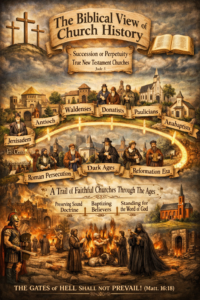
 The Gates of Hell Shall Not Prevail
The Lord Jesus Christ had and still has all authority in heaven and in earth (Matthew 28:18), which means He possesses all authority. When Jesus says something, it’s as sure as it gets. It doesn’t matter how impossible it may seem. He is God. In a pivotal passage in the New Testament and in all of history, the Lord Jesus Christ says in Matthew 16:18:
That thou art Peter, and upon this rock I will build my church; and the gates of hell shall not prevail against it.
You know I’m putting special emphasis on the last part: “the gates of hell shall not prevail against it.” How would someone not mention this when talking about true New Testament church perpetuity? What is a more pertinent passage to this doctrine? Who would ignore it in their attempt to come to a position? So, if the Lord says this, will it come true? Then, did it come true?
If someone cannot find “proof” of a true New Testament church in historical writings, does that make Jesus’ statement not true? In other words, no physical evidence shows a true church during a particular century? I speak of the subject of epistemology. How do we know what we know? In this case, we know as much as we can know. We know because the Lord said so. Then you have people who put the silence of historical writings ahead of what Jesus says in God’s Word, treating it like it can’t be trusted. What I and others say is that the presupposition is enough, but then you also have ample historical proof to go along with that.
Church History
Many church histories chronicle assemblies (ekklesiai) since the first century, which were separate from a “state church,” besides the little pamphlet written by James Milton Carroll, The Trail of Blood. Carroll didn’t write The Trail of Blood as an end all. It was a helpful pamphlet that gave a summary of a biblical view of true New Testament church history. It gave lay people a basic presentation. If someone wants to read full length works, then, yes, get the two volume, History of the Baptists, by J. T. Christian, another two volume set with the same name by Thomas Armitage, or A Concise History of Baptists by G. H. Orchard.
However, J. M. Carroll was a prominent Southern Baptist leader, not some fringe view of history. Something of Baptist perpetuity (succession or spiritual kinship) was the only view of Baptist historians until the period of modernism and empiricism dominated the late 19th century. Rising liberalism in SBC seminaries brought the English separatist view. The Carroll brothers, J. M. and B. H., were partly a reaction to that movement of liberalism among Southern Baptists. William Whitsitt originated the brand new view with his 1896 book, A Question in Baptist History.
The position of no true New Testament church perpetuity is a position for total apostasy. Someone who claims to be a biblical Christian should start with the Bible. What does the Bible say about total apostasy? Jesus promised it wouldn’t happen. Furthermore, the Apostle Paul declared that “some shall depart from the faith” (1 Timothy 4:1), not all. The Lord guaranteed in Matthew 28:20 that He would be with His church or churches through the end of this age, belying total apostasy. To Jesus Christ would be glory through His church to the end of this age (Ephesians 3:20-21).
Sufficiency of Scripture
I categorize historical research in a column of human experience. Peter rightly elevates scripture above that in 2 Peter 1:14-21. It’s possible historians are true, but not in contradiction of scripture. The Bible throughly furnishes for every good work (2 Timothy 3:16-17). God’s Word is truth (John 17:17). A man like Whitsitt with an agenda goes searching for a position that conforms to his own presuppositions and, not amazingly, finds it. Empiricism does not trump faith in what God said. Evangelical institutions are often prey to pleasing the academy and its ground of empiricism.
Peter commands, “Desire the sincere milk of the Word” (1 Peter 2:2). Scripture is the pure mother’s milk, bypassing experience, forensics, warped mindsets, and these lying eyes. Revelation by nature is non-discoverable. God’s Word is pure (Psalm 12). Naturalistic presuppositions cannot and should not overturn what God said. That is a faithless instinct.
Mark Ward and True New Testament Church Perpetuity
One — Saying that Baptists Come from Protestants, Including “Presbyterians”
A podcast, Room for Nuance, interviewed Mark Ward and asked him, “Are KJV-only people Protestants?” The answer was almost impossible to follow and full of direct contradictions. In the midst of his response, Ward said:
Baptists want to see themselves as the heirs of the Anabaptists. They want to say that the reformers actually persecuted people like us. I think my understanding of church history, there is some truth to both of those claims. Um, but the most responsible people I’ve read in this realm have unitedly said that Baptists are Protestants. that you don’t get the Baptists in England without Protestantism and the Reformation coming before that.
And all the Baptists in England, the reason why they have these confessional documents is because they actually wanted to show themselves to be a part of . . . . that [1689 London Baptist Confession], that comes straight from the Presbyterians who are obviously Protestants. Yeah. I I’ve never been able to credit the uh the trail of blood type view.
Two — Saying That “Trail of Blood” Is a Baptist Version of Apostolic Succession
The host then said, “But I don’t understand what is the trail of blood.” Ward again answered:
It’s it’s the ironically Protestant or Baptist version of apostolic succession. It’s saying that there has to be an unbroken line of the true church going back all the way to the beginning.
The host then piped in again: “which we I I would agree with that. I just would probably differ on what they mean by church.” Ward continued his response:
I think there were, you know, God always has his 7,000 who haven’t bowed the kneed to Baal. I think that was true at every period of church history. But whether there’s institutional.
Three — Saying That We Trace Church Succession Through Finding or Hearing from History Something Like the Gospel
The host then interrupted:
Exactly. continuity Yeah. No. We say that there are uh um you know there the ‘B’s’ you can try to have a uh a continuation of bishops that’s how you try to trace your succession, or you can do it through baptisms, like some of the Landmarkists and stuff like that. We believe in belief the right understanding of the gospel, that’s how we trace our succession.
Ward then said:
That that’s Protestant Catholicity and I appreciate though am a little wary of contemporary recoveries uh among reformed Protestants.
Mark Ward then went on to try to show how that he found his heritage in the teachings of the Roman Catholic Augustine, because in reading a book by Augustine, he thought he found marginal support for a right interpretation of scripture. This apparently was proof for tracing succession through a gospel profession, which these two men never ever explained. I want to unpack all of the above. I’ve divided that part of the Ward interview into three parts and will do my best to deal with each.
True New Testament Church Perpetuity
I can address church perpetuity through two questions. One, have there been independent Bible believing and practicing churches, separate from the state church, since the first church in Jerusalem? And, two, was there a total apostasy of true New Testament churches separate from the state church before the Reformation?
Very often I ask the two questions to many varied people. The right answers are “yes” to the first question and “no” to the second one. People who grew up in a Bible teaching church tend toward wanting to give those two correct answers. Even English separatists pause and say, “yes” and “no” to the two questions. These are not “Landmarkists,” just a pejorative. Those, however, contradict the naturalistic position of Whitsitt and Ward on New Testament church perpetuity. It requires an embrace of the state church of Roman Catholicism as a true church and the pillar and ground of the truth.
The Alternative: Restorationism
The ecclesiological alternative to perpetuity is restorationism. Someone should take and propagate the restorationist view if that’s what the Bible teaches. It does not. Many of you probably know that restorationism is foundational for cults. They’ve got to convince their followers that a true church and the truth itself was lost.
The Protestant Reformation occurred. The Reformers were restorationists. The Reformation itself was a restart after centuries of an apparent lost church and a lost truth. This position of Ward and Whitsitt says that the church had apostatized, then the Church of England (COE), another state church, started, and out of that a restorationist group proceeded, the Baptists. They separated from the COE in the 17th century. Belying that position, English preacher C. H. Spurgeon wrote [Public Meeting of Our London Baptist Brethren (April 2, 1861, associated with the opening of the Metropolitan Tabernacle) & in The Metropolitan Tabernacle Pulpit, Vol. 7, p. 225]:
We believe that the Baptists are the original Christians. We did not commence our existence at the Reformation, we were reformers before Luther or Calvin were born; we never came from the Church of Rome, for we were never in it, but we have an unbroken line up to the apostles themselves. We have always existed from the very days of Christ, and our principles, sometimes veiled and forgotten, like a river which may travel under ground for a little season, have always had honest and holy adherents.
Persecuted alike by Romanists and Protestants of almost every sect, yet there has never existed a Government holding Baptist principles which persecuted others; nor, I believe, any body of Baptists ever held it to be right to put the consciences of others under the control of man. We have ever been ready to suffer, as our martyrologies will prove, but we are not ready to accept any help from the State, to prostitute the purity of the Bride of Christ to any alliance with Government, and we will never make the Church, although the Queen, the despot over the consciences of men.
Answers to the Three Arguments from Restorationists Like Mark Ward and William Whitsitt
Someone like the podcast host above, Mark Ward, and William Whitsitt attack the biblical position of true New Testament church perpetuity. All they can offer in return is name-calling (“Landmarkist”) and restorationism in contradiction to biblical presuppositions. It is a naturalistic position very much like their view of the preservation of scripture. Empiricism reigns in their worldview, which requires rejection of scriptural teaching on both the preservation of the Words of God and His church. Their comments are full of ambiguity that allow for deniability.
One — Saying that Baptists Come from Protestants, Including “Presbyterians”
True Church, Not a State Church
C. H. Spurgeon’s personal view of Baptist perpetuity (emphasizing true Baptist principles always existed in faithful remnants since apostolic times, even if under different names through history in groups like Waldenses, Anabaptists, etc.) did not change the Tabernacle’s documented historical starting point in 1650 from English nonconformist/Separatist origins. Metropolitan Tabernacle did not arise out of English separatism. The group began as a small General Baptist assembly, which met secretly in a private house in Kennington. owned by Widow Colfe, to avoid persecution, despite parliamentary bans on Baptist meetings.
Ward in his answer didn’t debunk a trail of blood. He didn’t explain it either. Jesus and Paul both promised persecution of the true church. In the history of persecution, who persecuted and who was persecuted? State churches persecuted those separate from a state church. That trail of blood started with Jesus and kept going from century to century since Him. The truth doesn’t go through the state church. Ward’s only proof here is that Presbyterians wrote the WCF from which came the LBC, believed by Baptists, meaning that Baptists came from Presbyterians. That is not the true story here.
Confessions Don’t Disprove Perpetuity
The WCF was produced by the Church of England, influenced surely by Presbyterians, another state church, which began in Switzerland. These groups sprinkled infants. They got this belief and approach from the Roman Catholic Church.
Certain leaders of Particular Baptist Churches wrote the London Baptist Confession of Faith in 1648. After the invention of the printing press, true New Testament churches, separate from the state church, wrote statements that both distinguished themselves and agreed with Reformed doctrine. This is a complicated story. An early Baptist confession, the Schleitheim Confession of 1527, written by Michael Sattler, was not a full doctrinal confession but one that distinguished itself from Reformed Confessions. A relatively small group of Particular Baptists borrowing closely from the WCF in their LBC doesn’t mean they emerged from the Church of England.
When I quote from Reformed Confessions, it’s an easy way to prove historical doctrine. Many men and churches believed their doctrines. Obviously, it doesn’t mean everything in them is true. Also, it doesn’t mean that my beliefs and those of Baptists came from those Confessions. Mine come from the Bible. Separatist churches, which are mainly persecuted ones, didn’t publish much. That doesn’t mean they didn’t exist. The LBC looking like the WCF doesn’t prove that Baptists are Protestant.
More to Come
Thank you for this. Yes, we accept church perpetuity by faith on the basis of the Lord’s promises. I do not see church perpetuity and church succession as necessarily the same thing. There must be a succession of scriptural baptism, it seems, though we cannot produce evidence for this. My thoughts were stirred some years ago by some things Armitage wrote in his history. The early Christians, having received scriptural baptism, and moved by various factors, went out with the teachings of Christ and became churches without the participation or authorization of a “mother” church. Can a group of qualified believers (believing their baptism is scriptural), and believing the Lord has called them to enter into covenant relationship with each other, can these covenant together and be a scriptural church without any input from an existing church? If not, why not? I believe the Lord will recognize them as a scriptural church. Thanks again for writing.
Brother Barger,
Thanks for the comment. I put succession and perpetuity together like that mainly because I’ve seen both terms referring to the same thing. Spurgeon called it succession, but I do understand that many see succession as a chainlink visible succession versus unbroken authority. I understand what you’re saying, and I’ve written about this subject of authority. Vertical, horizontal, either, or both. My belief is that there is grounds for horizontal authority, but it is a matter of faith. The church up in Antioch doesn’t indicate a mother church model. It just started, but the Jerusalem church sent up Barnabas (Acts 11), showing also the importance of authority. I think it’s worth talking about. Again, the model is a sending church like Paul in Acts 13 and I would see not having horizontal authority as an exception to the model or paradigm in the New Testament. Much more can be said.
Thanks again!!
I feel like some of this has to do with ordination as well. If you can send me a direction on the subject of ordination, I would like to see any material you have on it.
Using Bro. Barger’s illustration, a church which has no sending agency (another Scriptural church) and then to add to the chaos, has a man as pastor who was never ordained or was ordained by a false group; would/should this be considered a church? Accept their baptism?
I miss the days when if a church had Baptist on the sign out front, it was a Baptist church, practicing the ordinances & structured like the Bible says. Those days are long past.
Jim
Bro Jim,
I believe the model is churches starting churches. The authority issue, I believe, matters, but it isn’t chain link, and the “Landmarkers” never were chainlink (you’re not saying that, but this is for everyone reading). Authority is still a matter of faith. This is presuppositional. Faith is seeing the model in scripture and doing it. It’s not taking the time to trace the line back, but being sure that someone is sent by a true church. How will they hear unless we be sent? Sent by whom? John’s baptism came from heaven — why would that matter? Jesus traveled 70-90 miles for baptism by John. Why not have someone baptize him in Galilee if it didn’t matter? It’s true that baptism needs proper administration.
When Jesus said “my church,” He was distinguishing it from other duly summoned and governing assemblies. This would include several marks true of genuine churches.
I mentioned the sending of Barnabas up to Antioch, but that group had already started without sending. I don’t believe that was the model for starting a church, but authority was important or else why would they send up Barnabas there?
When I say “true New Testament churches,” I’m saying that because they weren’t always known as Baptist. However, I do believe the historical position is that this is a line that ends with Baptist churches. Why call ourselves Baptist? Does that mean anything? I believe it does.
I’ve preached through all the NT, so I’ve hit the ordination passages. I might have a separate sermon somewhere on it, but it might be hard to find. There is Hiscox standard manual for Baptist churches. That is free online and old.
May I add a few things that stand out in my mind with respect to horizontal authority.
Paul and Barnabas ordaining elders in every church in Acts 14:23. The churches were there but they couldn’t ordain their own elders.
Likewise, Paul commanded Timothy and Titus to ordain elders in every city in their respective areas of ministry. It at least appears that the churches couldn’t just do that on their own, but once the authority was established it seems the newly ordained man was able to ordain others
So to me, it appears that there is at least a description of horizontal authority for ordaining power while there are no examples of churches being formed and then ordaining and baptizing among themselves.
I was wondering if you think a church could partake of the Lord’s Supper without an ordained pastor.
Hi Bro,
Paul and Barnabas were representing the Antioch church until the churches formed would become established to the extent that they had authority. This is the way to do it. I like the mission church status until the sending church authorizes. Paul also had apostolic authority. The laying on of the hands of the presbytery in 1 Timothy 4 meant that the church leaders, representing the church confirmed the ordination of Timothy as a pastor.
I believe church authority is necessary for the Lord’s Supper (1 Cor 10:16-17; 11:17, 18, 20, 33, 34). I don’t have a basis for excluding non-ordained men from administrating the Lord’s Table, but Acts 20:17 and 28 talk about the overseers and their care for the church. 1 Timothy 5 speaks about ruling the house of God. 1 Cor 14:40 requires orderly worship and that could intimate order of authority. Nothing says this explicitly though.
This is a good point. Thanks.
Jim
Are you ok with churches being 501c3? I am not that familiar with the arguments one way or another, but from what I’ve heard it sounds like that it makes a church a state church. Can you share your thoughts on this?
Andy,
If churches don’t want to be 501c3, they don’t have to. It’s not a biblical requirement. However, being one, I haven’t heard ample good argumentation against being 501c3. I could argue for without the church being a state church.
Hi Kent,
I read your 2017 article on en protois from 1 Corinthians 15:3 which is literally translated, “in first.” Thank you so much for your research it is excellent.
I published an academic thesis in 2016 against “doctrinal triage” where I argue exegetically that the prepositional phrase “en protois” from 1 Corinthians 15:3 is a dative of time.
check it out for free here:
https://bcri.wordpress.com/wp-content/uploads/2017/07/any-warrant-for-doctrinal-triage.pdf
1 Corinthians 15:3 is the locus classicus for doctrinal triage proponents, but their entire system is based on a mistranslation of 1 Corinthians 15:3 wrongly rendering it “of first importance.” However, your article can help a lot of people understand this prepositional phrase and how it is a hapax legomena.
Eric Powers
Thanks Eric. Thank you for putting the link to your paper. I would be interested in how this got on your radar, coming from where you do. As you probably know now, I’ve been talking about it for awhile. Thanks again!! Good work.