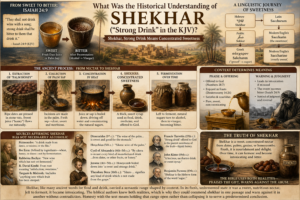
 Shekhar, Strong Drink Means Concentrated Sweetness
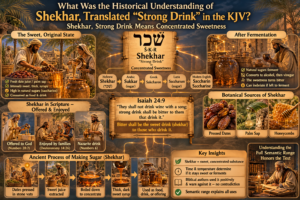
The connection between saccharin and shekhar (שֵׁכָר) is not just a phonetic coincidence. Instead, it is rooted in a deep linguistic history in a broad etymological sense that links the biblical “strong drink” to intense sweetness. Surely, when the actual substance was left to ferment or someone intended to have it do so, it then had the ability to inebriate. The Hebrew root Š-K-R (שכר) is part of a global linguistic chain that tracks the history of sweet substances, not alcohol. The ancestry travels through a chain of Semitic and Indo-European languages:
- Hebrew: Shekhar (שֵׁכָר)
- Arabic: Sukkar (sugar/sweet drink)
- Greek: Sakcharon (originally meaning “gravel” or “sand,” applied to crystalline sugar)
- Latin: Saccharum
- Modern English: Saccharin (the sweetener) and Saccharine (overly sweet)
Again, I hope you might notice that these do not necessitate an alcoholic or intoxicating root meaning. In the ancient world, the line between a “syrup” and a “liquor” was determined by time and temperature. In its sweet state, shekhar was a luscious, high-calorie nectar derived from dates, palms, or honeycombs. In this original state, it was “saccharine” — thick, sweet, and satisfying. Once fermented, the natural sugars in the date or grain juice converted into alcohol and then it become bitter.
An Analogy By God In Isaiah 24:9
God, speaking to the prophet Isaiah, used as an analogy in Isaiah 24:9 for this transition intensely sweet to bitter through the fermentation process:
They shall not drink wine with a song; strong drink shall be bitter to them that drink it.
The word shekhar is “strong drink” there in the KJV, but literally, the second half of Isaiah 24:9 is saying:
Bitter shall be the sweet drink (shekhar) to those who drink it.
One can read the process in the verse, as the shekhar, the nectar from dates, palms, or honeycombs moves from sweet to bitter in the fermentation process. Isaiah 24 describes a world turned upside down due to divine judgment. The “sweet to bitter” transition is a poetic device showing that even the most naturally delightful things have become repulsive. The transition from sweet to bitter in Isaiah 24:9 is a primary example of how the biblical text uses the physical properties of shekhar to illustrate spiritual and national judgment.
Commentary on Isaiah 24:9, Evincing The Analogy
Freshly pressed date juice or palm sap is one of the sweetest substances in nature. This represents the blessing of the harvest. Without modern refrigeration or preservation, shekhar quickly ferments. If left to continue, the sugars are converted into alcohol and then into acetic acid (vinegar), making the drink sharp, pungent, and eventually bitter. Isaiah uses this chemical transition to show that the joy of the people has fermented into grief. The drink that was once a delight to the palate is now a source of revulsion.
In his notes on Isaiah, Robert Lowth (1710-1787) argues that the bitterness described is a direct result of the spoilage and fermentation of the palm-wine, which was naturally the sweetest of all drinks. He notes that the judgment corresponds to the fermentation process, making even the most delightful beverage distasteful. By choosing the word shekar, which literally sounds like and means “sweetness,” and pairing it with mar (bitterness), he was describing a literal biochemical reversal. The judgment is that the sugar of the land has turned to gall, a process that mirrors the literal fermentation and spoilage of date-nectar into a bitter, unpalatable vinegar.
Because distillation, what today creates high-alcohol spirits, did not exist in biblical times, the “strength” of shekhar originally referred to its concentration. A “strong” drink was unmixed, heavy with natural sugars, and intensely flavorful, much like a thick syrup. Our word for artificial sweetener (saccharin) comes from this root, suggesting the essence of shekhar was its high sugar content.
Avoiding Contradictions By Understanding The Semantic Range of Shekhar
The etymology of shekhar explains why it is commanded to be offered to God (Numbers 28:7) or enjoyed by families (Deuteronomy 14:26). The biblical authors could commend shekhar in one passage and warn against it in another without contradiction precisely because the word had a semantic range. On the other hand, contradictions could exist in God’s Word if shekhar meant “always alcoholic drink,” in light of the prohibitions and warnings God makes, using the same word.
The word shekhar in its rudimentary meaning identifies the substance, a sweet, non-grape beverage, rather than a permanent state of intoxication. Before distillation in the ancient world, “strong” did not mean “high proof.” Instead, a drink was “strong” if it was:
- Syrupy/Concentrated — A high sugar content, like a thick date honey, made the drink “strong” in flavor and nutrition.
- Unmixed — Unlike oinos or yayin, the product of grapes, which was almost always diluted with water, shekar was often consumed in its thick, natural state.
Like yayin could become alcoholic, so could shekhar. In their original state they are two different categories of product that could become drink, the former from grapes and the latter from quite a few other sources.
Shekhar and the Ancient Process of Making Sugar for Consumption
1. The Extraction of “Palm Honey” (Dibis)
Ripe dates were placed in large stone vats. Under their own weight and the heat of the sun, the “honey,” the thick, saccharine juice, would begin to exude. To create a stable, storable sweetener, the juice was collected and boiled down. This evaporation process concentrated the natural glucose and fructose, creating a thick, dark syrup that served as the primary culinary sweetener of the ancient world. This was the sugar of antiquity. It was a material that could be used as a food topping, a baking ingredient, or, when diluted with water, a “sweet drink” (shekhar).
2. The Sap of the Tree, the Nectar
Another method involved the palm tree itself rather than just the fruit. Similar to how maple syrup is harvested today, ancient harvesters would make incisions in the crown of the date palm or the trunk to collect the sap. When first harvested, this sap is an intensely sweet, clear liquid. It was often referred to by historical writers (like Pliny and Dioscorides) as the “wine of the palm,” but in its fresh state, it was a high-energy sugar water. By boiling this sap immediately, they could create a solidified or syrupy sugar that was easily transported across trade routes.
In the ancient world, making sugar was the art of concentration through heat. Whether it was boiling the juice of the date or the sap of the palm, the goal was to capture the “strength” of the fruit’s sweetness. This is why historical scholars emphasize that shekhar was a material-based noun: it referred to the saccharine substance itself, which was the ancestor of what we now call sugar.
Sources That Show the Non-Intoxicating Original Shekhar
If people never believed what I’m writing here or ever wrote it, someone might accuse me of stretching this or making it up. What is it that men have written in the past that would not marshal the word shekhar, shekar, or sicara to push its only meaning an alcoholic one? The following sources do indicate that this substance was not necessarily alcoholic, which again is why scripture has variety in its usage. I’m not going to provide evidence that says this substance could turn into an intoxicating alcohol, just like yayin could. You can find that too, but that is not the point of my article.
Jewish Scholars and Sources:
- Maimonides (Rambam) wrote in his 12th century codification of law: “What is ‘shekar‘? It is a drink made from dates, or raisins, or the like” (Mishneh Torah, Hilkhot Biat HaMikdash (Laws of Entering the Sanctuary), Chapter 1, Halakha 3).
- The medieval Spanish commentator, Rabbi Ibn Ezra, in his commentary on Leviticus 10:9 identifies it as a category of drink defined by its ingredients — wheat, honey, or dates — not by its fermentation state as such. Wheat extract, honey, and date juice all exist in perfectly fresh, sweet, and non-intoxicating forms before any fermentation occurs.
- In various passages, Targum Jonathan ben Uzziel, the authoritative Aramaic translation of the Nevi’im (Prophets), a first-century AD disciple of Hillel the Elder, renders shekar as chamra chadat (new wine) or drinks made from other fruits.
- Rabbeinu Bachya, citing Targum Onkelos before offering his own view, identifies shekar in Numbers 6:3 specifically as “new wine which has not yet fermented” — a direct statement in the Jewish traditional literature that shekar can denote an unfermented drink.
- Rabbi David Kimhi (c. 1160–1235), one of the greatest medieval Hebrew grammarians and lexicographers, in his work, the Sefer HaShorashim (“Book of Roots”), defines Hebrew words by etymology and ingredient origin, not solely by their end-state. By defining shekar under the root shin-kaf-resh — cognate with the word for “satiation” or “sweetness” — and by listing wheat, honey, and dates as its source materials. Kimhi’s lexicographical method inherently encompasses those substances in their pre-fermented, non-intoxicating state. His definition is of the raw material and its class, not a fermented product.
- The Midrash Sifre, the commentary on the Nazarite laws (Numbers 6), argues that the word shekhar includes “anything into which fruit has been steeped.” This definition is purely material and covers the extract of the fruit regardless of its fermentation level.
- In his commentary on the Pentateuch, Rabbi Samson Raphael Hirsch (19th Century), notes that shekhar comes from the root shakar, meaning to be filled or satisfied. He argues that it refers to any “fruit-wine” (non-grape) and emphasizes its nutritional, satiating qualities.
Christian Scholars, Lexicographers, and Historical and Linguistic Sources:
- In his Cyclopaedia of Biblical Literature (1845), John Kitto explicitly defines shekhar as a “luscious, saccharine drink, or sweet syrup,” especially the honey of dates. He notes that it was only “strong” in its concentrated, unmixed form.
- A 19th-century biblical scholar and contributor to Smith’s Dictionary of the Bible, Horatio B. Hackett noted that shekhar included the unfermented juice of the palm tree, which was a common, sweet drink in the East.
- Moses Stuart, a professor at Andover Seminary and a pioneering American Hebrew scholar, in his Essay on the Wines and Strong Drinks of the Bible (1848), argued that shekhar was a generic term for all non-grape liquors, many of which were consumed in a fresh, sweet state.
- Biblical geographer and scholar, Edward Robinson, in his Greek and English Lexicon of the New Testament, noted that sikera (the Greek transliteration of shekhar) referred to “any strong drink” but specifically those made from dates and palms, which were often sweet syrups.
- 18th Century Scottish theologian, Thomas Boston, in his study of the Hebrew accents and roots, linked shekhar to the “nectar” of the date palm.
- He viewed the term as an identification of the species of the drink rather than its alcoholic potency. Boston was a root-oriented scholar. He analyzed Hebrew words by tracing them back to their primary agricultural or physical meanings. In his analysis of the beverages mentioned in the Pentateuch, he followed the line of thought that shekhar (or sicera) was a specific category of beverage derived from the sap or nectar of the date palm.
- The distinction between yayin (wine) and shekhar (strong drink) was botanical, not chemical. By identifying it as a “species,” he maintained that the word shekhar described the substance itself (the date-liquor/nectar) regardless of whether it was in a fresh, sweet state or a fermented, alcoholic state. This allowed for the term to be used positively in the context of Temple offerings, where purity and the best were required and negatively in the context of drunkenness.
- Benjamin Parsons in his book, The Anti-Bacchus (1840), argued that shekhar is the Hebrew form of the word “sugar” and that in many biblical passages, it refers to a thick syrup or honey used as food, not as an intoxicant. He maintained that in passages like Deuteronomy 14:26, where the tithe is spent on wine or “strong drink,” the term refers to this sweet syrup which was a “staple article of diet” and a luxury food for the feast.
- In several instances, such as Isaiah 24:9, the ancient translators of the Hebrew Bible into Greek in the Septuagint (LXX) used the term sikera. The Septuagint, produced in Alexandria between the 3rd and 2nd centuries BC, does not always translate shekhar into a Greek word for “drunk” or “intoxicate.” Instead, they often transliterated the Hebrew word into Greek as σίκερα (sikera).
- Ancient commentators on the LXX noted that in the East, this referred to a sweet drink made from dates. Hesychius of Alexandria (5th century) was an ancient Greek grammarian who compiled a dictionary of unusual or foreign words used in the Septuagint (Hesychii Alexandrini Lexicon). His entry for sikera provides plain evidence for the “sweet date drink” definition: “Σίκερα· οἶνος φοινίκειος,” which means in Greek, “Sikera: Wine of the palm.”
- Chrysostom, writing in the cultural context of Antioch and Constantinople, frequently distinguished between natural wine (from the grape) and artificial or manufactured drinks. In his commentary on the Gospel of Matthew, and specifically in his discussions on the laws of the Nazarites (relevant to the birth of John the Baptist in Luke 1:15), he uses the term sikera to describe beverages that are “made by the art of man.”
- He argued that while wine is a natural product of the vine, sikera was a product of human ingenuity using other fruits. This manufactured nature referred to the process of steeping, boiling, or pressing fruits like dates and grains to extract their sugars.
- The Old Testament speaks of the medicinal value of shekhar. In De Materia Medica (Book Five), Dioscorides (c. 40–90 AD), a Greek physician and botanist, was the primary source for botanical knowledge during this era and he describes sikera and palm-wine specifically as a medicinal nectar or syrup: “The wine of the palm… is sweet and good for the stomach… it is made by pressing the fruit of the palm.”
Patristics
- In his commentaries, Cyril of Alexandria (c. 376-444 AD) often distinguished between “natural” wine (from the grape) and “artificial” wine (sikera).
- He viewed sikera as a broad category of sweet extracts from other fruits. In his work De Adoratione in Spiritu et Veritate (On Adoration in Spirit and Truth), Cyril discusses the laws regarding what the priests and Nazarites were permitted to consume. He provides a technical breakdown of the term sikera: “By sikera is meant every kind of manufactured (poieton) drink which is not from the vine… produced from dates, or other fruits, or honey.” — De Adoratione, Book XI.
- Cyril’s evidence is particularly strong regarding the “sweet” nature of these drinks. In his Commentary on Joel, he discusses the “sweet wine” mentioned by the prophet. He notes that while oinos is the standard, the category of sikera encompasses the luscious and saccharine juices derived from palms and other local fruits common in Egypt and the Levant.
- Jerome (c. 347–420 AD) explicitly identifies a form of sikera that is a culinary product made from the hive: “. . . . when the honeycomb is boiled down into a sweet and strange drink.” — Letter 52 to Nepotian, Para 11.
Reformation Era Scholars
- Calvin’s successor in Geneva and a brilliant linguist, Theodore Beza (1519-1605) noted that sikera (the Greek form) was a transliteration of the Hebrew shekar and referred to any drink that was not grape-based, especially those made from grain or dates.
- Beza, a master of both Greek and Hebrew, addressed the word σίκερα (sikera) in his notes on Luke 1:15. He explicitly identifies it as a foreign word brought into the Greek language from Hebrew.
- He noted that sikera is not a native Greek word but a transliteration of the Hebrew שֵׁכָר (shekar): “Sikera is a word which the Greeks have borrowed from the Hebrews… it is the same as the Hebrew shekar. . . . It [sikera] signifies any kind of drink which is not made from the grape.” Beza doesn’t make this point, but someone reading knows he’s implying it, that since John the Baptist was a Nazarite, he would not drink an alcoholic version of shekhar or sikera.
- Beza then immediately follows this by listing the manufactured sources common in the East, such as those made from grain (cereals), dates, or other fruits.
- In his magnum opus, Institutes of Elenctic Theology (Institutio Theologiae Elencticae) Francis Turretin (1623–1687) provides analysis of “strong drink” (shekar) in the context of the Ceremonial Law and the nature of the Drink Offerings (Libations) required in the Old Testament. Turretin argued that since the offerings were for God, they could not be corrupt or inferior. In discussing the drink offerings (Numbers 28:7), where the KJV says to “cause the strong wine (shekar) to be poured unto the Lord,” Turretin interprets this as the highest grade of the fruit’s extract.
- He maintained that shekar in the sanctuary refers to the purest and sweetest form of the juice.
- In the sacrificial system, “leaven” (fermentation) was often associated with corruption. Therefore, Turretin and later scholars who followed his lead argued that the “strong drink” offered to God was the best or strongest in terms of its sugar concentration and purity.
- Turretin utilized the Rabbinic and Patristic traditions to identify the material substance of the offering. He identifies the “strong drink” of the Temple not as a modern spirit, but as the sweetness of the palm. He cites the Hebrew tradition that identifies the “honey” of the “land flowing with milk and honey” as date honey (devash). He viewed the shekar of the libation as the “liquid honey” or the saccharine extract of the date palm..
- He noted that it would be inconsistent with the holiness of the altar to offer a substance that was prized for its ability to cause “reeling” or “stupor.” Instead, the “strength” of the shekar on the altar was its nutritional and flavor excellence.
Conclusion
The King James translators did not translate shekhar, “strong drink,” because it was high proof or alcoholic, but because it was a strong concentration. This was what occurred in the making of this substance. It became strongly sweet. Imagine tasting something in syrup form in a concentrate and immediately saying, “Wow! That is strong!” It’s so strong, it needs to be diluted and that’s what the ancient world did with this product. They added it to different things. Surely some might taste it, like today mom letting you lick the spoon.
A historically and biblically honest treatment would acknowledge that shekhar has a semantic range — that it can refer to sweet, unfermented extracts in some contexts and to fermented, intoxicating beverages in others — and that the biblical authors were clearly aware of both possibilities. A fair reading of the biblical and historical evidence does not require choosing one meaning and forcing every passage through it.
Shekhar, like many ancient words for food and drink, carried a semantic range shaped by context. In its fresh, unfermented state it was a sweet, nutritious nectar; left to ferment, it became intoxicating. The biblical authors knew both realities, which is why they could commend shekhar in one passage and warn against it in another without contradiction. Honesty with the text means holding that range open rather than collapsing it to serve a predetermined conclusion.
Thank you very much for this helpful post.
I have explained to people before that “strong drink” in the KJV is simply “a drink that is strong,” not necessarily an alcoholic one. This post is a great reference to prove that this is indeed the case. Thank you!
You are welcome. I think it is important too and that many people are confused. There is no way a “strong drink” always equals alcohol works in the Bible. Others recognized this, but it’s also very proveable.
This is good. I got two questions.
First can is apply to grape products. I am aware that they used to boil down grape juice to a syrup thick as honey. This was used to preserve as well as make it easier to transport (especially for merchants and large armies). Of course boiling it down would cook out any alcohol, leaving just a concentrated form of grape juice to add water.
Secondly, why do you think the modern lexicons define shekar as intoxicated?
Hi Heath,
Good questions. (1) I don’t believe it applies to grape products, except that both, yayin and shekhar, would go together in a lot of texts to be all encompassing of all the beverages. (2) One meaning of shekhar is alcoholic. You can be drunk with shekhar, but that doesn’t mean that you can be drunk with all shekhar. Unfermented shekhar or just the paste or syrup added to water, and then fermented shekhar. All shekhar could become intoxicated and it was used that way.