Here is a one stop shop location on the subject of drinking alcohol — you can also add these (one, two, three, four, five) — and a five part series I wrote in 2009:
Parts One, Two, Three, Four, Five.
**************************************
Ephesians 5:18 and Its Context
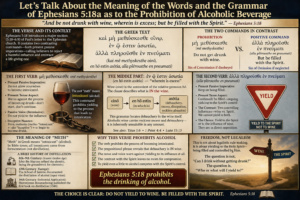 In Ephesians 5:18, the Apostle Paul writes:
And be not drunk with wine, wherein is excess; but be filled with the Spirit
This is an important verse, because it introduces an entire section, 5:18-6:9, a very long portion of the whole vital epistle to the Ephesian church. I’m saying, this verse kicks that all off and is integral to the understanding of the whole section. The verse has two commands or imperatives. When I say “Imperative,” I am talking about the mode of the two verbs. Both of them are in the present tense and passive voice. As you read it, you can see the contrast of the first verb with its prepositional phrase and the second with its.
The Translation of the Verse
The first verb has a negative adverb with it, making it a prohibition, and the second one is positive. Disobedience to the first half one could call a sin of commission and not obeying the second half, a sin of omission. God requires both of these. The Greek text of the verse and its transliteration are these:
καὶ μὴ μεθύσκεσθε οἴνῳ, ἐν ᾧ ἐστιν ἀσωτία, ἀλλὰ πληροῦσθε ἐν πνεύματι (kai mē methyskesthe oinō, en hō estin asōtia, alla plērousthe en pneumati)
The literal translation of the first four words into English are this: “And do not get drunk with wine” or “And do not be intoxicated by wine.” The verb methyskesthe commands against the process or state of being intoxicated. I would ask you to notice the first part of that verb in the Greek, which is “methy.”
The Meaning of the First Verb
“Meth”
People say “meth” today all the time, and it in fact refers to a particular drug now in the English. The Greek “meth,” that beginning part of that verb, means “intoxicant” or as we would say today, “alcohol” or “alcoholic.” In biblical times, there was no specific word for “alcohol,” but this would mean the same thing. Historically, I think it is accurate to say that a word for “alcohol” or “alcoholic” didn’t exist because all intoxication occurred from fermentation, a slow process, and not the distillation process. Here is the history of distillation of alcohol in bullet points:
- 8th–9th Century AD (Islamic Golden Age): Persian chemist Jabir ibn Hayyan refined the distillation apparatus (alembic) to improve methods, laying the groundwork for modern chemistry.
- 12th Century (Europe): The School of Salerno in Italy documented the distillation of alcohol (aqua vitae) from wine.
- 16th Century (Industrial Application): Hieronymus Braunschweig published the first book dedicated to distillation techniques in 1500, marking its rise in widespread medicinal and commercial use.
Inceptive Nuance
It is important to know that methyskesthe very often carries with it in its usage an inceptive nuance — “to become drunk” or “to get intoxicated” — marking the beginning or progression into intoxication. The root Greek verb is methusko, and the sko at the end is a common Greek verbal suffix that often marks inceptive or causative force. It is a causative form of the simpler methuo, so this is a unique form that marks this inceptive aspect.
In the Passive Voice
The verb in the passive voice means the subject receives or allows the action, that is, “do not allow yourselves to become intoxicated.” Some grammarians call this a permissive passive, emphasizing consent or yielding to the influence. The passive gives it the sense, “do not yield to the influence.” One might and should ask, the influence of what? In the verse, the influence comes from the wine.
The Present Tense
The present tense views the action as imperfective—ongoing, continuous, repeated, habitual, or in progress, rather than a completed whole, which would use the aorist. Tense in the Greek conveys aspect, how the action is viewed, rather than strictly time. With prohibitions like this one, that are mē (the negative) plus the present imperative, the force is often, “Do not start to do this,” which is a general, ongoing warning against entering into the state. That is especially here with the inceptive aspect of the verb methusko.
μὴ μεθύσκεσθε (mē methyskesthe) does not say “do not ever be found in a drunken state,” which would customarily be a punctiliar/aorist idea: “do not get drunk [as a discrete event]”. Instead, especially with this verb, the present tense warns against the process of becoming intoxicated. It targets allowing oneself to enter or habitually pursue the influence that leads to drunkenness.
The First Verb In Light of the Second One
The first verb must be examined in light of its contrast with the second verb. The second half of the verse reinforces this: ἀλλὰ πληροῦσθε ἐν πνεύματι (alla plērousthe en pneumati) — “but be filled with the Spirit.” This is also a present passive imperative. The parallel present aspect means “keep on being filled” or “continually be filled” — an ongoing yielding to the Spirit’s control as the alternative influence. The contrast is between two controlling influences (wine vs. Spirit), both viewed as processes or states to be avoided/embraced continually.
No way would the verse include a sometimes influence of intoxication. If the second command says, yield continually to the Holy Spirit, then the first half cannot allow for even a moment of yielding to wine as a combatting or competing influence. Even if someone were to take the thought, “I won’t allow it to influence me as I drink it,” if it is an intoxicating beverage, it already starts to influence at the very inception, what the verse is in fact prohibiting. This comes into competition with the Holy Spirit for control, which the believer cannot allow and be obedient to the second command.
The Middle Part of the Verse Between the Verbs
I’m not done here. I believe what we can see so far just on this verse, which is completely accurate to the meaning of the words and their grammar, is very persuasive on the prohibition of alcohol position, even without other verses and strong arguments from them. However, I want to go to something else here, the middle part of the verse: ἐν ᾧ ἐστιν ἀσωτία (en hō estin asōtia), “wherein is excess.”
Those Greek words mean literally, “in which is debauchery/excess/dissipation/riot.” En hō is the preposition en (ἐν) with the relative pronoun hō (ᾧ, dative singular masculine or neuter of hos, “which”). Estin (ἐστιν) is the third-person singular of “to be.” Asōtia (ἀσωτία) means reckless abandon, debauchery, dissipation, profligacy, or wasteful, excessive living (related to the idea of being “unsavable” or beyond moral restraint; see also Titus 1:6; 1 Peter 4:4; Luke 15:13 for the related adverb).
The Antecedent of the Relative Pronoun
Grammatically, the relative pronoun hō is attracted to the dative case of the immediately preceding noun oinō (“wine”). In Greek syntax, when a relative pronoun follows a noun in this construction (en plus relative pronoun plus estin plus predicate noun), it refers back to that noun as its antecedent. Greek syntax points the relative pronoun to oinos (wine), so not the entire verbal idea of “getting drunk” (methyskesthe).
This structure parallels other New Testament and extra-biblical examples (LXX, Josephus, Philo) where en hō plus estin describes a quality or characteristic inherent in the preceding noun. Older translations, like the KJV: “wherein is excess” and many commentators follow this, rendering it as “in which [the wine] is debauchery” or “in wine is excess.” This must be the alcoholic kind that can intoxicate. According to this grammar and syntax, the verse says that intoxicating beverages, meth, have in them asōtia. It is the location or vehicle in which debauchery resides or from which it flows.
Reckless Excess and Debauchery Is In Alcohol
The dative oinō is the closest and most natural referent for en hō. The clause locates asōtia “in” the wine. Therefore, alcoholic wine itself carries reckless excess and debauchery, making it inherently unsuitable in any amount. The contrast with being “filled with the Spirit” reinforces that one influence (wine) produces moral/spiritual ruin while the other produces edification. This is what the verse clearly, plainly is saying. This whole vitally important lengthy section of this very important epistle starts with the points of these two imperatives, divided by this prepositional phrase.
I understand alcohol drinkers not liking what I’m writing here. Those drinkers will have to go twisting this verse to make it “work” for them. It is not a stand-alone in scripture, but it is a very, very important New Testament accompaniment to many other places in scripture on this subject. When you contemplate what I wrote above, please do not think or read that I’m just making up strict rules in a legalistic way. I’m just looking at the words of the Bible. This is about being filled with the Spirit, yielding to the Spirit. This is just the opposite of legalism. It is a question of what or who someone is going to yield to.
Conclusion
Ephesians 5:18 prohibits the drinking of alcohol. Five arguments come directly from the meaning of the words and the grammar and syntax.
- The verb prohibits the process of becoming intoxicated.
- The prepositional phrase — the debauchery is IN the alcoholic beverage.
- The tense and voice warn against yielding to the influence at all.
- The contrast with the Holy Spirit leaves no room for compromise.
- To yield even once to alcohol competes or combats the Holy Spirit’s control.
Kent, an outstanding exegesis of Eph. 5:18. I have taught the inceptive nature of the first verb for decades; however, I believe the first part of the verse can be interpreted to mean this: “Do not begin to drink wine…” giving it the force of an infinitive. This nicely brings out the inceptive nature of the first verb.
Hi Gary, that is good, Do not begin to… to emphasize the inceptive quality. Thanks for the comment.
Thanks for sharing that, Gary!
What is the contextual and syntactical argument for an inceptive interpretation of the methusko in Eph 5:18? If it’s inceptive, I want to know.
How does that fit with the pleroo in Eph 5:18b? Do you also view that as inceptive?
My current understanding of this passage is here:
https://faithsaves.net/filled-spirit/
Thanks.
A. T. Robertson in his giant Greek Grammar (pp. 457-58): Verbs in –σκω are, like the Latin verbs in -sco, generally either inchoative or causative.
(Inchoative is inceptive.)
Dana and Mantey in their Grammar (p. 50): Inceptive stems. These are present stems in -σκω and are called inceptive because verbs of this class usually denote the initiation of a state or action.
Mounce calls it a lexical or derivational feature, recognizing the historical tendency with these verbs.
Herbert Weir Smyth, Greek Grammar – Standard reference for Classical Greek (p. 526): Inceptive Class – Verbs in -σκω
Encyclopedia of Greek Language and Linguistics (on inchoatives/inceptives): “Elsewhere in Greek the /-sk/ maintains its original inchoative or inceptive sense, so that Gk. γι-γνώ-σκω gi-gnṓ-skō … ‘to begin to know’.”
Nigel Turner, Syntax (p. 65): Discusses inchoative (inceptive) imperfects and related present formations, including examples where -σκω verbs contribute to beginning-of-action senses.
Wallace acknowledges the pattern, but defers to A. T. Robertson in lexical or morphology.
Hi Thomas, I did a search on your article to which you linked and I didn’t see a mention of -sko. Maybe you just missed it. You can miss things. That doesn’t make it wrong.
Thanks, Bro Brandenburgs, that is definitely helpful.
I didn’t see a category of inceptive present in Wallace. But if it is lexically influenced, that would explain it.
I have not thought before that it was inceptive, but you have given me some food for thought there that I need to look into if I preach or teach Eph 5:18 again.
Thanks a lot for that!
“It is inherently unsuitable in any amount.” AI got this right. Thank you, Pastor Brandenburg. Exegete on!
Thanks for the useful information.
Could one of you possibly list 3 or 4 verses that use this type of inceptive in order to illustrate?
ginosko, another -sko word, Mark 13:28, Matthew 24:32 — ginosko means, I know, but you can see, coming to know or recognizing, the inception of knowing. mimneskomai — calling to mind, used of beginning to think of something, translated, I remember, in Hebrews 13:3. Also Hebrews 2:6, “thou art mindful,” same Greek word. Many times then, Matthew 5:23, 26:75, 27:63, actually 23 times in NT. There are not huge numbers of these words, but quite a few. Not of this Greek word in Eph 5:18 though.
Thanks, that is helpful
In your mind can there be any execeptions? For instance, NyQuil? Having looked at every use of wine and strong drink in the Bible, I believe that every single warning warns against excessive use. Even your proposition that there is excess in wine itself does not preclude that the excess could be in the effect of overuse, i.e. drunkenness.
In England in the 1700s, children were given “small beer” which was an alcoholic beverage with 1-2% alcohol that was mildly nutritious and safer than water because of its brewing process. To get drunk on this one would have to drink an impractical amount. This reminds me of Paul’s words to Timothy.
My question is this. What would be wrong with teaching that drunkenness is a sin and immoderate use is evil and prohibition is wise without going so far as to say it is sin to put any alcohol in your body whatsoever. If it turns out that Paul’s encouragement to Timothy was not to drink grape juice in his water but alcoholic wine, then by your statement you have Paul encouraging Timothy to sin.
I’m not a liberal nor do I practice or encourage moderate drinking. However, it seems that total prohibition goes beyond what is clearly taught in the Bible. God could have said “Do not ever drink wine,” but he didn’t.
What you are saying also requires either accusing God of allowing the drinking of alcoholic wine in the OT or else constantly saying that “wine” is either alcoholic or not alcoholic depending on whether it was allowed or not allowed.
To the specific point of your post on the idea that we are not to begin the act of getting drunk, I don’t feel that I’m doing that when I take NyQuil. And I’m not making an absurd claim because you said “prohibits drinking alcohol” and I am drinking alcohol when I take NyQuil.
Do you think that taking NyQuil is beginning to get drunk?
Hi Bro Thompson,
I’m fine with the challenge. First, I see NyQuil as a red herring. The argument would go, since it’s permissible to take a small cup of NyQuil for a cold, therefore, a glass of Budweiser is fine. No one drinks NyQuil for intoxication. It is medicine. Pain killers can be narcotics, and that doesn’t justify drug addiction.
I see inherent contradictions in what you wrote, because it doesn’t address the varied usage of the words oinos, yayin, etc. It isn’t always alcoholic, meaning that it will cause someone to be drunk. This statement — “If it turns out that Paul’s encouragement to Timothy was not to drink grape juice in his water but alcoholic wine, then by your statement you have Paul encouraging Timothy to sin.” — it isn’t the best way to deal with what I’ve written, namely that by my statement I could have Paul encourage Timothy to sin. The rhetoric is extreme. So I’ve got to deal with it. If a bad water supply was causing stomach problems, which can be very bad, kill you, amoebic dysentery, and the like, then drink the juice from squeezed grapes, which is what oinos is. It can ferment and become the 5-12% that can cause someone to be drunk, but there are levels below that, where you can’t get drunk.
Take what I’ve written at face value. I’ve explained the words, the grammar, the syntax, told you what it meant. It is consistent with everything else in scripture on the subject. You can look at every passage and with what is called a “two-wine view,” you can fit everything together. You can’t do that with the one wine view, which is the position you seem to take.
For what it’s worth, with the current place I’m at with this I mostly agree. I think there are good arguments with Biblical support that would result in prohibition from social drinking. My concern is using language that goes beyond what the Bible does. It appears to me the total prohibition position does that.
I do believe in the two wine view, but when I studied this, with the intention of proving that the Bible demands total abstinence, I felt that I would have to lean very hard into a certainty that they were drinking non-alcoholic wine when the context and historical evidence seemed to be otherwise. It would be easier for me from a pastoral standpoint to say that the Bible demands total abstinence, but I don’t think it does.
If moderate use for medicine is allowed and there is evidence of alcoholic consumption in a moderate form in history (which there is), then it seems to me that my teaching should be in form with what the Bible says. Drinking alcohol is not drunkenness. God forbids drunkenness time and time again, but history
I wasn’t accusing you of saying that Paul encouraged Timothy to sin. My point was that if it turns out that the wine that Timothy was to drink as well as wine allowed and encouraged by God to be drunk in the OT were alcoholic then your conclusion is problematic. I’ve tried to find historical evidence that says the wine the Jews were drinking was non-alcoholic but I can’t find it. The prohibitionists I read leaned heavily on the writings of Pliny the Elder, but he only speaks slightly about the boiled must that was rehydrated into grape juice. Otherwise, the only way to store and use the juice was to let it ferment. However, they would dilute it and sweeten it, but they were not to get drunk from it.
Do you have historical evidence that the wine generally spoken of in the OT was non-alcoholic?
Hi again Bro Thompson.
I think the one wine view proceeds from two grounds mainly: a view from historical material and then the recent evangelical desire to support alcohol drinking as part of the church growth movement. When I was a young person, I never heard preachers of any stripe promoting alcohol. It was all against. I’ve seen this trajectory develop in my lifetime. A moderation position is more popular for obvious reasons. So, we’re talking then almost entirely about history and its interpretation. The idea is that history says that oinos and yayin are always alcoholic. I don’t think that’s true either. It might be something I write about.
I don’t hold the one wine view, but it does seem that the two-wine position requires some complicated hermeneutics.
Don’t you think your point about never hearing anyone promote alcohol could have to do with the era/type of church you grew up in? If you read commentaries from not that long ago (but prior to the prohibition era) they almost universally speak of wine as being able to use properly without becoming drunk.
For instance, here is John Gill on Ephesians 5.
nor is drinking wine for necessary use prohibited, nor for honest delight and lawful pleasure; but excessive drinking of it, and this voluntary, and with design, and on purpose; otherwise persons may be overtaken and intoxicated, through ignorance of the strength of the liquor, and their own weakness; and it is a custom, or habit of excessive drinking, for not a single act, but a series of actions, a course of living in this sin, denominates a man a drunkard; and generally speaking, excessive drinking deprives persons of the use of reason, though not always; and such are criminal, who are mighty to drink wine, and strong to mingle strong drink; as are also such, who though not guilty of this sin themselves, are the means of it in others: the sin is very sinful; it is one of the works of the flesh;
Again, he’s not the only one to use that type of language on this passage. As I said before, it seems that one has to come with a pre-determined view against drinking alcohol. When I studied this out I just couldn’t come to a total abolitionist teaching. The hermeneutics of when to know if the wine is alcoholic seems based on the pro-abolition stance rather than exegetical clarity.
Even in this article it feels like you’re stretching the language past Paul’s intention with a preconceived idea on alcohol. That is not meant to be disrespectful, but it’s my honest opinion.
Bro Thompson,
How is the Gill quote even an argument? I use actual grammar, syntax, meaning of words in Eph. 5:18 and you make zero comments to answer anything of it. That isn’t interacting with what I wrote, is it? Then Gill makes no argument from the text, none, and you believe it? Where is the prejudice in position here? If Gill doesn’t make an actual contextual, textual, exegetical comment, why does he get the benefit from you on that? Please explain. Don’t take this as my being upset with you, because I’m not and that isn’t an argument either.
Wikipedia actually has a whole article on these verbs, the inceptive or inchoative, same thing.
https://en.wikipedia.org/wiki/Inchoative_verb
Dear Bro Thompson,
Thanks for your comments.
Dr. Teachout gave me permission to post his doctoral dissertation on wine in the OT:
https://faithsaves.net/use-wine-old-testament-robert-teachout/
I would encourage you to check it out if you have not read it.
Thank you.
I don’t drink at all, but my question is, if there is a total prohibition on alcohol, why in 1 Tim 3:8 and Titus 2:3 does it say those people are supposed to be “not given to much wine”? It could have said “not given to wine”. It seems to imply an acceptance of some, just not much.
Is the wine in view grape juice?
Sorry for breaking up my comment, I just had another thought. In Titus 1:7 it says the bishop must be “not given to wine”. It could have said that with the people in view in 2:3, but instead it says “not given to much wine” so it seems like a contrast to me, but how do you understand this?
Andy, did you read the five part series?
No
The fifth article answers your question. 😀
Very good and informative article. I also agree that the Bible teaches complete avoidance of social drinking, although I tend to emphasize the aspect of not becoming a stumbling block to others.
My question is about the verb methuo. Many people use 1 Corinthians 11:21 as argument that the Lord’s supper uses alcoholic wine. That’s why some were drunk, they said. It’s a misuse of the Lords supper, but the point stands that alcoholic wine was used, they averred.
How do you respond to that. I usually say that the verb methuo does not necessarily mean drunken as in alcoholic drunkenness, but has the basic meaning well drunk, that is drunk to satiety or satisfaction. So it does not have to be alcoholic. I hope you will comment on this since you wrote about the verb. And also how to understand this verse in general as pertaining to alcohol use. Thanks.
Hi Tenrin,
There were a bunch of comments at once and yours slipped through the cracks. Sorry!
Paul highlights the selfish dysfunction of the church at Corinth as the reason for drunkenness. They turned the Table into a fiasco, using it with wrong motives and in a bad manner. The Lord’s Table requires sobriety and a solemn remembrance, but that’s not what they were doing. Paul was correcting what they were doing, not endorsing it.
Dear Tenrin,
That’s a good question. Even if one grants that methuo is always and only drunkenness, the Corinthians were doing a lot of stuff wrong. A congregation that has people who say there is no resurrection from the dead may not be the place to learn about whether alcoholic or nonalcoholic wine. 1 Cor 11:21 is not a statement about what Paul says should be used, and a corruption by the Corinthians is a bad place to go to derive positive doctrine. We would not conclude that women preachers are OK because in Revelation 2-3 a church was tolerating a Jezebel.
Thanks!
Hello Thomas,
Thanks for the reply. I agree that the Corinthian church had problems and we should be very careful about drawing conclusions from them. The situation is a bit different though, from the Thyatira church tolerating a Jezebel, because that specific sin was rebuked. Whereas in the Corinth, Paul rebuked them for not waiting for one another at Lord’s supper (divisions). Whereas if alcoholic wine had been used to the point of drunkenness, it seems that that would have been a greater problem to be addressed directly.
I did some digging for the verb Methuo, and it doesn’t occur very often in the NT. Another contentious place would be in John 2:10, and connects with the debate on whether the wine used by Jewish weddings in general, and in Cana in particular (and the one Jesus created) was alcoholic or not. Interestingly, the KJV used “well drunk,” instead of “become drunk” or something similar.
In the LXX OT, in Isaiah 55:10, methuo is used to mean to water, that is to “give drink” to the earth, which is definitely not alcoholic. Also the verse in question, Eph. 5:18, refers to drunk with wine. The additional phrase “with wine” seems to indicate that one can be drunk with other things (non alcoholic), whether figurative or literal. The OT has several references to being drunk with blood, for instance.
I appreciate the discussion, much food for thoughts, and if you have any other insights, please do share. Your writings have helped a lot. Thank you.
Great discussion. I enjoyed the exposition. I believe bro. Thompson was asking for historical sources for the two wine view. Isaiah 65:8 speaks of new wine in the cluster. Josephus related his version of the two servants in prison with Joseph. The one has a dream which he strained wine freshly squeezed from grapes into Pharaoh’s cup (Jos. Ant. 2.64 [2.5.2]). The Mishnah forbids chewing on grains of wheat during Passover because it might ferment (Pesahim 2.8). They weren’t allowed to have any yeast in their house during the festival. This relates how sensitive Jews were to alcohol. A number of ancient Jewish text suggest the fruit Adam and Eve ate was from a vine, implying alcohol was involved with the Fall. The same is true for rabbinic views of Nadab and Abihu based on the context in Lev 10:9. Many other example could be referenced but these few show wine needs to be understood based on its context.
Thanks Heath!
I know he wants history. This post, of course, wasn’t providing history and as you probably would agree, we should start with “what does the passage say.”
Thanks again!
I’m rather surprised that no one in these comments has mentioned the Biblical command for believers to be sober. The following is from Google:
The primary Greek words for “sober” in the Bible are nēphō (being calm, clear-headed, or vigilant) and sōphroneō (being of sound mind, moderate, or self-controlled). These terms often mean more than abstinence from alcohol, urging spiritual alertness, self-control, and balanced judgment. Key Greek Words for “Sober”Nēphō (νήφω) – Strong’s G3525 Meaning: Literally to abstain from wine; figuratively, to be calm, collected, temperate, and free from spiritual/mental intoxication. Usage: Used to describe being clear-headed, vigilant, and alert (1 Thessalonians 5:6-8, 1 Peter 1:13, 1 Peter 5:8). Context: Used when warning believers to be sober-minded and alert against spiritual dangers.Sōphroneō (σωφρονέω) – Strong’s G4993Meaning: To be in one’s right mind, sound-minded, or sensible.Usage: Refers to temperate behavior, curbing desires/passions (Titus 2:6, Romans 12:3). Nēphalios (νηφάλιος) – Strong’s G3524Meaning: Sober, temperate, or wine-less (adjective form of nēphō).Usage: Used to describe overseers and elders (1 Timothy 3:2, 1 Timothy 3:11, Titus 2:2).Sōphrōn (σώφρων) – Strong’s G4998Meaning: Sound-minded, self-controlled, or discreet. Usage: Often paired with nēphalios to mean a “sensible mind” (Titus 1:8, 1 Timothy 3:2). Nuances in Biblical Usage Mental Alertness: Nēphō emphasizes having a clear, undistorted perspective to avoid being fooled by spiritual passions, greed, or delusions. Self-Control: Sōphroneō (derived from sōzō “save” and phrēn “mind”) emphasizes having a “saved” or “sound” mind that curtails impulses. Pastoral Requirement: These words are frequently used in the pastoral epistles to describe the expected demeanor of church leaders and mature Christians (e.g., Titus 2:2).