Part One Part Two Part Three Part Four Part Five Part Six Part Seven Part Eight Part Nine
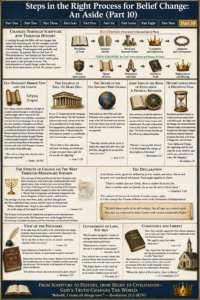 Changes through Scripture and through History
A reading through the Bible will see changes that came both bad and good. All the examples of all the changes through scripture show steps in processes of belief change. These happen both gradually and very quickly. In general, like the 2nd Law of Thermodynamics, bad changes are the tendency, parallel with the curse of sin on God’s world, going from good to bad and bad to worse. The instrumentation of good change comes then only by the divine intervention of God, His means of grace.
Old Testament Hebrew Text and the Logos
Even during periods of darkness, the light of scripture spread through a Jewish diaspora, which brought with it copies of the Old Testament Hebrew text and then a translation of it into the Greek language. Even though this also represents a breakdown of biblical teaching through Israel’s apostasy, it brought a conceptual framework that influenced the Roman empire and then Christian theology. Prominent Jewish scholars thought Hebrew scripture might harmonize with Greek logic, one such Jew being Philo of Alexandria. He showed truth of the Old Testament common with certain Greek philosophy.
The Apostle John wrote the Logos in John 1:1, which fundamentally sanctified a concept Philo introduced, using this already existent presentation to communicate a concrete, historical person, the Lord Jesus, in a way Philo did not. Logos was already in Greek philosophy in Heraclitus and Plato, but Philo incorporated Logos to describe a divine agent that mediates between God and the material world. It was an already existent concept that worked as an illustration in the first chapter of John’s gospel and later in his epistles under the inspiration of God.
The Example of Paul on Mars Hill
The Romans deeply respected ancient traditions. Because the Old Testament was clearly older than Roman or Greek institutions, it commanded a level of intellectual respect. In a Roman society often characterized by moral decay or transactional paganism, the Old Testament’s emphasis on justice, Sabbath rest, and a personal relationship with a single Creator offered a compelling alternative. The world wasn’t so ignorant of the God of the Bible, because the Old Testament spread through the scattered Jews throughout the world. Christianity does proceed from and correlate to the Old Testament.
New Testament missionaries, especially Paul, became the force multipliers of the Old Testament, weaving it into their writing, teaching, and preaching. In Acts 17, the Apostle Paul’s sermon at the Areopagus (Mars Hill) in Athens is a textbook example of how the Old Testament’s influence was translated for a Greek audience. Paul didn’t just quote Hebrew scripture; he engaged with the Greek philosophical landscape that had already been softened by centuries of Jewish-Hellenistic interaction.
Because the Jewish dispersion had already introduced the idea of a single, invisible, and transcendent God to the Mediterranean world, the concept wasn’t entirely foreign to the Stoic and Epicurean philosophers listening to him. Paul was essentially providing a name and a history, which was the Old Testament narrative, to a monotheistic niche that Greek philosophy had been moving toward for years. Paul famously quoted Greek poets, such as Aratus (“For we are also his offspring”, Acts 17:28), representing Genesis and Isaiah rather than quoting them by name.
The Truths of the Old Testament Were Universal
Paul picked up where Philo of Alexandria and other Hellenistic Jews sought to show that the truths of the Old Testament were universal. They were universal, what one might call ‘natural law.’ God is the Creator and was the unknown God, the true God, of which Athens was ignorant. Paul demonstrated that the God of the Old Testament was not a tribal deity of Judea, but the Sovereign Lord of all nations, a major theme in late Old Testament prophecy. This is something that Solomon himself did in Ecclesiastes, presenting the true God to a world which traveled to listen to him in a Hebrew verbiage unique to the Old Testament.
The Apostle Paul argued that the true God is not like gold, silver, or stone, images formed by human art. He thus directly applies the Second Commandment of God’s law. While the Greeks surrounded themselves with their magnificent idols of their Parthenon, Paul brought the Jewish aniconic (no images) tradition into the heart of Greek culture. The spread of the Old Testament had already made the Jewish critique of idolatry well-known to many educated Greeks, giving Paul’s argument a foundation to build upon.
By using the Greek style of rhetoric to discuss the Old Testament’s moral requirements, Paul utilized a bridge constructed by centuries of Jewish-Greek philosophical exchange. However, he hit a wall when he mentioned the resurrection. While the Greeks could accept the Jewish idea of a Prime Mover or a moral code, the idea of a physical body coming back to life was a point where the Old Testament worldview clashed sharply with the Platonic view that the “spirit is good, but the body is a prison.” John’s Logos could provide a fitting coup de grace to what Paul preached there.
John Then In the Book of Revelation
A Physical Kingdom
What John wrote in Revelation from the Isle of Patmos dramatically presented the antithesis to the devilish lies of Greek philosophy and the rejection of the Christ. John had ended his gospel with the challenge to believe the Jesus is the Christ. The Logos is Jesus, who is the Christ. The world would end with Him, a Messiah raised bodily and returning to His world after and in physical judgment to set up a physical kingdom in a glorified physical body.
John under inspiration of God replaced abstract, timeless ideals with a gritty, linear, and deeply physical climax to history. While Greek thinkers like Plato or the Stoics sought truth through human reason and the escape of the soul from the material world, John’s vision emphasizes divine revelation and the total renewal of the physical earth. John does not arrive at his conclusions through debate or logic. The book is an apocalypsis, an unveiling. Men do not “find” truth through intellect — God reveals it. John’s authority isn’t his education, but his role as a witness to what he saw and heard.
History Linear with a Definitive Goal
The Book of Revelation presents history as a linear arrow moving toward a definitive goal. There is a beginning and an end (the Alpha and the Omega, who is Jesus Himself). History is not a treadmill; it is a drama with a final act. This gave the early readers a sense of urgency and purpose that cyclical philosophy lacked. For the Greeks, the ultimate reality was often an impersonal principle, such as “The One,” “The Good,” or “Nature.” In Revelation, the center of the universe is a Person: the “Lamb that was slain.”
Ultimate reality isn’t a mathematical formula or a cold philosophical “First Cause”; it is a wounded, living Savior who interacts with human emotion and history. Revelation also acted as a critique of the Roman Imperial Cult, which used Greek philosophical language to justify an Emperor’s divinity. By naming Jesus as the King of Kings, John used the apocalyptic genre to mock the speculation that any human empire could be eternal or ultimate.
The Effects of Change on the West through Missionary Efforts
Western Values
The writings of John and Paul in the New Testament and their missionary work across the world turned the world upside down. John wrote to key cities in Asia Minor, modern Turkey, which were the front lines of the Imperial Cult, the worship of the Emperor. He used highly symbolic, apocalyptic imagery, which would help early Christians see past the glamor of Rome. He framed the world system, the final version of a Roman Empire, not as a glorious civilization, but as a “Beast” that was temporary and doomed compared to the future Kingdom of God on earth, ruled by Jesus.
The message of Jesus, then Peter, John, and Paul changed how the West understood time, justice, and the value of a human soul. The Roman world practiced widespread infanticide and found entertainment in the slaughter of the Coliseum. Christianity’s roots in the Old Testament view of the Imago Dei, image of God, led to the eventual banning of gladiatorial games and the protection of abandoned children.
The Declaration
In the Roman world, good was defined by power, wealth, and status. Slaves and the poor were considered sub-human. Paul taught that there is neither Jew nor Gentile, neither slave nor free, nor is there male and female. This introduced what became a radical concept, which eventually became the bedrock of modern human rights. The transition from a Roman mindset to a Judeo-Christian one was the most significant cultural shift in Western history. It was this concept that Thomas Jefferson wrote in the Declaration of Independence:
We hold these truths to be self-evident, that all men are created equal, that they are endowed by their Creator with certain unalienable Rights.
View of the Founders
On the other hand, the founders of the United States were deeply pessimistic about human nature, a view heavily influenced by the Old and New Testament theology of original sin. James Madison in Federalist No. 51 wrote: “If men were angels, no government would be necessary.” Because Paul wrote that “all have sinned” (Romans 3:23), they believed that no single person, be it a King or a President, could be trusted with absolute power. This led directly to the Separation of Powers and Checks and Balances. They designed a system to manage human fallenness rather than assuming human perfection.
Peter, Paul, and John argued that their ultimate allegiance was to God, not Caesar. The Founders codified this as the Free Exercise Clause. They argued that “the mind is free” and that government has no jurisdiction over the “inner man.” This was a radical departure from the Roman Imperial Cult where religious sacrifice was a mandatory civic duty. They feared that without the internal self-government of the individual, a core Pauline theme, the external government of the state would eventually become a “Beast” like the one John described in Revelation.
More to Come