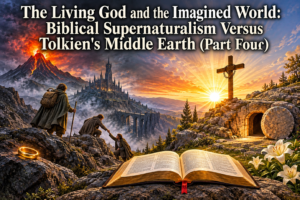
 By the time Frodo and Sam stagger up the slopes of Mount Doom, most readers are pulling for them with everything they have. I was too, fifty years ago. Sacrifice, mercy, and a rescue nobody saw coming make for a very good story, and Tolkien told it as well as anyone has.
But a good rescue story is not a rescue. The Bible tells us how sinners are actually saved, and it does so with a cross, a tomb, and a name given under heaven. This post asks what happens when the feelings of redemption pile up in a reader while the substance of it never shows up.
Admiration of Redemption With No Atonement Provided
The Emotional Shape of Sacrifice Versus Biblical Salvation
Tolkien’s tale is soaked in suffering, sacrifice, mercy, and surprise deliverance. Frodo’s burden costs him dearly, Sam’s loyalty is something to behold, and the pity shown to Gollum turns out to decide the fate of the ring. A reader feels all of it. Sacrifice matters, mercy bears fruit, and help sometimes arrives from the direction nobody was watching. The trouble starts when those themes begin to stand in for the Bible’s account of how God saves sinners.
The gospel is bigger than the idea that sacrifice is noble, mercy beats hatred, or suffering serves a higher purpose. It is a historical announcement: Christ died for our sins according to the Scriptures, and He rose again. Romans 5:10 says:
For if, when we were enemies, we were reconciled to God by the death of his Son, much more, being reconciled, we shall be saved by his life.
The Necessity of Christ’s Atoning Work
Look at both halves of that verse. The problem is that we were enemies of God. The solution is reconciliation through the death of His Son. A reader can be deeply moved by Frodo’s endurance or Gollum’s tragic part and walk away feeling he has understood Christian redemption. He hasn’t. A moving picture of sacrifice is no replacement for knowing what Christ’s death accomplished. Christ did not show us how lovely self-giving can be. He gave Himself as a ransom. Galatians 1:4 describes Him as the one:
Who gave himself for our sins, that he might deliver us from this present evil world, according to the will of God and our Father:
That’s a quiet kind of swap, and an easy one to miss. A reader gets the feelings of redemption and skips the substance.
Making Moral Nobility Seem Sufficient
Tolkien’s heroes earn our admiration for their courage, humility, loyalty, and endurance, and for their willingness to carry burdens that aren’t theirs. Those are good things, and Scripture itself praises faithfulness, humility, and self-sacrifice. The danger isn’t that Tolkien shows virtue. It’s that a reader may decide virtue is the answer. Without ever saying so, he comes to believe the world just needs more brave, faithful, self-sacrificing people, and spiritual maturity shrinks to growing those traits.
Nobody is saved by being noble. God justifies the ungodly through faith, and a Christian’s good works grow out of saving grace and never lay its foundation. Titus 3:5 says:
Not by works of righteousness which we have done, but according to his mercy he saved us, by the washing of regeneration, and renewing of the Holy Ghost;
That settles a lot. Tolkien’s characters are weighed by what they do inside a story. No sinner will be weighed against Aragorn on the last day. Our best works can’t wipe out our guilt, and we need the righteousness God gives in Jesus Christ alone.
Blurring the Distinction Between God’s Revealed Truth and Human Religious Imagination
Tolkien’s Catholicism explains the spiritual feel of his mythology, with its providence, sacrifice, mercy, the corrupting pull of power, and a rank of created spirits. All of that came out of an imagination shaped by Catholic Christendom. The trouble comes when readers let the atmosphere of a story carry authority. A tale that mixes real moral insight with an incomplete or invented picture of the spiritual world is easy to swallow whole, simply because parts of it ring true.
Scripture sets a much higher bar. 2 Timothy 3:16–17 say:
All scripture is given by inspiration of God, and is profitable for doctrine, for reproof, for correction, for instruction in righteousness: That the man of God may be perfect, throughly furnished unto all good works.
The Bible is not one spiritual book on a shelf of many, to be graded on how it makes us feel. It claims to be inspired by God, and it speaks with His authority. A Christian has to tell the difference between a story that illustrates a biblical principle and one that hands us a different spiritual framework altogether. The first can help us understand. The second must never take the place of what God has said.
Satisfying Spiritual Longing without Directing the Reader to Christ
Longing for Transcendence Versus Divine Revelation
A made-up mythology can scratch many of the same itches that biblical truth addresses. People want to believe that good isn’t futile, that evil won’t get the last word, that sacrifice counts, and that life holds more than survival. Tolkien gives those longings a stirring voice. Scripture agrees that God put us in a creation that declares His glory, that He holds us accountable, and that our hope rests on final justice and life beyond the grave. But wanting something transcendent doesn’t prove that any particular account of it is true. Ecclesiastes 3:11 says:
He hath made every thing beautiful in his time: also he hath set the world in their heart, so that no man can find out the work that God maketh from the beginning to the end.
The Exclusivity of Reconciliation Through Christ
We instinctively reach for the big picture, and we can’t find it by intuition or imagination. We need God to tell us. A rich mythology can make the spiritual seem close and give ordinary days a glow, and I enjoy that glow as much as anyone. But it can’t reconcile one soul to God. Jesus says in John 14:6:
I am the way, the truth, and the life: no man cometh unto the Father, but by me.
A reader can feel spiritually fed and know nothing of the gospel, mistaking the ache for the answer. Longing is not reconciliation. Wonder is not saving faith in Christ. And imagining evil defeated is no deliverance from sin.
Faulty Judgment of Spiritual Truth Merely by Beauty and Emotional Force
Tolkien’s craftsmanship gives Middle-earth an air of age, weight, and spiritual depth. The languages and histories give it texture, the landscapes inspire awe, the losses hurt, and the victories light a fire. All of that skews our judgment. When a world feels profound, we assume its ideas about morality and reality are profound too. But beauty doesn’t vouch for every idea wearing it. 2 Corinthians 11:14 warns:
And no marvel; for Satan himself is transformed into an angel of light.
Paul wrote that about false apostles. The principle is the useful part: looking like light proves nothing about where something comes from. A Christian tests every spiritual impression against God’s Word and doesn’t take it on its good looks. That’s especially true when fiction slips spiritual ideas in sideways, shaping what a reader feels about providence, morality, salvation, and eternity through mood and imagery rather than argument.
Frodo’s Mission Compared with Christ’s Saving Work
Burden-Bearing Versus Atonement and Divine Counsel
In The Lord of the Rings, Frodo is the one who carries the ring toward the fire where it can be unmade. He never asked for the job. The trip wears him down, and at the crucial moment he can’t let the ring go. Gollum seizes it, and in the struggle that follows it is destroyed.
That ending sits at the center of what Tolkien called eucatastrophe, a sudden, joyful turn when disaster looks certain. Plenty of scholars of his Catholic imagination have written about his views on providence and unlooked-for rescue. Frodo can remind a reader of sacrifice and of how little strength we have, but we must not set him up as a substitute for Christ. At least four things separate them.
First, Frodo’s mission is no atonement for sin. His suffering helps bring down Sauron, but it satisfies no divine justice for human guilt. He is a burden-bearer in a fictional war and no mediator between sinners and God.
Second, Frodo doesn’t win by his own moral strength. His failure at the Cracks of Doom shows how limited he is. The quest succeeds because of earlier mercy, Gollum’s own doing, and the providential shape of the story, and not because a heroic figure saved himself or the world.
Victory Over Death and the Limits of Fiction
Third, the work of Christ is no happy accident. Scripture shows His death and resurrection as the fulfillment of God’s plan to redeem. Acts 2:23 says:
Him, being delivered by the determinate counsel and foreknowledge of God, ye have taken, and by wicked hands have crucified and slain:
The cross was no failed mission rescued by lucky timing. It was the reason He came.
Fourth, Christ’s resurrection wins the victory over death itself. Frodo’s triumph doesn’t abolish mortality, and Middle-earth stays marked by sorrow, aging, death, and fading glory. Christ rises as the firstfruits of all who belong to Him. 1 Corinthians 15:21–22 say:
For since by man came death, by man came also the resurrection of the dead. For as in Adam all die, even so in Christ shall all be made alive.
Frodo can stand as a literary picture of costly service. He can never be the Saviour.
Gollum’s Mercy: A Parallel with Grace, But No Gospel
The most striking comparison may be Gollum. In The Hobbit, Bilbo spares him when he could have killed him, and later Frodo shows him mercy even when Sam can’t understand it. In the end, Gollum’s survival proves vital to the destruction of the ring. It is one of Tolkien’s most theologically suggestive choices: mercy shown to someone who seems beyond hope becomes part of how a greater evil falls. That echoes Scripture. Romans 12:21 says:
Be not overcome of evil, but overcome evil with good.
And Matthew 5:7 says:
Blessed are the merciful: for they shall obtain mercy.
Even so, Gollum’s story is not a conversion. Nothing in it shows repentance and saving faith in Christ, and the destruction of the ring is not God forgiving Gollum’s sins. The resolution belongs to the fate of Middle-earth. In the gospel, mercy is more than a kind act that happens to work out well. It is God’s gracious posture toward guilty sinners, carried out through Christ. Ephesians 2:4–5 say:
But God, who is rich in mercy, for his great love wherewith he loved us, Even when we were dead in sins, hath quickened us together with Christ, (by grace ye are saved;)
Frodo’s mercy moves a story toward its ending. God’s mercy in Christ saves sinners who could never have saved themselves.
Tolkien’s World and Salvation by Works
Justification by Faith Versus Literary Heroism
The deliverance in Tolkien’s tale comes through a quest that demands courage, endurance, loyalty, and sacrifice, and the characters’ choices really do shape what happens. That is a long way from the Bible’s doctrine of justification. Scripture never says a sinner gains acceptance with God by finishing a hard mission or showing enough virtue. Romans 4:5 says:
But to him that worketh not, but believeth on him that justifieth the ungodly, his faith is counted for righteousness.
None of this makes obedience optional for a Christian. True faith bears good fruit, but those works flow out of salvation and are never the ground on which God justifies anyone. Ephesians 2:8–10 hold both truths together: salvation is by grace through faith and not of works, and the redeemed are created in Christ Jesus for good works.
Imagining Deliverance Versus Receiving Redemption
That distinction matters whenever Tolkien’s heroes get compared with the gospel. A man can show courage, sacrifice, and loyalty, and none of it answers his guilt before God. And a sinner doesn’t have to prove himself heroic before he comes to Christ, because the gospel calls the ungodly to repent and believe. The gap is between a fictional picture of deliverance and God’s actual work of redemption.
Tolkien can use imagination to show moral truths and stir up a longing for hope beyond despair. But Christian hope rests on the promises of the living God, however moving a literary ending may be. John 11:25 records Jesus saying:
I am the resurrection, and the life: he that believeth in me, though he were dead, yet shall he live:
That is the difference between imagining salvation and receiving the salvation God has provided through Jesus Christ.
Conclusion
When I started this series, I said a hobbit’s second breakfast can be delicious and still not be biblical doctrine. Tolkien built a world of real beauty and moral seriousness. But we have laid it beside the Bible four times now, at the beginning of reality, at the problem of sin, at the question of death, and at the matter of salvation, and each time the same thing has turned up. Middle-earth is a story that points at things. Scripture is God telling us what the things are.
The real world has a Creator who made it, a law we have broken, an enemy called death, and a Saviour who has already done what no hero could. No amount of courage, loyalty, or lovely sorrow gets a sinner across that gap, because the gap is between a holy God and us. Frodo carried a ring to a fire, and the Son of God carried the sins of His people to a cross. One of those was written down by a man at his desk, and the other happened in history, with a tomb that was empty on the third day.
When the book closes, and the lump in your throat settles, a question remains that the book cannot answer: how will I stand before the God who made me? He has answered it in His Son, and He commands you to repent and believe the gospel. Test everything, hold fast to what is good, and put your whole weight on Christ.