Part One Part Two Part Three Part Four Part Five Part Six Part Seven Part Eight An Aside (Between Parts Eight and Nine) Part Nine Part Ten Part Eleven Part Twelve Part Thirteen Part Fourteen An Aside (Between Parts Fourteen and Fifteen) Part Fifteen
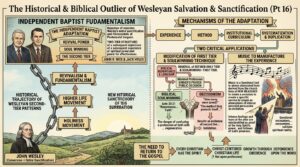 The Independent Baptist Adaptation: Revival Power, Soul Winning, and the Second Tier
The Wesleyan idea of a second level of Christian experience did not remain within Wesleyan churches. It traveled through the Holiness movement, Higher Life teaching, revivalism, and the developing fundamentalist movement. By the middle of the twentieth century, one of its most important adaptations appeared among Independent Baptist fundamentalists.
This adaptation did not, in particular, teach Wesley’s doctrine of entire sanctification. Independent Baptists generally rejected the idea that a second work of grace eradicates the sinful nature. They also rejected (for the most part) Pentecostal tongues. Nevertheless, some of the underlying structure remained. Conversion was one experience. A subsequent experience of spiritual power was another. The second experience did not make one a Christian, yet leaders presented it as essential for effectiveness in evangelism. That distinction became especially visible in the ministries of John R. Rice and Jack Hyles.
John R. Rice and the Revivalist Version
John R. Rice became one of the twentieth century’s most influential fundamentalist revivalists. He founded The Sword of the Lord in 1934 and used the paper, conferences, books, preaching, and personal relationships to influence thousands of fundamentalist pastors. Rice was a major national fundamentalist leader who mentored younger preachers and helped shape the movement for decades. His theology provides an important piece of the historical puzzle.
Rice did not teach Wesley’s entire sanctification doctrine. He explicitly rejected the idea that the great soul winners he discussed had eradicated the carnal nature. Yet he strongly taught a subsequent fullness or baptism of the Holy Spirit as an endowment of power for soul winning. In his writings, Rice argued that the great revivalists had experienced the fullness of the Spirit and that this fullness produced special power for evangelism. He included Moody, Torrey, Finney, Billy Sunday, and others in this history. He specifically connected the fullness of the Spirit with power for soul winning and said that this power came through prevailing prayer. This is significant for the present study.
Rice had moved away from Wesley’s vocabulary but retained a recognizable structural feature of the older system. Conversion comes first, followed by a fuller experience of spiritual power — the Christian, and then the Spirit-filled Christian. Salvation comes first, followed by an endowment that produces a higher level of ministry effectiveness. Rice did not call this entire sanctification. He did not say that the second experience eradicated the sinful nature. Instead, he emphasized power for soul winning. The content changed somewhat, but the structure remained.
The Second Tier Becomes Evangelistic
Rice’s own historical argument makes the connection especially interesting because he traced this fullness teaching backward through the revivalist tradition. He appealed to Moody, Torrey, Chapman, Billy Sunday, Finney, and others as examples of men who had received an extraordinary fullness of the Spirit for evangelistic effectiveness. Rice regarded this teaching as a major explanation for their usefulness. This placed revival power at the center of Christian experience. It created a spiritual classification in which one Christian possesses a special empowerment that another Christian does not.
The New Testament (NT) commands believers to be filled with the Spirit. It also commands believers to walk in the Spirit. But Scripture does not establish a permanent class of Christians with a superior spiritual status because they entered a later experience. Rice’s adaptation differed from Wesley’s. However, it remained historically related to the same revivalist and Higher Life stream. The language shifted with the movement. The second-tier pattern remained.
Jack Hyles and the Expansion of the Pattern
Jack Hyles became perhaps the most influential Independent Baptist pastor in the generation after Rice. In 1959, he became pastor of First Baptist Church of Hammond, Indiana. Under his leadership, the church developed an enormous ministry involving evangelism, bus ministry, Christian education, conferences, publishing, and eventually Hyles-Anderson College. His Pastors’ Schools influenced thousands of preachers.
The relationship between Rice and Hyles was especially important. Rice befriended Hyles after Hyles left denominational Baptist life. Hyles became closely associated with The Sword of the Lord. He spoke at its conferences, served in leadership connected with the organization, and preached alongside Rice extensively. Hyles himself reported that Rice and he shared pulpits more than 2,200 times over twenty-two years.
The result was not merely personal friendship. It was transmission. Rice had an enormous publishing and conference platform. Hyles had one of the most successful local church ministries in the Independent Baptist movement. Together they helped turn a particular revivalist philosophy into a repeatable ministry model.
Hyles and the Fullness of the Holy Spirit
Hyles’s book Meet the Holy Spirit reveals the same basic concern. He described his own experience of being filled with the Holy Spirit as a definite event and testified that he had pleaded with God for power. He then identified the evidence of that fullness in what followed in his preaching, soul winning, and ministry. Hyles did not teach that a second work of grace eradicated sin. But he did say that definite fullness of the Spirit could be sought, received, and demonstrated by subsequent ministry power. His expression distinguished between ordinary Christian experience and a more powerful Christian experience.
The results of “soul-winning” became the evidence of this heightened spiritual existence. The evidence of the second tier increasingly became ministry results. Rice connected Spirit fullness with soul-winning power. Hyles connected Spirit fullness with preaching, witnessing, and changed lives. Hyles urged people to seek God’s power. This version of the second tier that Wesley formulated still leaves an important question: How does a Christian know that he has entered the fuller condition? The answer increasingly becomes measurable ministry fruit.
How many people were saved?
How many were baptized?
How many came forward?
How large was the Sunday school?
How many buses ran?
How many people attended?
How many missionaries were supported?
How large was the church?
The danger is obvious. A movement that began with a spiritual experience can eventually measure that experience by numbers.
An Aside on the Use of the Term, “Soulwinning”
Rise of the Terminology
One could credit British pastor Charles Spurgeon for popularizing the term “soulwinning” as a preferred expression for evangelism. The concept draws from Proverbs 11:30 (“he that winneth souls is wise”). A publisher compiled Spurgeon’s lectures and sermons on evangelism after his death into the highly influential book, The Soul Winner (1897), which solidified the phrase across the English-speaking evangelical world.
In the 20th century, mid-to-late-century American revivalists and independent Baptists further popularized and operationalized the expression into specific techniques, most notably through John R. Rice, who published The Golden Path to Successful Personal Soul Winning (1961). The difference between biblical soul winning and technique-driven decisionism appears clearly in the contrast between C. S. Lovett and Charles Haddon Spurgeon. In his 1959 book Soul-Winning Made Easy, Lovett promoted a controlled conversation designed to secure a decision, even instructing the soul winner to apply physical and psychological pressure to overcome a person’s hesitation.
Lovett’s approach reflects the danger of treating soul winning as a technique that can reliably produce a desired response. Spurgeon taught that no particular method guarantees conversion. He emphasized the faithful proclamation of the gospel, earnest prayer, dependence on God, and perseverance in dealing with souls. He expected conversions, but he did not place his confidence in a prescribed procedure. The evangelist must proclaim Christ rather than trust in psychological maneuvers. However, Rice and then Hyles made the vocabulary “soulwinning” the most common and technical use of the word.
The Problem of Soulwinning and the Wesleyan Framework
The problem arises when a person’s response to a method becomes the principal evidence that conversion has occurred. When an evangelist treats a prayer, raised hand, or walk down an aisle as conclusive, he can count a decision without knowing whether the person has experienced the new birth. That practice can produce false assurance, inflate reported results, and preserve professions that lack the spiritual fruit Scripture associates with salvation. The gospel and the truth of Scripture must be the controlling authority, not the apparent success of a method.
In the Wesleyan framework, the second tier was a subsequent work of grace. In later revivalist and evangelical settings, the content of the second tier could change, but the structure could remain similar. People were understood to have reached a new spiritual standing because they had completed a recognizable experience. The technique did not merely invite a person to respond; it could supply the very test by which the worker judged that the desired spiritual event had occurred.
The historical argument is that the logic of a recognizable experience could migrate into methods that offered a more immediate, observable result. A technique could substitute for the more difficult biblical work of discerning repentance, faith, regeneration, and continuing spiritual fruit. The reported results validate the original expectation.
Second Tier Experience Validating the First Tier
The more responses the technique produces, the more the group trusts it. Those responses become testimonies, statistics, and evidence of spiritual effectiveness. If later fruit is absent, the explanation may be that the person needs another decision, a deeper experience, or further commitment. The method thus protects itself from serious examination: the immediate response counts as success. At the same time, failure to persevere is assigned to the individual rather than prompting scrutiny of the original conclusion.
In this Independent Baptist Fundamentalist iteration of Wesley’s two tiers, the first experience of salvation is established. By contrast, a subsequent decision or crisis experience is taken as evidence that the person has entered a higher level of Christian living. Within revivalistic Independent Baptist settings, the same logic can appear in a different form: a worker’s ability to secure decisions, lead people through a prescribed process, or produce impressive numbers becomes evidence of being an especially successful or spiritually effective Christian. The second tier can shift from the convert’s experience to the soul winner’s reputation.
Hunger for the Second Tier Experience to Validate First Tier
That is the self-fulfilling element: the technique defines success, produces the response that qualifies as success, and then cites that response as proof that the technique works. It does not, however, establish a person’s true conversion or whether the ministry’s conclusions agree with Scripture. If someone is not complete upon the profession of faith, the first tier of two tiers, he needs a second-tier experience to validate the first. He hungers for it and then operates in accordance with the required further experiences to get it.
The central criticism would be this: when a ministry measures success by decisions secured rather than by biblical evidence of conversion, it can manufacture the appearance of spiritual success and then use that appearance to justify its methods. A ministry may defend the right doctrines in its statement of faith while its evangelistic practice quietly substitutes a humanly manipulated response for God’s work of regeneration.
The Great Shift Toward Big-ism
This became particularly powerful in Independent Baptist fundamentalism during the 1960s and 1970s. Hyles’s books on soul winning and evangelistic church growth were widely circulated through The Sword of the Lord. He was one of the most influential teachers of this period’s new soul-winning and church-growth methods. The emphasis moved toward the largest church, the fastest-growing church, the greatest number of professions, and the most impressive evangelistic results.
The revivalist structure had been adapted. An ordinary Christian could become a more powerful Christian, an ordinary church could become a revived church, and an ordinary preacher could receive an anointing that produced greater results. The measure of that greater condition was increasingly visible success. The older Wesleyan structure had been democratized and repackaged.
The Southern Fundamentalist Stream
Through Lee Roberson
John R. Rice and Jack Hyles were not the only major influences. Lee Roberson’s Highland Park Baptist Church in Chattanooga became another enormous center of Independent Baptist fundamentalism. Roberson pastored Highland Park from 1942 to 1983, founded the Southwide Baptist Fellowship in 1956, and helped found Baptist International Missions in 1960. He influenced men such as Curtis Hutson, Tom Malone, and Jerry Falwell —as well as Jack Hyles.
Clarence Sexton later testified that he served with Roberson and was deeply influenced by him. Paul Chappell also identified Roberson as an important influence. Thus Roberson belongs in the historical chain connecting the earlier generation of revivalistic fundamentalists to the later generation of Independent Baptist institutions. Other major figures filled out this network: Tom Malone, Lester Roloff, Bob Jones Jr., Curtis Hutson, and others. The movement had no single headquarters or denomination. Its influence traveled through churches, Bible colleges, conferences, evangelists, newspapers, books, schools, and personal relationships. The ideas spread through the institutions.
Curtis Hutson and the Sword After Rice
When Rice died in 1980, Curtis Hutson became president and editor of The Sword of the Lord. Hutson had been deeply influenced by Hyles and had already built a large evangelistic ministry. He continued the Sword tradition and helped carry its influence into another generation. After Hutson died in 1995, Shelton Smith became president and editor. Smith himself says that he was a product of The Sword of the Lord, explaining that an anonymous subscription to the paper in 1963 profoundly changed his life and ministry. The influence therefore didn’t depend on one man’s pulpit. It became an institutional tradition.
Jack Trieber: The Hyles-Type Ministry Multiplied
Jack Trieber represents another major stage in this development. North Valley Baptist Church in Santa Clara, California, began in 1975 with seventy-five people. Trieber became its pastor in 1976 and remained there for decades. Trieber first assisted Larry Chappell in California, whose son, Paul Chappell, assisted him. The church established Golden State Baptist College in 1992. Trieber’s significance is not that he repeated Hyles word for word, but that the model became reproducible. The pattern could move from Hammond to California and, in turn, be taught to Bible college students. It could become an entire ministry philosophy.
Clarence Sexton: Heritage, Training, and Multiplication
Clarence Sexton represents another major institutional stream. Sexton came under the influence of Lee Roberson, eventually served with him at Highland Park Baptist Church, and later pastored Temple Baptist Church in Powell, Tennessee. Sexton’s greatest influence may have come through The Crown College. This represents a major development: a revivalist ministry model became a training system. The ideas were no longer transmitted only through sermons and conferences. They were taught to young men and women preparing for ministry. The model could reproduce itself.
Paul Chappell: The West Coast Model
In 1986, Paul Chappell became pastor of Lancaster Baptist Church, with only twelve people present. West Coast Baptist College opened in 1995. Lancaster Baptist Church later developed Striving Together Publications, which supplied Sunday school, discipleship, soul-winning, and ministry materials to churches around the country and beyond. He represents the model’s professionalization and systematization. The revivalist tradition increasingly became a ministry curriculum. Churches could receive materials designed to produce particular outcomes. This gave the older revivalist philosophy a new durability.
The Fundamentalist Version of the Two Tiers
The argument here is not that every Independent Baptist church became Wesleyan. It is more precise. A Wesleyan and Higher Life pattern entered fundamentalist revivalism through the doctrine of subsequent spiritual power and experience. Fundamentalist Baptists removed some of the original verbiage while retaining its foundational structure. The earlier parts of this series traced a progression:
Wesley: conversion and entire sanctification.
Holiness: conversion and second blessing.
Keswick: conversion and higher life.
Pentecostalism: conversion and Spirit baptism.
Evangelicalism: conversion and the carnal/spiritual distinction.
Independent Baptist revivalism: conversion and fullness, revival power, anointing, or soul-winning effectiveness.
The words are different. The theological systems are not identical. But the recurring question is the same: What does a Christian receive after conversion that distinguishes him from an ordinary Christian?
Once ministry success becomes the evidence of spiritual fullness, the movement faces a danger. Numbers become testimony. Growth becomes validation. Large numbers become evidence of God’s blessing. Baptism totals become evidence of revival. Professions become evidence of evangelistic power. A successful ministry becomes evidence that its methods must be biblical. But Scripture does not teach that numerical success proves spiritual fullness. Paul said (1 Corinthians 4:7):
For who maketh thee to differ from another? and what hast thou that thou didst not receive?
He also warned that ministers could build with different materials and that “every man’s work shall be made manifest” (1 Corinthians 3:13). God makes the final evaluation. The second-tier model naturally needs evidence. If someone says that he has entered a higher spiritual condition, there must be some way to recognize it. The revivalist points to power in evangelism, and the Independent Baptist version to souls saved, baptisms, bus attendance, church growth, or revival results. The problem of proving the second tier remains.
From Experience to Method
Once a spiritual experience produces a recognizable ministry result, men begin asking whether they can reproduce it.
If a church grows rapidly, what did it do?
If thousands make professions, what method produced them?
If a preacher sees unusual responses, what does he do?
If a church fills buses, how can another church fill buses?
The movement then shifts from revival to technique. The supernatural language remains: “Pray for power,” “Get the power of God,” “Be Spirit-filled,” and “Win souls.” But alongside the language comes a system.
Independent Baptist Fundamentalist Revivalist Modification of the First Tier
The Removal of Repentance from the First Tier
The revivalistic tradition that developed after Wesley did not preserve one uniform doctrine of salvation. The broader revivalistic pattern encouraged the expectation of a recognizable experience that could be identified as the decisive moment of spiritual change. As revivalism developed through Finney, Moody, and later evangelistic movements, the public decision increasingly became a practical way to identify and count responses. In some later Independent Baptist circles, the process went further.
The first tier of Christianity was reduced to a sinner’s profession of faith or a sinner’s prayer. At the same time, repentance, submission to Christ, and the evidence of a transformed life were treated as unnecessary conditions for recognizing a person as saved. The later Christian life could then be presented as a separate matter of dedication, surrender, or discipleship. This was not Wesley’s doctrine of entire sanctification, but it retained a comparable division between an initial experience and a subsequent stage of Christian living. The decisive difference was that the first tier could now be entered through a minimal profession that did not necessarily include the biblical repentance that accompanies saving faith.
The development within Independent Baptist revivalism illustrates the danger. Under Curtis Hutson and Jack Hyles, a narrower definition gained prominence, one that identified repentance principally with turning from unbelief to belief. This definition fit a numbers-oriented system in which the soul winner could guide a person through a prescribed presentation, obtain a prayer, announce that the person was saved, and record the decision as a successful conversion.
The Cause of Eliminating Repentance and Lordship
Repentance, when understood as a genuine change toward God and away from sin, could appear to obstruct the process because a momentary response could not reliably measure it. The practical system therefore encouraged a theology that made decisions easier to secure and easier to count. The concern is that a method can pressure doctrine into accommodating its demands. When repentance and Christ’s rightful authority are excluded from the first tier, the evangelist can assure a person of salvation based on a response while postponing the very transformation that should distinguish a genuine profession.
The result is a system that can produce the appearance of success, preserve false assurance, and call the biblical demand for repentance an enemy of soul winning. Scripture, however, does not authorize us to separate faith in Christ from repentance toward God or to treat a human decision as proof of the new birth. As Paul testified, he preached “repentance toward God, and faith toward our Lord Jesus Christ” (Acts 20:21). Biblical repentance did not conform to the first-tier decision that required a second-tier experience of soul-winning power.
One goal of the first-tier decisionism structure built by Independent Baptist Fundamentalist revivalists, using a borrowed Wesleyan framework, was massive numbers of professions. Professions authenticated the power needed to validate the soulwinner’s original profession—the methods themselves measure not divine power, but human manipulation. Yet, within the framework, they are necessary. The doctrines of repentance and Lordship inhibit these confirmatory results. Apparent power can’t bring repentance and Lordship, so purveyors of the methodology eliminate those carefully and systematically.
Using Music to Manufacture the Experience
Revivalist fundamentalist Baptists in this tradition used and continue using music as a functional tool to drive emotional decisions. Borrowing from Charles Finney’s “new measures,” these churches structure their services to provoke an immediate, visible response. In line with two-tiered Wesleyan thinking, they lead adherents to view ordinary Christian living as incomplete without a dramatic, second-tier experience. Fast-paced congregational singing and rhythmic choruses stir excitement and build momentum. This music breaks down emotional guardrails and prepares the audience for a decision.
During an invitation, soft organ or piano music plays continuously beneath the speaker’s voice to maintain emotional intensity. Repetitive verses and gentle crescendos work together to create an atmosphere of intense personal persuasion. These methods rely on human techniques to produce a feeling of spiritual gravity. An entire gathering provides a validating experience, using feelings to suggest the Holy Spirit, then pushes further to reach a first- or second-tier spiritual moment. Some now call it worship music, but it reformulates worship as an emotional or ecstatic experience.
In this setup, the intense feelings generated by the music are presented as proof of the Holy Spirit’s power. When people weep, walk the aisle, or pray at the altar, the music’s influence stands in for the fullness of God’s presence. With experience-driven systems, the leaders use emotional encounters to validate an audience’s spiritual reality. The musical program serves as a reliable mechanical trigger designed to deliver this necessary emotional proof. Ultimately, the song service acts less like simple worship and more like a crafted tool to secure visible results. This firmly travels in the trajectory described in this series.
The Historical Irony
The Independent Baptist movement often defined itself by opposition to Pentecostalism, liberalism, modernism, and theological compromise. It defended biblical authority and separated from churches that deviated from the movement’s doctrinal standards. Yet the movement’s revivalist methods inherited categories that had developed in the same larger stream of nineteenth-century experiential Protestantism.
Independent Baptists did not need to become Methodists to inherit Wesley’s structure. They did not need to become Pentecostal to believe in a subsequent spiritual empowerment. They did not need to accept tongues to believe that a Christian could receive a special post-conversion fullness that would produce a demonstrably higher level of ministry. The theology had been translated, yet the vocabulary and institutional setting changed. The basic architecture of these remained recognizable.
The Need to Return to the Gospel
The answer is not to deny the Holy Spirit’s power, evangelism, spiritual growth, or that some Christians are more fruitful than others. Every Christian has the Spirit, is called to walk in the Spirit, and should grow, witness, pray, serve, and bear fruit. No one needs to invent a second class of Christian to make these commands meaningful. The Christian life does not begin with a deficient salvation waiting for a superior experience. It begins with Christ, continues by faith, grows through obedience to God’s Word, depends upon the Spirit, produces fruit, and God receives the glory.
The historical development from Wesley to the Independent Baptist revivalist demonstrates something important. The Wesleyan contribution was not limited to churches that called themselves Wesleyan. Its deeper influence was a way of organizing Christian experience around a first work and a subsequent work, a first level and a higher level, an ordinary condition and a fuller condition. Independent Baptist fundamentalism adapted that structure to its own concerns.
The second blessing became revival, higher life became Spirit fullness, the anointing became soul-winning power, the evidence became ministry results, and the ministry model became institutionalized through churches, conferences, colleges, publications, and the training of successive generations. The next question is unavoidable: What happens when the second-tier Christian life becomes a method for producing the first-tier Christian life? That question leads directly into the modern evangelical and fundamentalist methods of conversion, assurance, invitation, soul winning, and church growth, and into the danger of confusing a profession of faith with the biblical evidence of regeneration.