Part One Part Two Part Three Part Four Part Five Part Six Part Seven Part Eight Part Nine Part Ten Part Eleven Part Twelve Part Thirteen Part Fourteen Part Fifteen Part Sixteen Part Seventeen
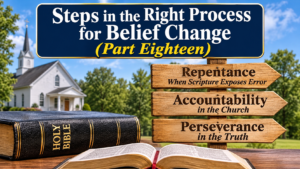 Navigating doctrinal change and institutional shifts within the church requires an unyielding commitment to God’s Word. When convictions shift, leaders, individuals, and churches must decide whether their realignment stems from true biblical reformation or subtle cultural conformity. Re-evaluating long-held traditions or practices demands more than conventional wisdom. It requires humility, a willingness to submit to divine authority, and a commitment to radical transparency before God and His people.
A church’s integrity depends heavily on how it handles the discovery of error and pursuit of truth. When Scripture exposes a misstep, genuine repentance — rather than administrative damage control or defensive rationalization — must guide the way forward. The following sections outline the essential principles governing biblical repentance, church accountability, steadfast perseverance, and the balance between reforming where needed and standing firm where God has explicitly spoken.
Repentance When Scripture Exposes Error
Humility must compel a believer or an institution to repent whenever Scripture reveals theological error or unscriptural practices. It is never sufficient to hold a mere quiet, internal realization that a past position was incorrect while maintaining the public status quo. True alignment with the Lord requires action. If a Christian has taught wrong doctrine, he needs to correct it publicly. If he has promoted an unscriptural standard or led others down a faulty path, he must take responsibility for that influence and actively work to repair the damage caused.
2 Corinthians 7:10 highlights the distinct nature of genuine conviction:
For godly sorrow worketh repentance to salvation not to be repented of: but the sorrow of the world worketh death.
Godly sorrow is far deeper than mere regret over negative fallout, a damaged reputation, or a loss of organizational influence. Worldly sorrow grieves exposure and consequence; godly sorrow grieves the offense committed against a holy God. Repentance means turning completely away from a practice or belief simply because it is wrong in the eyes of the Lord.
This principle applies equally to institutions. If a church has shifted its stance or practices, it must operate with total historical honesty. It should not obscure its past, silently redefine former positions, or pretend it always held its present view. If it has abandoned a clear biblical mandate, it must humbly restore it. Conversely, if it previously enforced man-made traditions as mandatory scriptural truths, it must confess and correct that legalistic error too.
However, biblical repentance does not mean mindlessly restoring every legacy practice simply out of nostalgia. Scripture, not tradition or sentimentalism, must evaluate what stays and what goes. Past customs can be just as unscriptural as modern innovations. Genuine repentance seeks correction in whichever direction the Bible demands.
Accountability in the Church
The Mandate for Biblical Vetting
Doctrinal shifts should never occur behind closed doors or through executive decree. A church must uphold the truth, and members are commanded to test every teaching against God’s Word. While biblical accountability does not mean equal administrative authority for every individual, it does mean that every leader, sermon, and policy remains strictly subject to the authority of Holy Scripture. 1 Thessalonians 5:21 delivers an explicit command:
Prove all things; hold fast that which is good.
This directive requires rigorous examination. Proposed shifts in doctrine or practice must be thoroughly vetted against the Bible, rather than blindly adopted because a dynamic leader promotes them, a megachurch practices them, or a majority favors them. The congregation must always ask: Is this good according to God’s Word?
Acts 15 provides a clear model for resolving doctrinal debate. When serious theological questions arose in the early church, the apostles and elders brought the matter into the open, examined the Scriptures, evaluated the evidence, and reached a conclusion grounded in God’s revealed Word. They did not suppress disagreement, hide behind executive privilege, or rely on personal charisma. Transparency and biblical fidelity guided the outcome.
Leadership Accountability and Open Governance
Accountability also demands honest communication regarding the reasons behind a change. If a teacher adopts a new position, he owes the body an open, passage-by-passage explanation of how his understanding evolved. Likewise, if a church leadership team updates an operational practice, it must clearly present the biblical foundation for the decision. Leaders must never prioritize protecting their personal prestige over honoring the truth.
A church environment that penalizes honest biblical questions, censors its own historical shifts, or uses charges of disloyalty to suppress inquiry undermines true accountability. Yet, accountability must also avoid descent into endless quarrels, personal attacks, or congregational disorder. The goal is not to elevate individual opinions, but to unite the body under clear authority of Scripture.
Church leaders carry a profound weight of responsibility here. They are called to preach the truth, confront error, and give an account for their stewardship. They must never misuse their office to shield unscriptural views from legitimate biblically based review. The church belongs to Jesus Christ, and its leaders remain fallible servants under His absolute authority.
Perseverance in the Truth
Continuous Reformation and Pastoral Charge
Arriving at a biblical conviction is not the end of the journey; the believer must persevere in living out that truth. Genuine biblical reformation fosters spiritual stability, not an ongoing thirst for theological novelty. Correcting one error should never lead to laxity in another area, nor should a church feel satisfied with correcting a single past misstep. The ultimate target is spiritual maturity across the whole counsel of God. Paul’s solemn charge to Timothy in 2 Timothy 4:1–5 directly speaks to this ongoing responsibility:
I charge thee therefore before God, and the Lord Jesus Christ, who shall judge the quick and the dead at his appearing and his kingdom; Preach the word; be instant in season, out of season; reprove, rebuke, exhort with all longsuffering and doctrine. For the time will come when they will not endure sound doctrine; but after their own lusts shall they heap to themselves teachers, having itching ears; And they shall turn away their ears from the truth, and shall be turned unto fables. But watch thou in all things, endure afflictions, do the work of an evangelist, make full proof of thy ministry.
Paul does not advise Timothy to tweak his message to accommodate shifting cultural trends. He instructs him to proclaim the Word faithfully, using sound doctrine to reprove, rebuke, and encourage. Paul warns that people will naturally seek out teachers who tell them what they want to hear. A minister must remain steadfast in truth even when sound doctrine becomes deeply unpopular.
Standing Firm Against Doctrinal Compromise
This warning exposes the cultural and internal pressures that often drive doctrinal compromise. People frequently seek new theological positions because the truth demands personal sacrifice or lifestyle changes. They look for interpretations that validate their preferences, minimize confrontation, or justify existing behaviors. A church that alters its message to appease such pressure has surrendered its calling. Perseverance calls for the exact opposite approach. The believer must hold fast to God’s truth even when standing alone. Popularity never measures the truth, just as hostility from the world is no proof of error. God’s Word remains the immutable benchmark, regardless of public response.
Jude 3 offers a complementary mandate:
Beloved, when I gave all diligence to write unto you of the common salvation, it was needful for Manuel to write unto you, and exhort you that ye should earnestly contend for the faith which was once delivered unto the saints.
The Christian faith was delivered “once for all.” It is not a fluid framework designed to be overhauled by every passing generation. The church is commissioned to guard and contend for this deposit of truth. Contending for the faith does not mean clinging to human traditions or resisting necessary biblical correction. It means guarding God’s timeless message against distortion or replacement.
The Bible contrasts reforming our flawed understanding of the faith with trying to revise it. The former is vital whenever Scripture uncovers error; the latter is apostasy. The church must continually submit its practices to biblical correction while refusing to surrender essential truth.
Change When Scripture Requires It; Stand When Scripture Has Spoken
Yielding to Biblical Authority
A biblical view of truth requires two basic duties when changing beliefs: change when Scripture demands it, and stand firm when Scripture speaks. Never defend an error to preserve personal history, family tradition, church heritage, or respected leaders. Human sentiment cannot overrule God’s Word. When Scripture exposes a flaw in your thinking or living, acknowledge it and turn. Equally, never abandon a biblical command to avoid cultural taboo, public offense, or modern dismissal. External pressure cannot invalidate divine truth. Where God has spoken, stand immovable.
This stance demands active discernment. It rejects both novelty for its own sake and stubbornness disguised as loyalty. Evaluate every practice through Scripture. Inspect your motives, trace the real authority behind your views, handle the text in context, explain changes transparently, and repent quickly when proven wrong.
Living out Scripture’s Sufficiency
A church must do more than post a correct statement of faith. It must align its worship, leadership, community, and daily conduct with biblical truth. No ministry can claim scriptural fidelity while treating clear commands as optional preferences. 2 Timothy 3:16–17 confirms the full sufficiency of God’s revelation:
All scripture is given by inspiration of God, and is profitable for doctrine, for reproof, for correction, for instruction in righteousness: That the man of God may be perfect, throughly furnished unto all good works.
Scripture does not offer polite advice; it equips believers for every good work. Neither individuals nor church leaders have the authority to set aside commands for comfort, acceptance, or convenience. Evaluating and adjusting your beliefs is how you demonstrate actual submission to Christ.
The goal of the Christian life is not constant change, but steady faithfulness. Correct what Scripture calls wrong, restore what it commands, reject human additions, and refuse compromise. Do not follow the spirit of the age. Follow Jesus Christ through His written Word, continuously reforming where corrected and standing firm where taught.