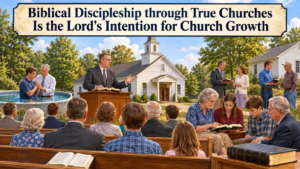
 The Lord’s Authority and the Mandate to Make Disciples (Matthew 28:18-20)
Every serious talk about church growth has to start where the Lord Jesus Christ started it, at the end of Matthew’s Gospel, in Matthew 28:18-20. A lot of folks start somewhere else. They start with demographics, marketing surveys, entertainment value, or whatever the culture is doing this year. They ask how to pack the most people into the building in the least time. That’s the same question a carnival asks, and nobody expects the carnival to be a church. When we bow to the authority of Scripture, we find the Lord never had marketing or crowd control in mind. He had biblical discipleship in mind, carried out in true churches under His sovereign rule.
The setting itself carries a lot of weight. After the resurrection, “the eleven disciples went away into Galilee, into a mountain where Jesus had appointed them. And when they saw him, they worshipped him: but some doubted” (Matthew 28:16-17). Some doubted, and they were looking right at Him. Of all the moments for the Lord to hand out a business plan, a doubting huddle on a mountain, with Him about to leave, wouldn’t seem the likeliest. Yet He speaks words that govern the entire church age. Church growth doesn’t rest on human confidence, clever campaigns, or the mood of the culture. It rests on the risen Christ, His authority, and His plain command.
All Authority Belongs to Christ (Matthew 28:18)
Jesus opens with a statement that leaves no room for negotiation: “All power is given unto me in heaven and in earth.” The Greek word is exousia, and it speaks of rightful rule and supreme jurisdiction. He isn’t offering helpful suggestions to tired followers, and He isn’t handing them a blank slate for human creativity. Every realm, heavenly and earthly, sits under His authority. Jesus leaves nothing over for a committee to decide.
Daniel saw it coming centuries earlier. He saw “one like the Son of man” come to the Ancient of days, and “there was given him dominion, and glory, and a kingdom, that all people, nations, and languages, should serve him” (Daniel 7:13-14). In Matthew 28:18, Jesus announces that the dominion has been given to Him as the victorious Redeemer. When authority is universal and absolute, His Word isn’t one option on the menu. It is the supreme law for His people.
Why Christ’s Authority Refutes Pragmatism
Shopping for Methods vs. Following the Head of the Church
That one declaration reshapes church growth from the ground floor. Pragmatism asks, “What works?” and then goes shopping. It visits the business school, the entertainment industry, and the psychology department, comes home with a cart full of techniques, and slaps a Bible verse on the receipt. Notice what it never asks: “What did He say?”
Think about how it sounds if Jesus had said, “All focus groups are given unto me in heaven and in earth.” We’d laugh. But that is exactly how a lot of churches operate. They survey the neighborhood, find out what the unchurched want, and then build the church to match. Whoever decides what the church will be is the one in charge, and that makes the customer the head of the church. Scripture has a different Head, and He never put the customers on His organizational chart.
And what does “works” mean, anyway? Works at what? Filling the parking lot? A monster truck rally can fill a parking lot. Paul wasn’t shy about saying where he stood (1 Corinthians 2:4-5):
And my speech and my preaching was not with enticing words of man’s wisdom, but in demonstration of the Spirit and of power: That your faith should not stand in the wisdom of men, but in the power of God.
If a man’s faith stands on a method, the method will have to keep running, and it will keep needing upgrades, and sooner or later someone has to pay for the fog machine.
Flawed Metrics and the Call to Obedience
Here is the trouble with the pragmatist’s own argument. He measures success by numbers, and then he gets to choose which numbers count. Paul had a word for that: “for they measuring themselves by themselves, and comparing themselves among themselves, are not wise” (2 Corinthians 10:12). Notice that he said they were not wise, which is different from saying they were a little unbalanced. And Solomon wrote, “There is a way which seemeth right unto a man, but the end thereof are the ways of death” (Proverbs 14:12). The pragmatist’s way seems right. It even has charts to prove it.
When a church makes pragmatic appeal its main guide, it quietly moves authority from Christ to the preferences of the crowd. The crowd delights to have that authority, and it will hold the position until the next trend rolls in. Then it will be somebody else’s church, and nobody will remember the old sermon series anyway. Paul asked a question every pragmatist should have to answer out loud (Galatians 1:10):
For do I now persuade men, or God? or do I seek to please men? for if I yet pleased men, I should not be the servant of Christ.
Please men, or be His servant. Paul didn’t leave a third box on the form.
Biblical faithfulness goes the opposite direction. Because all authority belongs to Him, His commands bind us, His design for the church is the standard, and obedience to Him measures our faithfulness. The Lord asked the question Himself: “And why call ye me, Lord, Lord, and do not the things which I say?” (Luke 6:46). That’s what the pragmatist has to answer, and “but look at the attendance” doesn’t answer it. And Scripture is enough for the job (2 Timothy 3:16-17):
All scripture is given by inspiration of God, and is profitable for doctrine, for reproof, for correction, for instruction in righteousness: That the man of God may be perfect, throughly furnished unto all good works.
Throughly furnished means there isn’t an aisle in the world’s store that we’re missing.
Authority and Preservation of the Word
A church can’t submit to Christ’s authority while treating His Word as uncertain, loose, or up for negotiation. Try telling a congregation, “We obey whatever He said, but nobody can say for sure what that was.” That’s like a soldier who swears loyalty to the general and then says that he lost his orders in the mail. If you can’t know with confidence what Christ commanded, you’re left to guess, compromise, or follow the latest thing, and the latest thing always shows up with a nice website.
God didn’t leave us there. He promised (Psalm 12:6-7):
The words of the LORD are pure words: as silver tried in a furnace of earth, purified seven times. Thou shalt keep them, O LORD, thou shalt preserve them from this generation for ever.
And the Lord Himself said, “Heaven and earth shall pass away, but my words shall not pass away” (Matthew 24:35). He made a promise, and He kept it. Our job is to believe it, not to hold a seminar on whether He managed. Submitting to His authority means taking His Word at face value and ordering our churches by what He actually said, rather than what we wish He had said.
One Central Imperative: “Make Disciples” (Matthew 28:19)
Read Matthew 28:19-20 carefully, and you’ll find something about the grammar. In the Greek text, there is one imperative verb, matheteusate, which means to make disciples. The King James renders it “teach” in verse 19: “Go ye therefore, and teach all nations.” The sense is the same, because the verb comes from the word for a disciple, and Acts 14:21 uses the very same verb for what Paul and Barnabas did at Derbe when they “had taught many.” Notice also that John 4:1 speaks of how “Jesus made and baptized more disciples than John.” Making disciples is the main verb. The participles surrounding it, going, baptizing, and teaching, explain how the command gets carried out.
Miss that structure, and you’ll distort both missions and church growth. Some treat mere movement or surface activity as the point. Others shrink evangelism down to getting a quick nod or a raised hand with every head bowed and every eye closed. They’ve missed the depth of the word. A disciple is a learner and a follower who submits to a Teacher. Becoming a disciple of Jesus Christ is no casual hobby, cultural label, or religious gesture. It’s a life-altering allegiance.
“Going” Serves the Command, Not Vice Versa
Notice how many English slogans isolate the word “go,” as if travel or frantic motion were the whole essence of the Great Commission. Churches put it on banners, T-shirts, and coffee mugs. But “going” (poreuthentes) is a participle that accompanies the central command. As believers go through life carrying the gospel to the nations, the aim isn’t to cover ground, log miles, or issue a busyness report at the annual meeting. The aim is disciples of Jesus Christ.
Busyness is easy to mistake for spiritual progress. A church can run programs every night of the week and still not produce one solid disciple. It’s like a man who works up a sweat on a treadmill and then announces he’s traveled four miles. He’s still in the living room. A church can be the same: out of breath, nothing to show for it, and proud of the mileage. Keeping the central verb at the center keeps our focus where it belongs. We want people brought to Christ, baptized into His order, and trained in His truth. A program that doesn’t do that is just noise with a budget.
Evangelism: Proclaiming Christ to the Lost
Evangelism in the technical sense is faithful witness to the gospel of Jesus Christ. It declares human sinfulness, the cross and resurrection of Christ, and the call to repentance and faith. God chose His method, and it wasn’t the one a consultant would have picked: “it pleased God by the foolishness of preaching to save them that believe” (1 Corinthians 1:21). God called it foolishness, which will embarrass the pragmatist. Paul wasn’t: “But we preach Christ crucified, unto the Jews a stumblingblock, and unto the Greeks foolishness” (1 Corinthians 1:23). He knew the message sounded like a bad marketing idea, and he preached it anyway.
A true church doesn’t outsource this to gimmicks or entertainment events built to get people feeling religious. If a man gets a free pizza, sits through a magic show, and signs a card, what has happened? A pizza has been eaten. Paul said, “But have renounced the hidden things of dishonesty, not walking in craftiness, nor handling the word of God deceitfully” (2 Corinthians 4:2). Equipped believers carry the clear gospel into their homes, neighborhoods, and communities, trusting the Spirit of God to bring the new birth.
When the gospel stays clear and uncompromised, conversions are real rather than manufactured. That protects the church from filling its rolls with unregenerate people who later drift off or corrupt the assembly. And it keeps us honest about who does the work (1 Corinthians 3:6-7):
I have planted, Apollos watered; but God gave the increase. So then neither is he that planteth any thing, neither he that watereth; but God that giveth the increase.
Neither is any thing, Paul said. That should do wonders for anyone’s marketing ego.
Edifying the Body of Christ Without Pragmatism
Paul adds that this work aims at “the edifying of the body of Christ.” Edification means building the church up in truth and love so that every part functions as God designed. Pragmatic methods bypass it, because edification is slow, unglamorous, and hard to put in a newsletter. Nobody puts “three more members now understand justification” on a banner. But it’s the building, and everything else is decoration.
Paul described how the body grows: “the whole body fitly joined together and compacted by that which every joint supplieth, according to the effectual working in the measure of every part, maketh increase of the body unto the edifying of itself in love” (Ephesians 4:16). Every joint supplies something. There are no spectators in that verse, only joints, and a body made mostly of spectators isn’t a body but an audience.
When a church concentrates on perfecting the saints for the work of evangelism and discipleship, growth happens according to God’s design. Sound doctrine equips true believers, evangelism stays faithful to the gospel, discipleship builds lasting maturity, and this strengthens true churches to the glory of Christ. It may not look as exciting as a light show. But it lasts, and the One who promised to build it, “I will build my church” (Matthew 16:18), has never missed a deadline.
Regeneration Precedes True Discipleship
We can’t make true disciples of Christ apart from the gospel that brings new birth. Jesus said, “Except a man be born again, he cannot see the kingdom of God” (John 3:3). An unregenerate person, “dead in trespasses and sins” (Ephesians 2:1), can’t do what a disciple does. “The natural man receiveth not the things of the Spirit of God: for they are foolishness unto him: neither can he know them, because they are spiritually discerned” (1 Corinthians 2:14). You can’t teach a corpse to run, however good the coaching and however much he likes the music. True discipleship begins when the Spirit of God uses the Word of God to bring a sinner to repentance and saving faith.
The Lord never hid the cost. “Whosoever will come after me, let him deny himself, and take up his cross, and follow me” (Mark 8:34). Luke adds the word “daily” (Luke 9:23). He even told would-be builders to sit down first and count the cost (Luke 14:28). Watering that down to make membership easy, painless, or popular doesn’t produce real disciples. It produces nominal professors with no root. Notice also what happened when Jesus preached hard truth in John 6: “From that time many of his disciples went back, and walked no more with him” (John 6:66). He didn’t chase them down the road with a revised message and a free sandwich. True church growth requires preaching the whole gospel, which means sin, repentance, Christ’s death and resurrection, and faith. That way real conversions take place, and a solid foundation is laid.
Baptism and Incorporation into the Church
See how closely making disciples is tied to baptism: “baptizing them in the name of the Father, and of the Son, and of the Holy Ghost.” Baptism isn’t an optional add-on for seasoned Christians years down the road, and it isn’t an empty ritual cut off from faith. In the New Testament pattern, it is the public step of obedience for those who’ve come to faith in Christ, identifying them with Him and marking their entrance into the visible fellowship of a true church. Look at Pentecost (Acts 2:41-42):
Then they that gladly received his word were baptized: and the same day there were added unto them about three thousand souls. And they continued stedfastly in the apostles’ doctrine and fellowship, and in breaking of bread, and in prayers.
They received the word, were baptized, were added, and continued. That’s how the Lord designed it to go.
True discipleship doesn’t exist in isolation or drift around outside biblical church order. From the start, converted and baptized believers were gathered into assemblies, where they could be taught, guarded, encouraged, and built up together. The Lord said, “I will build my church” (Matthew 16:18), and He didn’t say He would build a following of unconnected individuals. Discipleship and church membership belong together because Christ joins His disciples into assemblies or congregations.
Teaching “All Things” and Christ’s Abiding Presence (Matthew 28:20)
The Great Commission doesn’t stop at conversion or baptism. Jesus commands us to teach disciples “to observe all things whatsoever I have commanded you.” That points to ongoing, lifelong instruction and obedience. The disciple’s schooling isn’t over when he gets wet.
Teaching Aimed at Observance
Look at the word “observe.” Christian teaching is never mere academic theory, abstract speculation, or head knowledge detached from obedience. It aims at practical, consistent doing of what Christ commanded. A man can pile up information about Scripture and still resist its authority over his daily conduct, speech, worship, and church life. He may be able to outquiz everyone at the table and still not do a thing he’s learned. James has a word for that: “But be ye doers of the word, and not hearers only, deceiving your own selves” (James 1:22). Biblical discipleship presses truth all the way down into practice.
Refusing Selective Christianity: “All Things”
Equally important is the phrase “all things.” True discipleship refuses selective Christianity. We aren’t allowed to highlight the comfortable truths while quietly leaving the hard commands on doctrine, holiness, repentance, worship, or church order in the drawer, just to avoid friction or keep a crowd happy. Paul could say to the Ephesian elders, “For I have not shunned to declare unto you all the counsel of God” (Acts 20:27).
Notice that he declared all of it, and didn’t pick the parts people would like. Paul also warned about the opposite: “For the time will come when they will not endure sound doctrine; but after their own lusts shall they heap to themselves teachers, having itching ears” (2 Timothy 4:3). Itching ears have a way of finding a teacher who will scratch.
When a church faithfully teaches all that Christ commanded, the depth of the truth shapes the congregation. Growth is then measured by how faithfully believers are being grounded in the preserved Word of God and changed into mature, obedient disciples. It isn’t measured by how many people pass through the doors on a given Sunday or how slick the presentation looks.
Christ’s Unfailing Presence to the End of the Age
Jesus closes with His unfailing promise: “and, lo, I am with you alway, even unto the end of the world.” That promise frames the whole commission. It begins with His universal authority (“All power is given unto me”) and ends with His constant presence (“I am with you alway”). Everything we do sits between those two bookends.
Between that beginning and that ending, believers don’t walk alone. The Lord’s presence goes with His people as they preach the gospel, baptize converts, and teach all His commands. We don’t need worldly gimmicks or cultural tricks, because we have a living Savior whose authority rules all things and whose presence sustains His churches until He returns. If the One with all power is with you always, you can do without the fog machine. With this foundation set in Matthew 28:18-20, we’re ready in the next part to look at how true churches, regenerate membership, and doctrinal communion make up the God-ordained setting where this discipleship takes root and endures.
Ephesians 4:11-12 and the Purpose of Gifted Leadership
Paul’s teaching in Ephesians 4 opens up the internal life and ministerial structure of the assembly. The Lord intends true church growth to happen through biblical discipleship inside true churches. Ephesians 4 shows how Christ gifts His churches and calls believers to spiritual maturity and service. Paul says of the ascended Christ, “And he gave some, apostles; and some, prophets; and some, evangelists; and some, pastors and teachers; For the perfecting of the saints, for the work of the ministry, for the edifying of the body of Christ” (Ephesians 4:11-12). The gifts have a stated purpose, and the purpose is the equipping of the saints for the work of the ministry and the building up of the body.
Paul doesn’t turn church life into a stage for solo performers or celebrity personalities. He ties gifted leadership directly to the health and maturity of the whole congregation. Pastors and teachers are given to ground believers in sound doctrine, bring order and completeness to their walk, and prepare them for active service in the body. A pastor isn’t there to be the star of the show. He’s more like a coach, and the church doesn’t exist so that a few can watch him play.
“Perfecting the Saints” in Doctrinal Clarity
Perfecting the saints speaks of bringing believers into maturity, completeness, and readiness. Paul says the goal is “That we henceforth be no more children, tossed to and fro, and carried about with every wind of doctrine, by the sleight of men, and cunning craftiness, whereby they lie in wait to deceive” (Ephesians 4:14). In an age of doctrinal confusion and shifting trends, saints can’t grow strong on vague slogans or shallow emotion. A church that feeds on bumper stickers will end up with bumper-sticker Christians, and they’ll go wherever the wind blows. They need steady instruction in the preserved Word of God.
True maturity involves both right belief and right conduct. As pastors teach Scriptural truth to believers, God’s Word shapes their minds, sharpens their consciences, and lines up their lives more with Christ.
“The Work of the Ministry” in Its Technical Sense
In everyday church talk, people use the word “ministry” loosely to cover about any committee, program, or building task. Somebody’s in charge of the parking lot ministry, and somebody else has the coffee ministry. Yet in its technical, biblical sense, especially alongside the Great Commission, the work of the ministry centers on evangelism and discipleship.
Evangelism proclaims the gospel so that lost sinners will repent and believe in Jesus Christ. Discipleship then grounds those converted, baptized believers in the teaching of Christ so they grow into faithful followers who observe all He commanded. Seen this way, “the work of the ministry” isn’t an elite specialty reserved for a few paid staff members. It’s the shared calling of the saints as a true church equips them. Even the early believers who were scattered by persecution knew this: “Therefore they that were scattered abroad went every where preaching the word” (Acts 8:4). Those weren’t the apostles, and they didn’t wait to set up a program.
Evangelism: Proclaiming Christ to the Lost
Evangelism in the technical sense is faithful witness to the gospel of Jesus Christ. It declares human sinfulness, the cross and resurrection of Christ, and the call to repentance and faith. God chose His method: “it pleased God by the foolishness of preaching to save them that believe” (1 Corinthians 1:21).
A true church doesn’t outsource this to marketing gimmicks or entertainment events built to get people feeling religious. Paul didn’t hire a promotional firm. He wrote, “But have renounced the hidden things of dishonesty, not walking in craftiness, nor handling the word of God deceitfully” (2 Corinthians 4:2). Instead, equipped believers carry the clear gospel message into their homes, neighborhoods, and communities, trusting the Spirit of God to bring about new birth.
When the gospel stays clear and uncompromised, conversions are real rather than manufactured. That protects the church from filling its rolls with unregenerate people who later drift off or corrupt the assembly.
Discipleship: Grounding Believers in the Truth
Discipleship in the technical sense is the deliberate, ongoing process of teaching believers to observe all that Christ commanded. It happens in the life of a true church, where sound preaching, scriptural ordinances, mutual exhortation, and godly accountability take place. Paul described his own aim this way: “Whom we preach, warning every man, and teaching every man in all wisdom; that we may present every man perfect in Christ Jesus” (Colossians 1:28). Notice that he said every man.
A church doesn’t fulfill its calling by gathering a crowd on Sunday morning. It does it by steadily building up converted and baptized believers in the faith, so that they learn to live out the truth in every area of life.
Edifying the Body of Christ Without Pragmatism
Paul adds that this work aims at “the edifying of the body of Christ.” Edification means building the church up in truth and love so that every part functions as God designed. “Knowledge puffeth up, but charity edifieth” (1 Corinthians 8:1), so the building has to be done God’s way. Paul described the result: “the whole body fitly joined together and compacted by that which every joint supplieth, according to the effectual working in the measure of every part, maketh increase of the body unto the edifying of itself in love” (Ephesians 4:16). Every joint supplies something, which leaves no room for spectators. Pragmatic church-growth methods often bypass real edification, because they chase outward numbers instead of inward spiritual health.
When a church concentrates on perfecting the saints for the work of evangelism and discipleship, growth happens according to God’s design. It may not look as exciting as a light show, but it lasts, and the Lord Himself promised to build it.