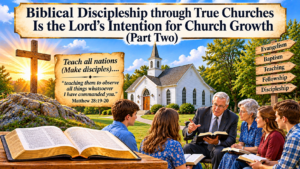
 The Lord lays the foundation for church growth in Matthew 28:18-20 and develops its inner workings in Ephesians 4. Christ claims all authority in heaven and earth, gives one central command to make disciples, and gifts pastors and teachers to equip the saints for the work of ministry: evangelism and discipleship. But those commands don’t float around in midair like a weather balloon. Scripture ties biblical discipleship to a concrete, visible home, and that home is the true church, which is local.
Many today pull discipleship out of the Lord’s assemblies and treat it as a private hobby, a parachurch program, or an informal chat over lattes with no church authority anywhere in sight. Others swing the other way and call anything a church if enough people gather around the music, the personality, or a shared love of pickleball. Both miss the Lord’s design. In the New Testament, the true church is the God-ordained sphere that receives, baptizes, teaches, guards, and matures disciples in the truth.
New Testament Examples of Discipleship as the Model of Growth
In Part One we saw that the risen Lord, holding all authority in heaven and earth, gave one central imperative: make disciples. Going, baptizing, and teaching are the means, and the command is matheteusate. Pragmatism measures success by crowds and charts. Scripture measures it by obedience to that command, carried out in true churches among regenerate members.
Now we turn to the New Testament itself. The Gospels, Acts, and the epistles don’t leave us guessing about the model. They show discipleship as the Lord’s actual method of growth, and they expose the difference between mere addition and the multiplication He designed. Anyone who wants to know how the Lord does it can open the book and watch Him do it.
The Gospels: Intensive Investment in the Twelve
Jesus didn’t build His church by renting arenas and hoping the crowd would stick around long enough to learn something. He chose twelve, and He spent the bulk of His public ministry with them. Luke tells us how seriously He took the choice (Luke 6:12-13):
And it came to pass in those days, that he went out into a mountain to pray, and continued all night in prayer to God. And when it was day, he called unto him his disciples: and of them he chose twelve, whom also he named apostles.
The Son of God spent a whole night in prayer over the staffing. No pragmatist would have prayed all night over twelve guys when thousands were available. Mark states the purpose: “And he ordained twelve, that they should be with him, and that he might send them forth to preach” (Mark 3:14). Notice the order. “With him” comes first, and “send them forth” comes second. Our age wants the sending without the being with, which is like wanting a harvest without the planting. The being with was the whole curriculum. They watched Him pray, handle opposition, and answer foolish questions without throwing anyone off a cliff.
The Twelve Received the Explanation, the Crowds Received the Story
He did not treat the multitudes as the real work and the twelve as a side project. It was the other way around. When the disciples asked why He spoke to the crowds in parables, He answered (Matthew 13:11),
Because it is given unto you to know the mysteries of the kingdom of heaven, but to them it is not given.
Mark adds (4:34),
But without a parable spake he not unto them: and when they were alone, he expounded all things to his disciples.
The crowds got the story, and the disciples got the explanation.
When it was time to separate the curious from the committed, He wasn’t shy about doing it. After the hard teaching of John 6, “many of his disciples went back, and walked no more with him” (John 6:66). Then He turned to the twelve and asked, “Will ye also go away?” (John 6:67). A man chasing crowds panics at that moment, but the Lord asked the question calmly because He was building something that would last.
The Gospels: Fruit That Remains
Even among the twelve, He invested more deeply in some. Peter, James, and John went up the mountain and into the room where the Lord raised Jairus’ daughter. The pattern is unmistakable: intensive, personal, life-on-life investment that produces men who can reproduce what they received.
From the Twelve to Those Who Believe Through Their Word
In His high priestly prayer He said, “I have manifested thy name unto the men which thou gavest me out of the world” (John 17:6), and He looked past them to the future: “Neither pray I for these alone, but for them also which shall believe on me through their word” (John 17:20). That’s the chain already forming.
The Purpose: Fruit That Remains
And He told them plainly what it was all for: “Ye have not chosen me, but I have chosen you, and ordained you, that ye should go and bring forth fruit, and that your fruit should remain” (John 15:16). Fruit that remains is the kind that’s still around after the tent is folded up.
The Book of Acts: Conversion, Baptism, and Incorporation
The same pattern continues after the resurrection. In Acts, the church doesn’t grow by adding programs that attract the unconverted and then trying to clean them up afterward. On the day of Pentecost (Acts 2:41-42),
Then they that gladly received his word were baptized: and the same day there were added unto them about three thousand souls. And they continued stedfastly in the apostles’ doctrine and fellowship, and in breaking of bread, and in prayers.
Count the steps: received the word, baptized, added, continued. They stayed in the doctrine, and they didn’t wander off to see what the church down the road was offering.
The Order Matters: Believing, Baptizing, and Belonging
The order matters. Conversion comes first, then baptism, then incorporation into the church, and then ongoing instruction. Nobody was baptized who hadn’t believed.
When the Ethiopian eunuch asked, “See, here is water; what doth hinder me to be baptized?” Philip answered, “If thou believest with all thine heart, thou mayest” (Acts 8:36-37). Faith came first, and the water followed. Peter at Caesarea asked, “Can any man forbid water, that these should not be baptized, which have received the Holy Ghost as well as we?” (Acts 10:47), and at Corinth “many of the Corinthians hearing believed, and were baptized” (Acts 18:8). The same order shows up at Samaria, at Caesarea, and among the Gentiles. Hearing, believing, and baptizing never changed places.
Staying Long Enough to Disciple: Teaching, Confirming, and Ordaining
Notice also how long they stayed. Barnabas went and found Saul and brought him to Antioch, “And it came to pass, that a whole year they assembled themselves with the church, and taught much people” (Acts 11:26). And when Paul and Barnabas came back through the cities they’d evangelized, they didn’t do a head count and move on. They went “Confirming the souls of the disciples, and exhorting them to continue in the faith, and that we must through much tribulation enter into the kingdom of God. And when they had ordained them elders in every church, and had prayed with fasting, they commended them to the Lord, on whom they believed” (Acts 14:22-23).
Look at that sales pitch, “through much tribulation.” No consultant would have signed off on it. They confirmed the souls, established the churches, and ordained elders, so the work could continue when the missionaries left. Discipleship wasn’t an optional advanced track for the especially spiritual. It was the ordinary means by which the church grew and was stabilized.
The Epistles: Every Man Mature and Four Generations of Transmission
The epistles press the same reality further. Paul told the Ephesian elders, “For I have not shunned to declare unto you all the counsel of God” (Acts 20:27), and he reminded them that he had “taught you publickly, and from house to house” (Acts 20:20) and “ceased not to warn every one night and day with tears” (Acts 20:31). That is three years of public teaching, house-to-house teaching, and tears, and the result was an eldership able to protect the flock after he left.
Every Man Mature: Giving Not the Gospel Only, but Our Own Souls
He reminded the Thessalonians (1 Thessalonians 2:7-8),
But we were gentle among you, even as a nurse cherisheth her children: So being affectionately desirous of you, we were willing to have imparted unto you, not the gospel of God only, but also our own souls, because ye were dear unto us.
Take note of “not the gospel only, but also our own souls.” He didn’t drop a tract and move on. He stayed, taught, modeled, and corrected. Discipleship costs the discipler something, which is why so few want to do it, and so many want to have a program about it.
To the Colossians he wrote, “Whom we preach, warning every man, and teaching every man in all wisdom; that we may present every man perfect in Christ Jesus” (Colossians 1:28). “Every man” isn’t a rhetorical flourish. Paul’s goal was maturity for the whole body, not a few polished platform performers surrounded by spectators. The word “perfect” means complete, full-grown. A church that is content with half its people stuck in infancy is not following Paul’s goal.
Four Generations of Transmission: Faithful Men Able to Teach Others
Then comes the verse that crystallizes the whole pattern: “And the things that thou hast heard of me among many witnesses, the same commit thou to faithful men, who shall be able to teach others also” (2 Timothy 2:2). Count the generations: Paul, Timothy, faithful men, and others. That is four in one verse, and each must be able to pass it on.
Notice the qualifiers too. “Among many witnesses” speaks of public, accountable teaching in the church, and not a secret club. “Faithful men” tells us the selection mattered. “Able to teach others also” means the teaching only succeeds when it reproduces. That isn’t addition. It’s multiplication by design. The Lord never intended a permanent bottleneck in which one gifted man does all the work while everyone else watches, and He certainly never intended the congregation to be his audience. He intended a chain of faithful transmission inside the local church.
You also see at least four generations in 1 Thessalonians 1:6-8:
- Generation 1: The Lord. The source of the gospel and pattern of faith (“followers of us, and of the Lord“).
- Generation 2: Paul, Silvanus, and Timotheus (“us”). The missionaries who carried the message to Thessalonica.
- Generation 3: The Thessalonians (“ye”). Those who received the word, imitated Paul and the Lord, and became living examples.
- Generation 4: Believers in Macedonia, Achaia, and beyond. Those who heard the word “sounded out” from the Thessalonians and followed their example (note that Philippi was a leading city in Macedonia, though chronologically Paul visited Philippi just before Thessalonica in Acts 16–17).
Exponential Growth versus Addition
The Math and the Quality of Multiplication
Addition Versus Multiplication: The Arithmetic
Addition looks impressive in the short run. A gifted evangelist preaches and counts a hundred decisions a year, and at the end of the year the numbers look large. Multiplication looks pitiful by comparison. One believer invests a year in one new convert, teaching him to observe all things Christ commanded, until that convert can do the same for another.
Do the arithmetic, and it’s illustrative only, since real life has funerals and failures in it. At the end of year one there are two, year two there are four, and at the end of year seven there are 128. The evangelist’s tally reached seven hundred, so he’s still way ahead, but at year ten the doubling reaches 1,024, and the evangelist has just reached 1,000.
By year twenty the doubling is past a million, and the evangelist is at two thousand and tired. Multiplication starts so slow you’d think it was broken, and then it leaves addition in the dust. The Lord’s own ministry fits this. He had twelve, then a hundred and twenty in the upper room, then three thousand at Pentecost, and the Book of Acts rolls on from there.
What Scripture Says: Added, Multiplied, and Established
Scripture uses both words, and an honest exegete should say so. Luke writes, “And the Lord added to the church daily such as should be saved” (Acts 2:47). A little later he writes, “And the word of God increased; and the number of the disciples multiplied in Jerusalem greatly” (Acts 6:7). Later still, “But the word of God grew and multiplied” (Acts 12:24), and “So were the churches established in the faith, and increased in number daily” (Acts 16:5).
Notice who does the adding. The Lord adds, and the word multiplies. So the contrast is not between God adding and men multiplying. It’s between a method that depends on a gifted man or an event, and a method that depends on carrying the Word of God from one faithful life to another. Notice also that the churches were “established in the faith” before they “increased in number.” The stable ones grew, and the shaky ones didn’t.
More important than the math is the quality. The product of multiplication is not a list of names. It is a growing number of mature disciples who themselves make disciples. Someone can print a list of names in the bulletin, but Scripture requires a disciple to send to the next town.
Faithfulness Over Lowering the Bar
Our Part Is Faithfulness; God Gives the Increase
The New Testament never treats numerical increase as an end in itself. “I have planted, Apollos watered; but God gave the increase” (1 Corinthians 3:6). Our part is faithfulness to the method He commanded. When churches chase addition by lowering the bar, with easy professions, delayed baptism, soft teaching, and entertainment in place of doctrine, they can fill the building for a season. But they don’t produce believers who can endure hardness, contend for the faith, or reproduce themselves. “Thou therefore endure hardness, as a good soldier of Jesus Christ” (2 Timothy 2:3) is a hard sell to a crowd that came for the free donuts.
Wood, Hay, and Stubble Versus What Survives the Fire
Paul has a sobering word for the builders (1 Corinthians 3:12-13):
Now if any man build upon this foundation gold, silver, precious stones, wood, hay, stubble; Every man’s work shall be made manifest: for the day shall declare it, because it shall be revealed by fire; and the fire shall try every man’s work of what sort it is.
Notice that he lists six materials, and the fire is what tests them. A church that builds with wood, hay, and stubble can put up a tall building in a hurry. It just can’t survive a match.
The result is a large but fragile assembly that collapses when the personality leaves or the culture shifts. And the Hebrew believers were rebuked for lack of progress (Hebrews 5:12):
For when for the time ye ought to be teachers, ye have need that one teach you again which be the first principles of the oracles of God; and are become such as have need of milk, and not of strong meat.
A church that never moves past milk will have a nursery full of forty-year-olds. Multiplication through biblical discipleship produces the opposite: smaller numbers at first, maybe, but believers who remain, grow, and multiply. The Lord builds His church that way, and He has never needed our marketing upgrades to keep His promise.
The Quality Produced by Practicing What Jesus Commanded
Situational and Systematic Discipleship
Obedience to the command to make disciples doesn’t merely increase quantity over time. It produces a different kind of believer and a different kind of church. Discipleship comes in two forms, and the New Testament has both.
Situational discipleship happens in the ordinary traffic of life: conversations after the service, shared evangelism, meals in homes, correction when sin appears, and encouragement when trials come. Moses commanded it long before the Lord repeated it: “And thou shalt teach them diligently unto thy children, and shalt talk of them when thou sittest in thine house, and when thou walkest by the way, and when thou liest down, and when thou risest up” (Deuteronomy 6:7). Paul “taught publickly, and from house to house” (Acts 20:20), and the Lord used situations as His classroom. When a storm hit, He taught faith; a rich young ruler walked away; He taught the cost; and when the disciples argued over who was greatest, He picked up a towel.
Systematic discipleship happens through deliberate structure, which means sequential teaching of the whole counsel of God, accountability, baptism as the public entrance into the ordered life of the church, and ongoing observation of everything Christ commanded. Paul told Timothy, “Preach the word; be instant in season, out of season; reprove, rebuke, exhort with all longsuffering and doctrine” (2 Timothy 4:2). “Doctrine” there means regular, ordered instruction. Both kinds are necessary. Situational without systematic gives you vague warmth, like a family that never learned to read. Systematic without situational gives you sterile information, like a man who memorized the map and never left the house.
Observable Results in the Church
When a true church practices both, the results show. Believers learn to deny self, take up the cross daily, and follow Christ: “If any man will come after me, let him deny himself, and take up his cross daily, and follow me” (Luke 9:23). They stop treating the Christian life as a weekly event and treat it as total allegiance. Believers become “doers of the word, and not hearers only” (James 1:22), learn “that ye should earnestly contend for the faith which was once delivered unto the saints” (Jude 3), and receive equipping for the work of the ministry so that the body edifies itself in love (Ephesians 4:12, 16).
The church itself becomes stronger, and the reason is that it obeyed the Head. Sound doctrine is protected. Church discipline can be practiced without the assembly dissolving. Evangelism stays clear instead of diluted. The next generation of leaders rises from within rather than being imported from the latest conference circuit. Paul’s pattern at Ephesus, Lystra, and every other place was to ordain elders from among those who had been taught, and he never ran short of men to send because he kept making them.
What Lasts
None of this is glamorous. It won’t fill a parking lot overnight and won’t produce the metrics that impress denominational statisticians or conference speakers, but it will produce the kind of Christians and churches the New Testament describes. Those are the ones who last when the stage lights go off, because they were never built on the stage.
The Lord Jesus Christ is still the One who builds His church: “I will build my church; and the gates of hell shall not prevail against it” (Matthew 16:18). He does it through the means He commanded, discipleship carried out in true churches among regenerate members who are taught to observe all things whatsoever He commanded. Addition may look faster. Multiplication, done His way, lasts. And what lasts is exactly what He intended.
Defining a True Church by Scripture, Not Trend
If church growth means the multiplication and strengthening of true churches through biblical discipleship, we first have to be clear on what makes a church a true church. Human tradition, organizational efficiency, and large attendance can’t turn a religious gathering into a New Testament assembly. Scripture itself supplies the marks and order. The word in the Greek is ekklesia, an assembly, and Jesus used it to describe something He builds and that He expects to be around: “Unto him be glory in the church by Christ Jesus throughout all ages, world without end” (Ephesians 3:21). It is a visible, local, called-out assembly, and it isn’t a mood or a movement or a mailing list.
Regenerate and Scripturally Baptized Membership
The New Testament pattern begins with conversion and scriptural baptism. In Acts 2:41-42, those who gladly received the word were baptized, added to the assembly, and continued steadfastly in the apostles’ doctrine, fellowship, breaking of bread, and prayers. The order is unbreakable: genuine faith in the gospel comes before baptism, and baptism comes before addition to the local congregation. The word “baptize” means to immerse, and the Ethiopian eunuch and Philip “went down both into the water” (Acts 8:38), which tells you what they did without leaving much to the imagination.
When an assembly ignores regenerate membership and fills its rolls with unconverted attendees, it destroys the spiritual nature of the church from the inside. You can’t disciple unregenerate people into obedience to Christ’s commands when they have no spiritual life, and it’s not a matter of working harder or better. True churches keep the biblical boundary between the world and the household of God by receiving only those who give credible evidence of repentance and faith and who submit to scriptural baptism. Luke gave us a reason for this when he recorded that “of the rest durst no man join himself to them: but the people magnified them” (Acts 5:13). The early church had a gate, and it worked. People who weren’t ready stayed outside and thought well of the people inside.
Doctrinal Unity and True Communion
Modern church-growth advocates keep praising “community,” by which they usually mean warm social compatibility, shared hobbies, or emotional comfort. Scripture uses a weightier word, “fellowship,” from koinonia, which carries the idea of sharing in common. Biblical communion isn’t built on demographics or atmosphere. It’s shared participation in the truth of God’s Word. John wrote, “That which we have seen and heard declare we unto you, that ye also may have fellowship with us: and truly our fellowship is with the Father, and with his Son Jesus Christ” (1 John 1:3). The fellowship came out of the declared truth, and not the other way around. Amos asked the question that explains it: “Can two walk together, except they be agreed?” (Amos 3:3).
Paul wrote that the church of the living God is “the pillar and ground of the truth” (1 Timothy 3:15). A pillar holds a thing up for everyone to see, and the ground is the foundation under it. A true church upholds, defends, and proclaims the whole counsel of God without trimming off the doctrines that offend modern sensibilities. If a church treats the truth as negotiable, it isn’t holding anything up. Discipleship flourishes only where truth is treated as settled, authoritative, and preserved, and doesn’t get a fresh vote every five years.
Scriptural Officers and Ordinance-Keeping
A true church also submits to Christ’s order regarding leadership and ordinances. Scripture recognizes two church offices, pastors (also called elders and bishops) and deacons, and Paul addressed them together: “to all the saints in Christ Jesus which are at Philippi, with the bishops and deacons” (Philippians 1:1). The qualifications are strict and are spelled out in 1 Timothy 3 and Titus 1, where Titus is told to “ordain elders in every city” (Titus 1:5). Notice that the qualifications are mostly about character. Nobody was asked about his platform following.
The Lord also entrusted two ordinances, baptism and the Lord’s Supper, to His local churches to picture the gospel and guard purity in the body. Paul said, “Now I praise you, brethren, that ye remember me in all things, and keep the ordinances, as I delivered them to you” (1 Corinthians 11:2), and he set the Supper in the assembly: “When ye come together therefore into one place, this is not to eat the Lord’s supper” (1 Corinthians 11:20) was his rebuke to a church that was abusing it. The ordinances belong to the church that keeps them in order, and they don’t belong to a campus club.
Why Parachurch Shortcuts Cannot Replace True Churches
Whenever Christians get impatient with the slow, steady labor of building true churches, they invent shortcuts. Parachurch organizations, campus clubs, and independent discipleship networks often claim they can evangelize and disciple people faster, without the supposed friction of doctrine, membership, or accountability. Friction is how a tire holds the road. Take the friction away and you have a very fast car in a ditch.
Missing Authority and Accountability
The fatal flaw in detached discipleship is the absence of Christ’s ordained church authority. In Matthew 18, Jesus puts corrective discipline and restoration squarely inside the local congregation: “And if he shall neglect to hear them, tell it unto the church: but if he neglect to hear the church, let him be unto thee as an heathen man and a publican” (Matthew 18:17). Tell it to whom? To the church. He never said “tell it to the ministry network.” Paul reinforced it in 1 Corinthians 5: “Know ye not that a little leaven leaveneth the whole lump? Purge out therefore the old leaven, that ye may be a new lump” (1 Corinthians 5:6-7), and he finished with, “Therefore put away from among yourselves that wicked person” (1 Corinthians 5:13).
A private study group or independent ministry has no scriptural authority to baptize converts, administer the Lord’s Supper, ordain pastors, or exercise church discipline. It has good intentions and maybe a nice logo, which won’t do the job. When discipleship stops in a church, it leaves believers without the spiritual covering, mutual accountability, and pastoral oversight Christ designed for their protection. And Paul’s list of what God has set up carries a clear point: “And God hath set some in the church, first apostles, secondarily prophets, thirdly teachers” (1 Corinthians 12:28). He set them in the church. He didn’t set them in a parallel organization with a mission statement.
Fragmenting What Christ Joined Together
In Acts, apostolic evangelism never ended with isolated converts floating on their own. Everywhere Paul and his companions preached the gospel, they gathered disciples into local assemblies, taught them the ordinances, and ordained elders in every church (Acts 14:21-23). Look at that Acts 14 sequence again: “And when they had preached the gospel to that city, and had taught many” (Acts 14:21). Preach, teach, return, confirm, ordain. They built churches, and none of the Lord’s missionaries went home and said, “We reached them. Let’s hope they find a good group.”
To separate discipleship from local church life is to divide what the New Testament consistently holds together. And it isn’t a mere preference. If the Lord promised that the gates of hell would not prevail against His church (Matthew 16:18), and He gave it to every age (Ephesians 3:21), then He wasn’t planning on handing off the job to a competing organization somewhere around the 1950s.
How True Churches Cultivate Lasting Discipleship
When a true assembly holds fast to regenerate membership, doctrinal fidelity, and biblical order, discipleship stops being a temporary program and becomes the normal life of the congregation. Nobody has to schedule it, and nobody can avoid it.
Regular Preaching and Teaching of the Whole Counsel of God
Consistent, expository preaching lies at the heart of church-based discipleship. Week after week, as the pastor opens the preserved Word of God and explains its meaning, believers learn to think biblically, discern error, and obey Christ’s commands. Ezra’s day set the pattern: “So they read in the book in the law of God distinctly, and gave the sense, and caused them to understand the reading” (Nehemiah 8:8). They read it, gave the sense, and caused the people to understand, and that’s expository preaching in a verse. No quick seminar or slick campaign can substitute for years of steady, faithful pulpit ministry. A man who preaches through the Bible book by book can’t dodge the hard verses, which is probably one reason people avoid it.
Mutual Exhortation Within the Body
Discipleship inside a true church also flows through everyday relationships among regenerate members. Scripture commands believers (Hebrews 3:13),
But exhort one another daily, while it is called To day; lest any of you be hardened through the deceitfulness of sin.
It says (10:24-25),
And let us consider one another to provoke unto love and to good works: Not forsaking the assembling of ourselves together, as the manner of some is.
And it says, “Bear ye one another’s burdens, and so fulfil the law of Christ” (Galatians 6:2). Notice “daily.” Sunday morning alone doesn’t cover it.
Older, mature saints model godly living for younger believers, and Paul spelled it out in Titus 2: the aged women are to be “teachers of good things; That they may teach the young women to be sober” (Titus 2:3-4). That’s a plan for multiplication in a single church, with older men and women teaching younger ones in the ordinary run of life. It creates a living pattern of obedience that reinforces the preaching of the Word, and it doesn’t cost anybody a registration fee.
Guarding Purity Through Loving Church Discipline
Finally, true churches protect the integrity of discipleship by practicing biblical discipline. When sin or false teaching enters the congregation unaddressed, it undermines the testimony of the gospel and confuses younger believers about what obedience to Christ looks like. Paul said it without sentiment: “Know ye not that a little leaven leaveneth the whole lump?” (1 Corinthians 5:6). And the goal of discipline is restoration. Jesus began with “if thy brother shall trespass against thee, go and tell him his fault between thee and him alone: if he shall hear thee, thou hast gained thy brother” (Matthew 18:15). Gained is the word. Loving, scriptural discipline preserves the holiness of the assembly and shows that following Jesus involves genuine submission to His Word.
True church growth is never achieved by lowering the walls of the church until the assembly looks indistinguishable from the surrounding culture. Rather, the Lord grows His work as true churches stand firmly upon His Word, guard regenerate membership, and faithfully disciple believers within the order He established. In the next part of this series, we will examine how pragmatic crowd-chasing and entertainment-driven models contradict Christ’s own ministry in John 6 and produce “false positives” instead of genuine disciples.
More to Come