Part One Part Two Part Three Part Four Part Five Part Six Part Seven Part Eight Part Nine Part Ten
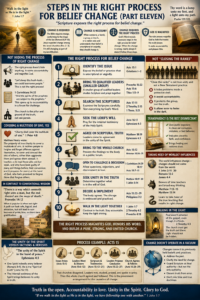 Scripture exposes the right process for belief change. The Bible requires change, conforming to the image of the Son (Romans 8:29-30). Jesus expected change among the seven churches in Revelation 2-3. I’m still changing as part of my sanctification. When someone, a family, a group, an entire church, or a nation sees and understands their belief is unscriptural or ungodly, they should change it. However, God’s Word also reveals necessary steps in the right process for belief change. When the change is wrong though, nearly always it doesn’t follow those steps.
Not Hiding the Process of Right Change
Even if the change is right, which is good, it should still follow correct steps in the right process. The right process doesn’t hide anything. It wants accountability and magnifies God, because by faith it makes His truth known, thus please Him. It isn’t and shouldn’t be the following: “Let’s keep this hush-hush, because if people know we’ve changed to this scriptural belief or practice, we could lose some people.” In 1 Corinthians 14:32, Paul writes, “And the spirits of the prophets are subject to the prophets.” This opens up to accountability in a forum for challenge. The church is the pillar and ground of the truth, not one person.
You’ve heard of the terminology, “Close the ranks.” It’s when a group of people to unite, bands together to present a united front —especially when facing outside criticism, conflict, or opposition. It implies putting aside internal disagreements to protect the shared interests of the group. In traditional infantry and cavalry formations, troops stood in organized lines or grids. If a soldier fell in battle or the formation was disrupted, a gap would open in the fighting line, leaving the troops vulnerable. The command to “close the ranks” instructed soldiers to step sideways and pack tightly together to eliminate any gaps.
“Closing the ranks” is not true unity and it is not a New Testament church practice. Here is another cliche: “Transparency is the best disinfectant,” which is a strategy of openness and honesty. Exposing the process will indicate sincerity, faith, and confidence. Closing ranks hides the problem inside a protective shell. The group acts as a shield to keep outsiders from seeing or exploiting internal flaws.
Transparency uses public exposure to clean out corruption, mistakes, or bad behavior.
Covering a Multitude of Sins, Yes
I’n not saying everyone needs to know everything. Peter writes, “charity shall cover the multitude of sins.” Matthew Henry, I believe, had this right, when he wrote in his commentary on the Bible:
The property of true charity to cover a multitude of sins. It inclines people to forgive and forget offences against themselves, to cover and conceal the sins of others, rather than aggravate them and spread them abroad. It teaches us to love those who are but weak, and who have been guilty of many evil things before their conversion; and it prepares for mercy at the hand of God, who hath promised to forgive those that forgive others.
The sins of individuals for which they repent should be kept private. This is different than the process of belief change. In Matthew 18, Jesus said, “between he and thee alone.” This is that covering the multitude of sins and also, “bearing all things” (1 Corinthians 13:7). Both of these ideas can be true at the same time, that is, hiding sin but not hiding a change in belief. The latter needs transparency and openness. You reading, I believe, can get or understand the difference.
Someone can have a private conversation, intended to be kept private, even about belief change, but the whole process must finally take a public turn, where the true doctrine, is taken to a public conversation. I noticed this even in a recent town meeting here in our small town, where the town intended to make some small changes in a few potentially controversial policies. The town lawyer recommended that the board open up the discussion to the floor, which means it invited people to offer public criticism of the changes, if anyone wanted.
In Contrast to Conventional Wisdom
Individuals, churches, and our whole country has often moved away from the opportunity of revealing biblical exegesis that challenges the conventional wisdom. Sometimes people call the latter, “political correctness.” What is popular, as you know, very often is not right. This is akin to Proverbs 14:12:
There is a way which seemeth right unto a man, but the end thereof are the ways of death.
Conventional wisdom warns you that what “everyone knows” to be true is often just a popular myth or a lazy assumption lacking hard evidence. Proverbs 14:12 warns you that a path can look perfectly safe, logical, and attractive, but still lead to complete ruin. A path appears right to an individual because of personal pride, bias, or short-term gratification, blinding him to the long-term consequences.
Walking in the Light
The Apostle Paul said he wasn’t ashamed of the gospel of Christ, even though he reveals the offensiveness of it. Walking in the truth is walking in the light (cf. 1 John 1:7, Psalm 119:105, Proverbs 4:18). The church especially, as the propagator of the truth, needs to get the truth out there. Whatever the truth of scripture, it is light, and shouldn’t be hidden as Paul writes in 2 Timothy 4:3, to satisfy “itching ears.” Maybe someone won’t have a good argument, and that’s embarrasing, or a leadership as a whole can’t defend its new position. Public airing could expose the flaws.
In Matthew 18:19-20, Jesus said:
19 Again I say unto you, That if two of you shall agree on earth as touching any thing that they shall ask, it shall be done for them of my Father which is in heaven. 20 For where two or three are gathered together in my name, there am I in the midst of them.
For people to agree, they’ve got to manifest what they are thinking about an issue or situation. Verse 19 reads like determining whether a belief, action, or philosophy is in the will of God. God is not going to support something not in His will. This meeting of the assembly, even if it is just a few, can bring greater determination of whether something is the will of God. God requires the prerequisite of His will for answered prayer: “if we ask any thing according to his will, he heareth us” (1 John 5:4).
The Unity of the Spirit Versus Factions and Heresies
One of the principles of oneness or unity for a church is “the unity of the Spirit” (Ephesians 4:3). If a church, which it should be, is a regenerate membership, then its members possess the indwelling Holy Spirit (Romans 8:9). That one Spirit will indwell every one of these, and He is also the “Spirit of truth” (John 16:13), so churches can come to agreement through what believers have called, “the internal testimony of the Spirit.” Bringing a change to the floor, to everyone, to a forum for challenge, can expose it to the joint internal testimony of the Holy Spirit.”
Of course, factions occur (1 Corinthians 11:18-19, Titus 3:10). The Bible also warns against this, which is why people need to be careful when they’re in a small minority of the group, espousing a different belief than the whole. It is always possible that the rest of the group is wrong, but if sound exegesis of and exposure to the Word of God is the norm, as it should be, then this is very highly unlikely. People can give their arguments. This is that possible disinfectant of transparency, but that position of one person is held in account to the whole in the authoritative institution that the church is (Matthew 16:19, 18:17).
Before leadership of a church brings the change to the whole church, scripture gives the example of a proper vetting. A smaller group of leaders vets the change through scripture and the agreement of the small group (cf. 1 Timothy 3, Titus 1). These are the witnesses. But they still bring their findings or results to the larger group if the change must occur. The smaller group acts as counsel, unique gifted, qualified men hopefully who know how to sort through these things and provide guidance.
Process Example in Acts 15
One can see the whole process work itself out in an example like Acts 15, where two churches, one in Jerusalem and the other in Antioch, have a disagreement on a doctrinal matter. The beginnings of this change come to qualified leaders first as seen in that chapter and in the beginning of Galatians. When you read Acts 15, you see these leaders speak in unity to the bigger group and the group agrees and follows. This is the preeminent arrangement for the causation of change.
The change “doesn’t operate in a vacuum.” The phrase comes from physics. A literal vacuum is a space entirely devoid of matter and air. In a laboratory vacuum, an object can move without encountering air resistance or friction. However, in the real world, these external forces are always present. When changes are made, it connects to previously held beliefs, that perhaps changed. All that must be addressed. Why is there the need of change in the first place?
Paul in Galatians 1-2 and then the church leaders of Acts 15 talk about what happened, and why change needed addressing. This goes back to the concept of Bible as final authority, but not the only authority. The Bible means something in God’s world, which He created. One can’t ignore what the church already believed and taught, and treat it like it didn’t or doesn’t exist. Clarification is needed at times, and we see that in the New Testament itself, especially when false doctrines arise and compete with the true ones. True doctrines can mix with false ones and create synthetic false ones.
Taking Heed of Worldly Influences Toward Wrong Change
The world influences change. Changes should not come from the world. If the world exerts its influence, leaders should address that and the pressure that causes toward wrong change. All the New Testament authors address this. In 1 John 2:15-20, John writes about the influence of the world. Paul does in Romans 12:2 and James in James 4:4. The world under its leader, Satan, provides alternatives to true doctrine much like what he did in the Garden with Eve and tried to do with Jesus in Matthew 4. False teachers exist, what Jesus calls at one point, “blind leaders of the blind” (Matthew 15:14).
Jesus also talks about the broad road destruction and implies that false teachers are the cause in Matthew 7:13-15:
13 Enter ye in at the strait gate: for wide is the gate, and broad is the way, that leadeth to destruction, and many there be which go in thereat: 14 Because strait is the gate, and narrow is the way, which leadeth unto life, and few there be that find it. 15 Beware of false prophets, which come to you in sheep’s clothing, but inwardly they are ravening wolves.
People have to learn not to take heed to the wrong teaching in order to escape wrong change. They also need to take heed of the true teaching that results in right change.
More to Come