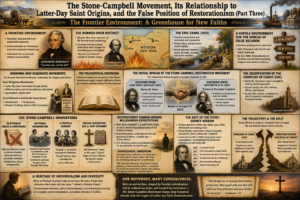
 The Frontier Environment: A Greenhouse for New Belief Systems
The wild West of the 1800s, then places like western New York, Kentucky, and Ohio, provided a unique ecosystem for religious innovation. Frontier life was physically disconnected from the accountability of already established biblical, doctrinal and practical roots. Individuals in these remote areas didn’t face the same obligation to report to true church authority. This democratization of Christianity mirrored the political spirit of the new American republic. The early 19th century was defined by “Jacksonian Democracy,” which prioritized common man over the elite, which included clergy.
Western New York became known as the “Burned-Over District” because the fires of revivalism had swept through so many times that there was no fuel left to burn. This area became the epicenter of what was labeled, the Second Great Awakening, a period of intense religious revivalism that fundamentally altered the American spiritual landscape. In this environment of constant religious fervor, people became exhausted by denominational infighting, which spawned a hunger for something pure or original.
The completion of the Erie Canal in 1825 transformed western New York from an isolated frontier into a bustling commercial corridor. This allowed not only goods but also radical new ideas and traveling preachers to move rapidly between towns like Rochester, Utica, and Buffalo. The sudden shift from subsistence farming to a market economy created a sense of social instability. People then looked to religion to find order and moral certainty in a rapidly changing world.
A Fertile Environment for the Spread of False Religion
The movement took off in this region also because it was populated by pioneers — people who had already left their homes, families, and traditions behind in the East. They were culturally predisposed to start fresh, making the concept of a New Testament only church highly appealing. By the late 1800s, Restorationism in its different iterations was the fastest-growing religious movement in the United States.
Influential revivalists like Charles Finney introduced “New Measures”—highly emotional, theatrical preaching styles and the “anxious bench” (a place for those considering conversion). This broke away from the elements of worship believed by churches with a true, orthodox ancestry. “Burned-Over District” was terminology coined by Charles Finney himself in his 1876 Autobiography. It was a metaphor based on some overlapping concepts.
In revivalist language, the “outpouring of the Spirit” was often described as a fire. Preachers aimed to set the hearts of their listeners “ablaze.” By the mid-1800s, Finney noted in his writings that the region had been swept by so many revivalist fires that there was virtually no one left to “convert,” meaning salvation decisions made in high pressure revivalist environments. The metaphorical fuel of unconverted souls in his surmisal had been burned off.
Spawning New Schismatic Movements
Just as a forest fire leaves the ground burned over and unable to support a new fire for some time, Finney expressed his feelings that the region had become desensitized. The constant cycle of emotional highs and intense religious pressure led to a landscape where people were either already converted in a Finneyesque manner or had become skeptical due to revival burnout. The Burned-over District became then a laboratory for American religion. The ground was so fertile for spiritual and psychological manipulation that it gave birth to several major movements and social reforms, including all of the following:
- New Religious Movements: The Latter Day Saint movement (Mormonism) began here with Joseph Smith; Millerism (the precursor to Seventh-day Adventists) flourished here; and Spiritualism (communicating with the dead) took off in Hydesville.
- The religious fervor didn’t just stay in the church. It fueled the Abolitionist movement, the Temperance movement, and the Women’s Suffrage movement — the Seneca Falls Convention took place right in the heart of the district.
One philosophical grounding of all of the movements emanating from the Burned-Over District was that centuries of tradition had corrupted the “True Church.” This led to Restorationism: the desire to bypass 1,800 years of history and restore the primitive church exactly as it appeared in the New Testament. The Stone-Campbell Movement, which produced the Churches of Christ (COC) and the Christian Church/Disciples of Christ was a new religious movement too, but it moved very quickly from consideration as a radical sect to a mainstream denomination.
The Initial Spread of the Stone-Campbell Restoration Movement
The Stone-Campbell Restoration Movement didn’t take off in a single city, but rather across the Upper South and Old Northwest frontier. It grew from two independent streams that eventually merged in Lexington, Kentucky, in 1832. The Southern spark of Cane Ridge, Kentucky (1801) was the Barton W. Stone stream, the Presbyterian who led the Cane Ridge Revival near Paris, Kentucky. The sheer emotional intensity and the cooperation between different denominations convinced Stone that human creeds were the only thing keeping Christians apart. He and his followers eventually dissolved their ties for “Christian only.”
The Northern spark of Western Pennsylvania & Virginia (1809) was the Thomas Campbell and his son, Alexander Campbell, stream, who were working in the tri-state area of Pennsylvania, Virginia (now West Virginia), and Ohio. Thomas Campbell published the Declaration and Address in Washington, Pennsylvania and Alexander Campbell did influential journals like the Christian Baptist and The Millennial Harbinger, which spread the movement’s ideas like wildfire across the frontier. From these two hubs, the movement swept further.
The Solidification of the COC in America
Nashville, Tennessee became a massive stronghold. Leaders like David Lipscomb, founder of Lipscomb University, solidified the movement’s presence here, and it remains a major center for the COC today. The movement also moved rapidly into Ohio, Indiana, and Illinois. The COC emphasis resonated with its idea of reading the Bible without needing a complex theology degree. St. Louis and the surrounding frontier served as a jumping-off point for the movement as it headed further West.
By the late 19th century, COC were widely recognized as one of the American Protestants, which would connect it to historical Protestantism. In contrast, those groups labeled as new religious movements often maintained a more distinct, separate identity for a longer period. However, if you define “New Religious Movement” as any religious group that started recently in American history, then the Stone-Campbell movement absolutely belongs in that category too. Many would contend that it does because it brings doctrinal innovation that breaks from evangelical orthodoxy.
COC Stone-Campbell Innovations
The Stone-Campbell movement did and does break from the biblical and historical doctrine of the perpetuity of the church, based upon scriptural presuppositions. It framed a gospel not before preached by biblical and historical gospel preachers of salvation by grace alone through faith alone. These are the innovations:
- The Rejection of Creeds and Confessions — Historical Christianity has long relied on creeds, confessions, or doctrinal statements to define truth and protect against heresy. The Stone-Campbell Movement rejected all human creeds as divisive shackles. They argued that if a creed says more than the Bible, it says too much; if it says less, it says too little; and if it says exactly what the Bible says, it is redundant. By removing these historical guardrails, they moved away from the historical church and toward a strictly individualistic, which is a private interpretation of the Bible.
- Baptismal Regeneration — Perhaps the most significant theological divide was over the role of baptism. Alexander Campbell taught that baptism by immersion was the literal moment when a believer received the remission of sins. He codified a process of salvation in steps: Hear, Believe, Repent, Confess, and be Baptized. The established doctrine of non-restored, already established true, biblical churches was baptism as an outward sign of an inward grace, something you do because you are already saved. The Stone-Campbell contradicted salvation by grace alone through faith alone.
- A Cappella Worship — This innovation eventually led to the 1906 split between the Churches of Christ and the Christian Church (Disciples of Christ). The COC argued that because the New Testament only mentions “singing” and “making melody in the heart,” but never mentions mechanical instruments, instruments are forbidden. This diverted from the historical worship of true churches and turned “silence” into a binding law. Most would argue that “making melody” (psallo, to pluck on a stringed instrument) isn’t silence (among other good biblical arguments). This was also another legalism clashing with grace.
- The Radical Distinction Between the Old and New Testaments — Alexander Campbell’s famous “Sermon on the Law” argued that the Old Testament, including the Ten Commandments and the Psalms, was nailed to the cross and had no authority over the Christian. By effectively discarding the Old Testament as a source of church law or practice, the movement created a “New Testament-only” theology that many compare to the old heresy of Marcionism. In the Stone-Campbell view, however, the church began on the Day of Pentecost (Acts 2), so that anything before that was Jewish and not Christian.
Thanks for this series. There is a lot of helpful information.
Thanks!