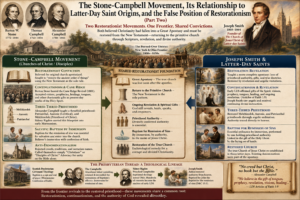
 Similarities surely exist between the Restorationism or Restorationist Movement in the dovetailing between the Churches of Christ (COC) Barton Stone and Thomas and Alexander Campbell and the Latter-Day Saints (LDS) Joseph Smith. The sameness revolves around the characteristics of the period in American history in particular the region from which both arose, the proceeding perceived necessity for restoration back to a primitive first century church because of total apostasy, and other crucially distinctive and agreed aberrant doctrines and practices.
Restorationist Conviction: Christianity Needed to Be “Begun Again”
Both movements were driven by the belief that the original Christian church had fallen into a “Great Apostasy” shortly after the apostolic era, requiring a full divine or scriptural restoration rather than mere reformation. At the same time and in the same region as LDS, Stone and Campbell sought to restore the apostatized church by returning to what they said was the New Testament as the sole blueprint. Saying you are “scriptural alone” and disavowing all creeds and traditions as human inventions provides a blank canvass to construct your own viewpoints.
Campbell famously called for the “restoration of the ancient order of things.” The COC and LDS leaders both claimed the mantel of the “primitive” pattern of Acts and the Epistles—simple, united, and free from denominational divisions. Stone’s Christians and the Campbells’ Disciples/Christians merged in 1832 largely on this shared restorationist platform. Joseph Smith taught an even more comprehensive apostasy: the early church lost priesthood authority, spiritual gifts, and true doctrine soon after the apostles died.
Through Alexander Campbell, Sidney Rigdon provided the blueprint for a priesthood apparently lost from the primitive church. For Joseph Smith, the restoration was not merely scriptural primitivism but involved new divine revelations, the return of angelic priesthood ordination. This would lead to the re-establishment of the true Church of Jesus Christ as a latter-day organization. Both COC and LDS saw contemporary Christianity as fragmented and corrupt, positioning their movements as the eschatological remedy. They used similar language of restoration and viewed themselves as fulfilling prophecy by bringing the church back into existence in its pure form.
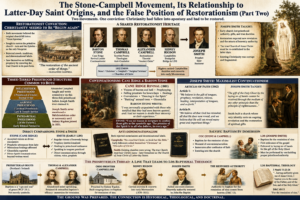
Three Tiered Priesthood Structure Common to the Beginnings of the COC and LDS
A three-tiered priesthood structure — Melchizedek, Aaronic, and Patriarchal — existed before Joseph Smith ever claimed to receive it. Alexander Campbell, one of the founding fathers of COC and Christian Church, discussed biblical priesthood categories in ways that made priesthood-restoration concepts culturally intelligible for Joseph Smith, especially through Rigdon’s mediation. Campbell wrote and preached extensively about restoring divine authority, a sentiment embraced by Smith, the talking points of which passed through Sidney Rigdon Campbell formed a structure of priesthood composed of:
- The Patriarchal Priesthood (associated with the early biblical fathers)
- The Levitical or Aaronic Priesthood (the law of Moses and temple service)
- The Priesthood of Christ (the eternal Melchizedek order)
These concepts are primarily addressed in general essays he wrote on the “Kingdom of Heaven” and his book, The Christian System. Not only did Sidney Rigdon bring into early Mormonism an abundance of converts, who formed the building block for the continuation of the movement, but also doctrines he already inculcated from Campbellism (see connection here in LDS material). Joseph Smith never mentioned a Melchizedekian order of priesthood as a necessity for his church until Rigdon joined in 1831.
The COC and LDS both annihilated the infrastructure of horizontal authority that existed with churches in the early 19th century. The continuationist dimensions of Barton Stone’s ministry — the charismatic phenomena at Cane Ridge and his openness to ongoing spiritual experience — draw him measurably closer to the spiritual world that Joseph Smith would inhabit a generation later.
What Is Continuationism and Why It Matters Here
Continuationism, Cane Ridge, and Barton Stone
Continuationism is the theological position that the charismatic gifts of the Holy Spirit described in the New Testament — prophecy, tongues, healing, visions, words of knowledge — did not cease with the apostolic age but continue throughout church history and into the present. Its opposite, cessationism, holds that these gifts were temporary scaffolding for the founding of the church and were withdrawn once the apostolic generation passed and the canon of scripture was complete. Barton Stone, one of the founders of COC was continuationist and Joseph Smith built an entire religious movement on a thoroughgoing, maximalist continuationism.
The Cane Ridge Revival of August 1801 was not merely a large camp meeting. It was, by any honest account, one of the most dramatically charismatic events in American Christian history, and Barton Stone was not a passive observer — he was its host, its primary organizer, and its most articulate theological interpreter. The physical and spiritual phenomena reported at Cane Ridge were extraordinary and well documented by multiple eyewitnesses, including skeptics.
Characteristics of Cane Ridge Continuationism
People fell prostrate and laid unconscious for hours, sometimes days, then arose with testimonies of visions and encounters with heavenly beings. Involuntary, violent physical convulsions seized both believers and scoffers alike, which witnesses reported could not be voluntarily produced or suppressed. They “danced in the Spirit,” where individuals moved in rhythmic, ecstatic patterns entirely outside their conscious control. They “barked,” where groups of people gathered around trees making animal sounds, which Stone interpreted as spiritual humiliation before God.
Most significantly, individuals reported seeing Christ, angels, heaven, and hell with vivid clarity. And prophesied, where ordinary men and women spoke forth what they believed to be direct divine messages.. Stone did not explain these experiences away, pathologize them, or condemn them as ecstatic or a disorder. He interpreted them as genuine works of the Holy Spirit — as evidence that God was directly, supernaturally intervening in human experience in ways that went beyond anything mediated by scripture or rational reflection. Stone wrote in his autobiography:
The scene to me was new and passing strange. It baffled description. Many, very many fell down as men slain in battle, and continued for hours together in an apparently breathless and motionless state, sometimes for a few moments reviving and exhibiting symptoms of life by a deep groan or a piercing shriek, or by a prayer for mercy fervently uttered. After lying thus for hours they obtained deliverance. The gloomy cloud that had covered their faces seemed gradually and visibly to disappear, and hope in smiles brightened into joy. They would rise, shouting deliverance.
Authentication by Barton Stone
And on the visions specifically, Stone did not merely tolerate them — he treated them as spiritually authoritative experiences, as genuine encounters with divine reality that produced transformed lives and theological conviction. He wrote:
I was personally acquainted with those who testified that they had seen heaven opened, and had witnessed the glories of the celestial world — and I had no reason to doubt their sincerity or their experience.
This comes from a man who professed commitment to the Bible as the sole written rule of faith. Stone held in tension two irreconcilable things: nuda scriptura on one hand,and the authority of personal visionary experience on the other. Barton Stone wrote:
I see no reason in scripture to confine these gifts to the apostolic age. The promise of the Spirit is to all who believe, in every age. If the church has lost these gifts, it is because of unbelief and worldliness, not because God has withdrawn the promise.
This placed Stone in striking proximity to the early LDS theological world, where the restoration of spiritual gifts was understood as a primary marker of the true church.
Trajectory from Stone to Smith
When Stone or Smith read Acts or 1 Corinthians, they could see that the “primitive church” acted with revelatory sign gifts, taking the restoration back further than what Alexander Campbell would cooperate with. From this foundation, Smith built a thoroughly continuationist ecclesiology. The LDS Articles of Faith, composed in 1842, state directly:
We believe in the gift of tongues, prophecy, revelation, visions, healing, interpretation of tongues, and so forth.
And Article 9:
We believe all that God has revealed, all that He does now reveal, and we believe that He will yet reveal many great and important things pertaining to the Kingdom of God.
This is continuationism as a defining institutional commitment. The church is constituted precisely by its access to ongoing revelation. Smith explicitly framed the restoration of spiritual gifts as one of the primary evidences that his movement was the true church, in direct contrast to what he saw as the dead formalism of existing Christianity. He wrote:
The world always mistook false prophets for true ones, and those that were sent of God they considered to be false prophets… The gift of the Holy Ghost by the laying on of hands cannot be received through the medium of any other principle than the principle of righteousness. . . . Whenever men can find out the will of God and know that they have complied with it, they will be ready to receive the gift of the Holy Ghost.
The Direct Comparisons Between Stone of COC and Smith of LDS
Stone accepted and defended the visionary experiences at Cane Ridge as genuine divine encounters, writing that individuals “saw heaven opened” and that he had no reason to doubt them. Smith’s entire prophetic career was built on vision — from the First Vision onward, he described regular visionary encounters with heavenly beings, including Moses, Elijah, Elias, John the Baptist, Peter, James, and John. The form of their religious experience — direct visual encounter with heavenly reality — is strikingly similar.
Cane Ridge produced prophetic utterances from laypeople, which Stone received cautiously but did not categorically reject. Smith institutionalized prophecy as a defining feature of the restored church, with himself as prophet, seer, and revelator, and with the gift of prophecy available to all members through the Holy Ghost. Stone’s openness to miraculous healing as a present possibility was part of his continuationist framework. Smith made healing a central feature of LDS practice, with the laying on of hands for the sick a standard ordinance from the earliest days of the movement.
The Cane Ridge meetings produced what some witnesses interpreted as glossolalia — ecstatic speech. The early LDS movement was explicitly charismatic in this regard, with speaking in tongues reported frequently in the Kirtland, Ohio period and treated as a genuine manifestation of the restored Spirit. Stone believed God communicated directly with the soul through the Spirit, beyond the mediation of the written word alone. Smith believed God communicated through audible speech, physical visitation, the Urim and Thummim, and a living prophetic office.
Theological and Philosophical Similarities, Early COC and LDS
The Atmospheric Ones
Smith grew up in precisely the religious environment that Cane Ridge had shaped. The so-called revivals of the Second Great Awakening that swept western New York in the 1820s — the region historians call the “burned-over district” — were direct descendants of the Cane Ridge tradition of camp meeting revivalism. The physical phenomena Smith described in his environment — the excitement, the emotional prostrations, the competing claims of various denominations to spiritual power — were the cultural inheritance of what Stone had helped unleash in 1801.
Joseph Smith’s own first religious experiences occurred in the context of Methodist revival meetings that bore the clear imprint of the Cane Ridge tradition. The theological hunger that drove people to Cane Ridge — the conviction that Christianity had become too formal, too rational, too creedal, and that God must be willing to speak and act directly in the present age — is the same hunger that Smith’s movement addressed and amplified. Cane Ridge demonstrated that there was an enormous popular appetite for direct, experiential, charismatic encounter with God.
Sidney Rigdon
Sidney Rigdon was the crucial connecting figure. Rigdon had been shaped by the Campbellite world; however, a Campbellite who believed Campbell had not gone far enough. His restorationism wanted the supernatural gifts restored, That longing, which was much closer to Stone’s Cane Ridge world than to Campbell’s rationalism, made him susceptible to Smith’s message. When the Mormon missionaries arrived in Ohio in 1830 with a message of restored gifts, restored authority, and direct ongoing revelation, Rigdon recognized something he had been looking for.
The middle position of Barton Stone makes him historically significant. He had seen and affirmed things at Cane Ridge out of a theology of the Holy Spirit which was open, experiential, and resistant to cessationist closure. Stone represented an unstable theological middle ground. The people in his movement who felt that pull most strongly toward the experiential, revelatory pole, when Sidney Rigdon told them about Joseph Smith, found something that completed what Cane Ridge had started.
Anti-Denominationalism and Refusal of Labels
Stone and Campbell and COC strongly opposed sectarianism. Early followers simply called themselves “Christians” (Stone’s group) or “Disciples of Christ” (Campbell’s). They refused creeds or denominational names, arguing that such labels divided the body of Christ. Alexander Campbell initially resisted even the name “Disciples of Christ” as too sectarian. Their plea was for Christian unity on the basis of the Bible alone (“No creed but Christ, no book but the Bible”).
Joseph Smith claimed the restored church should bear Christ’s name, later formalized as The Church of Jesus Christ of Latter-day Saints. Early LDS rejected existing denominations as products of the apostasy. Smith’s First Vision narrative reinforced this: all existing churches were wrong, their creeds an abomination. While they eventually developed a strong institutional identity, the early movement shared the frontier impulse against “man-made” religious parties.
Both COC and LDS started with a radical anti-sectarian ethos on the frontier, attracting people weary of competing denominations. Over time, both developed distinct identities and structures, but the initial impulse was to transcend or replace the denominational landscape.
Salvific Baptism by Immersion
Salvific baptism was a core shared practice between COC and LDS. Against the gospel preached in early 19th century United States, baptism for the remission of sins was central. Stone and Campbell saw this immersion as the moment of conversion/salvation when one entered the church, often accompanied by a simple confession of faith. This became a major point of unity between Stone and Campbell groups.
LDS also insisted on believer’s baptism by immersion (at age 8 or older for accountability) as essential for entry into the Church and for the remission of sins. It is the first ordinance of the gospel. The distinctive element is its linkage to the bestowal of the Holy Ghost by the laying on of hands (a separate ordinance) by those holding proper priesthood authority. Both COC and LDS elevated immersionist believer’s baptism far above the practices of the prominent Baptist preaching on the frontier.
The Foundational Presbyterian Understanding at the Beginning
Thomas Campbell was ordained in the Anti-Burgher Seceder Presbyterian Church in Ireland, and Alexander received his early theological formation in the same tradition. Along with Barton Stone, these two men had the greatest part in the foundations of the COC restorationist movement. Presbyterian theology had always taken seriously the idea that baptism does something — that it is not merely a symbol but a sign and seal with genuine spiritual significance.
The Westminster Confession of Faith states that in baptism “grace and salvation are not so inseparably annexed unto it as that no person can be regenerated or saved without it; nor that all that are baptized are undoubtedly regenerated.” This is a careful, qualified sacramental theology — baptism is genuinely connected to grace, though not mechanically or absolutely. The Reformed tradition as a whole had always resisted the teachings of Baptists on baptism, who rejected anything saving in the baptism, but instead symbolism of that salvation.
The Confusion of Baptism’s Efficacy in Salvation
When Alexander Campbell abandoned the Presbyterian mode and subjects of baptism — moving from infant sprinkling to believers’ immersion — he paradoxically retained and intensified the Presbyterian seriousness about baptism’s efficacy. He stripped away the covenant theology that justified infant baptism, but he kept and radicalized the conviction that baptism was a real means through which God works, not merely a human declaration about what God has already done. In this sense, his Presbyterian formation gave him resources for a high baptismal theology that pure Baptist theology resisted.
The Presbyterian tradition had also given the Campbells a very high view of the objective, external word of God over against subjective internal experience. For Presbyterians, assurance of salvation was notoriously difficult to achieve precisely because it was supposed to rest on God’s objective covenant promise rather than on internal emotional states. Campbell’s insistence that baptism for remission of sins provides the believer with a clear, objective, external basis for assurance — you know you have received forgiveness because you obeyed the command and were immersed.
How This Created the Bridge to LDS Baptismal Theology
The LDS doctrine of baptism shares significant structural features with the Campbellite position, and the connection is not merely coincidental — it runs directly through Sidney Rigdon and the hundreds of former Disciples who became the nucleus of the early LDS church in Ohio. LDS baptismal theology, as articulated in the Doctrine and Covenants and the Book of Mormon, holds that baptism by immersion is essential and commanded, that it is for the remission of sins, and that it must be performed by one holding proper priesthood authority. The Book of Mormon states in 3 Nephi 11:23-26, in words attributed to the resurrected Christ:
Verily I say unto you, that whoso repenteth of his sins through your words, and desireth to be baptized in my name, on this wise shall ye baptize them. . . . having authority given me of Jesus Christ, I baptize you in the name of the Father, and of the Son, and of the Holy Ghost.
And the connection to remission of sins is made explicit throughout. Both Campbell and Smith connected baptism explicitly to the remission of sins. Both treat baptism as a commanded, faith-filled act rather than either a Catholic sacrament or a Baptist memorial. Both connect baptism to the gift of the Holy Spirit as a subsequent, distinct blessing.
The Presbyterian Thread Pulled Through
A thread begins in Scottish Presbyterian covenant theology, runs through the Campbells’ rationalist biblical exegesis, produces believers’ immersion for remission of sins, and then flows through Rigdon into early LDS sacramental practice — and at each stage the thread is recognizable even as it is being transformed. The Presbyterians gave the Campbells a high view of baptism’s objective significance. The Campbells applied nuda scriptura to that high view and arrived at immersion for remission. Rigdon preached that Campbellite formula across Ohio and built congregations on it.
When Smith arrived with the Book of Mormon, those same congregations found a theology that shared the structure of what they already believed — believers’ immersion for remission of sins — but radicalized it by grounding it in restored heavenly authority rather than mere biblical command. The people who had been prepared by Rigdon’s preaching were, in a very precise sense, already halfway to the LDS position. They believed baptism by immersion remitted sins. Smith asked them to believe one additional thing: that the authority to perform it had to come from heaven.
The ground had been prepared, and the preparation runs in a direct line from the Presbyterian manse in County Down where Thomas Campbell first learned his theology, through the Ohio frontier where Alexander and Rigdon preached it, to the moment in the Susquehanna River where Joseph Smith and Oliver Cowdery claimed to have received from John the Baptist himself the authority to baptize for the remission of sins.
More to Come