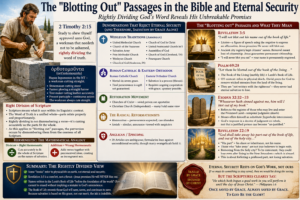
 In 2 Timothy 2:15, the Apostle Paul writes under the inspiration of God:
Study to shew thyself approved unto God, a workman that needeth not to be ashamed, rightly dividing the word of truth.
The Greek term translated “rightly dividing,” ὀρθοτομοῦντα (orthotomounta) is a hapax legomenon (once said or used) in the New Testament. It does appear in the LXX (Proverbs 3:6; 11:5) in the sense of making a straight path. The image is of a craftsman — a stonemason cutting stone, a farmer plowing a straight furrow, a tent-maker (Paul’s own trade) cutting leather accurately along a line. The present participle indicates continuous, ongoing action — the workman always cuts straight. The straight cut demanded by this word has several non-negotiable implications for handling the whole Bible.
Right Division of Scripture
Much could be said on this subject, but I’m relating it to “blotting out” passages, as pertaining to eternal security. Scripture is not a flat book randomly arranged. The text says what its words mean only within their linguistic context. Also, “the word of truth” (τὸν λόγον τῆς ἀληθείας) itself is a unified whole. Rightly dividing is not dismembering a verse or passage — it is cutting accurately so the parts also relate properly and proportionately. As this applies to “blotting out,” the perversion of those verses or passages occurs by means of the dismembering that proceeds from not conforming them to the cohesive oneness of all scripture.
The right and wrong hermeneutic (view or method of interpretation of scripture) one might compare to a mathematical analogy: division, the right hermeneutic, and addition, the wrong one. Division obviously corresponds to Paul’s “rightly dividing.” Thomas and Alexander Campbell, the 19th century restorationists who said, ‘speak where scripture speaks and silent where scripture is silent,’ read their preconceived understanding into places where it is not in fact ‘speaking.’ Rather than dividing the scripture to fit the whole on the nature of salvation, they added everything into an incongruent mix to alter their thinking on eternal security.
Denominations That Reject Eternal Security (and Therefore, Salvation by Grace Alone)
Quite a few denominations, who embrace adding works to grace or works salvation, reject eternal security.
- Wesleyan Traditions — These represent the largest and most theologically consistent body of Christians who reject eternal security, rooted in the soteriology of Jacob Arminius (1560–1609) and John Wesley (1703–1791):
- United Methodist Church — salvation can be lost through persistent, willful apostasy
- Church of the Nazarene — Wesleyan-Holiness; believers can “fall from grace”
- Salvation Army — Wesleyan in doctrine; genuine apostasy is possible
- Free Methodist Church — same Wesleyan framework
- Wesleyan Church — explicit rejection of “once saved, always saved”
- Church of God (Anderson, IN) — Holiness-Wesleyan tradition
- Church of God In Christ — salvation lost through intentional unholiness, persistent backsliding, and total abandonment of faith in Jesus Christ
- United Pentecostal Church International — continuous obedience and faithfulness required to remain saved.
- Assemblies of God — Pentecostal but Arminian; official position is that salvation can be forfeited
- Church of God (Cleveland, TN) — Pentecostal-Arminian
- Foursquare Church — Pentecostal, Arminian soteriology
- Roman Catholic and Eastern Orthodox — Both reject eternal security, though for reasons distinct from Arminianism
- Roman Catholic Church — mortal sin severs the state of grace; the sacrament of penance restores it. Final perseverance is a gift not guaranteed to any individual.
- Eastern Orthodox Church — salvation is a process (theosis) that requires ongoing cooperation with grace; apostasy is genuinely possible.
- Restoration Movement
- Churches of Christ — generally hold that a saved person can apostatize through sin or unbelief
- Christian Church (Independent) — varies, but many hold the same position
- The Radical Reformationists
- Mennonites — generally reject eternal security; faithful perseverance is expected and possible to abandon
- Amish — similar to Mennonites; assurance of salvation is actually viewed with suspicion as presumption
- Some General and All Free Will Baptists — The Mennonites and Amish relate to these historically, proceeding from the Protestant Reformation.
- Anglican / Episcopal — the 39 Articles are ambiguous and the tradition contains both views; the official formularies lean against unconditional security, though many Anglican evangelicals hold it.
The “Blotting Out” Passages and What They Mean
- Revelation 3:5 — “He that overcometh, the same shall be clothed in white raiment; and I will not blot out his name out of the book of life, but I will confess his name before my Father, and before his angels.”
- This is a litotes—a figure of speech where an affirmative is expressed by the negative of its contrary (e.g., saying “not bad” to mean “very good”).
- Jesus isn’t warning that He might blot names out; He is giving an absolute, ironclad promise that He never will.
- In the ancient world, a city registry (a “book of life”) was where citizens’ names were kept. If you committed a crime or died, your name was removed. Jesus is telling the believer that their “heavenly citizenship” is permanent and immune to the earthly threat of erasure.
- “I will never blot you out” is a rhetorical way of saying “Your name is permanently engraved.”
- Psalm 69:28 — “Let them be blotted out of the book of the living, and not be written with the righteous.”
- The Book of the Living (earthly existence) and the Lamb’s Book of Life (eternal salvation) are not the same book.
- In the Old Testament, being “blotted out of the book” almost always refers to physical death. David is praying an imprecatory prayer, asking God to judge his enemies by ending their lives prematurely so they can no longer harm the righteous.
- This isn’t about losing salvation; it’s a plea for the wicked to be removed from the land of the living. Since they were never “enrolled among the righteous” to begin with (as the second half of the verse suggests), they aren’t losing a salvation they never possessed.
- Exodus 32:32–33 — “Yet now, if thou wilt forgive their sin–; and if not, blot me, I pray thee,, out of thy book which thou hast written. And the LORD said unto Moses, Whosoever hath sinned against me, him will I blot out of my book.”
- Moses offers his own life (and potentially his soul) as a substitute for Israel’s sin. God responds then with the blotting out verse.
- Like the Psalm above, this refers to the register of those allowed to live and enter the Promised Land, so God is refusing Moses’ substitution and declaring that the generation that sinned will die in the wilderness (physical death).
- Moses is using hyperbolic language of intercession (similar to Paul in Romans 9:3).
- God’s response is a decree of temporal judgment on rebels, not a statement that a truly justified person can become “un-justified.”
- Revelation 22:19 — “And if any man shall take away from the words of the book of this prophecy, God shall take away his part out of the book of life, and out of the holy city, and from the things which are written in this book.”
- Taking away “his part” or a share in the tree of life communicates that the person loses the opportunity or the inheritance they claimed to have. The word “part” distinguishes what it says from saying that someone has his name removed or erased.
- Those who “take away” from God’s Word are not true believers to begin with, so their “part” is their professed part in the community, which is proven false by their rejection of the Word. Again, the word “part” is crucial to this.
- One should consider the idea of someone being removed from the holy city, once in the holy city, which is the New Jerusalem, if this is about losing salvation. To be consistent, he could also continue with the possibility of losing salvation even after he lives in the New Jerusalem. That’s not what it says.
Summary of Rightly Divided View or Answer
Some of the books in this realm of the book of life refer to physical life on earth, not eternal soul-security. In Revelation 3:5, the mention of blotting out is a comfort, not a threat—it emphasizes the impossibility of a believer being removed. If the names were written in the Lamb’s Book of Life “before the foundation of the world” (Rev 13:8), it would imply a mistake in God’s omniscience if He later had to reach for the eraser. The “Book of Life” is a record of those God will save, saves, and then continue to save, and because that choice is based on His grace rather than our merit, the ink is indelible.
The permanent writing of a name in the Book of Life harmonizes with the way salvation reads in the New Testament. God is doing the saving and if we need to do something to stay saved, it would then be us doing the saving. This is the way scripture reads about it.
There are Baptists who also hold to the possibility of a Christian forfeiting salvation.
The General Baptists, who does not believe in Limited Atonement, usually also believe in the possibility of apostasy.
The Free-Will Baptist is another group.
Of course, the Anabaptists, from whom many Baptists claim spiritual linkage also generally believe in possibility of forfeiting salvation, such as Balthasar Hubmaier.
Although many Baptists were subsequently influenced by Calvinism, but there are names such as Thomas Helwys and Thomas Grantham.
Rev. 3:5, “He that overcometh . . . I will not blot out his name out of the book of life”
The construction is a promise, but we can rightfully conclude that the one who does not meet the condition of the promise, will not get the promised reward, without that being specifically spelled out.
In other similar constructions:
John 6:54 “Whoso eateth my flesh and drinkieth my blood, hath eternal life; and I will raise him up …”
Valid conclusion: Whoso does not eat .. and does not drink .. does not have eternal life and Jesus will not raise him up.
John 14:21 “He that hath my commandments, and keepeth them, he it is that loveth me:”
Valid conclusion: He that does not have and keeps not the commandments, does not love Christ.
These examples can be multiplied. These are valid conclusions, even if they may not be spelled out in the very same verse.
Therefore, from Rev. 3:5, speaking to Christians, he that does not overcome (does not have faith that endure to the end), will have his name blotted out.
Much blessings to you,
Christopher
Hi Christopher, It is true that those who call themselves “Baptists,” the examples you gave, do believe that someone can lose his salvation. I did not include them, even as I don’t believe historical Baptists reject eternal security. I will add them to the list here at some point. Thanks!
Related to Revelation 3:5, concluding the inverse is a logical fallacy. It is called the fallacy of the inverse, also known as “denying the antecedent.” A simple secular example illustrates why:
“If it is a dog, then it is a mammal.”
Inverse: “If it is NOT a dog, then it is NOT a mammal.” Clearly false.
On the John 6:54, only saved people have eternal security, it is true. It’s true that if someone does not believe in Jesus, which is what it is not to eat of his flesh and drink of his blood in that context, he does not have security from that. I don’t know how John 14:31 applies, because it is a definition, not a conditional promise. Jesus is defining what loving Him consists of.
Nothing said here debunks what I wrote on this subject. Thanks though.
Just as a historical matter, I don’t know of a direct quote of Hubmaier that shows he rejected eternal security. I believe he was a rebaptizer, non Protestant or Catholic, but when he died early with a martyr’s death, he wasn’t fully squared away doctrinally. Regarding the general Baptists, I’m not arguing against that historically and the general Baptist men you provide. This isn’t my view or belief about Baptist History, but again, I concede the point. A group called, Freewill Baptists, arose from general Baptists, who rejected this true doctrine, and I don’t see them in the lineage of true Baptists, but they should be included in the list of those who don’t believe in eternal security.
Well, some historical Baptists do reject Unconditional Eternal Security.
As for Rev. 3:5, I am not arguing based on a logical necessity, like in a mathematical logical, but a theological conclusion based upon a statement in Scripture.
John 6:54 and 14:31 were used merely to supply similar sentence structures. But there are many examples even closer to home, as to each of the 7 churches, the Lord Jesus gave promises. Each one has the same pattern:
He that overcometh… I will….
To Ephesus (2:7)
(A) He that overcometh… I will give to eat of the tree of life (B).
Now, we can play a strict logical game and say: well it’s a logical fallacy to say that he that does not overcome (not A), Jesus will not give to eat of the tree of life (not B). From a mathematical logic, true enough. But what about the theological truth? What kind of information does God want to give? Or conclusions for us to take?
Yes, we can affirm that those who do not overcome, will not eat of the tree of life.
Or do you dispute this conclusion?
We can go down each of the 7 promises.
He who overcometh shall not be hurt of the second death.
Valid conclusion: he who does not overcome, will be hurt of the second death.
He that overcometh, I will give eat of the hidden manna.
Valid conclusion: he who does not overcome, will not be given to eat of the hidden manna.
I don’t need to list all of them.
So, why is it only on Rev. 3:5:
He that overcometh, I will not blot out his name out of the book of life.
That the conclusion is not then: He that does not overcome, Jesus will blot out his name out of the book of life?
Believing verbal plenary inspiration, there must be a reason why God inspired the words “blot out” instead of other terms.
May the Lord bless you,
Christopher
Hi Christopher,
Are you Baptist? True New Testament churches, separate from a state church, i.e., historical Baptists, believe in eternal security. These general Baptists don’t fulfill this distinctive of true New Testament churches, separate from a state church. That is my point, but I do agree with you — I give you that — that these groups did teach something against eternal security and I will reflect that in the post some time today, because of your mention. Thank you.
I read the gigantic volume many years ago, The Believer’s Conditional Security by Daniel Corner, so I know the position and have read the arguments. They were not convincing, but I was open to it. Scripture teaches eternal security, which I like better than unconditional or conditional security as a designator. The Bible would contradict itself with a conditional security position.
Regarding Revelation 3:5, the inverse isn’t logical and the Bible is always logical. God created the laws of logic. God will never be illogical. Romans 12:2 uses the Greek word, logikos, to describe true worship, translated “reasonable service,” but “reasonable” is logikos. You cannot logically conclude the inverse, and that is scriptural. You take what the verse says, and that is what is scriptural, not the inverse. Someone is missing the point, when he attempts to make a point from the inverse rather than what the verse says. The verse gives security, not takes away from it.
John 6:54 and 14:21 are not the same. The context of John 6:54 explicitly states the inverse (v. 53), but the verse itself is saying that someone must receive Jesus Christ to have eternal life. If you don’t receive Him, you won’t have it. John 14:21 is definitional, so it isn’t the same either in its structure. “He it is” is the critical difference in the structural difference. For 14:21, it is he and only he who keeps commandments who loves the Lord. That is definitional and not conditional.
The reason that those who do not overcome will not eat of the tree of life is because they were never saved in the first place. The structure there is identical to Revelation 3:5, where logically it teaches one thing. It identifies who receives the promise, but is completely silent about those outside the condition. This is important. The point of the verse is not the inverse and it is making that point. It cannot, because that would be illogical. It also is theologically incorrect.
Those are in fact not valid conclusions in your list of 7. They are invalid. It is not only Revelation 3:5. I believe in verbal plenary inspiration. In other words, I take my doctrine from the words, not from the inverse or from illogical, invalid conclusions. That’s not how to rightly divide scripture. It is wrongly dividing scripture. I appreciate your coming here to argue, but you should be willing to concede like I am with your list of general Baptists and free-will Baptists. I missed those. You are correct. I don’t think they are historical Baptists, just like with the seventh-day Baptists, but for a different reason, but I concede that they don’t believe in eternal security. The problem as I see it is that you go into these passages with presuppositions about what the Bible teaches, which someone told you, so that you put it in so that you can get it out. It’s not there on its own.
I concede that I have not communicated my points very well, and maybe I did not choose the correct analogies.
Let me put it this way:
As for Rev. 3:5, you said: “the inverse isn’t logical and the Bible is always logical. God created the laws of logic.”
I can see now, we are talking past each other because of the confusion of the term “logical”, which can carry different connotations.
I believe the meaning you are aiming for is: “the inverse is not logically NECESSARY.”
Something can be true without it being necessarily true.
For instance, it can be true that Mr. A is married to Mrs. B, without it being anything close to a logical necessity. Mr. A could have been married to any number of others. Even in Rom. 12:1, which you mentioned (not 12:2), our service to God is logikos, meaning reasonable, but not in the sense of something that will necessarily always happen (else it would not need to be admonished).
Also, if a king makes the following statement: The person who fulfill my requirements, I will marry him to my daughter. Now, while it is not NECESSARILY true (strictly from a linguistic point of view) that one who does not fulfill the requirement will not marry the princess, but nonetheless, it can be factually true (knowing the character of the king, etc.) that the one who does not fulfill the requirement, will not marry the princess.
Furthermore, yes, we can speak of Rev. 3:5, and the other 6 promises to the churches in Revelation, as a conditional, but it is implicitly conditional, not explicitly. The structure uses a participle instead of the explicit “if”.
But if it is implicitly conditional, what is it implicit for? Two options:
1. If A then B. (We were discussing this)
2. If A and only if A, then B. In which then, it is logically valid and necessary that If Not A, then Not B.
Originally, I went along with option 1, but delving further, it makes much more sense that the promise is implicitly option 2: If one overcomes, and only for the one who overcomes, then I will….
I don’t see how you can deny this.
Surely, only the one who overcome gets to eat the tree of life, gets to eat of the hidden manna, gets to have his name not blotted out, to be made a pillar in God’s temple, or granted to sit at Christ’ throne.
Surely, the one who does not overcome, doesn’t get any of these promises.
I don’t get how you can say that that’s an invalid conclusion. Are you saying people who do not overcome can get the blessings that God promised to those who overcome? Tell me that’s not what you are saying, because it sounds like it.
Now, you can define the one who overcome and the one who does not overcome in a certain way. Our discussion has not gotten to that point. I am merely making the point that it is valid to conclude: One who does not overcome, can have his name blotted out, as a valid inverse of the statement in Rev. 3:5.
I am a Baptist. I have also heard of Corner’s book, but I have not read it, and I don’t plan to. From little snippets, I suspect I won’t agree with him either.
One of the major verses that got me to my position today is 2 Corinthians 11:1-4, where Paul talked to saved people (espoused to Christ, language of salvation), about the danger of them being beguiled like Eve, and that danger coming from false gospel, false christ, false spirit. Now, a false gospel and a false christ, is damning, Paul vehemently averred so in Galatians and other places. So, a person espoused to Christ, is still in danger of being corrupted from Christ, through a false gospel, or else the whole warning is useless. This means, that one can forfeit a true faith in Christ. And the Bible is clear that without faith, one cannot be saved.
That’s not the only passage, but for myself one of the clearest. From there, many other passages of course makes much more sense from a view point of possibility of forfeiting faith.
May grace and truth abound in you,
Christopher
Hi Christopher,
“I don’t see how you can deny this” is not an argument, especially when I’m explaining how I can deny it in a very explicit way. You do see how I can deny it. I’m very open to what your saying being right. Instead of admitting where you are wrong though, which you are, you just double down as if it was your inability to explain something or my inability to get the obvious. You start by saying that you “concede” that you aren’t explaining it very well. That is conceding nothing. When the inverse is illogical, you cannot conclude it. You say, “No, you conclude it anyway.” I should just accept it anyway or I’m denying the obvious. The logic of not concluding the inverse is what is obvious to me and I explain the problem. It also completely corresponds to a biblical view of salvation. Someone is not justified by overcoming. Justification is by faith, not by works. However, overcoming is the expected outcome of justification. In other words, truly saved people will overcome, and that’s one way how they know they’re saved. You are saying, if someone stops overcoming, he loses it or walks away from it. You are saying, overcoming is a condition for salvation. This contradicts the rest of scripture. Cease from your own labor. He will give you rest. I reject that and so should you. That turns salvation into a process, which it isn’t. God does the saving, not us. And we are kept by the power of God, not by our ability to overcome. This is communicated completely in Revelation 3:5 and instead of taking it for what it says, you put the emphasis on the inverse, which you cannot conclude, because it is invalid or defies the laws of logic.
Then you try to explain away “reasonable service” by saying essentially that things are not always logical because people sometimes do not do the logical thing, which is why Paul admonishes it. That is a terrible twisting of what Rom 12:1 says with “reasonable service” (logiken latreian). Brethren offering their bodies as a holy, acceptable to God, act or acts of worship is logikos. Always. Sure they weren’t doing it, but he’s not saying, sometimes it is illogical to do that. No, it is always logical, which means it comports with the truth or reality or true to the real or factual nature of things. That’s what logikos means.
On 2 Corinthians 11:1-4, Paul’s espousing of them to Christ does not imply the salvation of every one of those in the Corinth church, which is why he commands them to examine themselves whether they be in the faith in 2 Corinthians 13:5. In the New Testament, letters written to churches by Paul, he addresses them by their collective identity. When Paul says, “I have espoused you to one husband,” he is speaking of his missionary work in planting the assembly there and setting it apart exclusively for Christ. While positionally we are married to Christ by an unbreakable legal covenant, practically we are living in the waiting period where false teachers try to defile our devotion.
“You” is plural in verse 2, not singular. He is speaking of his bethrothing the church there as a whole. Paul is addressing the corporate body at Corinth, not giving an individualized warning about losing personal salvation. Paul was clear again and again on eternal security. The truly elect are positionally joined to Christ by an unbreakable covenant. Practically, however, the church, the corporate body (Paul addresses the whole church), lives in an earthly engagement period where false teachers threaten to defile its devotion. If a church fails to guard its purity, it does not mean Christ divorces His true elect. Rather, it means that a visible congregation risks compromising its testimony, ultimately revealing that many of its professing members were never genuinely part of the bride to begin with. Paul acts as the paranymph (the bridegroom’s friend). His job was to present a chaste church, very much like he talks to the church at Ephesus. This is the historical, grammatical, and contextual way of understanding this. Paul isn’t acting as the husband (Christ) or the father, but as the trusted, fiercely protective good friend who is terrified that the bride is being seduced by false teachers before the Groom returns to claim her.
I’m sad for your having been deceived on this idea of “forfeiting faith.” It’s very bad. With this doctrine, you make Christ no effect unto you, His work profits you nothing, and you become a debtor to do the whole law.
Dear Kent,
You have missed my argument all along, which is this: if you deny the inverse, then that means you affirm that persons who do not overcome, can inherit the promises of God. Also, you skipped my contention that these verses are best to be understood as:
If A and only if A, then B. Which makes it perfectly logical, that if not A, then not B. Maybe you don’t have an answer to that, which is why you skipped it.
Let me make it even more clear and obvious:
Rev. 3:5 has 3 promises for the overcomer: 1) shall be clothed in white raiment; 2) will not have his name blotted out of the book of life; 3) Jesus will confess his name before the Father and angels.
If overcomer (A), and only if overcomer (A), then B (3 promises).
Inverse is true: If not A (not overcomer), then not B (does not get the 3 promises).
For you to deny the inverse, you would have to say that someone can be not an overcomer (not A), but still get the 3 promises of God (B).
Are you willing to say that? That is my point, that is my argument, that is my “reasoning” which you somehow missed, and said that I only conclude without any argument.
So, for the record then, are you saying that someone who does not overcome, will get white raiments, will not have his name blotted out, and will be confessed by Jesus? Is that what you are saying? Because denying the inverse leads to that.
So, if a person who fail to overcome, will not get white raiment, and will not be confessed by Jesus before the Father, then it is also very very logical to conclude that he can have his name blotted out of the book of life. It’s all in the same sentence and promise.
You have put words in my mouth about what I think overcoming is. “Justification is by faith, not by works.” 100% agree. See, we agree that the matter of a person having faith and another person not having faith, is not a matter of works. Faith is not works. Overcoming, just like justification, is by faith (1 John 5:4). I have not said anything about works, but you conclude that and put that in my position, because your worldview is that anyone who holds the possibility of apostasy is a work-for-salvation guy. Which is false, utterly false. The one who overcome is the one who has faith, until the end. The one who does not overcome is the one who does not have faith, until the end. Works has nothing to do with it, except as a result and proof of faith.
Is faith a human response to God’s drawing, or is it something God unilaterally and automatically installs and maintains in a person? Faith is a human responsibility, without it being a meritorious work. And if faith is a human responsibility (not a unilateral working of God), then a person can fail to have faith or fail to continue to have faith. I’m sad if you cannot see this.
In Corinthians 11:1-4, Paul is indeed talking to a plural audience. But he treats them as espoused to Christ. He does not treat them as a mixed multitude. He does not say: I think some of you are espoused, and some maybe not. That’s your take on it, to protect your doctrine, but Paul did not say that. Paul explicitly said: I am speaking to persons espoused to Christ here. And I am afraid that some of you (who are espoused to Christ, he is not speaking to those not really espoused to Christ), could become corrupted from Christ by false gospel and false christ. Of course Paul is not the groom or the father, or whatever. That is irrelevant. Paul is speaking the truth. In fact, Paul specifically said that these saved (espoused) Corinthians, have not originally accepted another gospel or another spirit (v. 4), which means that they have accepted the true gospel and the true Spirit. But now they are in danger of a false gospel. So Paul still has to fear for a person who has received the Gospel, and has received the Holy Spirit, that they might be corrupted from the simplicity in Christ, led astray by false gospel and false christ. It’s actually very clear when read without theological prejudice.
I apologize if my tone sounds harsh, the written media often lack nuance in tone. I am trying to keep our conversation cordial.
Much blessings to you,
Christopher
Hi Christopher,
I really did answer your “argument” because you are still concluding the inverse, which it is not valid to conclude. In other words, I already answered it. I will write to your words though. The argument smuggles in “and only if” without textual justification. Notice what you do.
First, “If overcomer (A), and only if overcomer (A), then B”: That “and only if” is the entire weight-bearing assumption — and it is not in the text. It is being added by you, which is ironic in a book that warns against adding or taking away. The text says: “He that overcometh shall…” Not: “He that overcometh, and only he that overcometh, shall…”
Your argument assumes that each promise has exactly one qualifying condition — but that is a theological assumption on your part, not something the grammatical structure of the promise itself establishes. You are assuming things that the verse itself does not say, which is arguing not from the text, but from silence. As a way to prove this to you, Christopher, consider Revelation 2:7 and 22:14. It is not if and only if one overcomes, when you read Revelation 22:14, which says, “they that do his commandments.” I do expect you to keep going with this, not out of deference to the truth, but to your own opinion. When someon says, “Grace and truth to you,” like you do, grace is not by works, and truth is what scripture says, not what it doesn’t say. You are neither grace nor truth with this “argument.”
Again, I answered what you said and I answered according to what the text says, not its inverse, which it doesn’t say. I am not saying that someone will be in the book of life if he does not overcome. What I am saying is that someone in the book of life will overcome. He will. You are saying, he may not. In the end, you will get to an open theism position, where God doesn’t know this or can’t know this. He is omniscient. He can say anyone who is in the book of life will overcome.
I’m not putting words in your mouth. You are advocating for adding works to grace, which is salvation by works. If you have to do good works to “stay saved,” that is you working for salvation. I hold to the possibility of apostasy and I’m not a works salvation guy, so it isn’t the denial of apostasy, but how one defines apostasy. Apostasy is not someone already justified, who then walks away from it, that is someone in Christ who could become out of Christ. He can’t and won’t walk away from it (see 1 John 2:19 and 3:6). Someone born of God cannot become unborn. Apostasy is someone who has received full revelation of the truth without justification, which includes intelectual assent or just emotional assent, and then turns away from it. I have much more to say about apostasy, but that’s the basic of it. Someone will not lose saving faith, a faith that saves, which is of God, which he does obtain (2 Peter 1:1-2). 1 Peter 1:3-4, says that once people are begotten to their inheritance, it is reserved (perfect tense) in heaven for them, that is, the reservation cannot be canceled.
True salvation is individual salvation. On 2 Cor 11:1-4, membership in the espoused community is not a gurantee of individual salvation. It’s true, this is the position that fits with everything else Paul says, which is how someone interprets scripture grammatically and historically, comparing scripture with scripture. You make the accusation that this is my fitting 2 Corinthians 11 into some preconceived false doctrine. In fact, Paul teaches eternal security everywhere, so you would assume he will not deny that here. I’m still though looking at the actual words of the text. When Paul says, Israel shall be saved in Romans 11:26, does that mean every individual Israelite shall be saved? He is careful in Roman 9-11 to argue against that.
The operative word is “that I may present you” — this is future tense. The espousal is a betrothal, not yet a consummated marriage. Paul is describing: (1) A present status (betrothed), and (2) A future goal (presentation as a chaste virgin). Betrothal in the ancient world carried real obligation and status but was not identical to the completed marriage. The outcome is still in view, not yet secured. And that applies only to the church as a whole, hence the plural “you.” Addressing the church corporately is a common Old Testament literary device. Corporate status did not and does not automatically confer individual status. Church membership is not salvation.
Concluding that everyone in the Corinthian church is saved from this passage would be the same logical error as concluding that every betrothed woman in the ancient world was guaranteed to complete her marriage. The betrothal established a real and meaningful relationship — but the text itself, in the very next breath, acknowledges the relationship could be compromised before completion. Corporate espousal and individual guaranteed salvation are simply not the same thing.
Jesus had warned against this in the parable of the tares and the wheat in Matthew 13. The tares Jesus describes are visually indistinguishable from wheat in early growth and only become identifiable at maturity. The two, tares and wheat, are all in the same field, growing up together. This maps directly onto the Corinthian situation where: all members appeared to be part of the espoused community, Paul could not be certain every individual was genuinely Christ’s, and external membership in the betrothed community did not settle the individual question. I could say way more on this and it is completely, 100 percent consistent, with everything the Bible teaches about salvation, unlike what you are saying.
Dear Christopher,
Please consider the New Covenant/Testament:
Hebrews 8:8 For finding fault with them, he saith, Behold, the days come, saith the Lord, when I will make a new covenant with the house of Israel and with the house of Judah:
Hebrews 8:9 Not according to the covenant that I made with their fathers in the day when I took them by the hand to lead them out of the land of Egypt; because they continued not in my covenant, and I regarded them not, saith the Lord.
Hebrews 8:10 For this is the covenant that I will make with the house of Israel after those days, saith the Lord; I will put my laws into their mind, and write them in their hearts: and I will be to them a God, and they shall be to me a people:
Hebrews 8:11 And they shall not teach every man his neighbour, and every man his brother, saying, Know the Lord: for all shall know me, from the least to the greatest.
Hebrews 8:12 For I will be merciful to their unrighteousness, and their sins and their iniquities will I remember no more.
Please note that both forgiveness of sins and a new heart that guarantees walking in God’s way are promises in God’s covenant. God promises and gives both.
Dear KJB,
What a blessing this new covenant is. In your opinion does getting a new heart that guarantees walking in God’s way, means that a Christian cannot fall into sin.
If he can fall into sin, how is that walking in God’s way?
Thank you,
Christopher
Hello Christopher!
It doesn’t matter what my opinion is on the New Covenant. But the actual words of the text say:
I WILL put my laws into their mind, and write them in their hearts: and I WILL be to them a God, and they SHALL be to me a people: … For I WILL be merciful to their unrighteousness, and their sins and their iniquities will I remember no more.
When God writes His law in your heart you are certain to be different. Before the new birth sin is written on your heart with a pen of iron and the point of a diamond (Jer 17:1, 9) but when you enter into the New Covenant God writes His law there instead and causes you to walk in His way.
Scripture does not give an exact line about how far someone can go in sin when God has written His law in that person’s heart. Sanctification is still a struggle and a process (Romans 7:14-25), and believers are not completely free from sin until heaven (1 John 1:8-10), but they are 100% guaranteed to be different.
Once saved, always saved from hell.
Once saved, always saved from the power and dominion of sin.
The difference is what you see in Judas and Peter when they sinned. One hanged himself and the other went out and wept bitterly. Peter was in the New Covenant. Judas was not.
I’m not going to have time to comment more. But you can watch this:
https://www.youtube.com/watch?v=pLrX185FV1Y&list=PLo8hPX0f2leaVxbxqdjVhmXqpdaveZ-ul&index=3
to see a fair debate between proponents of eternal security and those who think that God rejects some of His adopted and redeemed children and tortures them forever.
Thank you.
Many General Baptists believed in eternal security–and even in irresistible grace and unconditional election. All that made them “general” was denying limited atonement like the Particular Baptists. See, for example, the General Baptist Orthodox Creed.
I agree but I also have to admit I found General Baptists that gave plain statements that they could lose their salvation. I agree with you. I changed my post to admit that some general Baptists, and especially free will Baptists did not believe in it. I don’t agree on Hubmaier though, and that is unproven.
Dear Bro Brandenburg,
Yes, there were certainly some General Baptists who denied eternal security, and there were also some that went into total apostasy and became rationalists or Unitarians. But not all of them denied eternal security, and not all of them went into total apostasy, either.
Some of them certainly were Arminian, but not all of them were, and when they put out a confession of faith, it wasn’t Arminian.
“He that overcometh, the same shall be clothed in white raiment; and I will not blot out his name out of the book of life, but I will confess his name before my Father, and before his angels.”
— Revelation 3:5
Let us look at the verse according to the eternal truths of the Holy Bible, contextually and grammatically.
1. The Context Is the Church at Sardis
Christ is addressing:
i) a local church, with mixed conditions,
ii) where many had:
a name that they lived,
but were spiritually dead (v.1).
Yet notice carefully:
“Thou hast a few names even in Sardis which have not defiled their garments…” (v.4)
So the context already distinguishes:
– mere profession,
– from genuine overcoming believers.
2. “He That Overcometh”
This is critical.
Who is the overcomer?
The Bible defines this already:
“For whatsoever is born of God overcometh the world…”
(1 John 5:4)
and:
“Who is he that overcometh the world, but he that believeth that Jesus is the Son of God?” (1 John 5:5)
According to Scripture:
the overcomer is the true believer.
Thus Revelation 3:5 is not threatening loss of salvation.
It is describing the certainty and blessings belonging to the genuine believer.
3. “I Will NOT Blot Out His Name”
This is a promise of security, not insecurity.
The wording is:
“I will NOT blot out…”
Christ is reassuring the overcomer.
It is similar to saying:
“I will never leave thee.”
The emphasis is assurance.
4. The Verse Does NOT Say:
“If he fails, I will blot him out.”
“A saved man may lose salvation.”
“Your salvation depends on works.”
Presupposition inserts that into the text.
The verse is framed positively:
– promise to the overcomer,
– not a threat to the believer.
Once again, the scriptures never contradict. It should be obvious to those who study the scriptures to understand that a true believer has eternal life. He can never lose what he never earned. The only conclusion, based on the context, is that these who were blotted out were never believers in Christ.
Tom.
Oh, dear Kent,
I’ve seen it all now.
In order to win an argument, you are saying that people who do not overcome, can inherit all that promises that Jesus promised to the seven churches.
That the possibility exists for non-overcomers to eat of the tree of life, eat of the hidden manna, rule with Christ over nations, be clothed in white raiment, not have his name blotted out of the book of life, confessed by Jesus, be made a pillar in the temple of God, and sit with Christ on his throne. You affirm this possibility exist when you deny the inverse.
Such a theology is so patently wrong, it beggars belief that it needs any debunking, especially among people who claim to know the Bible.
Yes, If one overcomes, and only if one overcomes, will he inherit the promises of God. Yes, the “only if one overcomes” is IMPLICIT, as I stated, the words are not there, but the force is there. This is backed by overwhelming Scriptural principles. The terms of the promises are salvation specific, so it makes sense that only saved people (overcomers) inherit those promises. Non-overcomers (not saved people) has no claim to them. All the promises of God are yea in Christ (2 Cor. 1:20), so non-overcomers has no part in it.
Rev. 22:14 does not help you at all, because I affirm that only people who do His commandments has the right to the tree of life. Doing His commandments is a fruit of salvation, not a requirement of salvation, and overcomers, saved people, will do His commandments. This is in the same vein as Mat. 7:21.
It comes down to this: Christ promised those who overcomes, that He will not blot their names out of the book of life. It is reasonable to conclude that there can be another group of people (not the overcomers, but another group), whose name can be blotted out of the book of life. If there is no possibility of anyone whatsoever, to get their name blotted out, the promise sounds hollow. Why is Christ promising to not do something that cannot happen anyway? And for God to blot out someone’s name from the book of life, in no way implies open theism, just like God repenting that He made Saul king does not imply open theism. You just have to understand it correctly, that the omniscience of God is in perfect harmony with God creating humans as free agents that has responsibilities and that God responds to human actions, even if He already knows what they will do.
Another unbelievable thing: In order to defend your doctrine, you have come to assert one can be espoused to Christ without being saved. The text says: I have espoused you to one husband. The text does not say: you have become a member of the espousal community. You is a personal pronoun, in the plural in this case. It consists of persons, person A, B, C, D, etc. And Paul is saying: I have espoused you (person A, B, C, D, so on) to one husband. Even if it’s a community, it’s a community composed of espoused persons. There is no sense that Paul is saying: I am speaking now to an open community composed of those really espoused to Christ and also those not really espoused to Christ. That is not what Paul is saying at all.
Sure, Paul is not omniscient. You can argue that Paul does not know the salvation status of every person. True enough. But he is talking to them as saved persons, as espoused persons. He is assuming their salvation when he makes this warning. This is Paul’s theology, that he is giving this warning to saved (espoused to Christ) persons. And this is clear because he worries that they will be corrupted from the simplicity in Christ. Paul’s assumption is that they already possess that simplicity in Christ, in danger of corruption. For people not yet saved, the danger is not of being corrupted from Christ, because they don’t have Christ yet. The warning should have been: you should forsake the world and truly come to Christ, instead of do not be corrupted from Christ.
What next? Would you argue that children of God (Gal. 3:26) are not necessarily saved, because Paul warns them that they can fall from grace (Gal. 5:4) if they trade their faith in Christ to faith in circumcision?
You put words in my mouth, while denying it. You accuse me: “You are advocating for adding works to grace, which is salvation by works. If you have to do good works to stay saved, that is you working for salvation.”
Well, where have I said any of that? I thoroughly oppose works as a requirement of salvation. Salvation is only by grace through faith. One has to have faith, to the end, not just an initial faith, to be saved. If one has faith for a time, then forfeits faith, then he will not be saved. So, where is work in my position? Unless you count faith as work? Or you say that initial faith is not work, but continuing faith is work? Then it will be you who is inconsistent. I am consistent. Faith is not work. Faith is the opposite of work (Rom. 4). Salvation is by faith, but that faith has to endure. And that is not works. Believing is not working, but a human responsibility anyway. And continuing to believe is not works, but a human responsibility anyway. God empowers us to believe, but does not unilaterally make us believe.
May truth abound more and more for you,
Christopher
Christopher,
I’m not going to deal with the ad hominem, which your comment is packed with, but this is the last comment. I won’t accept any more. I’ve answered you and now we’re just going round and round. My position, you know, was not actually claiming non-overcomers inherit overcomer promises; it was making a precise logical point about what a conditional statement alone can and cannot formally entail. You cannot use these Rev 2-3 verses to make an inverse conclusion. They are not written to give saints in churches a warning about the possibility of losing their salvation. Just the opposite.
Anyone reading what I wrote would know that I said very clearly that overcoming is the outcome for someone who is truly saved. True believers with saving faith will overcome. Hence, they will eat the tree of life. Whomever God calls, He justifies, and whomever He justifies, He conforms to the image of His Son. THerefore, whomever He justifies will overcome. That’s what I wrote, not the monstrosity that you wrote, and saying something that in fact you just made up as what I was actually writing. It would be stronger if you engaged the actual argument I made, but instead you strawmanned it. I expect more of this, so this is the last comment.
God promises that His sheep shall never perish and no man can pluck them out of His hand. He doesn’t make that promise because it is possible that they could perish and someone could pluck them out of His hand. In the same manner, the Lord promises that those who overcome will eat of the tree of life and not have their names blotted out of His book of life. Overcomers are His sheep. Overcomers are those born of God.
You never showed any difference between and espoused group and a future marriage. He wants the church he espoused to Christ to be presented a pure bride to Christ the groom at the wedding — in his metaphor. And it is a metaphor. In other words, no marriage has occurred. Salvation is the actual marriage. I explained this one time, and you reject the explanation, but it is in fitting with the way Paul writes it with bethrothal and then the plural “you.” It also is in fitting with everything else Paul teaches on eternal security. You already made your argument. It’s not right. This is just answering the same argument again. We’ve got to end, because you’re repeating the same point.
On your new argument of Galatians 3:26 and 5:4, here are the two verses: Galatians 3:26, “For ye are all the children of God by faith in Christ Jesus” — Galatians 5:4, “Christ is become of no effect unto you, whosoever of you are justified by the law; ye are fallen from grace” In 3:26 Paul says people are the children of God by faith in Christ Jesus. In 5:4, Paul says those justified by the law, Christ is become of no effect unto them and they are fallen from grace. Justification by the law, that isn’t faith, so that is not a child of God. A crucial aspect in 2 Corinthians and Galatians, that you just ignore, is that Paul writes to mixed multitudes. Some of the people in Corinth and Galatia are not saved. When he writes the churches of Galatia, they are the children of God by faith, not by works. That is true. He makes both points: justification is by faith and justification is not by works. It is you who are twisting that when you teach that overcoming and doing His commandments are requirements for salvation.
This forfeiting of faith turns faith into a work. Faith that is not saving faith will not endure. The faith that saves is also the faith that keeps. This is the only consistent position. Thanks for coming by Christopher, and this discussion has now ended.