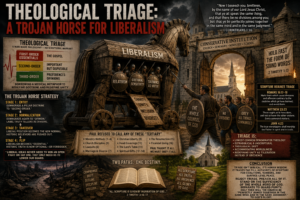
 Albert Mohler and others popularized theological triage. It sorts doctrines into tiers: first-order essentials like the gospel, second-order issues, and third-order matters where Christians can disagree without splitting. Its proponents borrow a medical metaphor – emergency-room prioritization – to argue for unity on the “fundamentals” while granting liberty everywhere else.
No Scriptural Warrant for Theological Triage
Scripture gives no warrant for this. Theological triage is a man-made philosophy. It undercuts the authority and sufficiency of God’s Word. The Bible never divides doctrine into “essentials” and “non-essentials.” It commands full obedience to everything God revealed. Paul told the Corinthians (1:10):
Now I beseech you, brethren, by the name of our Lord Jesus Christ, that ye all speak the same thing, and that there be no divisions among you; but that ye be perfectly joined together in the same mind and in the same judgment.
Paul isn’t asking for vague agreement on a minimal gospel while everyone diverges on the rest. He demands unanimity. He says, same speech, no divisions, same mind, and same judgment across everything the apostles taught.
Anatomy of the “Trojan Horse” Strategy
How It Works
A “Trojan Horse” enters a conservative institution, gets accepted, and then changes that institution from the inside. Triage builds the horse. It exploits the boundary lines between the tiers. It rarely attacks a first-tier doctrine head-on. A frontal assault gets spotted and rejected immediately. So the attack comes sideways, through the lower tiers, dressed up as charity, unity, or cultural sensitivity.
Someone rolls the horse through the gate by taking a doctrine the institution has always treated as essential and calling it secondary instead. A liberal idea doesn’t announce itself as a denial of the faith. It shows up as a “disputable matter,” something “faithful Christians can disagree on.” Historic positions on marriage, or the literal nature of certain biblical events, suddenly become interpretive differences rather than God’s Word.
The Resultant Takeover
Once that idea sits inside the walls as a second-tier issue, the next move downgrades it again – to the third tier, mere opinion. Now anyone who still insists it’s a core boundary marker gets labeled divisive, legalistic, unloving. As an institution normalizes the liberal position as an acceptable opinion, it dismantles its own conservative framework. The soldiers climb out of the horse. Faculty, pastors, and leaders who hold the historic view get pushed aside. Men who hold the “new normal” take their place.
Eventually the triage flips completely. The liberal position becomes a first-tier essential, while the original conservative doctrine becomes optional – or forbidden. Finally, the institution swallows the idea as a means of keeping the peace or remaining culturally relevant. Liberal ideas never need to win an open theological fight on day one. They only need the conservative institution to lower its guard by treating a pillar doctrine as a side issue.
Debunked by 1 Corinthians
Read through 1 Corinthians and count the issues Paul refuses to let slide. Ministry methods (chapters 1–4). Church discipline (chapter 5). Lawsuits among believers (chapter 6). Marriage and divorce (chapter 7). Christian liberty and stumbling blocks (chapter 8). Head coverings and gender roles (chapter 11). The Lord’s Table (chapter 11). Spiritual gifts (chapters 12–14). The resurrection (chapter 15). Financial giving (chapter 16). Paul doesn’t wave any of these off as “tertiary.”
The Apostle spends an extended argument on head coverings – an application of creation order. He doesn’t treat it as a cultural throwaway. He warns that unworthy participation at the Lord’s Table can bring weakness, sickness, even death (1 Corinthians 11:30). That’s not the language of “non-essentials.”
Further Contradicted in Romans
Paul tells the Roman church (Romans 16:17–18):
Now I beseech you, brethren, mark them which cause divisions and offences contrary to the doctrine which ye have learned; and avoid them. For they that are such serve not our Lord Jesus Christ, but their own belly; and by good words and fair speeches deceive the hearts of the simple.
The standard here is “the doctrine which ye have learned.” Not a pared-down core. The whole body of apostolic teaching. Biblical unity means a church agrees on everything scripture says, not just enough to hold a coalition together.
Triage Condemned by Jesus
Triage repeats the Pharisees’ error, and Jesus condemned it directly. They elevated their own traditions and neglected what mattered more. Jesus said it plainly (Matthew 23:23):
Woe unto you, scribes and Pharisees, hypocrites! for ye pay tithe of mint and anise and cummin, and have omitted the weightier matters of the law, judgment, mercy, and faith: these ought ye to have done, and not to leave the other undone.
Every command of God matters. None of them are optional. “Majoring on minors” is itself a made-up category. Picture a shirt with one small hole. It’s still a defective shirt. Similarly, any departure from scripture is a problem you address – not something you overlook to keep the peace. Satan doesn’t need a frontal assault. He chips away one “peripheral” issue at a time.
Lowest Common Denominator Theology
Triage functions as lowest-common-denominator theology. It puts pragmatic fellowship ahead of trembling at God’s Word. Jesus said (John 4:23):
But the hour cometh, and now is, when the true worshippers shall worship the Father in spirit and in truth: for the Father seeketh such to worship him.
The psalmist agrees (Psalm 111:10):
The fear of the LORD is the beginning of wisdom: a good understanding have all they that do his commandments: his praise endureth for ever.
Blessing comes from meditating on and obeying the whole law, not a curated subset of it (see Psalm 1:2; Joshua 1:8).
Extrabiblical Tool
Theological triage is an extrabiblical tool that has real consequences. It opens the door to theological drift, accommodates worldliness, weakens biblical separation, and redefines unity as toleration instead of shared submission to Scripture. True biblical unity comes from agreement on “all the counsel of God” (Acts 20:27), preached without apology.
Preachers must teach and apply every doctrine and practice the Bible reveals – dress, worship, eschatology, ecclesiology, music, separation – without apology, because “All scripture is given by inspiration of God, and is profitable for doctrine, for reproof, for correction, for instruction in righteousness: That the man of God may be perfect, throughly furnished unto all good works” (2 Timothy 3:16–17).
Conclusion
Theological triage isn’t biblical. It’s a human invention, the kind of worldly wisdom Paul rejects in 1 Corinthians 3:19:
For the wisdom of this world is foolishness with God. For it is written, He taketh the wise in their own craftiness.
So what is triage, in the end? A tool for doctrinal minimalism. It trades the full authority of scripture for coalitions, numbers, and a surface-level peace. Faithful believers must reject it. Stand instead on the sufficiency of the whole Word of God. Preach all of it with conviction. Separate where you must, to guard purity, the way Paul did. Only then will the church be “perfectly joined together in the same mind and in the same judgment,” to God’s glory.