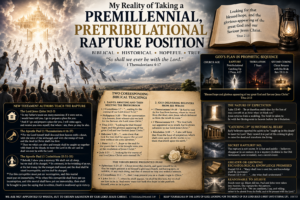
 New Testament Authors Teach the Rapture
The Lord Jesus
Jesus said this to His disciples in John 14:2-3:
2 In my Father’s house are many mansions: if it were not so,, I would have told you. I go to prepare a place for you. 3 And if I go and prepare a place for you, I will come again, and receive you unto myself; that where I am, there ye may be also.
The Apostle Paul
The Apostle Paul wrote this in 1 Thessalonians 4:16-17:
16 For the Lord himself shall descend from heaven with a shout, with the voice of the archangel, and with the trump of God: and the dead in Christ shall rise first: 17 Then we which are alive and remain shall be caught up together with them in the clouds, to meet the Lord in the air: and so shall we ever be with the Lord.
He also wrote this in 1 Corinthians 15:51-55:
51 Behold, I shew you a mystery; We shall not all sleep, but we shall all be changed, 52 In a moment, in the twinkling of an eye, at the last trump: for the trumpet shall sound, and the dead shall be raised incorruptible, and we shall be changed. 53 For this corruptible must put on incorruption, and this mortal must put on immortality. 54 So when this corruptible shall have put on incorruption, and this mortal shall have put on immortality, then shall be brought to pass the saying that is written, Death is swallowed up in victory.
Related References
2 Thessalonians 2:1 describes the rapture as “our gathering together unto him [the Lord Jesus Christ].” The Apostle Paul also calls it “the high calling of God in Christ Jesus” (Philippians 3:14). These are not the only passages on the rapture, but they describe this event for true believers, whom Christ will catch up in the sky. I’m writing about this because, along with attacks against Israel and dispensationalism, I read accompanying ones against the rapture. Not many that I read are exegetical, which I surmise is because scripture teaches the rapture. Usually they are mockery or something about the history of rapture belief or teaching.
Two Corresponding Biblical Teachings
Saints Awaiting and Then Meeting the Bridegroom
Two other biblical teachings corresponding to the rapture are, one, saints awaiting and then meeting the bridegroom, and, two, God saving believers from His wrath. Certain of the former passages are these:
1 Corinthians 1:7, “So that ye come behind in no gift;; waiting for the coming of our Lord Jesus Christ.”
Philippians 3:20, ” For our conversation is in heaven; from whence also we look for the Saviour, the Lord Jesus Christ.”
Titus 2:13, “Looking for that blessed hope, and the glorious appearing of the great God and our Saviour Jesus Christ.”
Hebrews 9:28, “So Christ was once offered to bear the sins of many;; and unto them that look for him shall he appear the second time without sin unto salvation.”
1 Peter1:13, “Wherefore gird up the loins of your mind, be sober, and hope to the end for the grace that is to be brought unto you at the revelation of Jesus Christ.”
Jude 1:21, “Keep yourselves in the love of God, looking for the mercy of our Lord Jesus Christ unto eternal life.”
God Delivering Believers from His Wrath
The former and latter are interrelated. Saints look for Jesus, as their Bridegroom, to deliver them from wrath.
1 Thessalonians 1:9-10, “9 For they themselves shew of us what manner of entering in we had unto you,, and how ye turned to God from idols to serve the living and true God; 10 And to wait for his Son from heaven, whom he raised from the dead, even Jesus, which delivered us from the wrath to come.”
1 Thessalonians 5:9, “For God hath not appointed us to wrath, but to obtain salvation by our Lord Jesus Christ.”
Revelation 3:10, “Because thou hast kept the word of my patience, I also will keep thee from the hour of temptation, which shall come upon all the world, to try them that dwell upon the earth.”
The Virgin Bride Presented Pure
A good way to look at the rapture is the bride meeting the bridegroom. She awaits his coming, and as his virgin, she stays pure for him. This is where the following verses fit.
Ephesians 5:25-27, “25 Husbands, love your wives, even as Christ also loved the church, and gave himself for it; 26 That he might sanctify and cleanse it with the washing of water by the word, 27 That he might present it to himself a glorious church,, not having spot, or wrinkle, or any such thing; but that it should be holy and without blemish.
2 Corinthians 11:2, “For I am jealous over you with godly jealousy: for I have espoused you to one husband, that I may present you as a chaste virgin to Christ.”
1 John 3:1-3, “1 Behold,, what manner of love the Father hath bestowed upon us, that we should be called the sons of God:: therefore the world knoweth us not, because it knew him not. 2 Beloved, now are we the sons of God, and it doth not yet appear what we shall be: but we know that, when he shall appear, we shall be like him; for we shall see him as he is. 3 And every man that hath this hope in him purifieth himself, even as he is pure.”
John 14:1-3 is also a picture of this, the bridegroom receiving his bride. He prepares a place for the bride, and then he comes and gets the bride. The Apostle Paul’s later references correspond exactly with what Jesus said and read as if Paul’s beliefs came from Jesus.
The Nature of Expectation
In Luke 12:36, Jesus tells His followers to be like servants waiting for their master to return from a wedding banquet. If Jesus is returning from a wedding at the Second Coming, the wedding itself must have already taken place in heaven. The bride is officially married to Christ in heaven while the earth undergoes the tribulation. Christ then returns with His bride at His second coming. The bride isn’t on earth. Jesus returns with His bride. Luke 12:35–40 connects to the rapture as the imminent, unannounced “trigger event” that sets the entire end-times timeline into motion.
The command in Luke 12:40, “Be ye therefore ready also: for the Son of man cometh at an hour when ye think not,” supports the doctrine of imminency. The context of Luke 12 demands a posture of readiness, alertness, watching, and waiting without a checklist of prior events. While the immediate context of Luke 12 applies to the Jewish remnant awaiting the Messianic Kingdom, the same expectation of a signless, any-moment return is mirrored by the Apostles in the New Testament Epistles for the church age rapture. They received this urgent readiness from Jesus and then wrote of this nature of expectation.
Even though those waiting for Christ in Luke 12:35-40 are in the tribulation and looking for the second coming, their anticipation parallels that for the meeting or gathering of Jesus and His bride.
“Catching Up” Is Historical Belief
The concept of “catching up in the clouds” from 1 Thessalonians 4:17 was known and discussed in early Christianity, but not in the form of the modern popular rapture doctrine. The Greek harpazō (caught up/snatched) was later rendered rapiemur in the Latin Vulgate, giving us the English term “rapture.” Early writers affirmed this event as a real, future transformation and meeting with Christ. Writings such as Didache, Epistle of Barnabas, Shepherd of Hermas, and Ignatius emphasize the imminent return of Christ amid persecution.
Overall, patristic writers treated 1 Thessalonians 4:17 as describing part of the dramatic, public parousia (coming/arrival) of Christ, using imperial imagery of a king visiting a city, where citizens go out to meet him and escort him back.
Secret Rapture? No
One of the ways modern critics attack the doctrine as modern is the language, “secret rapture.” “Secret rapture” is a terminology concocted by critics. I’ve never thought the rapture was secret. It is fast, so fast that everyone disappears. They are there, and then they are not. It isn’t secret.
Imminent rapture advocates considered the rapture a mystery and not a secret. They did not mean that people wouldn’t know when it happened. They meant that what was hidden in the Old Testament was now revealed in the New. Proponents never viewed the rapture as a hidden occurrence. It was later enemies who twisted the mystery teaching into a secret, mocking the rapture as a stealthy, invisible coming of Jesus in contrast to the second coming of Christ.
Greater or Growing Eschatological Knowledge Promised
A biblical basis exists for greater understanding of eschatological passages as believers get closer to the end. This is a belief expressed in Daniel 12:4, 9-10:
4 But thou, O Daniel, shut up the words, and seal the book, even to the time of the end: many shall run to and fro, and knowledge shall be increased. . . . 9 And he said, Go thy way, Daniel: for the words are closed up and sealed till the time of the end. 10 Many shall be purified, and made white, and tried; but the wicked shall do wickedly: and none of the wicked shall understand; but the wise shall understand.
It isn’t new teaching or new revelation. The history of doctrine is not static. Through years of study of the same material, believers gain further insight, especially in response to attacks on particular doctrines. Daniel alludes to increased prophetic insight and discernment in the last days. Dispensationalism itself is not a new belief, but a systematization of premillennialism, already held from the completion of the New Testament. As events align, believers near the end are expected to have heightened awareness and readiness (cf. Luke 21:28).
Reasonable to Believe
Opponents can make the rapture sound crazy depending on how they frame it, but it has a great heritage. Enoch went up. Elijah did too. Jesus also. Then Isaiah went up into the throne room of God; Ezekiel was brought there, Paul made a trip into the third heaven, and so did John at the very end of the Bible in Revelation. Rapture seems par for the course when one considers all that happened through history according to the Bible. The Apostle Paul writes in 2 Corinthians 5:8:
We are confident, I say, and willing rather to be absent from the body, and to be present with the Lord.
Good overview. Only ignorance of the Scriptures, or a failure to believe what they plainly teach, will lead a man away from the truth concerning the rapture of the church. Every contrary position ultimately drifts either into the error that the church is bringing in the kingdom, or into the denial of the second coming of Jesus Christ altogether, which is absurd.
Tom
I agree with the pre-millennial and literal rapture but disagree with the pre-tribulational portion written here. I have a few questions regarding the points you made if you’re willing to have a good faith discussion. If not, I will abstain from asking. You don’t need to publish this if you don’t desire to discuss it with me.
Hi David,
I wasn’t attempting to write about the pretrib position so much as the rapture doctrine itself, which you know I believe is pretribulational. I’ve not wanted to get into the timing with you, not because I’m not sure about it. I am sure. I was dealing with the attacks on the rapture in this.
I’ve read the major post-trib, mid-trib, prewrath works. They didn’t persuade me, not because of an unwillingness to change. When I read Marvin Rosenthal’s book many years ago, I thought he was losing a lot to take his position, so I gave him the benefit of the doubt, sort of wanting to believe him because of what he lost to take the position. He didn’t persuade. It was a stretch to me. If we argue that, it’s going to take time to read each other, write, etc. It’s going to be emotional for you. My guess is that it would be ugly, something I don’t want. I also have many, many things going right now to spend that time in front of the world in the comment section.
I understand. It is true that there are consequences amongst independent Baptists for not being pre-trib. I guess that’s partly the reason that someone like me wishes others might join me in my conclusions.
Since you’re older and wiser than I, what would you suggest someone like me do who is absolutely convinced that the pre-trib rapture is not found in the Bible?
@Tom, I think “the rapture of the saved” would closer to biblical meaning than the phrase you used – “the rapture of the church”. Perhaps I am missing something, but I think using “church” in that phrase often unconsciously supports the doctrine of an unassembled, invisible assembly (a doctrine I cannot find in Scripture). I’d like to hear what others think on this terminolgy. One thing that makes this less-than-straightforward is that Paul used the words “we which are alive and remain”, so I guess to use exclusively Bible terms we’d say it is the catching up/rapture of us [believers] which are still alive and remain (here on earth) at that time.
I agree that the Bible nowhere says, “rapture of the church.” It is eisegesis to say that. This is why I didn’t say it anywhere, and this is normal speech for premill, pretrib evangelicals. One following comment, however, is that there is no church in the tribulation period in Revelation, so someone could say that the church is gone for the tribulation, which is helpful, taking that from the book of Revelation.