 John Wesley came along in the history of England in and under the authority of the Church of England (COE), which represented and preached a false gospel, hence a damning one too. False gospels don’t change lives and conform people to the image of the Son, so it results in all the evidence of a lack of conversion. Wesley saw and knew that, but as a solution he came with a novel syncretization of a pathwork of various doctrines related to salvation and sanctification that were brand new. Those lead to even further perversions and did not correct the non-saving views of the COE.
It is difficult to sort through Wesley’s doctrine of salvation and sanctification, because it is not taught in God’s Word. It does seem to be an attempt at a correction of the COE and to reform it from the inside, which didn’t happen, even as seen in the condition of the COE today. It only got worse in that state church. Biblical theology and exposition preceding the distortion of Wesley provides an alternative to what he wrote that should be a decisive for correction of Wesley and separation from his false doctrine.
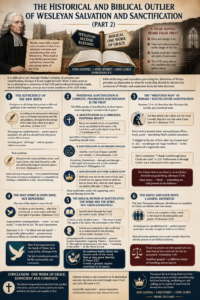
A Biblical Answer to Wesleyan Entire Sanctification
One, The Sufficiency of the New Birth
The foundational error in Wesley’s doctrine is its implicit denial that what God accomplishes at regeneration is complete and sufficient for the believer’s sanctification in this life. First, however, scripture declares no such deficiency in the new birth. The Apostle Peter writes:
According as his divine power hath given unto us all things that pertain unto life and godliness, through the knowledge of him that hath called us to glory and virtue. (2 Peter 1:3)
The Greek here is decisive: δεδωρημένης (dedōrēmenēs), a perfect passive participle — meaning the gift has already been fully given and its effects remain. God’s divine power has already granted “all things” — πάντα (panta), without exception — pertaining to life and godliness. There is no residual category of spiritual empowerment left ungiven at the new birth awaiting a “second blessing.” The perfect tense confirms a completed action with ongoing results. Paul echoes this with equal force:
Blessed be the God and Father of our Lord Jesus Christ, who hath blessed us with all spiritual blessings in heavenly places in Christ. (Ephesians 1:3)
Again, πάσῃ εὐλογίᾳ πνευματικῇ — “every spiritual blessing.” The aorist εὐλογήσας (eulogēsas) points to a definite, completed act. Wesleyan theology requires that some spiritual blessings be withheld at conversion and dispensed later through an emotional crisis experience. Paul allows no such withholding.
Two, Positional Sanctification Is Complete; Progressive Sanctification Is the Fruit
Wesley’s bifurcation of sanctification into an “initial” and an “entire” stage misreads the New Testament’s own categories. The Bible speaks of sanctification in three tenses, none of which require a discrete “second work of grace”:
Sanctification as a Completed, Positional Reality
But ye are washed, but ye are sanctified, but ye are justified in the name of the Lord Jesus, and by the Spirit of our God. (1 Corinthians 6:11)
The aorist ἡγιάσθητε (hēgiasthēte) here is past tense — something already done. The Corinthians, of all congregations, were hardly exemplars of moral perfection, yet Paul declares them sanctified. This is the positional sanctification that belongs to every believer at the moment of union with Christ.
Sanctification as an Ongoing Process
And the very God of peace sanctify you wholly. (1 Thessalonians 5:23).
The Greek ὁλοτελεῖς (holoteleis) — through and through — is the target of a process, not the sudden possession of a crisis moment. Paul is praying for completion of what God has begun (cf. Philippians 1:6: “He which hath begun a good work in you will perform it until the day of Jesus Christ”). Note carefully: it is God who performs it, not an emotional revivalist meeting or crisis or ecstasy producing session.
Sanctification as Future Glorification
Beloved, now are we the sons of God, and it doth not yet appear what we shall be: but we know that, when he shall appear, we shall be like him. (1 John 3:2)
Final conformity to Christ is eschatological. It awaits His appearing, not a second blessing in this life. Wesley collapsed the third category into the second, effectively claiming that what belongs to glorification — complete cleansing from inbred sin — could be achieved in this present body. This is precisely what Paul denies:
For I know that in me (that is, in my flesh,) dwelleth no good thing. (Romans 7:18)
The word σάρξ (sarx) — “flesh” — here refers to indwelling sin still present in the regenerate man. Paul writes this in the present tense, as an apostle of many years, not as an unconverted man, a misreading some have forced upon the text.
Three, The “Wretched Man” of Romans 7 Refutes Entire Sanctification
The critical passage is Romans 7:14–25, which Wesley assigned to the pre-converted state in order to preserve his doctrine of entire sanctification. Yet the grammar will not permit it.
For that which I do I allow not: for what I would, that do I not; but what I hate, that do I. (Romans 7:15)
Every verb here is present tense: κατεργάζομαι, θέλω, ποιῶ, μισῶ — all present active indicatives, describing Paul’s current experience. The entire section maintains this present tense throughout. Moreover, the spiritual discernment displayed — “I delight in the law of God after the inward man” (v. 22), συνήδομαι τῷ νόμῳ τοῦ θεοῦ — is not the response of an unconverted man. An unregenerate person does not “delight” in God’s law in his inner man. This is the cry of a regenerate man experiencing the ongoing conflict between his new nature and his flesh, a conflict that continues throughout the believer’s life until glorification.
Paul’s resolution here also contradicts a second blessing: “I thank God through Jesus Christ our Lord” (v. 25). Deliverance is through Christ, not through a subsequent crisis experience. And the deliverer is not the believer’s own fervent seeking but God’s gracious and finished provision.
Four, The Holy Spirit Is Given Once, Not Repeatedly
Wesley’s framework naturally produced what part one in this series rightly identifies as a cascading series of further blessings, “fresh oil,” baptisms of the Spirit for power, and on without end. This finds no support in the New Testament economy of the Spirit. The Apostle Paul again writes:
In whom ye also trusted, after that ye heard the word of truth, the gospel of your salvation: in whom also after that ye believed, ye were sealed with that holy Spirit of promise. (Ephesians 1:13)
The aorist ἐσφραγίσθητε (esphragisthēte), “ye were sealed,” is a once-for-all act. The seal of the Spirit is not broken, renewed, and re-administered. It is God’s permanent mark of ownership on the believer. Paul’s command in Ephesians 5:18, “be filled with the Spirit,” is present tense (πληροῦσθε, plērousthe), indeed indicating a continuous and repeated filling. But this is the ongoing control of the Spirit in the believer’s daily walk and worship, not the reception of an additional Person or an additional permanent endowment. The Spirit indwells permanently as Romans 8:9 says:
Now if any man have not the Spirit of Christ, he is none of his.
He fills experientially and continuously as the believer walks in obedience. The Wesleyan system confuses these two realities and then turns the filling, which is the normal, repeated experience of every obedient believer, into a dramatic crisis event requiring emotionally manufactured conditions to achieve.
Five, The Biblical Method of Sanctification: The Word and the Spirit, Not Crisis Experiences
If the Wesleyan “second blessing” is not the biblical path of sanctification, what is? The Bible is clear. “Sanctify them through thy truth: thy word is truth” (John 17:17). The Lord Jesus, in His high priestly prayer, identifies the instrument of sanctification: ὁ λόγος ὁ σὸς ἀλήθειά ἐστιν — “Thy word is truth.” The agent is the Spirit; the instrument is the Word. There is no mention of revival meetings, emotional crises, or a second definitive blessing. Sanctification comes through the sustained, Spirit-illumined intake of scripture. Paul confirms this in Romans 12:2:
And be not conformed to this world: but be ye transformed by the renewing of your mind.
The word μεταμορφοῦσθε (metamorphousthe) — “be ye transformed” — is a present passive imperative. It is ongoing. It is passive, meaning God works it. It is accomplished through the ἀνακαίνωσις τοῦ νοός — “renewing of the mind” — through the Word of God applied by the Spirit, not through a punctiliar event of an emotional experience. The means of growth are therefore: “As newborn babes, desire the sincere milk of the word, that ye may grow thereby” (1 Peter 2:2). Growth is the metaphor — gradual, organic, nourished by scripture, not vaulted by a second birth experience.
Six, The Haves and Have-Nots: A Gospel Distorted
Perhaps the most pastorally devastating consequence of Wesleyan doctrine is exactly what part one of this series identifies: a two-tiered Christianity in which some believers are complete and others are deficient, awaiting a further experience. This is not the New Testament’s portrait of the church. Paul addresses the entire congregation at Corinth — troubled, sinning, divided — as “them that are sanctified in Christ Jesus, called to be saints” (1 Corinthians 1:2). He does not divide them into the second-blessed and the not-yet. He addresses all of them as those already constituted holy in Christ.
To the Colossians he writes: “And ye are complete in him, which is the head of all principality and power” (Colossians 2:10). The Greek πεπληρωμένοι (peplērōmenoi) is a perfect passive participle, so already brought to fullness, in a state of completeness, in Christ. There is no incompleteness in the believer’s standing in Christ that awaits a second blessing to supply. The completeness is in Him, and the believer possesses it by virtue of union with Him at the moment of saving faith.
To manufacture spiritual crisis through manipulated music, emotional pressure, and revivalist techniques to give people something they already possess in Christ is not biblical ministry. It is, as Paul warned, “another gospel” (Galatians 1:6), not in the sense of different content necessarily, but a different basis of spiritual standing and progress, one rooted in human experience rather than the finished work of Christ.
Conclusion: One Work of Grace, Sufficient and Complete
The biblical answer to Wesley’s doctrine is not a colder or more formal Christianity. It is a richer one, one that says the believer at the moment of regeneration has been united to Christ (Romans 6:5), crucified with Christ (Galatians 2:20), raised with Christ (Colossians 3:1), sealed by the Spirit (Ephesians 1:13), indwelt by the Spirit (Romans 8:9), and complete in Him (Colossians 2:10). The call is not to seek a second experience to supplement an insufficient first one. The call is to reckon on what is already true for a person already genuinely converted through a true gospel:
Likewise reckon ye also yourselves to be dead indeed unto sin, but alive unto God through Jesus Christ our Lord. (Romans 6:11)
The Greek λογίζεσθε (logizesthe) — “reckon ye” — is present imperative, so continuously count it as true, because it is true. The power for holy living flows not from manufacturing an ecstatic second blessing but from believing, meditating on, and walking in the reality of what God has already done in Christ. That is the biblical doctrine of sanctification — one work, one Spirit, one Lord, and one gospel — sufficient for everything.
More to Come