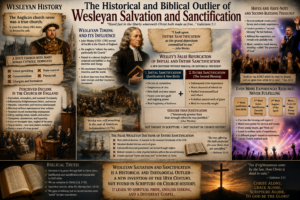
 Wesleyan History
The Anglican church never was a true church. You reader probably know the history. It arose from Henry VIII’s desire to divorce his wife. From this rejection of the Roman Catholic Church proceeded a Protestant Reformation in England, that never did discard the state church and many Roman Catholic teachings. In whatever way the Church of England became evangelical, it kept serious unbiblical doctrine and practice. It had more ways of following the Bible than the fully apostate Roman Catholic Church and varied Puritan figures through the centuries tried to make it better.
The Anglican church still has a very small evangelical faction today; albeit still full of problems. Certain Anglican churches will preach an evangelical message within an infrastructure of false doctrine and practice. Trying to fit a true gospel into the Church of England (COE) is very much like putting the new wine into the old bottles of Jesus’ parable. John Wesley knew something was wrong about the COE in which he stayed his entire life as an “Anglican priest,” still sprinkling infants. He tried to change the COE using a novel patchwork of doctrine and practice, some never before seen in history.
Perceived Decline in the Church of England
The COE that John Wesley grew up in during the early 18th century was widely perceived as spiritually and morally declined, marked by formalism, rationalism, and nominal Christianity. Wesley did not leave it but sought to renew it in a manner not rejecting Anglican doctrine outright. After the English Restoration (1660) and especially the Glorious Revolution (1688), COE leadership trended toward latitudinarian views, which emphasized broad tolerance, reason, and moral decency over doctrinal precision, fervent piety, or supernatural experience.
Influenced by Enlightenment thought, many state church clergy downplayed miracles, personal conversion, and emotional religion in favor of polite, rational Christianity. This blended with Deism, which viewed God as a distant clockmaker who did not actively intervene, reducing Christianity to ethics without true faith. There was barely a trace of a true gospel anywhere to be found.
As a result of non-conversion in the COE, worship was routine and lifeless. COE clergy as a whole prioritized social status, pluralism, or political advancement over pastoral care. Sermons were moralistic without calls to repentance or personal holiness. COE parishioners were Christian in name only (nominal) and with widespread moral corruption in society. Many clergy were seen as corrupt, time-servers, or absentee. This also led to capitulation to materialism, prioritization of the upper class, and unresponsiveness and exclusion of the working classes, essentially non-land owners. It was an unjust society.
Wesleyan Timing and Its Influence
Raised in a devout High Church Anglican home with his father a rector, John Wesley was ordained and served within the COE. Wesley saw the COE of his day as having lost the fire of primitive Christianity amid formalism, rationalism, and moral/spiritual decline. He saw his Methodist movement as an attempt to bring back what it had lost in vibrancy and fire, while staying rooted in COE doctrine and liturgy as much as possible. He lived from 1703 to 1791. His life affected religion in England and because of its timing, it also had a huge impact and still does on evangelical religion in the United States.
Wesley was still going strong in the year of American independence (1776). If one understands history, he can see that many American denominations inculcated Wesley’s unique views, arising as a reaction to the problems of the COE. A direct line runs from Wesley to the beginning of the Charismatic movement, one of the most significant perversions of true biblical teaching. His teachings corrupted, which resulted in even greater corruption, of a true gospel. This fits the broader restorationist impulse seen in various reform movements, claiming to return to a perceived purer, earlier form of the faith.
Wesley’s False Bifurcation of Initial and Entire Sanctification
While elements of Wesley’s teaching had precedents, his synthesis and emphasis on entire sanctification — Christian perfection/perfect love as a distinct second work of grace — stood out as a new invention. He drew from diverse sources — Eastern fathers, Catholic mystics, Moravians, Anglican High Church tradition — in a more eclectic manner than most of his contemporaries. The main contribution of Wesley to the theological landscape was his doctrine of entire sanctification, distinguishing it from initial sanctification.
Wesley taught that at conversion (justification and the new birth), a person receives initial sanctification — a real beginning of holiness with power over sin’s guilt and reigning power — but not the entire cleansing from inbred sin or “perfect love.” He divided salvation into a first work of grace (sufficient for immedate but not ultimate salvation and an initial holiness) and a subsequent “second blessing” or work of entire sanctification, which brings fuller deliverance and is to be earnestly sought, though not absolutely guaranteed without continued faith. This was a new view. He presented entire sanctification as a distinct subsequent experience greater than justification.
The False Wesleyan Doctrine of Entire Sanctification
If you are a Wesleyan or a Methodist, understand that you are getting a presentation of doctrine innovated by a 19th century movement within the Church of England. This does not trace back through historical and biblical Christianity. It starts in England related to its king taking his state church out of a Roman state church. In his doctrine, John Wesley described the change at entire sanctification, the second blessing, as “immensely greater than that wrought when he was justified.” Wesley did not believe or teach that conversion gives everything needed for sanctification in this life.
For full sanctification, which is very difficult to quantify, because it doesn’t even bring eternal security, Wesley believed that a person needed or had to have a second blessing experience, one he also needed to seek for. For Wesley, after justification someone becomes aware of his remaining carnal nature and still hungers for full deliverance and perfect love. This is not a biblical doctrine. It is a Wesleyan reaction to the nominal Christianity of the COE, which itself didn’t preach a true gospel. To get this second blessing, you had to really, really want it, hunger for it, and even that was, again, not a guarantee.
Haves and Have-Nots and Second Blessing Theology
The Wesleyan doctrine creates a system of spiritual haves and have-nots that still populates many denominations and churches. Revivalists and pseudo preachers use methods to create a crisis, fervor, or ecstatic experience to give something more. They are calling down heaven to do something big, so people could experience this second and ultimately third, fourth, fifth, and probably many more blessings. Without this experience, Wesley taught that the believer remains in a state of partial holiness.
Entire sanctification involved for Wesley, and still involved for all those influenced by him, a distinct crisis moment — an instantaneous work where the heart is cleansed and perfected in love by the Holy Spirit. It is often described as a “second blessing,” “second work of grace,” or “second change.” Wesley noted that many in the early Methodist revival received it suddenly after seeking, not merely as a slow process. That’s very much why today people have “revival” meetings, that is, to get to this state through the emotionally charged experience. Leaders offer this, accompanied by a style of music also invented to impact ecstasy.
Even More Experiences Required, Never Fulfilling
Something further than a second blessing was the natural consequence of Wesleyan teaching. Someone could always blame his carnality on the need of it, which produces two different kinds of Christianity, yet both “saved.” Wesley’s primary division is twofold: a first work, initial sanctification, and a second one, entire sanctification. After entire sanctification, however, one can lose the blessing through neglect and regain it by faith again. This extended the pattern into additional experiences (e.g., baptism with the Spirit for the fulness of the Spirit).
Directly from Wesleyan teaching came the idea of special blessing for power in service after justification, what some call “fresh oil.” This special power of the Spirit recieved after salvation enables Christian service. Most say it brings more results. If you aren’t getting the results you want, you need a fresh dose of power from the Spirit. You very often can receive that special power in an emotional gathering with revivalist style music, hand-waving, yelling, and various other ways that the Holy Spirit is said to be showing that He is there or really, really there, which is different than “just there.”
More to Come
Thank you for this post.
Wesley also believed in baptismal regeneration:
https://faithsaves.net/john-wesley-hero-heretic/
which is not very widely known.