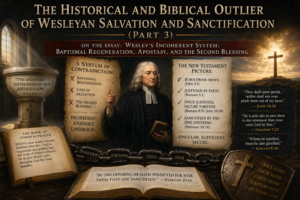
 Wesley’s Incoherent System: Baptismal Regeneration, Apostasy, and the Second Blessing
Very few modern Wesleyans and Methodists deal with or consider at all their historical and theological foundations in baptismal regeneration. What has happened across the spectrum of Wesleyan and Methodist denominations is not a careful theological resolution of the contradiction but rather a quiet, selective amnesia about it. Different branches of this tradition have handled the problem differently, but nothing can resolve it without either abandoning Wesley or abandoning any claim to evangelical soteriology.
This is not a minor footnote. With baptismal regeneration the foundation on which Wesley built his entire experiential superstructure, the entire subsequent edifice of initial sanctification, entire sanctification, and the second blessing rests on this sacramentalized base. Most modern Wesleyans have effectively sawed off this crucial aspect, while insisting the building still stands. It does not stand, but stays unnoticed by those living in it. Later in this series, I’ll address what happened.
Wesleyans and Methodists, no matter what they choose to drop, hide, or deemphasize of Wesley, they retain him in their name to show their assocation with him. They claim him and their trajectory proceeds from him. Whatever errors remain, or even multiplied, proceed from the beginnings that they continue through their embrace of this history.
First, The Internal Contradiction at the Heart of Wesleyan Soteriology
Wesley never abandoned infant baptism or its regenerating effect, and he never abandoned the possibility of losing salvation. When these two commitments are laid alongside his doctrine of entire sanctification, the system collapses under the weight of its own internal contradictions. A man can be regenerated by water as an infant, lose that salvation, be re-converted, still lack full sanctification, seek a second blessing, lose that, seek it again — and the cycle never resolves into anything the New Testament would recognize as the settled, secure, Spirit-wrought salvation it actually proclaims.
Second, Baptismal Regeneration Undermines the Very Conversion That Entire Sanctification Requires
Affirming the Anglican Book of Common Prayer
John Wesley held to the Anglican Book of Common Prayer‘s doctrine that baptism conveys regeneration. He wrote explicitly that baptism is “the ordinary instrument of our justification” and that infants receive the new birth through it. The Book of Common Prayer then read:
SEEING now dearly beloved brethren that this Child is regenerate and grafted into the body of Christ’s Church, let us give thanks unto Almighty God for these benefits.
Despite this, Wesley’s entire doctrine of entire sanctification presupposes a definable conversion moment, a conscious first work of grace from which the believer then progresses toward the second blessing.
Versus ‘Born from Above’
The problem is immediate and fatal to the system. If a man was regenerated as a baptized infant, where precisely is the “first work of grace” from which entire sanctification is the sequel? Wesley was forced into the awkward position of teaching that baptismal regeneration could be — and in most cases, given the nominal Christianity he himself condemned in the COE, was — lost, requiring a subsequent conscious conversion. The new birth thus had to happen twice before the second blessing could even be sought. God’s Word, however, knows nothing of a regeneration that can be undone and re-administered. The Lord Jesus said:
Verily, verily, I say unto thee, Except a man be born again, he cannot see the kingdom of God. (John 3:3)
The word ἄνωθεν (anōthen) means “from above” — this is a birth whose origin is divine, not sacramental. And birth, by its very nature in every analogy scripture employs, is a singular, unrepeatable event. One is not born, unborn, and re-born. The sacramental system Wesley retained from Anglicanism was therefore irreconcilable with the experiential revivalism his second-blessing doctrine demanded.
Third, Baptismal Regeneration Contradicts Justification by Faith
Wesley’s retention of baptismal regeneration also sits in deep tension with justification by faith alone, which he otherwise affirmed under Moravian and Reformation influence. Paul is unambiguous:
Therefore being justified by faith, we have peace with God through our Lord Jesus Christ. (Romans 5:1)
The Greek δικαιωθέντες (dikaiōthentes) is an aorist passive participle, so someone justified at a point in time, by God’s act, received through faith. The instrument is πίστει (pistei) — faith, not water. Water is conspicuously absent from the entire argument of Romans 3–5, which is the New Testament’s most sustained exposition of justification. To insert the baptismal font as the ordinary instrument of justification is to add to what Paul deliberately excluded.
Peter’s account of Cornelius settles the matter definitively. The Holy Spirit fell on the Gentiles before baptism:
Can any man forbid water, that these should not be baptized, which have received the Holy Ghost as well as we? (Acts 10:47)
The sequence is unmistakable — Spirit, then water. Regeneration preceded the sacrament. Baptism followed and confirmed what God had already sovereignly done. It did not produce it.
Fourth, The Loss of Salvation Makes a Ruin of Justification
Striking at the Root of Justification by Faith Alone
Wesley taught that a genuinely regenerate, justified believer could fall from grace and be finally lost. This was not a peripheral matter for him; it was integral to his entire system, providing the motivating urgency behind seeking entire sanctification as a more secure state. Yet this teaching strikes at the very nature of what justification is in the New Testament. Justification in scripture is a forensic declaration, a legal verdict rendered by God as Judge: “It is God that justifieth. Who is he that condemneth?” (Romans 8:33–34).
The θεὸς ὁ δικαιῶν — “God the one justifying” — is the present active participle of a God who stands as the justifier of the one who believes. Paul’s rhetorical question “Who is he that condemneth?” is not an anxious question. It expects the answer: no one, because the Judge Himself has declared acquittal.
Once a Settled Legal Case, No Reopening of It
If that verdict can be reversed, it was not a true verdict. No human court issues a verdict of “not guilty” and then re-opens the case on the same charges because the acquitted man subsequently behaved badly. The very concept of a legal declaration requires its permanence. Wesley’s apostasy doctrine turns God’s justifying verdict into something more like a provisional parole, revocable upon the parolee’s subsequent conduct — which is, in its essence, a works-based standing before God, however Wesley may have tried to avoid saying so.
Paul explicitly addresses those who would make salvation contingent on continued human effort or experience:
O foolish Galatians, who hath bewitched you, that ye should not obey the truth? (Galatians 3:1)
The Galatian error was beginning in the Spirit and then seeking completion in the flesh — precisely the structure of Wesleyan soteriology, which begins in grace and then requires sustained human seeking, crisis experience, and maintained blessing to arrive at spiritual completeness.
Fifth, The Permanence of Justification: What God Declares, No One Reverses
Grounded in the Immutable Nature of God’s Justifying Act
The security of the believer is not a temperamental preference, but it is grounded in the immutable nature of God’s justifying act and the intercessory work of Christ. Paul’s chain in Romans 8:30 is a decisive text:
Moreover whom he did predestinate, them he also called: and whom he called, them he also justified: and whom he justified, them he also glorified. (Romans 8:30)
Every verb — προώρισεν, ἐκάλεσεν, ἐδικαίωσεν, ἐδόξασεν — is aorist indicative. Glorification is stated in the past tense as a certainty so absolute that Paul speaks of it as already accomplished. There is no link in this chain that can be broken. A man whom God justified, God has already — in the certainty of His eternal purpose — glorified.
Reinforcement by the Intercessory Work of Christ
Wesleyan apostasy doctrine requires that the chain be broken between justification and glorification, which Paul’s grammar will not permit. The intercessory work of Christ reinforces this:
Wherefore he is able also to save them to the uttermost that come unto God by him, seeing he ever liveth to make intercession for them. (Hebrews 7:25)
The phrase εἰς τὸ παντελές (eis to panteles) — “to the uttermost” — means completely, perfectly, finally. Christ’s intercession is perpetual — πάντοτε ζῶν (pantote zōn), “ever living” — and its purpose is to save those who come to God through Him completely. If a believer could be lost, Christ’s intercession would have failed, which is an impossibility given its divine character. The Lord Jesus Himself gave the most unambiguous statement of the believer’s security:
And I give unto them eternal life; and they shall never perish, neither shall any man pluck them out of my hand. (John 10:28)
The double negative οὐ μὴ ἀπόλωνται (ou mē apolōntai) is the strongest possible negation in Greek — “they shall by no means ever perish.” Wesley’s loss-of-salvation doctrine requires that some do perish after having eternal life. But the Lord said they shall by no means perish. These statements cannot both be true. One must yield to the other — and it cannot be the words of Christ that yield.
Sixth, How the Three Errors Compound One Another Into a System of Bondage
Baptismal Regeneration, Entire Sanctification, and Loss of Salvation
When the three doctrines — baptismal regeneration, entire sanctification, and loss of salvation — are held together, the pastoral result is exactly the bondage the essay describes: a Christianity of perpetual insecurity and unending crisis-seeking.
Consider the trajectory Wesley’s system produces. A man is baptized as an infant and supposedly regenerated. He lives nominally, loses whatever grace he had, and must be consciously converted — the first work of grace. He is now justified but incompletely sanctified, still carrying inbred sin, and insecure in his standing because he can fall again. He must now seek the second blessing, the crisis experience of entire sanctification, to reach a higher plateau of holiness. But even that can be lost and must be re-sought. And beneath all of it is the sacramental foundation of an infant sprinkling that scripture nowhere authorizes as a regenerating act.
Absolute Different Picture from New Testament
The New Testament’s picture could not be more different. Paul writes to the Philippians, not to urge them toward a second-blessing crisis, but to remind them of what they already possess:
Being confident of this very thing, that he which hath begun a good work in you will perform it until the day of Jesus Christ. (Philippians 1:6)
The word ἐπιτελέσει (epitelesci) — “will perform it” or “will complete it” — places the burden of completion entirely on God. Not on the believer’s seeking. Not on a revival meeting. Not on a crisis experience. God began it; God will complete it; the guarantee is the day of Christ, not the intensity of human effort.
Seventh, The New Testament’s Singular, Sufficient, and Secure Salvation
Against the entire Wesleyan architecture, the New Testament sets a salvation that is singular in its initiation, progressive in its expression, and certain in its completion — all of it rooted in the finished work of Christ and the sovereign grace of God.
For by one offering he hath perfected for ever them that are sanctified. (Hebrews 10:14)
This verse is a completely concentrated refutation of the entire Wesleyan system:
- Μιᾷ γὰρ προσφορᾷ — “by one offering” — singular, unrepeatable, complete.
- Τετελείωκεν (teteleiōken) — “he hath perfected” — perfect tense, a completed act with permanent results.
- Εἰς τὸ διηνεκές — “for ever” — without interruption, in perpetuity.
- And the ones so perfected are τοὺς ἁγιαζομένους — those being sanctified — the present passive participle indicating the ongoing process of sanctification that flows from the one perfect offering.
One offering. Perfected for ever. No second blessing needed. No sacramental re-generation. No loss and recovery of standing. The cross was sufficient — and the believer’s security, holiness, and ultimate glorification rest entirely on its sufficiency, not on the measure of his experienced blessings.
More to Come
Question for you Pastor Brandenburg:
You write: “the guarantee is the day of Christ, not the intensity of human effort.”
It seems to me there is a paradox within second-blessing theology. I think that it is true that second-blessing theology teaches that there is effort required in order to seek the second blessing. However, during the time that I spent within this movement (IFB-Keswick, revivalism), it was very, very commonly taught that this second blessing (ie. revival) was acquired by ceasing from all effort.
My question: Could you comment on this? Are you familiar with the idea of “ceasing from all effort” (Let go and let God) to acquire the blessing (ie. activate the Holy Spirit from His dormant state)? And if so, how does that square with the idea that they also seem to teach that we need to apply effort toward this crisis experience? Any thoughts?
Thanks,
Mat
Hi Mat,
You are in part 3, and the Wesleyan movement, Wesleyan theology, I mention has three main errors: the baptismal regeneration (work), initial sanctification (grace) and final sanctification (work), and loss of salvation (work). It was a problem from the beginning as described. I don’t think this beginning is a commentary on what it became, except that it started with very flawed beginnings. Ultimately it forked off into a lot of variety. Little turned out with baptismal regeneration. Much more kept the loss of salvation. Every one of them kept some form of the two-tier scheme. I’m explaining right now in part 6 how this turned into what it did in revivalism. Some of what Wesleyanism became was also a reaction to the problems of Wesleyanism, but there were aspects inculcated in later revivalism. I’m going to write about that, Lord-willing.