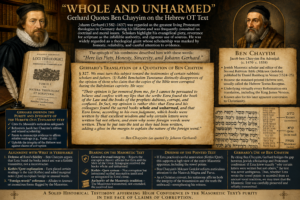
 Johann Gerhard (1582–1637) was regarded as the greatest living Protestant theologian in Germany during his lifetime and was frequently consulted on doctrinal and moral issues. Scholars highlight his evangelical piety, reverence for scripture as the infallible authority, and rigorous use of sources. He was widely regarded as a theological giant whose scholarship was marked by honesty, reliability, and careful attention to evidence. The epitaph of his tombstone described him with these words: “Here lies Piety, Honesty, Sincerity, and Johann Gerhard.”
Gerhard’s Translation of a Quotation of Ben Chayyim
§ 327. We must turn this subject toward the testimonies of certain rabbinic scholars and fathers. (1) Rabbi Benchaiim Tunetanus distinctly disapproves of the opinion of those who claim that the copies of the Bible were corrupted during the Babylonian captivity. He says:
Their opinion is far removed from me, for I cannot be persuaded to believe and confess with my lips that the scribe Ezra found the book of the Law and the books of the prophets dubious, corrupt, and confused. In fact, my opinion is rather this: that Ezra and his colleagues found the sacred books whole and unharmed, and that Ezra knew, according to his own judgment, which books were written by that excellent wisdom and why certain letters were written but not others, and even why some foreign words were written. These he put into the text as they had been written, adding a gloss in the margin to explain the nature of the foreign word.
Ben Chayyim
The Competency of the Gerhard Translation
Alignment of the Ben Chayyim Quote with What Is Historically Verifiable
1. The defense of Ezra’s fidelity. Ben Chayyim’s introduction addresses questions about textual transmission and Ezra’s role. The argument that Ezra found the books intact and acted as a faithful transmitter rather than a reconstructor is consistent with traditional rabbinic views he would have wanted to uphold against critics.2. The Kethiv/Qere explanation. The most significant and identifiable element of this quotation is the explanation that Ezra placed certain readings in the text as written (Kethiv) while adding marginal annotations (Qere) to explain foreign or unusual words. This is a recognizable description of the Kethiv-Qere apparatus — one of the most important features of the Masoretic tradition. Ben Chayyim would have had extensive first-hand engagement with this system as editor of the Mikraot Gedolot.3. The “foreign words” reference. This likely alludes to the handful of Aramaic or otherwise anomalous forms in the Hebrew text that the Masoretes flagged with marginal notes.
Bearing of the Ben Chayyim Quote on the Masoretic Text
- General textual integrity. Ben Chayyim’s rejection of the corruption theory, the idea that centuries of manual copying had introduced errors, omissions, and alterations into the text of the Old Testament, corresponds to the doctrine of preservation. The argument that Ezra and the men of the Great Synagogue received the books whole and unharmed (integros et illibatos, as Gerhard would render it) was naturally employed by Protestant scholastics in support of the doctrine of providential preservation articulated in confessional statements such as Westminster Confession I.8.
- The Kethiv-Qere system specifically. Ben Chayyim’s explanation here is significant for understanding the Masoretes’ own self-understanding. The Kethiv-Qere distinctions represent not corruption but intentional scribal annotation — that Ezra himself instituted or recognized the practice of writing one form in the text and glossing it marginally. This defends the Masoretic apparatus as traditional rather than corrective, meaning the Masoretes were passing on what they received, not emending a broken text.
- The vowel points. The quotation does not address the vowel points directly, but its logic has an indirect bearing on the great points controversy of the 17th century. The debate — associated with Louis Cappel (Arcanum Punctationis, 1624) on one side and the Buxtorfs on the other — concerned whether the Masoretic vowel points were original to Moses and the prophets or were a later rabbinic addition.
Defense of the Pointed Text of the Hebrew Old Testament
One can and should include Gerhard’s use of Ben Chayyim with his broader defense of the antiquity and authority of the pointed text, since:
- If Ezra himself was already practicing the kind of careful textual annotation ben Chayyim describes (Kethiv/Qere), this supports a high view of the entire Masoretic apparatus, including the pointing.
- Ben Chayyim’s own work in the Second Rabbinic Bible presupposes the authority of the Masoretic pointing — his edition is notable for its meticulous attention to the Masorah Magna and Parva, the marginal apparatus that defends and explains the received text.
- As a Christian convert, his testimony carries apologetic weight: a man trained in the rabbinic tradition who could affirm both the integrity of the transmission and then embrace Christianity would have seemed to Protestant scholastics a doubly credible witness.
- Gerhard utilizes this quote to bridge the gap: if Ezra knew exactly “why certain letters were written but not others,” the text was never ambiguous. Therefore, whether Ezra physically wrote the vowel points or later recorded from an ancient vocal tradition, the quotation supports confidence that the Masoretic text was carefully preserved and reliably transmitted.
Is there any evidence that Ezra is actually the person who began the Kethiv / Qere system, or is it attributed to him without proof?
Thanks in advance
There are a lot of different points of evidence for it. He is considered the founder of the “Soferim,” which are the scribes, and the head of the scribal tradition from which came the Kethiv and Qere. There is inferential evidence this traces back to him.
Hello Jim!
Please see here:
https://faithsaves.net/inspiration-hebrew-vowel-points/
for some evidence.
Thank you.
Thanks, Bro Brandenburg, for this post. How different the view of Ben Chayyim was from that of the modern editors of the critical Hebrew Old Testament!
Thanks for bringing this out.