 From my perspective and, I believe God’s, I hate to say it, but preterism seems to be growing. It’s presence also corresponds to rising Israel and Jew hatred. Right now this even affects the Iran War, United States foreign policy, the mid-term elections, and far more than that. In addition, what is the future for a nation that overall hates Israel?
Preterism is a definitive force on scripture. It is not a natural interpretation that comes out of plain reading, where scripture all fits together as one. No. It starts with a point of view and then looks to find things. The position of preterism, an eschatological belief, sticks out like a sore thumb. It can find some proof texts that work for it, so that someone would do well to find answers in those places. Not intending to offend, I’m not really sure that a preterist that sees grammatical-historical evidence would believe it if he saw it, but it’s at least good for a futurist to know what’s happening.
First, What Is Preterism?
The Root of the Word
The word preterism comes from the Latin praeter, meaning “past” or “beyond.” The same root is in ordinary English words like preterite, the grammatical past tense, and preternatural, beyond or outside the natural order. Praeter itself was a common Latin preposition or prefix meaning “past, beyond, by, or beside,” and was used in classical Latin to indicate something passed or left behind.
The label “preterism” as a theological category is relatively modern, so not used by preserved early interpreters. Origen, Eusebius, and others who read Revelation or the Olivet Discourse as referring to Jerusalem’s fall in 70 AD didn’t need a special label for what they did at that point. What we now call preterism, however, traces to a Jesuit academic, Luis de Alcazar (1554–1613), who wrote Vestigatio Arcani Sensus in Apocalypsi (published posthumously in 1614). Alcasar speculated that Revelation described the early church’s victory over Judaism and paganism, events already complete.
Alcazar used his approach to counter non-Catholics, who saw the papacy as the Antichrist of Revelation. “Preterism” then emerged in theological discourse in the 18th and 19th centuries as academics began to categorize varied types prophetic interpretation with preterist, futurist, historicist, and idealist. These were useful, invented taxonomic labels. “Preterist” works because it captures the viewpoint’s essence, that the prophetic events are praeter, already passed by. You are living after all of it, not before it. Preterest describes this central claim of an eschatological position.
What “Preterism” Is
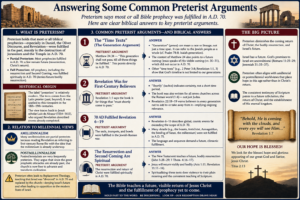
Preterism holds that the fulfillment of most or all biblical prophecies, particularly those in Daniel, the Olivet Discourse (Matthew 24), and the book of Revelation, occurred in the past in events surrounding the destruction of Jerusalem and the Second Temple by Rome in 70 AD. “Partial Preterism” says that most prophecies were fulfilled in 70 AD, but that a few remain future — including the bodily resurrection of the dead and the final return of Christ. “Full Preterism” views all biblical prophecy, including the resurrection and Second Coming, as fulfilled spiritually in 70 AD, thus denying a future bodily resurrection.
Preterists take texts like Revelation 6–19 or Matthew 24 as describing events that were imminent to their original first-century audience, not ones still thousands of years away. Preterists insist the language of imminence (“this generation,” “shortly,” “quickly”) points to something chronologically closer, so 70 AD. Preterism contrasts with futurism, the latter arguing that the scope of the events described absolutely demands a still-future fulfillment.
Second, How Does Preterism Relate to Amillennialism and Postmillennialism?
Preterism is a hermeneutical lens about the timing of prophetic fulfillment. It intersects with millennial views like this:
- Many amillennialists are partial preterists, because reading Revelation as largely referring to first-century Rome (rather than a far-future tribulation) fits naturally with seeing the millennium as already underway.
- Postmillennialists are very frequently preterists too. They argue that since the great prophetic obstacles (like the Jewish-Roman war, the Neronic persecution, the fall of Old Covenant Israel) are already past, the church is now free to advance and transform civilization.
Preterism functions as a powerful interpretive key that shapes and often unites both amillennial and postmillennial readings of scripture. It also produces one of the more extreme forms of Replacement Theology because it widely teaches that the theme of Revelation is about God’s divorce of Israel, which is replaced by the church as the bride of Christ. Preterists say Rome’s destruction of Israel in A.D. 70 annihilated Israel’s future, so Israel has no national future whatsoever. Most preterists, therefore, do not support the modern State of Israel and tend to be sympathetic to Palestinian propaganda.
Rather than shaped by a grammatical-historical, literal interpretation of scripture, amillennialism and postmillennialism along with their companion preterism arose out of conforming scripture to fit already completed historical events. Men looked around at what happened and those occurrences had a strong influence on how they would approach scripture. It also corresponds to a strong Roman Catholic or state church bias that chose to see itself as the replacement to Israel.
Third, Now for the Arguments of Preterists
1. The “Time Texts” (The Generation Argument)
Preterest Argument. In Matthew 24:34, Jesus states, “This generation shall not pass, till all these things be fulfilled. ” Preterists argue “this generation” strictly meant the people living at that exact moment, pointing directly to the destruction of Jerusalem in 70 AD. Answer.
1. “Generation” can mean a race or lineage, not a time span
The Greek word genea, “generation,” has a semantic range that includes not just a contemporary cohort but also a “kind,” “race,” or “stock.” Jesus could mean the Jewish people as an ethnic group, saying that this race will not pass away until all these things occur. This would be a prophecy of Jewish preservation through history, not a time indicator. Occasionall Greek literally uses genea this way and the context of the chapter focuses heavily on Israel. The synoptic gospels do use this to refer to contemporaries, but it is again a possible interpretation to say it’s speaking of race.
2. The abomination of desolation points beyond 70 AD
Jesus in verse 15 refers to the abomination of desolation spoken of by Daniel and tells people to flee when they see it. What happened in 70 AD under Titus — while terrible — doesn’t match Daniel’s description. Daniel’s prophecy has a dual or ultimate fulfillment yet to come. If the abomination still awaits fulfillment, then “all these things” can’t have been completed in 70 AD.
3. The cosmic language demands a literal, universal event
Verses 29–30 describe the sun and moon being darkened, stars falling, and the Son of Man appearing in the sky with power and glory, with all the nations of the earth mourning. There is the global and cosmic scale of this language. Nothing in 70 AD, however catastrophic for Jerusalem, darkened the sun or was visible to all the nations of the earth. As much as preterists want “this generation” to mean something chronological because of that common usage, it is too convenient to draw on apocalyptic metaphor related to the imagery of this event.
4. The “immediately after” of verse 29 creates a problem for preterism
Verse 29 says, “Immediately after the tribulation of those days” the cosmic signs will appear. If the distress refers to 70 AD, then the cosmic signs and the visible coming of the Son of Man should have followed “immediately.” Preterists have to argue these were fulfilled spiritually or symbolically in ways that weren’t visibly apparent, which effectively empties the word “immediately” of its plain meaning.
2. The Imminence of the New Testament Writers
Preterist Argument. New Testament writers frequently used urgent language: “the time is at hand” (Rev 1:3), “the coming of the Lord draweth nigh” (James 5:8), and “it is the last” (1 John 2:18). Preterists claim that if these events didn’t happen within decades, the apostles were false prophets.
Answer. “At hand” (eggizo) means imminent, saying it is the next major event on God’s prophetic calendar and could happen at any moment, not that it must happen immediately. From God’s timeless perspective, the entire era between the first and second comings is the “last hour.” Much prophetic material works this way. As a consideration, think of the fulfillment of Isaiah 7:14, a prophecy given to Ahaz over 700 years before it happened.
3. The “Coming on the Clouds” Imagery
Preterist Argument. Matthew 24:30 describes the Son of Man “coming in the clouds of heaven.” Preterists argue this is Old Testament judgment language, like Isaiah 19:1 where God rides a swift cloud to judge Egypt. They claim Christ’s “coming” in 70 AD was a non-physical, spiritual judgment via the Roman armies. Preterists make Christ’s coming not Christ’s coming.
Answer. Acts 1:11 explicitly says “this same Jesus, which is taken up from you into heaven, shall so come in,” which was physical, visible, and cloud-borne. Reducing the second coming of Christ to a hidden, metaphorical judgment through pagan Roman soldiers strips the text of its plain meaning and robs true churches of their blessed hope. Preterists become like the scorners Peter described in 2 Peter 3:3-4, mocking a literal fulfillment of the second coming.
4. The Nature of the Resurrection
Preterist Argument. Preterism teaches that the resurrection predicted in Daniel 12 and 1 Corinthians 15 is not a physical raising of biological corpses, but a covenantal resurrection, the corporate rising of the church out of the dead body of Old Covenant Judaism in 70 AD.
Answer. 1 Corinthians 15 links our future resurrection directly to Christ’s physical resurrection. If Christ rose bodily, our resurrection must be bodily. Spiritualizing the resurrection is a dangerous error akin to the heresy of Hymenaeus and Philetus (2 Timothy 2:17-18), who claimed the resurrection had already taken place. I call this kind of allegorical interpretation a “gumby doll approach,” which allows someone to bend passages in whatever way he wants with little consideration of the actual meaning of words or grammar.
5. The “Passing Away” of Heaven and Earth
Preterist Argument. Phrases like “heaven and earth passing away” (Matt 24:35, Rev 21:1) do not mean the physical destruction of the planet. Instead, they represent the collapse of the Jewish political and religious cosmos, which is the temple system.
Answer. Heaven and earth will pass away, a literal, cosmic de-creation and re-creation based on 2 Peter 3:10, where “the heavens shall pass away with a great noise, and the elements shall melt.” This cannot be localized to 70 AD Jerusalem; the physical universe is literally slated for a molecular overhaul to purge it of the curse of sin.
6. The Binding of Satan
Preterist Argument. Preterists argue that Satan was bound during Christ’s earthly ministry and decisively defeated in 70 AD, meaning his global authority is broken and Christ’s Kingdom is expanding unhindered now.
Answer. I’ve heard someone address the preterists on this, “If Satan is bound, he’s on a very long leash.” 1 Peter 5:8 outright says that “the devil, as a roaring lion, walketh about, seeking whom he may devour,” and 2 Corinthians 4:4 reveals about Satan, “the god of this world hath blinded the minds of them which believe not,” written well into the New Testament era. Satan is highly active until his future literal binding in the abyss (Revelation 20).
More to Come
Concerning the coming de-creation and re-creation, and the claim that it’s not meant to be taken literally, it reminded me of an approach I’ve recently thought of concerning other passages where people suggest God is not meaning what He literally says. When someone says the 1,000 year millennium is not a literal period of time, or that the days of creation were not literal 24-hour days, I now ask the question, “Looking at the text, what could God have added to His statements to have made it more clear that he meant a literal period of time?” Such as, how could God have been more explicit than listing out “1,000 years” 6 times in 6 verses?” If God’s goal was to be absolutely clear that He meant a definitive period of time, what more could he have said?
The same with the days of creation, or the coming destruction and re-creation of the cosmos- how could God get more clear than, “The evening and the morning were the first day,” or ” the heavens being on fire shall be dissolved, and the elements shall melt with fervent heat”?
If someone cannot think of a reasonable way in which God could have been more obvious in His intentions to convey literal information, then we’re left with the obvious conclusion that God did indeed mean to be understood according to the plain and obvious meaning (literal) of the text.
Very good Adam.
“Preterists argue that Satan was bound during Christ’s earthly ministry and decisively defeated in 70 AD, meaning his global authority is broken and Christ’s Kingdom is expanding unhindered now.”
This is some next level ignorance of human history!
Good stuff, Thanks
Thanks Jim.