Part One Part Two Part Three Part Four Part Five Part Six
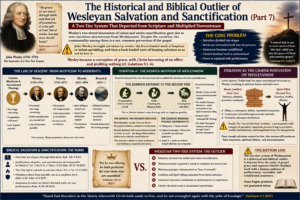 Wesley’s two-tiered innovation of initial and entire sanctification gave rise to new variations downstream from Wesleyanism. Despite the variation, the commonality among them is a net, common perversion of the gospel. John Wesley brought salvation by works: the front-loaded work of baptism or infant sprinkling, and then a back-loaded work of keeping salvation so as not to lose it. Wesley became a corruption of grace, with Christ becoming of no effect and profiting nothing (cf. Galatians 5:1-6).
Comparison of the later manifestations of the two-tier scheme of Wesleyanism doesn’t mean total similarity with all things Wesley. The later effects of Wesleyanism, which arose from his two-tiered framework, are not identical. They mutated, saying they’re a further mutation of Wesley’s two-tier system. Despite proceeding from Wesley’s innovation, it didn’t always produce the same kind of salvation-by-works problem as his. The results were still ruinous. Not necessarily in this order, here are some later iterations of the two-tiered system that proceeded from Wesley.
Iteration #1: The Keswick Mutation of Wesleyanism
The Keswick distinctive — counteraction rather than eradication of the sin nature — was a deliberate modification of Wesley’s doctrine of eradication, but the two-tier structure was completely retained. The following represents the Keswick pathway to the second tier:
- Consecration — total surrender of self
- Faith — claiming the filling by faith
- Rest — ceasing from self-effort
This is Phoebe Palmer’s altar theology with its Anglican gentility. Phoebe Palmer (1807–1874) was a female American Methodist evangelist, often called the “Mother of the Holiness Movement.” Her teachings on entire sanctification directly inspired the “Higher Life” and Keswick theology. The Keswick convention’s entire purpose — annual gatherings of Christians for “deeper life” teaching — was the institutional expression of the two-tier system: Christians gathering to move from tier one to tier two, or to renew their tier-two standing.
Keswick fed directly into:
- Moody, Torrey, and the American fundamentalist tradition
- The Student Volunteer Movement — entire consecration as the basis of missionary calling
- Hudson Taylor’s “exchanged life” theology
- The Dallas Theological Seminary curriculum through Chafer’s Keswick dependence
The Keswick Two-Decision Structure
The iteration of Wesleyan initial, first step, and entire sanctification, second step, fleshes out in a later Keswick two-decision model:
- First decision: Accept Christ as Savior — the gospel invitation, minimal in its demands
- Second decision: Full consecration/surrender to Christ as Lord — the deeper life invitation, addressed to already-saved believers
This structure trained an entire culture to think of salvation and lordship as sequential decisions rather than components of a single act of genuine faith. When this structure is fully internalized, the following conclusion follows almost inevitably:
- If lordship belongs to the second decision, then the first decision must not require lordship
- If consecration belongs to the deeper life, then initial salvation must not require consecration
- If Spirit-filling is after salvation, then initial salvation must not require the Spirit’s fruit
The Keswick Warning Passage Hermeneutic
Keswick’s treatment of the New Testament warning passages — Hebrews 6, Hebrews 10, James 2, the Sermon on the Mount — emerged from Wesleyanism and led to the two-decision framework. Keswick relocated these passages from salvation questions to rewards questions:
- The warning about falling away → warning about losing rewards, not salvation
- The judgment passages → the Bema seat (rewards judgment), not the Great White Throne (salvation judgment)
- James 2 (faith without works is dead) → works as evidence of Spirit-filled tier, not saving faith
So Far, This Line of Descent
The following bullet points the line of descent of the two-tier framework of Wesley:
- Catholic mysticism and sacramental theology → two-stage soteriology, cooperation with grace, loss of grace possible
- Wesley → Protestant two-stage soteriology, entire sanctification as a second tier, loss of salvation possible
- Finney → voluntaristic two-stage system, total consecration as second tier, revival results as evidence
- Moody → Spirit-filling as second tier, Savior/Lord distinction implicitly present, two-decision evangelism
- Keswick → Defeated/victorious Christian, Savior/Lord as sequential decisions, rewards hermeneutic for warning passages
Iteration #2: The Chafer Innovation on Wesleyanism
Lewis Sperry Chafer kept the same unscriptural structure as Wesley, resulting in a similar consequence of spiritual haves and have-nots. Wesley’s initial sanctification was a have-not until he reached entire sanctification, which still wasn’t suitable enough to keep someone saved. Chafer preserved Wesley’s initial spiritual deficit: the merely justified Christian is spiritually inadequate — defeated, unfruitful, powerless. He also kept a second tier: Spirit-filling is a subsequent, definite, experiential transaction that elevates the believer to an effective Christian life.
Chafer also maintained the Wesleyan epistemology: the filling must be consciously received, through surrender and faith, and its reality is verified by subsequent fruitfulness. This apparent solution generates the carnal Christian problem, which is a permanently valid category of genuinely regenerate persons living in persistent, undifferentiated, worldly unfruitfulness, indistinguishable from the unregenerate. The cost of solving Wesley’s works problem was the creation of an equally serious antinomian problem.
Even though in Chafer’s mutation, the originally justified person cannot lose his salvation, even by failing to maintain the second tier, it presents other, often fatally harmful ideas. A person gets a false assurance while living as a “carnal Christian.” Becoming a “spiritual Christian” requires these crisis moments, which will produce surrender. This places the burden of “spiritual Christianity,” in contrast to a potentially interminable “carnal Christianity,” on seeking after these secondary experiences, still never reaching a place of complete fulfillment.
The Carnal Christian Problem Revisited
Chafer’s carnal Christian doctrine, as established, created a permanently valid category of genuinely regenerate persons living in persistent worldliness, unfruitfulness, and apparent spiritual deadness. This was a load-bearing, not peripheral, feature of his system. The carnal Christian doctrine created an immediate theological pressure: If genuine salvation can coexist with no observable difference from the unregenerate state — no fruit, no perseverance, no discipleship, no submission to Christ’s lordship — then what exactly does saving faith consist of?
Chafer’s answer pushed toward a purely intellectual, momentary act: saving faith is the mental assent to the proposition that Christ died for sins and rose again, expressed in a moment of “accepting Christ.” Nothing more is required — not repentance as a change of life direction, not submission to Christ’s authority, not the beginning of discipleship. Chafer explicitly taught — most clearly in Salvation (1917) and his Systematic Theology — that:
- Christ is offered in the Gospel as Savior.
- Receiving Christ as Lord is a subsequent, separate commitment — the second tier of consecration and discipleship
- To require Lordship at salvation is to add works to grace — to submit a condition of justification
This is the foundational move. Once Christ’s Lordship is relocated from salvation to the second tier, saving faith is definitionally stripped of any element of submission, surrender, or life-direction change. Faith becomes the acceptance of a benefit (forgiveness, eternal life) without any necessary change in the relationship of the will to Christ’s authority.
Chafer’s Redefinition of Repentance
The two tiers of Wesley, inherited by Chafer, easily found themselves in Savior at the first marker and Lordship at the second. Chafer twisted the perception of lordship, that you must make Christ Lord of every area of your life before you can be saved, framing it as a condition of merit. Chafer taught that repentance is not a component of saving faith for the church age. His argument:
- Repentance (metanoia) means literally “a change of mind.”
- In the Gospel context, repentance means changing one’s mind about Christ — from unbelief to belief.
- Repentance does NOT mean sorrow for sin, turning from sin, or a change of life direction.
- To require repentance (in the sense of turning from sin) as a condition of salvation is to add human effort to grace.
Chafer argued that a call to repentance in the Synoptic Gospels and Acts is addressed to Israel under a different economy, that is, Jews, being called to turn from their national rejection of the Messiah, not Gentiles being called to turn from sin. For the church-age Gospel (Paul’s epistles), Chafer argued that repentance is either subsumed into faith (believing is the change of mind) or absent as a distinct requirement. All of this doctrinal and exegetical change, significant to the gospel, Chafer inherited from Wesley’s split of initial and entire sanctification.
Assurance Inflation from Chafer
The Chafer/revivalist tradition created an assurance inflation — virtually anyone who had prayed a prayer at any point could be assured of salvation, because the evidential standard had been effectively removed. This produced specific pastoral pathologies:
- The “carnal Christian” as a permanent pastoral category — churches full of people assured of salvation with no evident regeneration, interpreted not as evidence of false profession but as evidence of carnality to be addressed by a second experience (Spirit-filling, rededication, revival)
- Rededication as the functional substitute for regeneration — the revival altar call for the already-saved, structurally identical to the Wesleyan second-blessing altar, addressing the same problem (nominal Christianity) with a different theological label
- Soul-winning statistics divorced from discipleship — if the prayer is what saves, and the carnal Christian is genuinely saved, then recording decisions is a legitimate metric regardless of subsequent evidence of regeneration.
Iteration #3: Classical Pentecostalism — First and Second Blessing with Tongues
Necessary Evidence of a Second Tier
Pentecostalism is the most transparent iteration because it explicitly names what the others tried to soften:
| Wesley | Pentecostalism |
|---|---|
| Baptismal regeneration/conversions | Salvation / new birth |
| Entire sanctification | Baptism of the Holy Spirit |
| Evidence: inward witness + loving conduct | Evidence: speaking in tongues as initial physical evidence |
As founder of modern Pentecostalism, Charles Parham’s decisive move (1901) was to attach a specific physical manifestation to the second tier as its necessary evidence. This solved the epistemological problem that had plagued the entire tradition from Wesley onward: How do you know you have the second blessing? Parham’s answer: You speak in tongues. These tongues aren’t actual languages, however, like in Acts 2, so they’re easy to fake. The outward, observable, physically verifiable sign removes all ambiguity. The trajectory starting with Wesley led to this logical conclusion:
- Wesley: inward witness + loving conduct = evidence
- Palmer: public testimony = evidence
- Finney: revival results = evidence
- Holiness movement: separation from worldliness = evidence
- Parham: tongues = evidence
Each step further externalizes and objectifies the evidence, because the internal and behavioral evidence always proved insufficiently decisive for the pastoral and communal purpose of determining who had the second blessing.
Keeping or Reinstating Wesleyan Possible Loss of Salvation
The loss-of-salvation question in Pentecostalism followed the Wesleyan original more closely than Chafer did: many classical Pentecostal traditions retained the possibility of losing salvation, making the maintenance of Spirit-baptism (and its ongoing evidence in spiritual gifts, prayer, separation) a practical condition of ongoing salvific standing. Parham and classic Pentecostalism kept or maybe reinstated Wesley’s works-salvation problem: salvation not merely by grace through faith, but by grace through faith maintained by a further requirement of Spirit-baptism and accompanying signs.
More to Come
Thank you for writing. I think you can see all these trends in the fundamental movement to varying degrees. The Chafer innovation particularly. Do you think churches that adopt one or more of these innovations as their dominant view have moved into apostasy?
Hi Benjamin,
Thanks for comment. Yes, it tends toward apostasy. It has become the way of thinking and resulted in a lot of the problems in everything adjacent to evangelicalism, including fundamentalism of all sorts. I’m not done with the series. I’ll get closer to home.