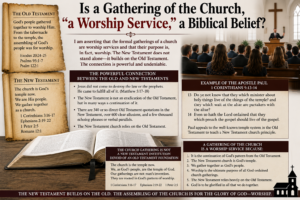
 When a pastor or church calls its meeting on Sunday morning or evening, “a worship service,” is that a biblical belief or practice? For years, I’ve called the assembling of our church “AM Worship” and “PM Worship.” Is that just a tradition? Is it the scriptural way to look at it? Recently, an online commentator made these various separate and yet related statements:
Let me be explicitly clear – music in church was primarily designed to teach you and grow you, not to help you worship God.
Thousands of churches and thousands of pastors think that they have to do something to make their music better or else the worship stinks. They fail to grasp that music is not worship.
In point of fact, your church marquee probably says that. Worse yet, the vast majority of people in your church believe that. They think they go to church to worship God. Indeed, they think that is the very point of the church service. The stubborn truth is that the church service was not designed or purposed to produce worship. God does not live in a building. You do not need to go to a geographical location to meet with Him.
The New Testament church service is not a worship service. Yes. You read that correctly. The New Testament church service is not a worship service.’
I often ask them to take the Bible and show me the scriptural support for declaring the church service to be a worship service. Right away they want to run to the Psalms or Exodus or some such Old Testament reference. This is highly problematic for the church is explicitly a New Testament institution.
He proceeded:
Turning to the New Testament then they grasp for all they are worth on the solitary passing reference to worship in a church service. And thus are the secrets of his heart made manifest; and so falling down on his face he will worship God, and report that God is in you of a truth. (I Corinthians 14.25) That’s right. This is only New Testament mention of worship in connection with a church service. The only one. And it does not say that the church service was designed to worship God. It says that the lost man recognized God being in them and responded appropriately.
Did someone or something hoodwink pastors and churches, so that they believe their church meetings are worship services? Did this view proceed from scripture, or did somebody at some point in the past invent this? I am asserting that the formal gatherings of a church are worship services and that their purpose is, in fact, worship. The above writer argues, No, and that ‘the New Testament doesn’t teach this.’ Instead, he reports that the purpose, and especially the primary purpose, is not worship, but edification.
The Powerful Connection Between the Old and New Testaments
Understanding the New Testament with an Old Testament Priority
The first layer of Biblical Theology, in which Scripture presents the church meeting as a worship service, is a powerful connection between the Old Testament and the New Testament. The Bible takes an Old Testament (OT) priority. God meant the Old Testament audience to understand what He said to them. Then the New Testament (NT) relies on the Old Testament. These are not disconnected. Neither is the church as an institution in the NT devoid of a foundational OT understanding.
Jesus Did Not Come to Destroy the Old Testament
The Lord Jesus said in Matthew 5:17:
Think not that I am come to destroy the law, or the prophets: I am not come to destroy, but to fulfil.
One cannot isolate “the law or the prophets” only to the law of Moses. That expression refers to the entire OT text, which was all of written scripture at that time. God couples law and prophets ten other times in the NT (Matthew 7:12; 11:13; 22:40; Luke 16:16; 24:44; John 1:45; Acts 13:15; 24:14; 28:23; and Romans 3:21). The joining of these two refers to all of the OT scripture. Sure, “the law” refers to the first five books, but “the prophets” refers then to the rest of the OT.
In the next verse (verse 18), Jesus says, “the law,” without “the prophets.” That doesn’t mean He is referring to just the law. Actually, He must continue meaning all of the OT. The Greek conjunction gar (“for”) at the beginning of verse 18 connects “the law” in verse 18 to “the law or the prophets” in verse 17. The fulfillment in verse 17 is not distinct from it in verse 18. They’re identical. The conjunction starting verse 18 requires “the law or the prophets” and “the law” to be the same. Negatively, the NT is not an eradication of the OT, and positively it is in many ways a continuation of the OT.
Quotations of and Allusions to the Old Testament in the New Testament
There are 340 or so direct OT quotations in the NT, which occupy even more verses. Then there are over 600 clear allusions in the NT to the OT and a few thousand echoing phrases or verbal parallels. The heavy saturation of OT references demonstrates that the NT authors did not view their writings as a new religion, but as the organic climax of an existing story. It is easy to see that strong implications in the NT arise directly from the OT.
Example of the Apostle Paul in 1 Corinthians 9:13-14
As an example, the Apostle Paul paralleled tithing as a function of the New Testament church with the support of the work of God in the OT by the Levites. In 1 Corinthians 9:13-14, Paul argues that the support of the work of the Lord in the NT through church leaders is the same as that done for the Levites and priests in the OT. He writes:
13 Do ye not know that they which minister about holy things live of the things of the temple? and they which wait at the altar are partakers with the altar? 14 Even so hath the Lord ordained that they which preach the gospel should live of the gospel.
In verse 13, Paul appeals to the well-known temple system. Under the Mosaic Law, the tribes of Levi and the priests did not receive land inheritances. Instead, God commanded the other eleven tribes to support them through the tithes, offerings, and portions of the sacrifices they brought to the temple (Numbers 18:21–24). They lived off the very altar they served.
In verse 14, Paul uses the phrase “even so,” meaning, “in the same way,” to establish an exact parallel. Just as God structurally provided for Old Testament temple workers through the community’s giving, Jesus instituted the same principle for the New Testament church. Paul notes that this is not just his opinion, but that “the Lord ordained” or commanded it. He is referencing the instructions Jesus gave to His disciples in Matthew 10:10 and Luke 10:7, where Jesus stated that the laborer deserves his wages (worthy of his hire or his meat) when sending them out to preach.
The Congregation in the Old and New Testament
Jesus said, “I will build my church,” as if contrasting His NT congregation with one that already existed in the OT. The church wasn’t the first assembly. The Old Testament refers to Israel explicitly as the congregation of God. The word “congregation” translates two primary Hebrew terms — ‘edah and qahal — both of which specifically denote the assembly of Israel called together by God for covenantal relationship, worship, and national purpose.
The congregation was not just a social gathering; it was deeply tied to God’s presence. In the wilderness narratives, God meets with this congregation in a structured way. Known in Hebrew as the ohel mo’ed, the Tent of Meeting was the physical location where the LORD met with the congregation and spoke with Moses. The entire community was expected to present themselves as a unified whole before God. Instructions regarding the Passover were given to “the whole assembly of the congregation of Israel” (Exodus 12:6).
When men translated these Hebrew terms into Greek (the Septuagint), they used ekklesia, the Greek word that then translates into the English word “church.” One of the great themes that unites the Old and New Testaments is the dwelling place of God among His people. In the OT, God dwelt in the tabernacle and later in the temple. In the NT, after the coming of Christ and the sending of the Holy Spirit, God no longer dwells in a physical building made with hands. He dwells in His assembled churches. The local church is the NT temple of God.
God’s Presence Dwelt in the Tabernacle
The tabernacle was the place where God met with Israel. Exodus 25:8 says, “And let them make me a sanctuary; that I may dwell among them.” God’s purpose was not merely to give Israel a place to worship. He desired to dwell among His covenant people. The tabernacle represented His presence. Exodus 40:34-35 speaks of its completion:
Then a cloud covered the tent of the congregation, and the glory of the LORD filled the tabernacle. And Moses was not able to enter into the tent of the congregation, because the cloud abode thereon, and the glory of the LORD filled the tabernacle.
The visible glory of God filled His house.
The Temple Continued God’s Dwelling Among Israel
When Solomon built the temple, the same truth continued. 1 Kings 8:10-11 says:
And it came to pass, when the priests were come out of the holy place, that the cloud filled the house of the LORD, So that the priests could not stand to minister because of the cloud: for the glory of the LORD had filled the house of the LORD.
The temple became God’s appointed dwelling place among His people. David understood this central purpose, as he writes in Psalm 27:4:
One thing have I desired of the LORD, that will I seek after; that I may dwell in the house of the LORD all the days of my life, to behold the beauty of the LORD, and to enquire in his temple.
The temple represented God’s presence, worship, holiness, and fellowship with His people. It was the place of God’s name. God repeatedly emphasized that He placed His name there. Moses writes in Deuteronomy 12:11:
Then there shall be a place which the LORD your God shall choose to cause his name to dwell there.
The temple belonged to God because His presence rested there.
The Temple Was Holy Because God Was There
Among other places, in Leviticus 19:30, God warned Israel not to defile His sanctuary: “Ye shall keep my sabbaths, and reverence my sanctuary: I am the LORD.” Its holiness did not come from its stones or gold but from the God who dwelt there. The prophets anticipated a day when God’s dwelling with His people would be fuller than the physical temple. Ezekiel 37:26-27 says:
Moreover I will make a covenant of peace with them… yea, I will place them, and multiply them, and will set my sanctuary in the midst of them for evermore. My tabernacle also shall be with them: yea, I will be their God, and they shall be my people.
God promised a future sanctuary among His people. Christ did not merely replace the temple; He began building a new one. The church becomes God’s new dwelling place. This is one very specific aspect of Christ coming to fulfill the Old Testament, as prophesied by Him in Matthew 5:17-19. In addition, one doesn’t precisely understand how the church functions without first comprehending the Old Testament temple and congregation. The latter feeds off the former as seen in several NT passages.
The Church Is God’s Building
Paul deliberately uses temple language. He says in 1 Corinthians 3:9, “Ye are God’s husbandry, ye are God’s building.” He then identifies that building in verses 16-17:
Know ye not that ye are the temple of God, and that the Spirit of God dwelleth in you? If any man defile the temple of God, him shall God destroy; for the temple of God is holy, which temple ye are.
The context is not an individual Christian but the church assembled at Corinth. Throughout the chapter, Paul addresses the congregation as the plural “ye.” God’s Spirit dwells in the assembled church exactly as His glory once filled the tabernacle and Solomon’s temple. The Apostle Paul expands the same imagery in Ephesians 2:19-22:
Now therefore ye are no more strangers and foreigners, but fellowcitizens with the saints, and of the household of God; And are built upon the foundation of the apostles and prophets, Jesus Christ himself being the chief corner stone; In whom all the building fitly framed together groweth unto an holy temple in the Lord: In whom ye also are builded together for an habitation of God through the Spirit.
Notice the progression: household, building, holy temple, and habitation of God. Just as the OT temple was God’s dwelling place, the New Testament church is “an habitation of God through the Spirit.”
Peter Uses the Same Temple Language
In 1 Peter 2:5, the Apostle Peter likewise describes churches as a spiritual temple.
Ye also, as lively stones, are built up a spiritual house, an holy priesthood, to offer up spiritual sacrifices, acceptable to God by Jesus Christ.
Individual believers are living stones. Together they form one spiritual house. The emphasis is corporate.
The Church Is the House of God
Then in 1 Timothy 3:15, Paul identifies the church as God’s house.
But if I tarry long, that thou mayest know how thou oughtest to behave thyself in the house of God, which is the church of the living God, the pillar and ground of the truth.
The Old Testament temple was called God’s house. Now the church bears that title. The church is where God’s truth is upheld because God Himself dwells there. The church replaces the Old Covenant Temple. The New Testament repeatedly teaches that God no longer dwells in temples made with hands. Stephen declared in Acts 7:48: “Howbeit the most High dwelleth not in temples made with hands. . . .” And the Apostle Paul preached that same truth in Acts 17:24:
God that made the world and all things therein. . . . dwelleth not in temples made with hands.
God’s dwelling has moved from a physical structure to His assembled churches through the indwelling Holy Spirit.
Christ Is the Great High Priest of This Better Sanctuary
The earthly sanctuary pointed to Christ’s heavenly ministry. Hebrews 9:11 says:
But Christ being come an high priest of good things to come, by a greater and more perfect tabernacle, not made with hands. . . .
The earthly temple was temporary. Christ ministers in the heavenly reality while His churches serve as His earthly dwelling places. The assembly fits the temple pattern. The Greek word translated church (ekklesia) means an assembly. The temple was never merely a building; it was the place where God met with His assembled covenant people. Likewise, a New Testament church is not merely a collection of scattered Christians but an assembled congregation in which God dwells by His Spirit.
The assembly corresponds to the Old Testament sanctuary because: God dwells there, God is worshiped there, His Word is proclaimed there, His ordinances are observed there, His holiness is maintained there, and His presence sanctifies it. The church fulfills in the New Testament what the temple represented under the Old Covenant.
The New Jerusalem Completes the Theme
The Bible ends in Revelation 21:3 where it began — with God dwelling among His people:
Behold, the tabernacle of God is with men, and he will dwell with them, and they shall be his people, and God himself shall be with them, and be their God.
John then makes a striking observation in 21:22:
And I saw no temple therein: for the Lord God Almighty and the Lamb are the temple of it.
The progression is complete: God dwelt in the tabernacle, in Solomon’s temple, in Christ, in His churches through the Holy Spirit, and finally, God dwells forever with His redeemed people without the need of an earthly temple. The OT temple was never an end in itself. It anticipated a greater reality.
God intended from the beginning to dwell among His redeemed people. Through Christ, the shadows give way to the substance. The New Testament identifies the church — not a material building, but the assembled congregation of baptized believers — as “the temple of God,” “an holy temple in the Lord,” “an habitation of God through the Spirit,” and “the house of God.” Thus the OT sanctuary and temple find their fulfillment in the NT church, where God now manifests His presence until the day when He dwells visibly with His people forever in the New Jerusalem.
The Church as God’s Temple in the New Testament
When believers assemble as a church, they gather in God’s house — not because of a particular building, but because God dwells in His church. Just as there was prescribed conduct in the tabernacle and temple, there is prescribed conduct in the church. Paul’s concern is how believers are to “behave” in God’s house because they are meeting in the dwelling place of God. The church is a spiritual temple.
In 1 Peter 2:5, already quoted above, Peter combines several Old Testament temple images. The church is: a spiritual house (the temple), a holy priesthood (the priests), and offering spiritual sacrifices (the worship). In the Old Testament, priests served in the temple by presenting sacrifices before God. Under the New Covenant, believers themselves are priests, the church itself is God’s spiritual house, and the sacrifices are no longer animals but spiritual sacrifices acceptable through Christ. Therefore, when the church assembles, it does exactly what priests did in the temple — it worships God.
Every Believer Brings His Sacrifice
In Romans 12:1, the Apostle Paul writes:
I beseech you therefore, brethren, by the mercies of God, that ye present your bodies a living sacrifice, holy, acceptable unto God, which is your reasonable service.
Unlike the Old Testament sacrifices, Christians do not place dead animals upon an altar. They present themselves. Each believer comes into the assembly bringing his own sacrifice — his life yielded to God. The offering is living rather than slain. The sacrifice is continual rather than temporary. The worshiper himself becomes the sacrifice.
“Present” is obviously worship terminology, a synonym for which is “offer.” “Present” and “offer” are service. Service is giving something to God that He regulates or prescribes. A gathering of the church is mainly not what someone can get from God. Paul in Romans establishes in the first eleven chapters what God gave by His mercies to “brethren.” Then Paul beseeches brethren to present or offer what is holy, what God wants.
From many passages, at the point of the justification of a child of God, he receives everything he needs to be what God wants Him to be. Now, based on what God has given him, he gives back, like a fountain of living water spewing forth what God has already rained down on him. He is essentially giving back to God.
Reasonable Service
“Which is your reasonable service” translates the Greek, ten logiken latreian humon. “Your” is plural, so Paul speaks of the entire church at Rome. He in particular refers to the whole church, because all of Romans 12 is about body parts, members, fitting into the body, the church at Corinth. The sacrifice or the service is not arbitrary. It must cohere to the whole church, not just the individual. Paul says that when that doesn’t occur, the offerer or the member thinks more highly of himself than he ought to think (verse 3).
Every assembly of the church is fundamentally a worship service because the gathered congregation comes together to present themselves to God in His house. The emphasis is not merely hearing a sermon or enjoying fellowship, important as those are. The assembly is an act of priestly worship before God’s presence.
“Service” in 12:1 translates the Greek, latreia, which is the specific term for “priestly service or worship.” It is used five times in the New Testament, one of which is Hebrews 9:6:
Now when these things were thus ordained, the priests went always into the first tabernacle, accomplishing the service of God.
Among many other reasons, this is why people call the solemn assembly of NT saints, “a service.” God’s character or nature doesn’t change. He still requires worship that is “solemn.” “Solemn” is a King James word, but the Hebrew word means, “sacred.” It isn’t worship if it isn’t sacred or holy, not common or profane.
More to Come (I’m Far From Done On This)
Very well written and thought through. I was scared for a second when I was reading the quotation that was being refuted. I had not noticed right away that it was not yours.
Thanks!
I too saw the social media post that a New Testament church service is not worship and flags went up for me as well. I don’t think the writer disregards the importance of the Old Testament, but like you, I believe the Old and the New are closely related and should not be ignored. I appreciate your defense of New Testament church services being times of worship. I tell our people that we come to worship by singing psalms and hymns and spiritual songs, we come to worship with our giving, and then we worship the Lord by carefully listening to the preaching and teaching of the Word. Worship is not just something emotional (as many churches have made it) but it purposefully brings honor and glory to our Lord by allowing our hearts and minds to respond to the Lord and His precious Word. Thank you for your scholarly, but very practical insight into this subject matter. May the Lord continue to bless your ministry!
Thank you, Pastor Flaming!! Good to hear from you. Appreciate the influence you had on my life when I was young.
Thank you for this. Shortly after taking the pastorate, I began to realize that I had unknowingly accepted the “functional” approach, that is, that the primary purpose of the service was purely for edification. I realized that I didn’t even have a solid understanding of what “worship” meant, and I began to study to that end. I eventually came to the same train of logic you presented here; that while the church is a New Testament reality, who’s government and order is entirely dictated by the New Testament material, it was a continuation of God’s plan for temple worship. Such study has altered my preaching, song selection, and overall tonal approach to our services; though in many ways, it’s not much different from what I grew up with (I doubt those who led our church fully embraced the functional view). I suspect that even those who do fully espouse the functional view rarely implement it rigorously, for there is something too natural about worship for godly, regenerate men to completely abandon it in corporate worship.
(Hi Benjamin!)
Thanks Adam! I actually never heard worship used for church when I was growing up. I also never heard it taught when I was in college and graduate school. It is something later that developed for me out of expositional preaching and a much strong biblical theology. I was always dispensational, but I like the terminology, leaky dispensationalist, someone else coined that describes how I’m relating the OT with the NT. I’ve got more to write on this.
You wrote:
“In verse 14, Paul uses the phrase “even so,” meaning, “in the same way,” to establish an exact parallel. Just as God structurally provided for Old Testament temple workers through the community’s giving, Jesus instituted the same principle for the New Testament church.”
Not sure why you went off topic, but if you are going to be consistent in your teaching, then why is it that in every church (broad brush) only pastors are provided for? Are there only pastors that do work in the church? I have never once saw or heard in any congregation that a teacher of the bible is compensated? Or deacons? Or administrators?
Why is that true?
Tom
I didn’t go off topic, Tom. I was showing how the OT works in the NT, as an example, for how that OT worship relates to NT worship. I could have given many examples, but I used this one, because I think it is easy to understand. So being off topic; that’s false right from the top of that paragraph. I get that you are broad brushing with “every church.” Many churches take care of more than pastors, so many that “every” is very broad brushed. Very. Okay, so the question. Paul actually doesn’t take anything as a church planter/evangelist/missionary, because of how that might be taken by unbelievers, not to be confused as the traveling peripatetic of the day, the snake oil salesman, or giving people the impression that the gospel costs something. But, in another passage, he brings in the office of the pastor/elder/bishop/preacher/teacher, in 1 Timothy 5:19-20, to say uniequivocally that the-church-pay-the-pastor is worthy. He uses a similar argument as 1 Cor 9. Many evangelists/church planters/missionaries are given full support. Very, very few missionaries go out without support, even though that is how Paul did it. So you seem to be reversed on this. That is huge in evangelicalism, among Baptists, etc. Did you konw that?
I look forward to reading through this series.
Jack Hyles popularized the teaching that the church assembly is not for worship. I believe he waxed eloquent on this topic in his book “The Church” (but I could be wrong, and I no longer have that volume to check).
As you point out, the word “service” means worship. To me, saying “worship service” is like saying ATM machine: unnecessarily redundant. So, to hear some say the church service is not worship is as absurd as saying an ATM is not a machine. The clue is in the name.
Thanks again.
Thanks Cephas.
“Paul actually doesn’t take anything as a church planter/evangelist/missionary, because of how that might be taken by unbelievers, not to be confused as the traveling peripatetic of the day, the snake oil salesman, or giving people the impression that the gospel costs something.”
Therefore, a pastor, following the biblical pattern, ought to work like everyone else and be given “a gift” as also others who work and give time serving the congregation (preaching, teaching, visitation, administration, cleaning, etc.) and evangelistic efforts (homes, jails, schools, streets, etc.) to the lost.
That would follow an honest biblical pattern that no one can stand against.
Tom
Tom,
One of the reasons we stopped allowing your comments is demonstrated here. You act like you’re persecuted, having freedom of speech rights taken away, or that we’re all too chicken to talk to you, until we do again. You didn’t even pay attention to what I wrote. You seem to pay attention when people agree only. 1 Timothy 5:19-20 is different than 1 Corinthians 9, the latter which deals specifically for Paul’s situation. Paul deserved to get something just like the Levites did in the OT, who did get something, those in charge of the worship, but he didn’t take that right because of what he says there in 1 Cor 9. When churches take care of their pastors financially, they are fulfilling 1 Timothy 5:19-20 and really 1 Corinthians 9. I could say more, but I’m not going to argue with you.
You also did not acknoweldge anything. Anything. Where you were wrong. I told you why I used 1 Cor 9 as an example in this piece. You offensively made a claim, which is wrong, and then didn’t asknowledge it. Now you are trolling me on a subject I wasn’t dealing with in this piece after saying that I, me, not you, went off topic. You’re off topic.
Persecuted? Has never entered into my mind. I make one negative comment and you just attack for no reason after making so many positive comments. Why?
It never says anywhere “the pastors” in 1 Corinthians 9. It speaks about men who sow spiritual things. Do you believe being a teacher or a deacon is not sowing spiritual things?
How about an evangelist in a local church going out to minister? Is he not sowing spiritual things?
Never once have I seen a collection taken up for him, or teachers or deacons.
Just being scripturally consistent rather than using presuppositions to teach a partial truth that benefits only one group, as though 1 Corinthians 12 were not written! Are not all these gifts spiritual since they were given to saints by the Holy Ghost?
Why use 1 Timothy 5:19, for I am also an elder at a local assembly?
PS: I never wanted a dime for all the preaching and teaching I have done. God gave me a great job and took care of me and my family. I have been giving faithfully to God’s people and the church for the work of the ministry. But, after 40 years, I have known many that were faithful men who also had families and could have been given a offerings other than just “pastors”.
I care for all my brethren, for I am not a respecter of persons.
Tom
Tom,
I “attack” for no reason? Your comment was an attack, that was wrong. You’ve still not admitted or confessed you were wrong. That would be easy, but you won’t do it. Expecting that from you is not an attack. And then talking about pastoral support when the post is not about that? This is not an attack.
Saying that it doesn’t say “pastors” in 1 Corinthians 9 is not much of a substantive analysis. Being a church planter/evangelist/missionary (which I think is all the same thing), means having to fulfill pastoring. He taught them the Word of God, even the whole counsel of God’s Word. Paul said he had the right to be paid. That seems to be a pretty good argument. Paul just didn’t take it. Then he uses the same language in 1 Timothy 5:17-20. He talked about elder that rule well. In 1 Peter 5, Peter mixes elder/shepherd/overseer(bishop) in vv. 1-3. In 1 Tim 3:5, Paul talks about the pastor ruling in that context. Paul did get support from Philippi church.
This isn’t personal, Tom. I don’t know what you do. You are an elder. You don’t want to take anything from your church. Fine. Good for you, but that isn’t a biblical teaching. I was writing off the top of my head, like I am here. I should have said 1 Tim 5:17-20. He uses the same passage he uses in 1 Cor 9. Don’t muzzle the ox. The labover is worthy of reward (wages). Give him double honor. This is instructing to pay him. What Paul was doing, exactly what he was doing, he had the right to take something in that role. He teaches that for the pastor. Your attack on pastors taking something, I don’t get. I could say much more here.
You care for all brethren. Good for you. So do I. But paying the pastor doesn’t mean you don’t care for other brethren. This is really a big deal for you to go out of your way to push this. You’ve not convinced me with anything, except that I used the wrong verse (19 instead of 17-20, my bad). I really wonder about guys who are all-in for pastors not getting anything. I don’t hear them arguing for other workers out there not getting anything. THe argument Paul makes is to say that what they give is greater than the soldier or the ox and what they give, and yet they get paid. The spiritual and eternal has more value than the physical. Pastors, and I mean very sincerely, who rule well, laboving in the word and doctrine, truly qualified, they deserve more than they get. I’m not speaking of everyone who calls himself a pastor.