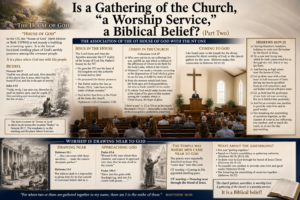
 The House of God
“House of God”
When Israel came to their temple to worship, they recognized that it was where God dwelt. The Old Testament (OT) already established it as the “house of God.” In the OT, the “house of God” (Beth Elohim or Beth YHWH) is not mainly a building or a meeting space. It is the literal localized dwelling place of God’s earthly presence among His covenant people. Maybe you see the term “Bethel” in the OT, a compound Hebrew word that means “house of God” (Beth = “house,” El = “God”). The Bible uses “House of God” 90 times. It is an emphasis that stretches across all of scripture, OT and New Testament (NT).
Bethel
The first occasion of “house of God” is when Jacob names the location “Bethel” in Genesis 28:17. So, he called the place “house of God,” where there was no house, no building. The original understanding was a place where God met with His people, or in this case, with His person, Jacob. The emphasis is on the meeting and the place where it occurs. The site of his dream is also a prophetic picture of Christ (cf. John 1:51):
And he was afraid, and said, How dreadful is this place! this is none other but the house of God, and this is the gate of heaven.
Jesus tells Nathaniel in John 1:51:
Verily, verily, I say unto you, Hereafter ye shall see heaven open, and the angels of God ascending and descending upon the Son of man.
In the dream, the Lord (Yahweh) stands above the ladder and speaks to Jacob, reaffirming the Abrahamic covenant. While Jacob does not see a physical human manifestation on earth during this specific event, the Person speaking from heaven is the eternal Word, the pre-incarnate Christ, who reveals the Father to mankind. Just as the ladder connected earth to heaven, Jesus bridges the gap between God and humanity.
The Association of the OT House of God with the NT One
Jesus in the House
The Lord Jesus and then the Apostles associate or join the OT reality of the house of God or the Father’s house to the NT. When Jesus said this was His assembly (“my assembly,” Matthew 16:18), He put His imprimatur upon this corporate body. It is easy to see how He made this transference from the OT body to the NT one. He gave the NT one the keys of His kingdom and the authority to loose and to bind. He also promised His divine presence. The Father said to the Son in Psalm 110:2, present tense, “rule thou in the midst of thine enemies.” How did the Lord Jesus fulfill this command?
The Apostle Paul writes that He is the Head of the body, the church (Ephesians 5:23; Colossians 1:18). A direct path proceeds from the OT to the NT, from the authority over the congregation of Israel to the church, between Psalm 110:2 and Ephesians 5:23 and Colossians 1:18. As the Head of the body, Jesus is also present. Jesus said that in Matthew 18:20, 28:20, and Revelation 1:19-2:1. Someone should include the Spirit of Christ references (Romans 8:9, 1 Peter 1:11) with those.
Christ In the Church
Consider Colossians 1:24-27:
24 Who now rejoice in my sufferings for you, and fill up that which is behind of the afflictions of Christ in my flesh for his body’s sake, which is the church: 25 Whereof I am made a minister, according to the dispensation of God which is given to me for you, to fulfil the word of God; 26 Even the mystery which hath been hid from ages and from generations, but now is made manifest to his saints: 27 To whom God would make known what is the riches of the glory of this mystery among the Gentiles; which is Christ in you, the hope of glory.
When Paul writes, “Christ in you” in verse 27, he is saying, “Christ in the church,” because “you” is a plural pronoun. Christ is in them, “his body,” “which is the church.” Revelation 1:19-2:1 says that seven golden candlesticks are the seven churches, which represent all true churches through the entire church age. Then John in 2:1 writes that Jesus walks in the midst of those seven golden candlesticks.. In other words, He walks in the midst of, right in, His true churches. This is how Jesus can observe everything He reported to those seven churches in Revelation 2-3.
Like Israel came to the temple for the divine presence for direct worship of God, so the church gathers for the same. Hebrews makes this connection too in one of the most prominent NT church passages in Hebrews 10. In Hebrews 10:19–25, the writer synthesizes the redemptive work of Jesus Christ into an imperative for worship. The passage directly contrasts the restricted, shadow-based ritual of the Old Covenant Levitical system with the direct, bold access granted under the New Covenant, culminating in the corporate “assembling together.”
Worship Is Drawing Near to God
Drawing Near
Hebrews repeatedly connects worship with drawing near. Hebrews 10:1 says, “. . . they can never with those sacrifices. . . . make the comers thereunto perfect.” The “comers” are worshipers approaching God. Later, Hebrews 11:6 uses the same language:
But without faith it is impossible to please him: for he that cometh to God must believe that he is. . . .
Coming to God is the worshiper’s approach into God’s presence. It is more than conversion. It is continual access to God through Christ. Under the OT, coming to God meant coming to His dwelling place. No Israelite simply “came to God” in an abstract sense. He came to God by coming to God’s appointed dwelling place with the prescribed sacrifice. For example, Psalm 65:4 says:
Blessed is the man whom thou choosest, and causest to approach unto thee, that he may dwell in thy courts.
Approaching God
Approaching God meant approaching His courts. Likewise, Psalm 100:4 says,
Enter into his gates with thanksgiving, and into his courts with praise. . . .
The temple was where men came near to God. That is why the priests were repeatedly described as those who “come near” unto the LORD. Leviticus 21:17 evinces: “. . . . which hath any blemish, let him not approach to offer the bread of his God.” The priest literally approached God by ministering in the sanctuary.
Hebrews Takes This Temple Imagery and Applies It to Christ
Hebrews 7:25 says:
Wherefore he is able also to save them to the uttermost that come unto God by him, seeing he ever liveth to make intercession for them.
Coming to God is no longer by Levitical priests. It is by Christ. He is the High Priest who brings His people into God’s presence. The assembly is the place where the church draws near together. This becomes especially interesting when Hebrews reaches 12:22-24
But ye are come unto mount Sion, and unto the city of the living God, the heavenly Jerusalem. . . To the general assembly and church of the firstborn. . . . And to God the Judge of all. . . . And to Jesus the mediator of the new covenant. . . .
The writer does not say believers will someday come. He says, “Ye are come.” Just as Israel assembled at Mount Sinai and later at Zion before God’s earthly dwelling, the New Testament church comes to the heavenly Zion through Christ. Notice what is all together in this passage: Mount Zion, the heavenly Jerusalem, the general assembly, the church, God, and Jesus the Mediator. The church’s gathering is presented as entrance into the heavenly sanctuary. It’s that real and that serious.
Old Testament Background: Approach and Restriction
No OT Drawing Near
Under the Levitical order, worship was characterized by distance, barrier, and perpetual remembrance of sin rather than its removal. Access to the Holiest of all was restricted exclusively to the High Priest, once a year on the Day of Atonement (Yom Kippur), carrying the blood of bulls and goats. In the Septuagint and the Levitical law, the verb προσέρχομαι (proserchomai) is the technical term used for a priest approaching the altar or sanctuary to offer sacrifice (e.g., Leviticus 21:17, 21:21). The common Israelite could not “draw near” past the outer court under penalty of death.
Hebrews 10:19–20 transforms the Levitical terminology from a restricted priestly duty into a privilege shared by all believers:
Having therefore, brethren, boldness to enter into the holiest by the blood of Jesus, By a new and living way, which he hath consecrated for us, through the veil, that is to say, his flesh;
In ancient Greek, parrhēsia (boldness) denotes freedom of speech or unreserved openness. In the OT sanctuary, the High Priest entered the Holy of Holies with fear and clouding incense to hide the mercy seat. Under the New Covenant, believers enter the true sanctuary with outspoken, unhindered confidence based entirely on the blood of Jesus.
Drawing Near through the New and Living Way
πρόσφατον (prosphaton), “new and living way” in verse 20 derived etymologically from pros (toward) and pheinō/sphazō (to slay), originally meaning “newly slain.” While in Koine Greek it carries the sense of “recent” or “new,” the underlying sacrificial nuance highlights that Christ’s sacrifice remains perpetually fresh and effectual, unlike the repeated, decaying sacrifices of the OT.
ζῶσαν (zōsan), “living,” contrasts with the dead animal sacrifices and the inanimate stone or curtain structure of the earthly tabernacle. The way itself is alive because it is mediated through the resurrected Christ. The veil of the temple was torn at Christ’s death (Matthew 27:51). The writer equates the veil spiritually to His “flesh” — the physical barrier that was broken to open access to God’s presence.
The Manner of New Testament Worship: Three Exhortations
Having established the opened way, Hebrews 10:22–25 shifts to three practical exhortations (“Let us…”) detailing the manner of NT worship, grounded in OT priestly ritual imagery. One, “Let us draw near,” is the hortatory subjunctive of proserchomai. What was once strictly forbidden to the congregation under the Mosaic Law is now commanded for every believer. The imagery explicitly parallels the consecration of Aaron and his sons in Exodus 29:4, 21, and Leviticus 8:6, 30.
The sprinkling of the blood cleanses the inner conscience (“hearts sprinkled from an evil conscience”), fulfilling the antitype of the OT sacrificial blood applied to the altar and priests. The washing of the body cleanses the outer person (“bodies washed with pure water”), echoing the OT priests washing at the laver before entering the tabernacle. In typology, not reality, the washing at the laver corresponds to New Testament baptism. The entrance into the temple comes first through a sacrifice and second through a washing.
Corporate Assembly: The Gathering of the Priestly Body
The individual right of access (“draw near”) immediately expands in verse 25 into corporate responsibility (“assembling together”). God executes direct access to Himself not in isolation, but within the gathered covenant community.
Not forsaking the assembling of ourselves together, as the manner of some is; but exhorting one another: and so much the more, as ye see the day approaching.
ἐπισυναγωγή (episynagōgē), translated as “assembling together,” intensifies with the prefix epi- (upon/towards) the base noun synagōgē. While synagōgē referred to the traditional Jewish local gathering or building, the writer uses episynagōgē to designate the distinct, intentional Christian assembly gathered around the resurrected Christ.
Contrast in Worship Manner
In the OT, the congregation stood outside in the court while the priest acted as a representative inside. The people were passive observers of a mediated ritual. In the NT, the entire congregation enters the “holiest” together. Because every believer is now part of the royal priesthood, gathered worship (ἐπισυναγωγή) is the mutual exercise of this access, exhorting, encouraging, and maintaining faith together in light of “the day approaching.”
For over 1,000 years, every Jew knew one absolute rule about the Holy of Holies: If you go in there, you die. Only the High Priest could enter, only once a year (Yom Kippur), and only with a cloud of incense to obscure the Mercy Seat so he wouldn’t gaze directly on God’s presence and perish (Leviticus 16:13). The average Jew stood in the outer court, separated by massive stone walls and thick veils.
Hebrews 10 speaks directly to this ingrained fear of divine judgment: “If I abandon the Temple and join this new group, am I committing sacrilege? Am I trespassing where only priests can go?” The writer shows that entering God’s presence through Christ is not a violation of God’s holiness, but the ultimate fulfillment of it. Because Christ’s blood is infinite — unlike the temporary blood of bulls — it grants genuine parrhēsia, an unreserved “boldness” or right of speech before God (Hebrews 10:19). They aren’t gatecrashing. The True High Priest invites them in.
It Resolves the Problem of an Ineffective Conscience
Every Jew knew the cycle of the Mosaic Law: sin, sacrifice, temporary relief, repeat. As Hebrews 10:2–3 notes, those annual sacrifices acted as a “remembrance again made of sins every year,” a constant, nagging reminder that the problem of sin had never actually been cured, only covered over (kopher). This addresses the hesitation of a fence-sitting Jew in the audience: “Does this Jesus really offer something better than the ancient sacrifices given to Moses on Mount Sinai?” The writer uses priestly consecration language that every Jew understood.
In verse 22, he speaks of having “our hearts sprinkled from an evil conscience, and our bodies washed with pure water.” Under the OT, priest washing and blood sprinkling only made a person ceremonially clean to stand in an earthly court. In Christ, the internal conscience is clean once and for all. God in Hebrews offers the Jewish fence-sitter freedom from the perpetual burden of sacrificial guilt.
It Replaces the Physical Temple with a Superior “Assembly”
One of the hardest psychological hurdles for a first-century Jew considering the church was the loss of the physical temple in Jerusalem with its grand architecture, golden altars, visible priesthood, and heritage. The early church met in homes and gathered informally, which to an observer might have looked unsophisticated or illegitimate. Again, the fence-sitting Jew thinks: “Where is your temple? Where is your altar? If I leave the Synagogue and the Temple, I am leaving the divine institution.”
The writer reframes the episynagōgē, “assembling together,” in verse 25. Under the Old Covenant, the congregation stood outside while one man went inside. Under the New Covenant, the Christian assembly is the place where heaven and earth meet. When believers assemble, they are not meeting outside a physical building; they are together stepping past the veil into the true heavenly sanctuary (Hebrews 10:20). By joining the local assembly, the Jew isn’t stepping down from glory into obscurity; they are stepping out of shadows into reality.
It Leverages the Impending Crisis
When Hebrews was written, the political and religious tension in Jerusalem was reaching a boiling point, leading up to the Roman destruction of the Temple in 70 AD. In Hebrews 10:25, the writer urges them to assemble and exhort one another “so much the more, as ye see the day approaching.” To a Jew watching the geopolitical instability around Jerusalem, this phrase was a prophetic warning. The physical Temple and its Levitical system were about to be shaken and removed (cf. Hebrews 12:27).
The writer is essentially saying: “The earthly shadows are crumbling. Don’t cling to an institution that is about to pass away. Step into the unshakeable, new, and living way before the storm hits.” When you read, “the day approaching,” you should permit yourself to think of the return of Jesus Christ. The day approaching is a divine visitation of God’s judgment. You read a regular dual fulfillment of this in the Old Testament. In Isaiah 13, it’s obvious that the day of the Lord is more than just the shorter-term judgment of the Babylonian empire, but the future destruction prophesied in Revelation 18.
Does someone wish that Christ finds him not drawing near in the NT temple in the worship of assembling together with His church? The answer is an unequivocal, “No!” Just like God required perfect attendance to the worship meetings of the Old Testament congregation, He would of His NT one too. Meeting in the OT wasn’t optional. Neither is it in the NT.
Worship Is the Church’s Primary Activity
The Old Testament temple was not primarily a lecture hall or civic center. It existed for worship. Likewise, because the New Testament church is God’s temple, its assemblies are worship assemblies. Everything done in the gathering contributes to that worship. God regulated the offerings of the OT temple. He did not permit alternatives or syncretism. In like manner, God expects the NT temple to regulate its offerings according to scripture, especially and first in its elements:
- prayer,
- singing,
- reading Scripture,
- preaching,
- giving,
- observing the ordinances,
- mutual exhortation,
- and obedient submission to God’s Word.
Each activity is part of the church’s priestly service before God.
God’s Presence Makes the Assembly Holy
In the Old Testament, the temple was holy because God dwelt there. The same is true of the church. As the Apostle Paul writes in 1 Corinthians 3:16:
Know ye not that ye are the temple of God, and that the Spirit of God dwelleth in you?
Because God dwells in His assembled church, its meetings are sacred. The church does not manufacture God’s presence through music, emotion, or ceremony. Rather, because it is God’s temple, His presence sanctifies the assembly, making it an occasion of worship.
The New Testament consistently presents the church as the fulfillment of the Old Testament temple. The church is the house of God (1 Tim 3:15). It is a spiritual house in which God’s priesthood offers spiritual sacrifices (1 Pet 2:5). The chief sacrifice each believer brings is himself, presented to God as “a living sacrifice, holy, acceptable unto God” (Romans 12:1).
For this reason, the assembling of the church is not merely a meeting for instruction or fellowship. It is, by its very nature, a worship service. As God’s temple, the assembled church gathers before His presence to offer itself to Him in reverence, obedience, praise, prayer, thanksgiving, and submission to His Word. The New Testament assembly stands in continuity with the Old Testament temple: not in outward form, but in its central purpose — to be the place where God dwells among His people and receives their worship.
More to Come
Thank you brother Brandenburg for taking the time to study and write about this topic. I can’t help myself but to agree with what you have expounded upon. I think I’m experiencing a bit of cognitive dissonance. The teaching that I have been exposed to says things like, “A Christian worships God 24/7”; “Anywhere the Christian prays is an altar”; “A Christian can worship God anywhere and at anytime”; “We worship in spirit and in truth, it’s the new and living way”. Forgive my ignorance, is worship in both OT & NT only corporate? Also, out of curiosity, why do you think there is amongst our brethren a resistance to call a church service a worship service? Is it simply to disassociate and distance ourselves from new-evangelical “worship”?
Thanks Scott. I’m glad you’re interested in this. The assembly is required and unique in the worship life of God’s people. God will not receive individual worship from the one who will not submit to the corporate worship of His covenantal people. Like Romans 12:3 says, this person thinks more highly of himself than he ought to think. There is a basis for individual worship too, which is important. Someone who sincerely — in spirit — worships God individually is not someone who doesn’t do church. The individual worship will proceed from the corporate. Scripture shows this. I do get how that it seems that corporate alone is worship though from what I’ve written so far. I’m not done yet here. There is a greater seriousness to corporate worship, even as we see sharper, greater penalties for coming to God illegitimately in corporate worship, violating what God said. Thanks for asking though.
It may be a pendulum swing from those who have hijacked worship for their own purposes. The utilization of ecstasy and in a subjective, individualized, preferential manner, which we also see throughout scripture in false worship, should not throw out corporate worship. Apostasy takes about everything right and syncretizes or corrupts it. Love is sentimentalism, faith is presumptousness, grace is persmissiveness, holiness is haughtiness, etc. There are many other examples. Thanks.
Hi Brother Kent,
I have been reading your articles here, and I have 2 questions to make sure I understand the way things work:
1. On the cause of rejection of individual worship: When God refuses to receive the individual worship of someone who refuses to assemble, is He rejecting it-
a. morally—because an unrepentant, rebellious heart hinders prayer—
Or
b. structurally—because individual worship is inherently invalid on its own apart from the corporate temple of the local church?
In other words, is assembling with a local church simply a biblical command to be obeyed (where willful rebellion hinders prayer, like any other sin), or is the local church an indispensable structural conduit without which private worship cannot validly reach God?
2. On believers in non-Baptist churches: If a born-again Christian genuinely loves Christ and walks in daily obedience, but attends a non-Baptist assembly (such as a Presbyterian or non-denominational church, but one that is not doing things right):
a. Is that local church recognized by God as a true “temple” assembly?
b. If not, is that individual believer’s worship privately at home acceptable to God?
Thanks.
Hi Brother Kent,
I just finished reading your second article. Scott Ashley sent me the link. I have a question.
How does this effect those non-Baptistic churches. Say someone is not in a church that we approve and yet they are genuinely saved.
Is their assembly considered temple worship?
I saw your response to Brother Scott’s answer where you said, “The individual worship will proceed from the corporate.”
It made me think of this question, if the person is not a part of us, as a non-baptistic church member who is personally in love with Christ and obedient, does God recieve their worship?
Hi Troy,
Based on what I read all over the Bible, God doesn’t accept unscriptural worship just because someone has a strong feeling or seems to mean well. If someone is shown scripture and won’t follow it, because he’s not convinced, does he get a pass for not believing it or practicing it? Lofe in the bible ties into the truth always. Someone loves in the truth. Here’s someone, he really, really loves Jesus, just doesn’t believe or do what He says. 1 John 5 says loving God is keeping what He says. It’s not going to help Presbyterians to say they’ll be okay like they are. I think this thinking comes out of uncertainty aobut the Word of God, either its inspiration, meaning, preservation, etc. Since we really can’t surely know, then people who believe and do wrong can’t be held responsible.
“Mr. Ken, what are your thoughts if someone says that church gatherings shouldn’t be called ‘worship’, citing John 4:23? They claim that Christian worship is our entire way of life. Therefore, gathering at church shouldn’t be called worship, but rather a service, because our worship is no longer limited by the physical body, but is in spirit.
I’d love to hear your thoughts on this. Thank you!”
Your question gets answered in part 5, which is why I didn’t answer this comment.