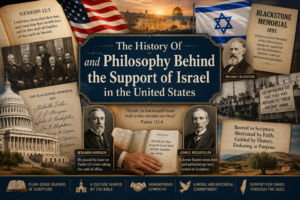
 The Charge Against American Support for Israel
Modern Criticisms of Zionism
Some people today want to see the United States drop its support of Israel. For example, recently, outgoing Republican Congressman Thomas Massie referred to Israel as the “biggest welfare recipient of the United States.” Some anti-Israel proponents say the United States’ support proceeds from Jewish conspiracies. This includes the Rothschilds’ funding of Scofield’s reference Bible. They say dispensationalism was a deceived and heretical movement that arose in the 19th century. It led to the excessive support of Israel in the United States.
The Essay’s Thesis
Commentary and historical analysis suggest that ordinary, non-elite church-going Protestants, especially Baptists and other Bible-oriented believers, supported Israel, and, hence, Zionism, through straightforward, devotional Bible reading rather than elaborate premillennial prophecy frameworks. This “plain-sense” or cultural biblical familiarity with the Old Testament (stories of Abraham, Moses, the Promised Land, etc.) fostered a general sympathy for Jewish historical claims to Palestine/Israel.
The Biblical Roots of American Sympathy for Israel
Plain-Sense Reading of Scripture
Historians and observers describe a pervasive “Bible Belt” or mainstream Protestant ethos in America where everyday church-goers absorbed narratives of Israel’s ancient covenant and restoration. This created instinctive support for a Jewish homeland as fulfilling scriptural patterns, without needing dispensational charts or Rapture theology. Ordinary Baptists and others shared an outlook of the Bible as a straightforward moral and historical guide. While premillennial views amplify this in evangelical circles today, historical commentary evinces that simpler devotional reading was long the baseline factor among rank-and-file churchgoers.
Israel in American Religious and Political Culture
Post-Civil War (roughly 1865-1940s) American support for Jews and Zionism was evident in religious, cultural, political, and diplomatic spheres, driven by a mix of Protestant, evangelical, and Baptist biblical beliefs, humanitarian sympathy, and strategic/nationalist interests. This support predated modern political Zionism (Theodor Herzl, 1890s) and helped lay the foundations for later U.S. policy toward Israel. Antisemitism existed alongside it in minority factions, but congressional actions, prominent figures, and public efforts showed notable backing for Jewish restoration to the land of Israel.
The Blackstone Memorial
In 1891, many prominent Americans (including Chief Justice Melville Fuller, J. P. Morgan, John D. Rockefeller, etc.), representing many others, signed the Blackstone Memorial, a petition urging President Benjamin Harrison to support Jewish settlement in Palestine under an international guarantee. It predated Herzl’s formal Zionism and framed it as a humanitarian solution to European Jewish persecution. Earlier roots trace to 19th-century figures, clergymen and writers, who promoted “restorationism.”
Benjamin Harrison
Benjamin Harrison was a deeply religious Presbyterian. When Blackstone presented a petition talking about restoring the biblical people to their biblical land, it resonated perfectly with Harrison’s personal worldview. His respect for biblical teachings was so profound that when he took the oath of office as President, he chose to place his hand specifically on Psalm 121, which contains the line:
Behold, he that keepeth Israel shall neither slumber nor sleep.
From a Lifetime Familiarity with Scripture
William E. Blackstone himself was a premillennial dispensationalist. Very few signers of his Memorial were. In Gilded Age America, the Bible was the foundational text of cultural literacy. Even for leaders who did not share Blackstone’s end-times theology, a lifelong familiarity with scripture made the petition’s core concept feel historically natural, morally just, and deeply familiar. When Blackstone drafted the Memorial, he used phrases that subtly triggered the biblical memory of his readers without sounding like a sermon. He famously wrote:
Why not give Palestine back to them again? According to God’s distribution of nations it is their home, an inalienable possession. . . .
To a 19th-century American political or business elite, the phrase “God’s distribution of nations” directly recalled the Genesis covenants made with Abraham, Isaac, and Jacob. Because they grew up respecting the Old Testament, the signers readily accepted the premise that the Jewish people had a unique, enduring historical claim to that specific piece of land.
Rockefeller as a Signer of the Blackstone Memorial
John D. Rockefeller Sr. (1839–1937) was not a dispensationalist. He was a devout Northern Baptist with conservative evangelical leanings typical of 19th-century Protestantism, which emphasized personal piety, Bible reading, tithing, Sabbath observance, and philanthropy rooted in scripture. There is no evidence he subscribed to dispensational premillennialism. Among regular Protestant and Baptist attenders, knowledge of the Bible was often devotional and narrative-focused (Abraham, Exodus, Promised Land, prophets) rather than systematic theology or prophecy timelines.
The Bible in Everyday American Church Life
Brought Restorationist Sympathy
Pastors and educated elites might debate dispensationalism, but this did not filter down uniformly to the pews. Average believers absorbed a simpler “God keeps His promises to Israel” outlook from sermons, Sunday school, and family Bibles. Hymns, sermons, and devotional literature emphasized God’s faithfulness, biblical literalism in narrative sections, and sympathy for the “children of Israel.” This fostered instinctive support for Jewish return without requiring dispensational frameworks. Restorationist sympathy grew from biblical stories plus real-world events more than from elite theology.
A Devotional Approach to Scripture
The weight of the evidence indicates that average American Protestants supported Jewish restoration primarily through a plain-sense, devotional approach to the Bible, seeing God’s promises to Abraham’s descendants as ongoing and just, rather than precise eschatological systems. This simpler foundation was sufficient to generate sympathy and policy influence. Sophisticated dispensationalism was more influential among leaders and motivated subgroups than the typical churchgoer.
Israel Support As Represented Among Presidents of the United States
John Adams to William Howard Taft
John Adams, in private correspondence, expressed hope for the restoration of Jews to Palestine as an independent nation, viewing it as justice and aligned with prophecy. James Madison and James Monroe both showed general sympathy for Jewish rights and restoration ideas circulating in early American Protestant thought. Teddy Roosevelt signed the Blackstone Memorial. He backed the idea of a Jewish homeland as a refuge, and his public profile helped legitimize restorationist ideas among elites and the public. Roosevelt helped transition restorationist sentiment into practical foreign policy support.
President Benjamin Harrison received the Blackstone Memorial in 1891. While he took no formal action, the petition was respectfully received, and his administration engaged with the idea. This marks an early presidential interaction with organized Christian Zionist/restorationist advocacy. Before becoming president, William McKinley signed the Memorial. As president, and later, William Howard Taft expressed sympathy for Jewish causes and a homeland. He supported relief efforts and was generally favorable toward Zionist aspirations.
Woodrow Wilson to Harry Truman
In 1916, at the urging of Louis Brandeis, the United States Supreme Court justice, American businessman Nathan Straus contacted Blackstone to prepare a second Memorial for President Woodrow Wilson. The goal was to build American support for the developing Balfour Declaration. The second Memorial secured endorsements from mainstream Protestant groups (e.g., Presbyterians) and was presented privately to Wilson, helping sway him to signal U.S. sympathy to Britain.
President Warren G. Harding signed the Lodge-Fish Resolution in 1922, which formally endorsed the Balfour Declaration and a Jewish national home in Palestine. Calvin Coolidge continued support for the Lodge-Fish framework and expressed sympathy for Jewish aspirations. He signed “The Anglo-American Convention on Palestine,” a covenant with Britain that recognized the British Mandate over the land of Israel. The Convention was characterized by Coolidge as a reflection of his sympathy with
the deep and intense longing which finds such fine expression in the Jewish National Homeland in Palestine.
Herbert Hoover publicly backed a Jewish homeland. President Harry S. Truman overruled State Department opposition to recognize the State of Israel just 11 minutes after its declaration in 1948. He cited biblical history and is often described as acting on a restorationist impulse rooted in plain Bible reading.
Just Plain Reading
The support from American presidents of the United States did not arise from their dispensationalism or premillennialism. Not a single United States president or even Supreme Court justice was a dispensationalist or premillennialist. The history of the United States is that a majority of church-goers have no defined doctrine of last things. I don’t write that proudly. Scripture is plain about the end of all things. Whatever influence the Bible has for the support of Israel’s right to its land comes from a general reading or knowledge of scripture, not a system of biblical hermeneutics.
No doubt today a sympathy exists in the United States for the Jews and for their homeland in Israel, that also fueled dispensational and premillennial belief. Those supportive would say, “It’s just Bible.” In the 2006-2007 edition of Pew Research, 44% of Americans said they believe God gave the land that is now Israel to the Jewish people. According to one 2017 survey from Southern Baptist publisher LifeWay, 8 in 10 evangelicals believe that “God’s promise to Abraham and his descendants was for all time.”
Not a Jewish Conspiracy
Jews Actively Opposed Zionism
Support for Israel possessing its own homeland, a national Israel, in the United States proceeds from an underlying biblical thinking at the bottom of Americanism. This is a shrinking viewpoint today, but it still fuels Israel support. It’s important to know that this was not a Jewish conspiracy, because a vast majority of Jews did not support Zionism before the Holocaust. Before the rise of Nazi Germany in the 1930s and the subsequent horrors for Jews, most Jewish communities actively opposed or were indifferent to Zionism, choosing several alternative paths for their future.
Reasons for Jewish Opposition to Zionism
In Western Europe and the United States, emancipated Jewish people largely believed that the solution to antisemitism was integration. They viewed themselves as loyal citizens of their respective nations who happened to practice Judaism. To them, political Zionism was dangerous because it threatened to trigger accusations of dual loyalty. In the early 20th century, the most powerful Jewish political organization in Eastern Europe, where the majority of Jews lived, argued that Jews should stay in Europe and achieve equal rights where they lived, rather than escaping to Palestine.
The overwhelming majority of Orthodox and Hasidic rabbis at the time strongly opposed political Zionism on theological grounds. Traditional Jewish law held that the Jewish people were exiled by divine decree and could only return to the Land of Israel en masse under the leadership of the Messiah. Religious leaders viewed it as a heretical attempt to force the hand of God and usurp a divine prophecy through human politics. Other Jewish groups sought self-determination but rejected Palestine as a realistic or safe option.
Non-Jews Trying to Convince Jews of Zionism
Before the Holocaust, it was mainly non-Jews who attempted to convince Jews to return to Palestine or Zionism. A lot of different immigration policies of various nations with a Jewish population supported sending Jews to their own land as a solution. The Lodge-Fish Resolution of 1922 committed the U.S. government to support a Jewish National Homeland in Palestine. Advocating for Zionism perfectly aligned with Henry Cabot Lodge’s immigration goals. By pushing this document, Lodge could frame himself as a humanitarian champion for persecuted Jews abroad while ensuring they had a destination other than the United States.
Rothschilds Split on Zionism
Only about 15 percent of American Jews were Zionist in 1922. American Jews did not spur the restorationist view in the United States. Zionism wasn’t even the position of all of the Rothschilds. Sir Conyers Shirley and Leopold de Rothschild helped found the League of British Jews, an organization dedicated to fighting political Zionism. The latter was the head of the British Rothschilds bank. They argued passionately to the British cabinet that Judaism was a religious faith, not a nationality, and that establishing a Jewish state would inadvertently validate antisemitic claims that Jews didn’t truly belong in Europe.
Scofield Reference Bible Not Jewish At All
Jews did not fund the Scofield Reference Bible at all. Jews historically would oppose dispensationalism. They didn’t need saving, in their opinion, very much like in the days of Jesus on earth. The actual project was funded and brought to life entirely by a small group of wealthy, devout Christian businessmen. They shared Scofield’s passion for dispensational theology and wanted to provide everyday readers with an accessible study Bible. Henry Frowde, of the Plymouth Brethren, was called “Publisher to Oxford University Press,” and he secured this prestigious press to publish Scofield’s Reference Bible in 1909.
Factors for Greater Support of Zionism
A literal approach to the Bible, grammatico-historical, Old Testament priority, plain reading of the text, led to greater support of Zionism. It didn’t start with the systematization of dispensational theology. Neither was it funded by Jews. Other factors contributed: humanitarianism, atrocious treatment of the Jews in Russia, Germany, and across Europe, and national immigration policies. A conservative, more isolationist foreign policy supports nation-states over the existence or reality of empires.
Jewish Culture
As much as Americans support Jews, very often Jews themselves do not and cannot integrate into Americanism. I’m not saying they all can’t, but someone could make a good argument that a majority won’t and don’t. It’s not just them. Many in the late 19th and early 20th century United States believed that as well. This wasn’t antisemitism. This was reality. The natural outgrowth of that fundamental belief about all people groups would support a homeland for the nation Israel. Today, I believe that the United States itself has more in common culturally with the Jews in Israel than it does with American Jews.
Proper or Rightful Division of Land
The land of Israel today is .4% of the former Ottoman Empire at its peak. On the other hand, Muslims control 85%-90% of the land mass of that former empire. A former conservative view of the world said that the world works and functions better and more peacefully when each people group – tribe, ethnicity, or language – has its own land and can govern it in and for its own self-interest. This is the historically conservative view, albeit not the position of all contemporary conservatives.
Conservative Argument Related to Nation States
Separate Peoples within their Own Borders
Like Henry Cabot Lodge, many conservatives believed and now believe that multi-ethnic, multi-linguistic empires or states are naturally prone to internal friction and instability. They argue that human beings are naturally tribal, and that “good fences make good neighbors.” Forcing entirely different cultures into the same political system breeds conflict; giving each group its own sovereign home lets them protect their own traditions in their own self-interest. Based on that, Israel too should have its own land.
Historically, the belief that the world functions best when distinct ethnic or language groups have their own borders is conservative in its anthropology. This means that it shares the traditional conservative view that human beings are inherently tribal, deeply tied to their ancestors and soil, and that a stable society requires deep, organic cultural homogeneity rather than abstract political ideas. Conservative thinkers argued that human beings are not interchangeable units. They are shaped entirely by their specific landscape, language, ancestral bloodlines, and ancient traditions.
Constitutional or Founder Parallel with States’ Rights
The principles behind this philosophy—that a distinct group of people thrives best when it governs itself according to its own self-interest and unique cultural character—are heavily present in the states’ rights arguments of the Founding Fathers. To the Founders, a “state” was not just an administrative boundary; it was a distinct political community with its own unique history, religious baseline, economic interests, and way of life. They fiercely believed that forcing these distinct communities into a monolithic, centralized government would inevitably destroy their liberty.
In Anti-Federalist No. 14, the writer Brutus wrote:
In a republic, the manners, sentiments, and interests of the people should be similar. If this be not the case, there will be a constant clashing of opinions; and the representatives of one part will be continually striving against those of the other.
The Founders recognized that a merchant in Massachusetts, a small farmer in Pennsylvania, and a plantation owner in South Carolina had completely different languages of commerce, local habits, and moral outlooks. They argued that if a distant federal government tried to pass blanket laws over all of them, it would breed perpetual political warfare.
Versus Liberalism
The thinkers of the French Revolution and the Enlightenment (early liberals) believed in universalism. They argued that all human beings are fundamentally the same, governed by abstract “Rights of Man.” They believed you could take any group of people, erase their history, and build a perfect society based purely on reason and universal laws. The father of modern conservatism, Edmund Burke, famously mocked this idea. He noted that he had met Frenchmen, Italians, and Englishmen, but he had never met this abstract “universal man” the liberals kept talking about.
In Conclusion
I see Jews as their own nation. Even when I listen to conservative Jews, they very often still seem foreign. I love them, like I love Italians, even more so, because I do know that they are God’s people. However, they should have their own land to live like who they are and aspire to be. I understand the desire of American Jews to live here. The world hasn’t allowed or made Israel a safe place to live for its people.
All nations, including Israel, will not fit, harmonize, or work together until Jesus saves all of those in His kingdom, and they dwell together in complete harmony. This would, will, and could never happen until the Lord Jesus Christ comes back.
I appreciate the push-back against the idea that belief in the right of the Jewish people to the land God had given them came from a slavish love of systematic dispensational theology. I suspect most such supporters today have little more understanding of systematized dispensational thinking, despite the myriad more publications and podcasts explaining it; to suppose that in a world with far less widely-available information, that everyone was just jumping on the theological bandwagon is just disingenuous. For the vast majority of Christians who support a national home for Jews in the land that God gave to their forefathers, it is just the natural result of believing God’s Word never changes.
Thanks Adam! And I’m not done writing on the subject. I had a little more to go in a previous very related series.