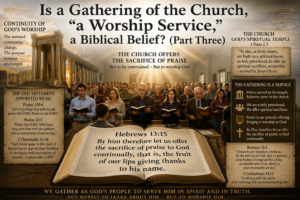
 How should singing and playing in the church be understood? Does sacred music somehow become less worship under the New Covenant than it was under the Old? Has God transformed what was once a priestly offering into a merely educational exercise? Has congregational praise lost its sacrificial character simply because Christ fulfilled the ceremonial system? The answer of scripture is no.
The Bible presents remarkable continuity between the worship of God’s covenant people under the Old Testament (OT) and under the New (NT). The outward ceremonies change. For instance, animal sacrifices cease because Christ has fulfilled them. A unique caste of priests gives way to the priesthood of all believers. A tangible temple yields to a gathering of true believers. Yet the essential purpose remains unchanged. God’s people assemble before His presence to offer Him acceptable worship according to His own prescription. Music belongs to that worship.
The Direct Association of OT with NT
When Christ explained His own ministry, He did not present Himself as beginning an entirely new religion. Instead, He repeatedly appealed to Moses, the Psalms, and the Prophets as explaining His work. After His resurrection, He taught His disciples “beginning at Moses and all the prophets,” showing “the things concerning himself” (Luke 24:27). Later He summarized the entire OT by saying (24:44),
All things must be fulfilled, which were written in the law of Moses, and in the prophets, and in the psalms, concerning me.
No NT writer approaches worship as though the OT had nothing to contribute. This principle becomes especially important when discussing sacred music. Suppose someone asked an Israelite why music accompanied the sacrifices in the temple. He would not answer, “To prepare the people for the sermon.” Nor would he answer, “Primarily to educate the congregation.” He would answer that the music belonged to the worship of God. The burden of proof therefore rests upon anyone who claims that this understanding fundamentally changed under the New Covenant.
Did Christ abolish sacred praise? Did He transform priestly music into something essentially different? Or did He fulfill and elevate what the temple had always anticipated? These questions cannot be answered merely by counting occurrences of the English word worship in the NT. Such a method ignores the entire structure of biblical theology. Throughout scripture, many activities constitute worship without being labeled “worship” every time they occur.
The Continuity of OT and NT Worship
Prayer is worship. Giving is worship. Offering sacrifices was worship. Burning incense was worship. Reading God’s Word was worship. Preaching God’s Word is worship. Likewise, singing praise to God is worship. The activity derives its character not because scripture repeatedly attaches the noun “worship” to it, but because it is offered directly to God according to His prescription within His appointed assembly.
The assembled church stands in direct continuity with the OT temple. If that is true, then the activities performed within that assembly must likewise be understood through the temple pattern unless the NT explicitly teaches otherwise. The NT nowhere teaches that sacred praise has ceased to be worship. Instead, it assumes the very opposite.
Indeed, one discovers that the entire OT presentation of sacred music prepares the reader to understand the church’s singing as one of its principal priestly sacrifices before God. That foundation begins not with David but with God’s own appointment of music in connection with His dwelling place.
Hebrews 13:15 In Its Context in Hebrews
The Sacrifice of Praise: The Church Continues the Priestly Worship of the Temple
Hebrews 13:15 plainly demonstrates that congregational praise is worship. After spending twelve chapters explaining how Jesus Christ fulfilled the OT priesthood, sacrifices, tabernacle, and covenant, the writer concludes by describing what believers now offer in the NT. He writes:
By him therefore let us offer the sacrifice of praise to God continually, that is, the fruit of our lips giving thanks to his name.
This verse is not an isolated devotional statement. It is the culmination of the argument of the entire Epistle to the Hebrews. If someone removes Hebrews 13:15 from everything that precedes it, he misses its force. The writer has spent the entire book demonstrating that the ceremonial worship of the Old Covenant has not disappeared into nothingness. Rather, it has reached its fulfillment in Christ. Therefore, when he finally speaks of “the sacrifice of praise,” he deliberately uses temple language to describe NT worship.
The language is not metaphorical in the sense that it merely borrows religious vocabulary. Rather, it is theological. The writer intentionally presents the church as continuing the priestly worship anticipated by the OT sanctuary.
“By Him Therefore”
The first two words deserve careful attention. The conjunction “therefore” ties the verse to everything already established in Hebrews. Christ is the Great High Priest (4:14). He entered the greater and more perfect tabernacle (9:11). Also, He offered Himself once for all (9:26-28; 10:10-14). As well, Christ opened the new and living way into God’s presence (10:19-22). Christ continually intercedes for His people (7:25). Therefore, the worship that follows depends entirely upon His completed priestly work.
Notice that the writer does not say, “Since Christ fulfilled worship, worship has ceased.” Neither does he write, “Since Christ fulfilled sacrifice, believers no longer offer sacrifices.” Instead he says, “Let us offer.” The sacrifices have not disappeared. Their nature, the altar, priest, and the offering have changed, but worship itself continues.
The Verb “Offer”
The writer deliberately chooses sacrificial language. The verb translated “offer” (ἀναφέρω, anapherō) regularly describes the presentation of sacrifices before God. Earlier Hebrews repeatedly uses the same verb concerning Christ Himself. Hebrews 7:27 says Christ “offered up himself,” and 9:28 declares, “So Christ was once offered to bear the sins of many.” The identical sacrificial vocabulary now applies to the church.
Believers do not offer themselves as sin offerings. Christ alone accomplished that. Neither do believers repeat Calvary. Rather, they bring before God the offerings appropriate to redeemed priests serving under the New Covenant. The action remains priestly. The offering changes.
“The Sacrifice of Praise”
The expression itself deserves careful consideration. The writer does not merely say, “Praise God.” Neither does he command thanksgiving. He specifically writes, “the sacrifice of praise.” Every Jewish believer immediately recognized the significance of those words. Throughout the Mosaic economy, sacrifices formed the very center of temple worship: morning sacrifices, evening sacrifices, peace offerings, thank offerings, burnt offerings, sin offerings, and trespass offerings. Everything revolved around sacrifice. This mimics the OT doctrine of Jeremiah 33:11:
The voice of joy, and the voice of gladness, the voice of the bridegroom, and the voice of the bride, the voice of them that shall say,, Praise the LORD of hosts: for the LORD is good; for his mercy endureth for ever: and of them that shall bring the sacrifice of praise into the house of the LORD. For I will cause to return the captivity of the land, as at the first, saith the LORD.
Now Christ has fulfilled the sacrificial system. Yet the writer still speaks about sacrifice. Why? Because worship still involves offering something to God. The worshiper never comes empty-handed. Under the Old Covenant he brought an animal. Under the New Covenant he brings praise. The offering changes because redemption has been accomplished. The principle remains because worship has not ceased.
The Old Testament Prepared This Transition
Hebrews introduces nothing unexpected. The OT itself repeatedly elevated praise above mere ritual. David writes in Psalm 50: “Offer unto God thanksgiving.” Again in Psalm 69: “I will praise the name of God with a song. . . This also shall please the LORD better than an ox or bullock.” “This also shall please the LORD better.”
Hosea prophesied the same transition. After calling Israel to repentance, he writes in Hosea 14:2: “Take with you words, and turn to the LORD.” The King James translators then render the final clause: “So will we render the calves of our lips.” The Hebrew expression is striking. Instead of presenting calves upon the altar, God’s restored people offer the sacrifices of thankful lips. Animal sacrifices give way to verbal sacrifices. The worship remains. The offering changes.
The Fruit of Our Lips
The writer explains exactly what constitutes this sacrifice. It is “the fruit of our lips giving thanks to his name.” Praise now becomes the believer’s priestly offering. Notice carefully. The writer does not speak primarily about inward feelings. Neither does he merely describe private meditation. The sacrifice proceeds from the lips. It is verbal, expressed, and offered.
The church does not merely possess gratitude. It uses its lips to speak, sing, and confess it. These become priestly acts performed before God. What is singing except the fruit of lips praising God’s name? Singing occupies a unique place because scripture consistently identifies praise with song. The Psalms repeatedly command, “Sing unto the LORD.” Hebrews now identifies that praise as sacrificial worship.
Praise Is Directed “To God”
Perhaps the simplest observation proves the entire point. The sacrifice is offered “to God.” The direction never changes. Throughout the preceding sections we have repeatedly observed this same pattern. The Psalms command singing unto the Lord. Paul commands making melody unto the Lord. Hebrews commands offering praise unto God.
Every major New Testament passage describing sacred praise directs it heavenward. The congregation certainly hears. Believers certainly learn. Unbelievers may even be convicted. Nevertheless, the offering ascends to God Himself. That is worship.
Continually
The writer also says, “continually.” This word reminds the reader of the continual offerings under the Mosaic economy. Morning. Evening. Day after day. Year after year. The priests continually ministered before God. Now the church continually offers praise. The continuity is beautiful.
The continual burnt offering has ceased because Christ completed redemption. The continual praise never ceases because Christ completed redemption. The fulfillment actually increases worship rather than diminishing it.
The Church as the Priestly Body
One cannot isolate Hebrews 13 from 1 Peter 2. Peter writes:
Ye also, as lively stones, are built up a spiritual house, an holy priesthood, to offer up spiritual sacrifices, acceptable to God by Jesus Christ.
Notice the parallels. Hebrews: Offer. . . Sacrifice. . . Praise. . . To God. . . By Him. Peter: Offer. . . Spiritual sacrifices. . . Acceptable unto God. . . By Jesus Christ. Both deliberately describe the church as functioning in priestly terms.
The church does not merely resemble priests. She is God’s priesthood. She ministers before His presence. And she offers spiritual sacrifices. Consequently, congregational praise should never be reduced to performance, inspiration, or education alone. It belongs among the church’s priestly offerings before God.
This Explains Why Churches Call Their Meetings “Services”
Modern writers sometimes ridicule the expression “church service.” Yet Hebrews actually explains why Christians have historically spoken that way. The priests performed sacred service. The Levites rendered sacred service. Romans 12:1 calls the believer’s offering “your reasonable service.” The Greek noun λατρεία (latreia) refers specifically to priestly worship.
Hebrews likewise presents believers offering priestly sacrifices. The church therefore gathers for service — not because men invented religious terminology, but because the New Testament deliberately continues the Old Testament concept of priestly ministry before God. The assembly is a service because God’s priests assemble to serve Him.
More to Come
Can you please point me to the article you are answering—the article written by the other preacher that wrote differently on the church service from you?
concerningjesus.blogspot.com/search/label/worship
He also posts on facebook.