Part One Part Two Part Three Part Four Part Five Part Six Part Seven Part Eight An Aside (Between Parts Eight and Nine) Part Nine Part Ten Part Eleven Part Twelve Part Thirteen Part Fourteen An Aside (Between Parts Fourteen and Fifteen) Part Fifteen Part Sixteen
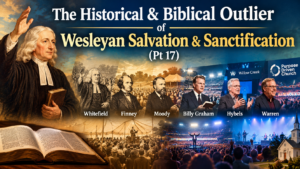 The Historical Pattern: One Structure, But Different Theologies
John Wesley brought itinerant evangelism, public conversion, religious experience, and a second work of grace. Finney and American revivalism contributed protracted meetings, new measures, organized invitations, and visible responses. Moody, Torrey, and Billy Sunday bestowed organized campaigns, evangelistic music, inquiry rooms, and public decisions. Independent Baptist revivalism emphasized personal soulwinning, invitations, decisions, and reported numbers. Evangelical mass evangelism and church growth — Billy Graham, Bill Hybels, Rick Warren, etc. spearheaded campaign evangelism, seeker-oriented outreach, and strategic ecumenical organization.
The Wesleyan contribution is significant because Wesley combined itinerant preaching with a disciplined system for gathering, instructing, and organizing converts. His societies and small groups sustained the movement and promoted spiritual growth. Historians also recognize that revivalism moved toward more professionalized techniques aimed at eliciting conversions. A problematic revivalistic legacy was an increasing reliance on planned methods, public responses, and visible evidence of success. It may not have been an inevitable result of Wesley’s ministry, but it was a tendency later evangelists could intensify.
Billy Graham: Bridge Between Revivalism and Mass Evangelicalism
Graham’s relationship to earlier revivalism is clearer even than the claim that he inherited Wesley’s doctrine. He worked within a long American tradition of mass evangelism that included Finney and Moody. The parallel concerns the public decision as the recognizable climax of the evangelistic event. The invitation makes a response visible. Counselors can speak with those who respond, and the campaign can report the results.
There is nothing inherently wrong with asking someone to respond to the gospel. The question is what the response establishes. Coming forward does not itself prove regeneration. Nor does a counselor’s assurance make a profession genuine. The biblical grounds for assurance must remain the truth of the gospel and the reality of faith, with the new life that Scripture associates with salvation. Graham therefore helps illustrate how revivalism could become a broad evangelical institution that crossed denominational boundaries.
Bill Hybels: From the Evangelistic Campaign to the Seeker-sensitive Church
Bill Hybels and Willow Creek represent a shift from special evangelistic campaigns to designing the congregation’s regular services around reaching unchurched people. Rather than relying only on an occasional citywide crusade, the church itself becomes a carefully orchestrated outreach setting. In the earlier revival meetings, an “evangelist” organizes a special event to lure a crowd. In the seeker-sensitive model, church leaders consider the unchurched person’s likely expectations and experiences when designing the regular service. The church may reconsider its music, language, presentation, schedule, and atmosphere to reduce barriers for unchurched attendees.
Clear language, a welcoming congregation, and an intelligible explanation of the gospel are not inherently unbiblical, if that’s what’s really happening. The critical question is what determines the changes. If a church removes needless obstacles so that people can understand biblical truth, that is one thing. If it adjusts the character of its gathering to make unbelievers comfortable with the church while muting biblical truths that confront them, that is another. A church assembly is not a product designed for a target audience. It is “a spiritual house, an holy priesthood, to offer up spiritual sacrifices, acceptable to God by Jesus Christ” (1 Peter 2:5).
God’s will must govern an assembly, not what makes an appealing event for visitors. It is not whether unbelievers feel welcome, but whether worship and preaching remain governed by Scripture. An unbeliever should be able to understand the truth, but the church must not make his preferences its authority. The seeker-sensitive model parallels revivalism in method. Both organize religious activity around the anticipated response of people who have not yet demonstrated that they are believers. The revivalist wants to secure a response at a meeting. The seeker-sensitive strategist tries to design a service to induce the unchurched to attend, feel comfortable, and become receptive.
Rick Warren: Organizing Religious Activity Around an Anticipated Human Response
Another Iteration of Experience-Centered Christianity
Rick Warren’s The Purpose Driven Church represents a later development of this pragmatic logic. Warren advocated studying a community, identifying people’s preferences, and shaping a church’s ministry to reach them. His approach included surveying the unchurched about their musical preferences and adapting the church’s musical style to attract the people it wanted to reach. Music thereby became a strategic instrument for drawing an audience. The preferences of the unconverted shaped the character of his church’s worship. His strategy was not Wesley’s doctrine of entire sanctification, but it reflected a later form of organizing religious activity around an anticipated human response. The focus had shifted from seeking a particular spiritual experience to manufacturing an appealing religious experience.
This historical development helps explain how revivalistic pragmatism could move from the evangelistic invitation into the church’s life and worship. In some revivalistic settings, a technique was designed to produce a profession that could be counted as a conversion. In Warren’s model, the ministry was designed to produce an experience that would attract people and induce attendance. Both approaches allowed the desired human response to govern the means of ministry. The connection is that later movements could retain an emphasis on experience and effective means while changing the experience’s content and purpose.
A Chosen Verification for a Second-Tier Experience
A recognizable spiritual crisis could become a measurable decision, and an evangelistic decision could become a statistic. Likewise, a church’s worship could become a product designed around the tastes of its intended audience. The common danger is that the method defines success and then claims legitimacy because it produces the expected response. A crowd can be attracted without being converted, and a profession can be made without genuine repentance. The outcome is the chosen verification for a second-tier experience.
Scripture does not authorize the church to determine its message, worship, or ministry by polling the surrounding culture. The church belongs to God, who must govern the church by His Word. Its commission is to preach the gospel, call sinners to repentance and faith, make disciples, and worship according to biblical truth—not to manufacture an experience that people will prefer. Market-driven church growth represents a later expression of the pragmatic tendency that can emerge when advocates measure religious effectiveness by the response a method produces rather than by faithfulness to God’s revealed will.
The Common Problem: A First Response As a Substitute for Conversion
Wesley treated the first response, what he called initial sanctification, and later holiness as separate tiers of the Christian life. The experience of the second tier confirmed the first tier. Until arrival at the second tier, if it ever happens, no evidence of conversion occurs. Charles Finney then treated the apparent effectiveness of his methods as the evidence. Billy Graham’s campaigns were a hotbed of counterfeit salvation experiences, confusing a visible response at a campaign with proof of regeneration. Rice and Hyles counted professions as conversions without adequate biblical examination. Hybels and Warren let target audiences and measurable results dictate church practice.
A recurring problem emerged in each setting. The church became more confident in its ability to produce, identify, and retain religious responses than in its ability to distinguish genuine profession from false profession. The sequence itself is tell-tale.
- An evangelistic method produces a visible response.
- The response is counted as a conversion.
- The person receives assurance based on the event.
- The person’s subsequent life does not demonstrate the transformation Scripture associates with salvation.
- The church explains the problem as deficient commitment, spiritual immaturity, or the need for a further experience.
- The original method remains unquestioned because its results have already been counted as successes.
This connects revivalism to the two-tier problem even if revivalists didn’t teach Wesley’s doctrine or if every person who responded at a meeting was unconverted.
Connection to Worship
The same pragmatism that arose from the Wesleyan trajectory moved from evangelism into worship. When a church evaluates its ministry primarily by visible responses, attendance, or the ability to retain people, it also adjusts its worship to maintain those results. Adherents evaluate music, atmosphere, preaching style, and the character of the gathering according to their effectiveness with the intended audience. That then created and creates a reinforcing cycle:
A method produces responses → Responses are counted as conversions → The church adapts to retain the constituency → Worship and church life increasingly accommodate audience preferences → The adapted church reinforces the original method
This is a theological analysis of the tendency, not a claim that every church in these movements followed each step in the sequence. When the church treats its gathering as an event for an audience rather than an assembly of God’s people before God, the practical authority shifts from Scripture to human response. Proponents select music and other features of worship for their ability to attract, move, or retain people. The danger goes beyond musical style. If the church adjusts its methods to satisfy people not transformed by biblical truth, it eventually adjusts its expectations of Christian conduct as well.
Worldliness becomes normal; holiness seems excessive; doctrinal precision becomes an obstacle; and the church’s distinct identity weakens. Romans 12:2 says, “And be not conformed to this world: but be ye transformed by the renewing of your mind.” A church cannot faithfully obey that command if its ministry is governed by a determination to make Christianity conform to the world’s expectations. A system can retain Christian terminology, religious activity, and public professions while weakening biblical tests of conversion and allowing pragmatic considerations to shape the church’s worship and life.
Has Wesleyanism and Its Trajectory Ruined Everything in Evangelicalism, Fundamentalism, and Even Independent Baptists?
For your historical series, I would make an important distinction: the strongest contrast is not simply a church that rejects Billy Graham, Jack Hyles, Bill Hybels, or Rick Warren. It is a church that replaces the underlying assumptions with a consistently biblical understanding of conversion, perseverance, the local church, discipleship, and worship.
A church can reject contemporary music and seeker-sensitive methods yet still practice decisionism. It can use traditional hymns, preach doctrinally sound sermons, and count professions as conversions without adequately examining the biblical basis. Conversely, a church can use an organized outreach strategy without necessarily embracing pragmatism. We need to examine the theology and practice, not just the labels.
Where Is the Historical Exposure of the Two-Tiered Paradigm of Salvation and Sanctification?
J. C. Ryle, the 19th-century evangelical Anglican leader and author of the classic work Holiness, shared a similar diagnosis to mine in this series. The structural overlap between Ryle’s historical pushback against the “Higher Life” / Keswick movements and my critique of Wesleyan-derived frameworks centers on several core points.
The Rejection of the Two-Tier Architecture
In his book, Holiness: Its Nature, Hindrances, Difficulties, and Root, Ryle explicitly targeted the error of drawing “such a deep, wide, and distinct line of separation between conversion and consecration, or the higher life, so called.” In my analysis of Wesleyanism (and its downstream mutations through Phoebe Palmer, Keswick, and figures like Lewis Sperry Chafer), sImilarly to Ryle I demonstrate how bifurcating salvation and sanctification creates an unscriptural split: the ordinary Christian versus the “fully surrendered” or “higher life” Christian.
Ryle directly attacked the notion that Christians can be neatly categorized into distinct tiers based on a subsequent crisis experience. He wrote:
The modern teachers of this day who tell us that professing Christians are of three sorts—the unconverted, the converted, and the partakers of the ‘higher life’ of complete consecration—appear to me to occupy very much the same ground… But sudden, instantaneous leaps from conversion to consecration I fail to see in the Bible.
Ryle was addressing the 19th-century Holiness movement (promoted by figures like Phoebe Palmer and the Keswick conventions), which taught that an ordinary believer could remain “carnal” or uncommitted for years until reaching a second, distinct moment of faith, surrender, or “entire sanctification.” My series traces how this exact DNA bled into broader evangelicalism — subsequently showing up in frameworks like Lewis Sperry Chafer’s dispensational “carnal Christian” model. In both cases, the architecture assumes a believer can experience the new birth without a fundamental transformation of life orientation, necessitating a second, specialized mechanism to achieve real spirituality.
Underestimating the New Birth (Regeneration)
Ryle warned that pushing a “second conversion” or a later crisis experience effectively devalues the massive, sweeping reality of initial regeneration. As I argue across my series, creating a separate tier for a subsequent “blessing” or “empowerment” implies that the new birth leaves a believer fundamentally deficient, requiring a methodological mechanism (like an altar formula) to fix what regeneration supposedly failed to complete.
Ryle recognized that to argue for a subsequent “higher life” tier, one has to systematically cheapen what God actually accomplishes in initial regeneration. He asked:
Are they not, when they urge on believers the ‘higher life’ as a second conversion, underrating the length, and breadth, and depth, and height, and of that great first change which Scripture calls the new birth, the new creation, the spiritual resurrection?
He went further, delivering a sharp evaluation of the teachers pushing this paradigm:
I have sometimes thought, while reading the strong language used by many about ‘consecration’ in the last few years, that those who use it must have had previously a singularly low and inadequate view of ‘conversion,’ if indeed they knew anything about conversion at all.
This mirrors the core thesis here regarding Wesleyanism and its descendants. When salvation and sanctification are legally or experientially decoupled, conversion is reduced to a mere “fire-insurance” transaction (getting a ticket to heaven), while true devotion and obedience are relegated to a optional, secondary tier (“making Jesus Lord” later on). As I demonstrate, this fundamentally subverts the biblical reality that anyone truly regenerated by the Spirit is, by definition, set apart (consecrated) to God. As Ryle noted:
If he was not consecrated to God in the very day that he was converted and born again, I do not know what conversion means.
Subjectivism vs. Biblical Sanctification
Ryle fiercely opposed the shift from objective biblical truth and daily progressive growth in grace to an inward, experience-driven crisis point. He noted that such teaching often leads either to spiritual pride (“weak brethren who fancy they are something”) or deep despair among believers who cannot manufacture the promised perfection. Both Ryle’s pastoral defense and my critique emphasize the practical fallout of this error. When sanctification is treated as a crisis-induced emotional peak or a mechanical “let go and let God” toggle switch, what happens?
First, it fosters an environment of spiritual pretense where people claim a “higher blessing” or instantaneous eradication of indwelling sin, while their daily tempers and behaviors show no genuine transformation. Second, it crushes sincere, weaker believers who try to manufacture the promised emotional or instantaneous “breakthrough,” only to find that sin still indwells them, driving them either into cynical hypocrisy or deep spiritual discouragement. Instead of an abrupt, bifurcated staircase, both Ryle and I point back to the uniform biblical pattern: a single radical new birth, followed by a lifelong, unbroken, uphill path of daily mortification, progressive growth, and practical obedience.
More to Come