Part One Part Two Part Three Part Four Part Five Part Six Part Seven Part Eight Part Nine Part Ten Part Eleven Part Twelve Part Thirteen Part Fourteen Part Fifteen
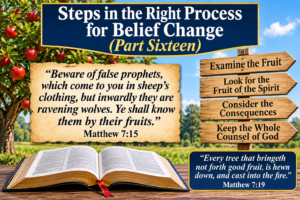 Belief change produces consequences. When someone changes what he believes, that change does not remain confined to an isolated statement of doctrine. It can affect his interpretation of other Scriptures, his worship, his conduct, his relationships, his decisions, and the direction of his life. A change in belief may correct error and lead to greater obedience to God. It may also introduce error that eventually produces disobedience, confusion, and departure from the truth. Therefore, the right process for belief change must consider not only whether someone can defend a new position from Scripture, but also what follows from that position.
Previous parts emphasized openness to examination and testing proposed changes by the whole counsel of God. This examination must include the consequences of a change. We should ask what a new belief teaches, what it requires us to reject, what other beliefs it affects, and what kind of life it encourages. We must not substitute practical results for biblical truth. Nevertheless, Scripture itself teaches us to examine fruit. We need to understand what fruit means in its biblical context and how to use it to evaluate changes in beliefs.
The Fruit of a Tree Reveals Its Character
The Warning Against False Prophets
Jesus teaches in Matthew 7:15–20:
Beware of false prophets, which come to you in sheep’s clothing, but inwardly they are ravening wolves. Ye shall know them by their fruits. Do men gather grapes of thorns, or figs of thistles? Even so every good tree bringeth forth good fruit; but a corrupt tree bringeth forth evil fruit. A good tree cannot bring forth evil fruit, neither can a corrupt tree bring forth good fruit. Every tree that bringeth not forth good fruit is hewn down, and cast into the fire. Wherefore by their fruits ye shall know them.
Jesus warns about false prophets. The immediate context is not a general invitation to judge every teaching by whether it produces results that people like. It warns that false teachers can appear harmless while inwardly working against the truth. Their appearance and claims do not establish their character. Obedience to Jesus’ command to “beware” requires examination.
Discernment and Belief Change
The illustration of trees and their fruit makes an important distinction. A tree’s fruit does not make the tree what it is; it reveals the tree’s nature. Grapes do not grow on thorns, and figs do not grow on thistles. The kind of tree determines the kind of fruit it produces. In the same way, a teacher’s life and teaching eventually disclose what his ministry produces.
This principle applies to belief change. Someone may present a new doctrine as an improvement. He may say that it will make a church more effective, help Christians relate to others, remove unnecessary conflict, or attract people who would otherwise remain outside the church. Those claims do not establish whether the change is right. We must examine the doctrine itself and consider the direction it leads.
For example, if a proposed change requires a church to disregard biblical teaching to accommodate its community, the fruit of that change will include weakening its submission to Scripture. Even if attendance increases, the result does not make the change good. If a teacher alters the gospel to make it easier to accept, he may gain a larger audience while leading people away from the truth.
The warning in Matthew 7 requires discernment. A false prophet does not become true because his ministry appears successful. Neither does a true teacher become false merely because his ministry encounters opposition. Jesus directs attention to fruit that corresponds to the teacher’s true or false character and his teaching. The standard is not popularity but conformity to God’s truth.
The Fruit of the Spirit and the Character of Biblical Change
The Contrast Between Flesh and Spirit
Paul identifies the fruit of the Spirit in Galatians 5:22–23:
But the fruit of the Spirit is love, joy, peace, longsuffering, gentleness, goodness, faith, Meekness, temperance: against such there is no law.
The context of these verses matters. In Galatians 5, Paul contrasts walking in the Spirit with fulfilling the lust of the flesh. He identifies works of the flesh in verses 19–21 and then describes the fruit of the Spirit in verses 22–23. The contrast concerns two different directions of life. The flesh produces its characteristic works, while the Spirit produces fruit consistent with His work in a believer.
This passage helps evaluate the consequences of changing beliefs, but it must not be misused. We cannot conclude that a doctrine is true simply because its advocates appear loving, peaceful, or gentle. A person can speak pleasantly while teaching error. Paul himself warns in Romans 16:18 of those who serve their own interests through flattering speech and fair words. Outward pleasantness does not replace doctrinal examination.
Evaluating Belief Change and Christian Liberty
Neither should we conclude that a doctrine is false merely because its advocates sometimes display impatience or other sinful conduct. Christians still need correction. A believer’s indwelling sin does not automatically disprove every doctrine he holds. The issue is whether a change leads toward the obedience Scripture requires or encourages conduct that contradicts God’s Word.
The fruit of the Spirit nevertheless provides a biblical standard for the kind of character that should accompany Christian belief and practice. A proposed change that encourages pride, uncontrolled desires, bitterness, or worldliness stands in tension with the character Scripture commands. A change that genuinely conforms a believer to God’s Word should not lead him to excuse the works of the flesh.
Consider a person who changes his doctrine of Christian liberty. If he uses his new understanding to justify gratifying sinful desires, disregarding biblical commands, or resisting correction, the consequences require serious examination. Christian liberty does not authorize disobedience. Paul writes in Galatians 5:13, “For, brethren, ye have been called unto liberty; only use not liberty for an occasion to the flesh, but by love serve one another.”
Paul’s instruction prevents someone from turning liberty into a justification for the flesh. The right process of belief change does not merely ask whether a person can defend a practice under the name of liberty. It asks whether that defense agrees with the purpose and limits of liberty as Scripture defines them.
Wisdom from Above Produces Different Fruit
Wisdom Demonstrated Through Conduct
James 3:13–18 provides another important test. James asks in verse 13:
Who is a wise man and endued with knowledge among you? let him shew out of a good conversation his works with meekness of wisdom.
He does not treat wisdom as a personal self-claim. He calls for demonstrating wisdom through conduct. The expression “good conversation” refers to a good way of living and showing wisdom through meekness. True wisdom is not merely an ability to argue persuasively or win a theological dispute. It expresses itself in a life consistent with God’s wisdom.
James then contrasts earthly wisdom with wisdom from above. In verses 14–16, he warns against bitter envying and strife, explaining that such wisdom is earthly, sensual, and devilish. He also identifies confusion and evil works as its consequences. This is a significant warning against changing beliefs. A person may present a change as intelligent, progressive, or necessary while its actual source and effects reveal something different.
Heavenly Wisdom: Purity Before Peace
James describes wisdom from above in verse 17:
But the wisdom that is from above is first pure, then peaceable, gentle, and easy to be intreated, full of mercy and good fruits, without partiality, and without hypocrisy.
Notice the order. Wisdom from above is “first pure.” Peaceableness does not take precedence over purity. Gentleness does not permit compromise with error. Being easy to be entreated does not mean accepting every proposed change. The whole description must be taken together. Biblical wisdom is pure, and it also produces peaceable, gentle, merciful, and good fruit.
This order matters when churches consider changes to their beliefs and practices. Sometimes people appeal to peace as the reason to accept a change. They want to avoid disagreement, preserve relationships, or prevent people from leaving. But James does not teach that peace can be purchased by abandoning purity. He places purity first and then describes the other qualities that characterize wisdom from above.
Righteousness and the True Nature of Peace
Verse 18 concludes:
And the fruit of righteousness is sown in peace of them that make peace.
The peace James describes is connected to righteousness. It is not peace at the expense of truth. A church should seek peace, but it must be the peace that accompanies righteousness and submission to God. If maintaining peace requires silence about biblical error, that peace may conceal a deeper problem rather than resolve it.
James therefore gives a way to evaluate the consequences of changing belief. Does the change arise from a desire to submit to God’s wisdom, or from envy, pride, ambition, and pressure? Will it produce righteousness, or does it generate confusion and evil works? Does it preserve purity while pursuing peace, or does it sacrifice purity to avoid conflict? These questions do not replace examination of Scripture. They help expose the character and consequences of a proposed change.
Do Not Confuse Immediate Success with Lasting Fruit
The Illusion of Immediate Outcomes
The Bible repeatedly warns against judging solely by appearances. A change may offer immediate advantages while sowing long-term spiritual harm: a teacher can attract a crowd by telling people what they want to hear, a church might dodge controversy by refusing to address error, and an individual may feel temporary relief by abandoning an inconvenient conviction. None of these superficial outcomes proves that a change is right.
Conversely, a faithful change often brings immediate difficulty. Correcting error exposes sharp disagreement, restoring a neglected biblical practice typically requires sacrifice, and refusing an unscriptural compromise frequently invites opposition. Such hardships do not mean that a change is wrong.
The Danger of Seeking Human Approval
The apostles themselves received severe resistance when they preached the truth. Paul never measured his message’s validity by whether his audience welcomed it. In Galatians 1:10, he writes:
“For do I now persuade men, or God? or do I seek to please men? for if I yet pleased men, I should not be the servant of Christ.”
Paul’s question exposes a fundamental conflict of allegiance. When pleasing people becomes the primary motive for altering doctrine, human approval replaces God’s authority.
This does not mean Christians should court opposition or view every conflict as a badge of honor; one can be misguided, unnecessarily offensive, or foolish and still provoke hostility. Neither popularity nor opposition settles the matter—Scripture alone must decide whether a conviction is right.
Integrating Scriptural Standards for Discernment
We must also avoid evaluating a doctrine by external success or personality of its advocates. A person may hold sound biblical beliefs yet live inconsistently with them; conversely, another may promote harmful error while exhibiting traits that win admiration. Conduct matters, but Christians must weigh it alongside the message itself. Jesus’ warning in Matthew 7 commands us to examine a teacher’s fruit, while the Bereans in Acts 17:11 set the standard for testing every teaching directly against the Scriptures.
The Right Process for Belief Change: A Biblical Conclusion
Biblical Reformation or Departure from the Faith?
On opposite ends of a spectrum, change could be either biblical reformation or departure from the faith. Both involve change, but they differ in sources, authority, direction, or results. Biblical reformation brings belief and practice into greater agreement with Scripture. Departure moves belief and practice away from God’s revelation. One submits to the Word of God. The other, whatever its claims, places something else above it.
Change itself is not the test of faithfulness. A person can change and become more faithful to God. He can also change and become less faithful. A church can correct an error that it has held for generations. It can also abandon a truth that it once believed and practiced. Neither age nor novelty establishes whether a belief is right. The question is whether it agrees with Scripture.
The Authority That Determines Whether Change Is Right
The Supreme Authority of Scripture
Scripture provides the sole foundation for genuine spiritual transformation. Belief change must begin with the Bible, proceed according to its principles, and culminate in obedience to its commands. Scripture is not merely one opinion among many to weigh when deciding what to believe; it is God’s definitive revelation and the ultimate authority governing every claim.
In Romans 12:1–2, Paul summarizes this core responsibility:
I beseech you therefore, brethren, by the mercies of God, that ye present your bodies a living sacrifice, holy, acceptable unto God, which is your reasonable service. And be not conformed to this world: but be ye transformed by the renewing of your mind, that ye may prove what is that good, and acceptable, and perfect, will of God.
Paul does not urge believers to re-create themselves according to personal preference. Instead, he commands them to yield completely to God, allowing Him to transform their minds. This mental renewal enables believers to discern and align with God’s will. The standard for belief is never the spirit of the age, popular demand, corporate success, or human opinion — it is the revealed Word of God.
Correcting Understanding vs. Revising Truth
No human authority possesses the right to revise divine truth. Believers must continually correct their understanding of Scripture, but they must never attempt to correct Scripture itself.
Legitimate reasons for belief change include:
- Discovering an interpretive error in a previously held position.
- Recognizing that a practice rested on human assumption rather than explicit biblical instruction.
- Abandoning a tradition that lacks scriptural support.
When changing a conviction, believers must prove their error directly from the biblical text rather than relying on personal dissatisfaction or cultural pressure as evidence.
The Comprehensive Scope of God’s Word
The authority of God’s Word extends to every area of Christian life. No doctrine, practice, or choice falls outside its jurisdiction. Scripture directly governs:
- Doctrine and theological convictions
- Corporate worship and local church practices
- Personal relationships, ethics, and daily decisions
A church cannot claim biblical faithfulness in its theology while ignoring God’s authority in its conduct or governance. True submission to Scripture requires bringing every aspect of life and ministry under the judgment of God’s Word.
More to Come