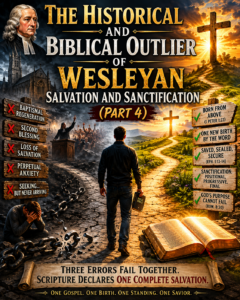
 One Gospel, One Birth, One Standing, One Savior
The System Assessed and the Alternative Declared
John Wesley was a man responding to real and observable spiritual decay — the deadness of the Church of England (COE) was not imaginary, and his zeal for genuine holiness was admirable in its motivation. However, a reaction to false religion built on a false foundation will not produce true religion, however earnestly pursued.
Wesley never left the institution, the COE, that shaped his errors. He retained its sacramentalism, carried its instability into his doctrine of salvation, and then constructed an elaborate superstructure of second-blessing theology to compensate for what he perceived as deficiencies in the new birth. Those deficiencies were in reality the logical consequences of their unbiblical starting points.
The resulting Wesleyan system did not improve Anglican nominalism. It originated a different kind of bondage. Where Anglican formalism left men cold and indifferent, Wesleyan revivalism left men still anxious and perpetually unsatisfied. It doomed its adherents to always seeking, yet never arriving, always subject to the loss of whatever they had gained, yet always being told that what they possessed was insufficient. Furthermore, it required something more, something greater, and something sadly taylored by a charged emotional atmosphere, the inherent manipulation accompanying an unbiblical plan.
Three Errors Fail Together
Errors That Fail Together
The aforementioned three doctrines Wesley held — baptismal regeneration, entire sanctification as a second work of grace, and the loss of salvation — fail together in a way that makes the system as a whole impossible to embrace with any biblical coherence. Baptismal regeneration as Wesley retained it from COE practice means the sacramental administration of a new birth to infants who exercise no faith whatsoever. This grounded the initiation of salvation in a ritual act rather than in the divine work of the Spirit through the Word.
As exposed earlier, ritual regeneration directly contradicts Jesus’ definition of regeneration as a birth ἄνωθεν — from above — a divine act that, like every birth, is singular and unrepeatable. It also contradicts Peter’s account of Cornelius, where the Spirit fell before water was applied. In addition, it belies the entire argument of Romans 3 through 5, where Paul demonstrates that justification comes through πίστει — faith — with no mention of anything of baptism or any other sacramental instrumentation.
Effectively Two New Births
Having posited a regeneration that is sacramentally administered and frequently lost, Wesley then also required a conscious conversion — a first work of grace — as the foundation for his second-blessing doctrine. This means he effectively required two new births before sanctification could even begin its second stage, a construction the New Testament nowhere contemplates. And having made entire sanctification an attainable plateau of “perfect love” — a state of heart Wesley himself described as immeasurably greater than justification — he then allowed that even this higher state could be lost through neglect and must be re-sought.
The system erected by Wesley therefore produced a believer who could be regenerated, lose it, be converted, still be incompletely sanctified, seek and receive the second blessing, lose that, seek it again — and at every stage remain uncertain of his final standing before God. The pastoral fruit of this is not holiness. It is exhaustion, manufactured emotionalism, and a Christianity of chronic spiritual insecurity dressed in the language of seeking more of God. The revivalist meeting, the manipulated music, the altar call for the second blessing — these are not the means of grace the New Testament prescribes. They are the institutional machinery required to keep a defective system functional.
What Scripture Declares Instead
Singular in Initiation and in the Finished Work of Christ
Against every element of the Wesleyan system, the New Testament sets a salvation that is singular in its initiation, unlosable in its nature, progressive in its daily expression, and certain in its final completion — grounded not in the believer’s experienced blessings but in the finished work of Jesus Christ and the immutable purposes of God. Regeneration is the sovereign act of the Spirit through the Word, as seen in 1 Peter 1:23:
Being born again, not of corruptible seed, but of incorruptible, by the word of God, which liveth and abideth for ever. (1 Peter 1:23)
The seed is the Word; the agent is God; the result is permanent, incorruptible life. No font of water produces this. No emotional crisis re-administers it. It happens once, from above, by divine initiative.
Justification, Sanctification, and Glorification
Justification is a forensic declaration by God as Judge. Sanctification in its positional sense is complete in Christ and in its progressive sense it is the ongoing work of God through His Word accomplished not in crisis meetings but through the Spirit-illumined intake of scripture in the daily life of the believer walking in obedience. In its final sense it awaits glorification at the appearing of Christ, a completion that is guaranteed not by the believer’s earnestness but by the interceding Christ
Glorification is stated as already accomplished in the certainty of God’s purpose. The man God justified from the vantage point of God’s own unalterable counsel is already glorified. No Wesleyan doctrine of apostasy can insert a point of failure into a chain whose every link was forged in eternity. The entirety of the believer’s sanctification — its initiation, its progress, and its completion — rests on a single, sufficient, unrepeatable sacrifice.
Conclusion
No second blessing supplements true, biblical salvation, no sacrament initiates it, and no apostasy annuls it. The cross was enough, because the Christ who went to it was enough and the salvation He secured there requires nothing added by human experience, ecclesiastical ritual, or emotional crisis to make it whole. That is the biblical answer to Wesley: not less zeal for holiness, but a holiness grounded in what God has done rather than in what the believer must yet obtain. Not a second blessing, but the inexhaustible sufficiency of the one offering. Not a salvation that can be lost and re-sought, but a standing before God as secure as the intercession of the Son who ever lives to maintain it.
“Now unto him that is able to keep you from falling, and to present you faultless before the presence of his glory with exceeding joy, to the only wise God our Saviour, be glory and majesty, dominion and power, both now and ever. Amen.” (Jude 24–25)
The Rest of the Story: What the Thinking of Wesley Produced
What was the fruit of Wesley’s attempts to reform the COE from the inside and his new doctrines? Methodists and Wesleyans may have ejected from infant sprinkling as baptismal regeneration, but that still left a faulty and unreliable superstructure that was built on that erroneous foundation. Jesus said He would build His church on the heavenly revealed gospel already professed by Peter in Matthew 16 (cf. verses 15-19). True authority for a true church originates from that gospel and the churches in that trajectory.
How did the defective beginnings of Wesleyanism effect what emerged from it? Even though some of the terminology comes from the Bible, the non-historical and unbiblical beliefs flow from what John Wesley derived from a patchwork of aberrant theological influences. How did that turn out?
The Liberal Methodist Solution: Abandon Everything
The mainline United Methodist Church (UMC), which represents the largest number of Methodists in the United States, resolved the tension in Wesley’s doctrine by abandoning not just baptismal regeneration as a doctrinal anchor but nearly every distinctive of historic Christian orthodoxy along with it. As a denomination, it no longer believes in substitutionary atonement, bodily resurrection, the exclusive claims of Christ, or the authority of scripture.
Internal contradictions in Wesley’s soteriology cease to be pressing problems for the UMC, as they have no theological crisis over a second blessing when they no longer believe in a first one in any meaningful sense. The UMC today is in advanced stages of fragmentation precisely over whether the Bible speaks authoritatively on anything.
The recently formed Global Methodist Church broke away from the UMC to recover something closer to historic Wesleyan orthodoxy. Even that, however sincere, still inherits the unresolved foundational problems in Wesley’s system. Recovering that theology is not recovering scripture. Instead, it would recover a man-made system that contained the very seeds of liberalism that destroyed it. Wesley’s elevation of experience alongside scripture, his eclectic borrowing from Catholic mysticism and Eastern fathers, and his retention of sacramental grace all created the conditions for a tradition that could drift wherever experience and cultural pressure directed it.
The Evangelical Wesleyan Solution: Quietly Redefine Baptism
The evangelical Wesleyan denominations — the Wesleyan Church, the Free Methodist Church, the Church of the Nazarene — took a different approach. They all trace back to Wesley, but without any formal announcement of doctrinal change, they functionally abandoned baptismal regeneration. Still, however, some or many retained infant baptism or at least infant dedication as a practice, and without carefully examining how this relates to a Wesleyan system that still serves as the substructure for what they teach.
In practice, these denominations treat baptism as an outward sign, a covenant rite, or an act of parental dedication rather than a regenerating sacrament. This is a significant departure from Wesley’s own position and from the COE formularies he never renounced. Wesley explicitly and repeatedly affirmed that baptism is the ordinary means of the new birth. The Book of Common Prayer he used throughout his ministry declares in the baptismal liturgy that the child is “regenerate and grafted into the body of Christ’s Church.” Wesley did not reject this language. He used it and defended it.
When modern evangelical Wesleyans quietly strip the regenerating content from baptism while retaining the rite, they have done something theologically consequential even if they don’t know how it disappeared. They have removed the foundation of Wesley’s ordo salutis — his order of salvation — that he constructed. Wesley used prevenient grace to explain how an infant received regenerating grace through baptism while still in a state of original sin. This was the mechanism upon which he built and operated his entire sacramental and soteriological system.
The Prevenient Grace Maneuver
Wesley’s original system had an internal logic, however flawed: sacramental grace administered in baptism restored to the infant the spiritual capacity lost in Adam, providing the foundation on which the subsequent works of grace — initial sanctification at conscious conversion, entire sanctification at the second blessing — could operate. The system was wrong, but it was at least coherent on its own terms.
When Methodism crossed the Atlantic and spread through the American frontier in the late 18th and early 19th centuries, it encountered a religious culture hostile to sacramentalism and institutionalism of every kind. The camp meeting, the anxious bench, the frontier revival — these were not environments in which a COE sacramental theology of infant baptismal regeneration could survive. American Methodism needed a way to preserve Wesley’s system while quietly detaching it from the sacramental delivery mechanism that Wesley used to ground it. Almost no one sitting in Methodist or Wesleyan churches today have any idea that this happened.
When Wesley spoke of original sin being counteracted by the grace of Christ extended to all through the atonement, he was not yet speaking of a grace that operates entirely apart from means. The means, for infants, was the sacrament. Prevenient grace for Wesley was not a single doctrine but a description of the initiating movement of God toward the sinner across multiple channels, one of which was infant sprinkling.
The Emotional, Experiential, and Ecstatic Piece in the Wesleyan System
The ecstatic element in the Wesleyan and Methodist tradition had its roots run through several distinct streams that converged in Wesley’s eighteenth century religious landscape. Wesley’s transformative contact with the Moravian Brethren — particularly on his voyage to Georgia in 1735 and through his relationship with Peter Böhler leading up to Aldersgate in 1738 — introduced him to a tradition of pietist religion where the felt assurance of grace, the warmth of personal experience, and the community of shared spiritual emotion played central roles.
The Moravians under Count Zinzendorf developed a highly experiential, even sensory, devotional life centered on the wounds of Christ and the emotional apprehension of forgiveness. What the Moravians claimed as a revival at Herrnhut in 1727 came with manifestations of spiritual intensity that left permanent marks on the movement’s self-understanding. Wesley absorbed from the Moravians the critical conviction that saving faith involved not merely intellectual assent but a felt, experiential assurance.
Wesley described after Aldersgate as his heart being “strangely warmed.” This was not, for Wesley, a peripheral decorative element. It was the very definition of genuine conversion as distinguished from the cold formalism of the COE. The problem was that once felt experience became the authentication of genuine grace, the entire soteriological framework tilted toward the production and verification of felt experience as its primary pastoral goal.
The American Severance: Francis Asbury and the Frontier
The decisive transition from infant sprinkling as a primary means of prevenient grace for conversion began with the practical realities of American frontier Methodism. Late 18th and early 19th century American Methodist, Francis Asbury, faced a continent in which the infrastructure of COE sacramentalism was entirely absent. There were no parish churches, no established clergy in sufficient numbers to administer sacraments regularly, and a population that regarded institutional religion with deep suspicion. The circuit rider did not carry a baptismal font as his instrument of ministry.
In this environment, the sacramental grounding of prevenient grace became practically irrelevant and then doctrinally inconvenient. American Methodists still baptized infants when the occasion arose, but the theological weight that Wesley had placed on that baptism quietly shifted. The circuit rider’s message was not “your baptism has given you initiating grace which you have neglected — return to it.” It was “God has already been working in your heart, drawing you, convicting you — respond now.”
By the time systematic Methodist theologians like Richard Watson in England and Nathan Bangs in America began writing their formal theologies in the early nineteenth century, prevenient grace had already been largely detached from its sacramental moorings and was being presented as a freestanding doctrine of universal divine enabling. The transition was rarely argued for explicitly. It happened because the sacramental context had evaporated and nobody formally required its reinstatement.
Connection Between Prevenient Grace and Revivalist Ecstasy
The connection between prevenient grace and revivalist ecstasy is not merely cultural or historical. It is logical and structural, and it works as follows. The American Wesleyan tradition taught that God was already at work in every human heart prior to conversion — drawing, convicting, restoring capacity, creating spiritual hunger. The revival meeting was not creating something from nothing. It was bringing to crisis and conscious resolution a work that God’s prevenient grace had already been doing secretly and preparatorily in the hearts of the hearers.
The revivalist preacher’s task, on this understanding, was not to proclaim a message through which the Spirit would sovereignly regenerate dead sinners. His (or hers today) task was to create conditions under which the prevenient grace already present in his hearers could be brought to the point of conscious response and decision. This fundamentally reoriented the entire enterprise of preaching and religious meeting.
With the Spirit already present in everyone through prevenient grace, restoring capacity and creating readiness, then the revivalist preacher’s role shifts from herald to facilitator. Part of his job was to create an environment — through music, through emotional appeal, through physical arrangement, through protracted meetings, through the anxious bench — in which the prevenient grace already present can be harvested into conscious decision.
Wesleyanism Dovetails with American Revivalism
Charles Finney, not a Wesleyan but whose influence on American revivalism was enormous and whose methods both drew from and fed back into the Wesleyan tradition, argued that a revival is not a miracle but the result of the right use of constituted means. If one correctly applies the psychological and social conditions that produce religious response, revival will reliably follow. The Wesleyan prevenient grace logic naturally tended toward this revivalism. The Methodist tradition absorbed Finney’s methods with relatively little resistance precisely based on its explanation of how the Spirit works.
When Methodism encountered the American frontier, the ecstatic element that had been present but partially contained in Wesley’s English context erupted with an intensity that Wesley himself, dying in 1791, never witnessed. The decisive event was the Cane Ridge Revival of 1801 in Kentucky, which, while not exclusively Methodist, involved Methodist preachers and became the generative model for the American camp meeting tradition.
Revivalism as the Delivery System for Wesley’s Initial and Entire Sanctification
The camp meeting revival became the primary institutional mechanism for the delivery of both Wesley’s first work of grace, initial sanctification, and, increasingly, the second work, entire sanctification. The emotional, physical, and social dynamics of the camp meeting were not theologically neutral. They were understood, within the Wesleyan framework, as the conditions under which the Spirit’s sanctifying work could be received and verified, which created a feedback loop of enormous power.
The Wesleyan doctrine taught that entire sanctification was a distinct, receivable, experiential second blessing. The camp meeting created conditions of extreme emotional intensity in which people reliably had intense experiences. Those experiences were interpreted as the second blessing. The interpretation validated the doctrine. The doctrine produced the next camp meeting. The entire system became self-reinforcing.
More to Come