 Historical Material
This might seem really obvious, but the further back we go in history, the harder it is to prove something from available extra-scriptural historical material. Consider Adam and Eve. Understatement alert — we don’t have historical material from the time of Adam and Eve outside of the Bible. Nothing survived from them archaeologically. However, Adam and Eve existed. That last statement is true. Why? The Bible shows it.
Not as long ago was the first church in Jerusalem. Did it exist? Outside of the Bible, we don’t have much, but I still believe that happened too like scripture describes and explains it. For one, we have sites and structures explicitly tied to New Testament events. Relative to other history, this is pretty good. When I say, “not much,” I’m saying we have some things, but even those are exciting, they aren’t very much either. I still preach the biblical account as a historical event though.
Scripture Evidence
Is Evidence
Today we still have the New Testament, the words that were originally written. Some modern liberal theologians or textual critics might challenge that, but many scholars today say that’s true too. As a historical artifact, we have the New Testament, based on the abundance of manuscript evidence. The preservation of the New Testament is relatively amazing compared to other ancient texts.
Now when we try to gather the available history of the church after the completion of the New Testament, we definitely do not have much outside of what monks or monk-like scribes hand copied under the auspices of the state church, the Roman Catholic Church. They almost entirely kept what they valued doctrinally and nothing else, based on their commitment to hand down their traditions. Age, elements, wars, persecution, and many other difficulties resulted in the continued existence of little to nothing else, except for that preserved by the Roman Empire and its authorized religion.
Priority of Preservation
Something that did occur is the copying of scripture. That was of obvious importance especially compared to the much lesser amounts of the preservation of other types of writings. There are only 250 or so manuscripts of the various annals of Julius Caesar that exist. In light of the longevity, legacy, and size of the Roman Empire, many would consider him the most famous, important, or relevant figure in ancient history. Much more, one would think based upon that criteria, would have been kept about him. But that’s it, and nothing of that is older than the 9th or 10th centuries.
One can understand, I do, how that we have New Testament scripture today. Believers deemed that necessary to copy and keep safe. They wouldn’t scurry and scrounge and sacrifice so much to preserve their own biographies or personal or group histories. And no one invented a printing press until 1440, which made the process much easier. Neither am I writing my own life story in any detail or the history of our church or churches either. The church I started in California and pastored for thirty-three years put a lot of effort into printing Bibles though. Scripture doesn’t tell the church to preserve or keep its own history.
Evidence of Persecution and Scripture
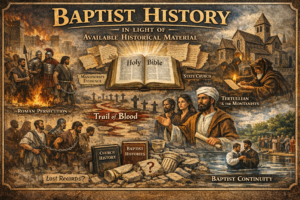
Some secular Roman sources exist, such as Tacitus, Pliny the Younger, Suetonius, and the Edicts of Decius and Diocletian. Some other early sources tell the story of a few hundred years of Roman persecution of Christianity. Starting with the crucifixion of Jesus and then the martyrdom of most of the twelve disciples, the earliest history of the church was a trail of blood. I use that term purposefully also to describe a particular view of Baptist history. The history of the true New Testament church, which I believe is Baptist, is in fact a trail of blood. Persecution is the true history of the church and that matches a biblical presupposition.
Does a belief in true New Testament church succession or Baptist succession proceed from physical, historical evidence? This is a matter of epistemology. How do we know what we know? The Bible is physical and historical evidence. The copying of scripture is also history and physical. The Bible has succession in it. Men copied scripture because it was God’s Word.
What To Expect as Evidence
The modern argument against Baptist perpetuity and succession proceeds from the inability to find physical evidence of churches with true New Testament or Baptist distinctives. Relative to post-1440, very little physical material exists today from before 1440. Should we expect these true New Testament churches to produce physical evidence and preserve it? Based on the physically available Bible, I would say, “No.” True churches would not be in charge of the government, making it easier to keep the physical evidence that the state church existed.
From the Bible too, someone can find physical proof of the nature of the church, what supporters and advocates of scripture and the gospel it communicates say the church is. They never say it is a state church. Never. It is an assembly, which is only local. There is far more to this: a true gospel, authorized means of evangelism and discipleship, church offices, etc. The accepted empirical evidence of a state church joins with doctrine and practices that diverge from scripture, which is the true, only reliable, and authoritative source of actual church and Christianity.
Separation from the State Church
Almost all of the physical, tangible, empirical and historical evidence for churches separate from the state church comes from comments from those aligned with the state church. The state and the state church persecuted and even tried to destroy true New Testament churches, the ones loyal to scripture as the authority for doctrine and practice. The aforementioned types of evidence show the brutal treatment from the state and state church to opposing groups. This coercion does not characterize or typify biblical Christianity. The result of the physical copying and preserving of the New Testament evinces this.
Persecution of the Godly
This is the presupposition that the godly will suffer persecution (2 Timothy 3:12; e.g. Matthew 5:11-13; 1 John 3:13). The persecuted side, which can’t and then doesn’t preserve physical historical evidence of its existence, parallels with scripture. A valid epistemological view says that this persecuted side is where the true New Testament churches are. As an essential characteristic of true churches, this changes the viewpoint of the preserved and, therefore, historical statements of the state and persecuting side. Let’s look at this point of view on a people such as the Montanists.
Evaluating the Montanists as an Example
Were the Montanists an example of true New Testament churches? If you examine all the material on the Montanists, almost entirely written by Roman Catholics, the state church, persecuting, and false doctrine side, you would say, “No.” If you make up a check box list with the Trinity, faith alone gospel, soul liberty, autonomy, the typical, very biblical list of true church distinctives, the Montanists would not make it based on the Roman Catholic historian accounting. How can a list of true, New Testament distinctives be anything helpful if someone struggles to find churches that took them?
I’m saying that churches took the true New Testament church distinctives in every century, yea decade, since the first church in Jerusalem in the first century. How? It’s in those copies of the New Testament, received, copied, received more, kept, and propagated, so that there are thousands of them. One should assume that would happen, because God promised in them that He would preserve them. The presuppositions also should lead people faithful to those scriptures that the state church would get it wrong about opposing groups through history. This guides in the analysis of the historical evidence. The scriptural guidelines predate the Montanists and those who opposed them.
Tertullian’s Writings on the Montanists
In my representation of the assemblies adverse to the state church, I call them assemblies with faith in scripture, separate from the state church. That’s the location and identity of true churches. Tertullian made a defense of the Montanists in his writing, De Pudicitia (On Purity). He argued that the authority related to forgiveness of sins did not belong to a line of bishops, but to “spiritual men” (the spirituales). To Tertullian, the presence of the Holy Spirit’s direct activity was the true mark of the church, not apostolic succession. He saw the Montanists as the true church because they maintained the strict discipline he believed the New Testament demanded.
To Tertullian, apostles ended, but not the guiding of the Holy Spirit. Montanists operated independently of the burgeoning episcopal (bishop-led) structure that sought to centralize all authority in Rome or Carthage. This is about all we’ve got in defense of the Montanists. I’m certainly open to more. Many times we expect more and then we find we have so little. From this do I jump to Baptist succession through a claim of the Montanists as the true succession? I am not necessarily doing that.
Interpreting History
From the physical, tangible, empirical evidence of the Montanists, I can’t put all the checks in the boxes of distinctives of true New Testament churches I have. Here’s the approach I’m taking related to the Montanists and just as an example of doing history here. From scripture, I know true New Testament church succession. The Montanists is what I’ve got historically. I would use the writings preserved from that period to say that not everybody was state church and for scriptural reasons. Maybe the Montanists were the ones. Several historians now have made that argument and it was a majority view of true churches in the last three hundred years.
The Montanists were not the trajectory of killing actual Christians for believing the Bible. They were not the state church trajectory that led to a multitude of unbiblical doctrines and traditions and led to an annihilation of a true gospel. Jesus founded the true church on a true gospel first and foremost. That didn’t happen through Roman Catholicism.
Many Baptists in the last two to three hundred years include the Montanists. I encourage anyone to read what they’ve written in those Baptist Histories. I am sympathetic to their view of history based upon scriptural presuppositions. Maybe someone needs a different explanation. They would criticize it based on modern historiography and historicism. Modern viewpoints that eliminate the Montanists require primary sources for something to be true. That’s the standard, which is a naturalistic one. Naturalism is a scourge to the church today. Churches and other institutions go liberal on this viewpoint.
More to Come
Thanks for this article.
There are various pre-Reformation Anabaptist groups (as you know, of course). I think that it is significantly easier to identify the Waldenses (for example) with Baptists than it is to do it with the Montanists. But was there Catholic bias against the Montanists? I don’t doubt it.
Thanks again for the Biblical presuppositions–whatever was going on with them, the Biblical presuppositions are right, because God will never fail.
I agree with the biblical presuppositionalism and Baptist succession, but I have read Tertullian’s work and would argue Montanist should be rejected in such a succession. They had many heretical views evident in the primary sources of Tertullian’s materials. His early writings, which would be classified as “Catholic” in the broad sense (true Catholicism didn’t actually exist that early) were much better for doctrine. For example, his early works rejected female teachers while as a Montanists he followed two prophetess, along with tongues and new prophecy, subordinationism, etc. there were valid reasons for “Catholics” to reject them, and modern Baptist would be wise to do so as well. One error being made is following historians along with their errors instead of reading primary sources. Anyone who reads Tertullian’s Montanist material would reject them, unless their charismatic and need them to justify their continuationism view like Wayne Grudem.
Hi Heath,
This was in large majority not about the Montanists or Montanism. I said I wasn’t including them in a succession, but explained how it happens, related to how much historical, empirical, or tangible evidence there is for early centuries after the completion of scripture. I also was talking about a trajectory. The Montanists went from 2nd to 6th century, so they straddled the beginning of the RCC. I wanted to add one more thing in this comment — the earlies manuscript of Tertullian is 8th century and for some of his writings, there is one source. Who made the copied that and who made the copies of that? They were Roman Catholics. I’ll have more to say on the actual subject I wrote about. Thanks for dropping by.
BTW, I think that the case for (at least some) Montanists being ancient Anabaptists is weaker than for, say, the Waldenses. But would I definitively say that NONE of them were Anabaptists and the Catholics put together the good people with the wacko people? I wouldn’t say that, either. Thankfully, we can know 100% that God has preserved true churches from Scripture, even if some of the history is murky. Thanks for the post, Bro Brandenburg!