Part One Part Two Part Three Part Four
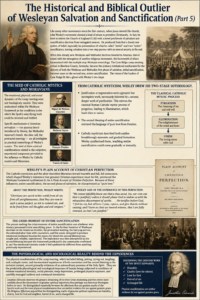 Like many other movements since the first century, when Jesus started His church, John Wesley’s movement claimed a kind of return to primitive Christianity. In fact, he tried to reform the Church of England (COE) with a novel patchwork of salvation and sanctification doctrine from variagated sources. He produced from that a brand new system of belief, especially his presentation of what he called “initial” and then “entire” sanctification, turning salvation into a two step process with no eternal security in the end.
When this already new Wesleyan and Methodist doctrine traveled to America, then it mixed with the emergence of another religious movement, the framework of which harmonized with the multiple step Wesleyan soteriology. The Cane Ridge camp meeting revival in Bourbon County, Kentucky, became the primary institutional mechanism for the delivery of both the Wesleyan and Methodist first phase of salvation, initial sanctification, but even more so the second one, entire sanctification. The vision of the leaders of Cane Ridge fit like a glove with Wesley’s two steps.
The Seed of Catholic Mystics and Moravians
The emotional, physical, and social dynamics of the camp meeting were not theologically neutral. They were understood within the Wesleyan framework as the conditions under which the Spirit’s sanctifying work could be received and verified. Specific mechanisms of American revivalism — the anxious bench introduced by Finney, the Methodist mourner’s bench, the altar call, the protracted meeting — are all intelligible as practical outworkings of Wesley’s system. The seed of these external manifestations related to the subjective, experiential component provided by the influence on Wesley by Catholic mystics and Moravians.
Wesley was a voracious reader of Catholic mystical literature. He read Miguel de Molinos’s Spiritual Guide and was attracted to his Quietist doctrine of “pure love” (amor purus), love of God stripped of self-interest. Also, he read the writings of Madame Guyon and François Fénelon and their concept of holy indifference and the annihilation of self-will, which fed directly into Wesley’s explanation that entire sanctification was essentially the perfection of love. Finally, he studied Francis de Sales’s Introduction to the Devout Life, which democratized Christian aspirations, saying these validating experiences were for every Christian, not just the elite.
From Catholic mysticism, Wesley drew his two-stage soteriology. Justification or regeneration were a genuine but incomplete work, necessarily followed by a second, deeper work of purification. This mirrors the classical Roman Catholic mystic process of purgation, leading to illumination, which leads then to union. The second blessing of entire sanctification mirrored the language of pure love from Fenelon. Catholic mysticism described both sudden breakthrough moments and gradual formation. Wesley synthesized these, teaching entire sanctification could come gradually or instantaneously.
Wesley’s Plain Account of Christian Perfection
The Catholic mysticism and the afore described Moravian inward warmth and full, felt assurance, which shaped Wesley’s insistence that genuine Christian experience must be felt, produced the Wesleyan framework synthesized in his A Plain Account of Christian Perfection. Because of those influences, entire sanctification, the second phase of salvation, he characterized as “pure love.” About the perfection, Wesley wrote:
Christians are saved in this world from all sin, from all unrighteousness; that they are now in such a sense perfect, as not to commit sin, and to be freed from evil thoughts and evil tempers.
Wesley said of the experience of this perfection:
We cannot infallibly know one that is thus saved, (no, nor even one that is justified,) unless it should please God to endow us with the miraculous discernment of spirits. . . . He testifies before God, `I feel no sin, but all love; I pray, rejoice, and give thanks without ceasing; and I have as clear an inward witness, that I am fully renewed, as that I am justified.’
The person seeking the crisis moment of entire sanctification was a believer who already possessed initial sanctifying grace. In the further iteration of Wesleyan doctrine on the American frontier, the protracted meeting, the tarrying service, the extended altar time with counselors, and the music designed to produce emotional readiness became the means by which the second blessing was sought and, reliably, experienced. The experience was then interpreted as the second blessing because the framework predicted it, the community confirmed it, and the emotional intensity made it feel qualitatively different from anything previously experienced.
The Physiological and Sociological Reality Behind the Experiences
The physical manifestations of the camp meeting, which included falling, jerking, crying out, laughing, and cataleptic states, and the emotional experiences of both conversion and the second blessing in the revivalist context, are not evidences of an extraordinary presence of the Holy Spirit. Instead, they are the predictable physiological and sociological responses of human beings subjected to conditions of extreme emotional intensity, social pressure, sleep deprivation, prolonged physical exposure, and carefully managed auditory and communal stimulation.
Jonathan Edwards observed the genuine awakening of the First Great Awakening and then wrote more carefully about the discernment of genuine spiritual experience than perhaps any American theologian before or since. He distinguished repeatedly between the affections that are genuine marks of the Spirit’s work and the mere physical manifestations that are neither evidence for nor against genuine grace. His Religious Affections argued that the distinguishing marks of genuine spiritual experience are moral and ethical in nature, not physical manifestations, and emotional intensity.
Contrast by Scripture and Exposed by Jonathan Edwards
Because its entire soteriological system requires experience as the verification of grace, the Wesleyan and revivalist tradition never agreed with Edwards’s distinction. If, as Wesley taught and as the the entire Holiness and subsequent Pentecostal tradition maintained, that the second blessing must be received in a conscious, experiential crisis moment, then the absence of felt experience is the absence of the blessing. The system structurally demanded the product of an experience with the revivalist meeting as the machine designed to cause it.
Scripture by contrast verifies genuine grace not with felt experience but by the transformation of life and the ongoing work of the Spirit through the Word. “Ye shall know them by their fruits” (Matt 7:16) is the Lord’s own standard for discernment, and the fruits He identifies are moral and behavioral, not experiential and ecstatic.
The Trajectory from Wesley to the Charismatic Movement
Wesley to Phoebe Palmer
The full trajectory from Wesley’s foundational commitments to the modern Charismatic movement is now visible as a single continuous line, each stage following logically from the one before. Wesley established experience as the verification of grace and entire sanctification as the experiential second blessing. American Methodism detached prevenient grace from a sacramental context and turned the revival meeting into the enabling mechanism instead.
Figures in the outgrowth of the Holiness Movement like Phoebe Palmer, who simplified Wesley’s second blessing into an instantaneous act of consecration and faith receivable at the altar, made entire sanctification more immediately accessible and the altar experience its normative means of delivery. Her Tuesday Meetings for the Promotion of Holiness ran a direct line to the Keswick Convention in England and the Higher Life movement, which spread entire sanctification language into other circles and denominations under slightly modified terminology.
Charles Parham, Azusa Street, to Modern Charismatic Movement
From the American Holiness camp meetings ran another direct line to Topeka, Kansas in 1901, where Charles Parham taught that the biblical evidence of the baptism of the Holy Spirit — his reframing of entire sanctification — was speaking in tongues, and to Azusa Street in Los Angeles in 1906, where William Seymour’s revival launched global Pentecostalism.
The Charismatic movement of the 1960s onward brought these Pentecostal distinctives — tongues, healing, prophecy, and the direct experiential encounter with the Spirit — into mainline Protestant and Roman Catholic contexts, completing a journey that had begun with Wesley’s attempt to renew the Church of England through a novel synthesis of Anglican sacramentalism, Moravian pietism, and his own doctrine of entire sanctification.
At every stage, the ecstatic element expanded because the doctrinal framework demanded more experience to verify more grace. Wesley needed an experience to verify conversion as distinct from dead Anglican formalism. His second-blessing doctrine needed a more intense experience to verify entire sanctification as distinct from mere conversion. Pentecostalism needed an even more unmistakable experience — tongues — to verify the baptism of the Spirit as distinct from entire sanctification. The Charismatic movement needed continuous, renewable, and increasingly spectacular experiences to maintain the tradition’s experiential economy.
The Pentecostal and Charismatic Branches: Experience Swallows Everything
A direct line from Wesley runs through the Holiness movement into Pentecostalism and the broader Charismatic movement. In these traditions, the baptismal regeneration question has been resolved in the most thoroughgoing way possible: experience has been elevated to such a degree that foundational doctrinal questions of this kind are simply never asked. When the authentication of spiritual reality is the ecstatic experience itself — tongues, healings, manifestations, and emotional catharsis — the question of whether the sacramental foundation of the tradition is biblically defensible becomes effectively invisible.
Wesley placed experience alongside scripture as a theological authority with a Wesleyan Quadrilateral of scripture, tradition, reason, and experience. Experience, being the most immediate and emotionally compelling of the four, invariably expands to dominate the others in any tradition that grants it formal theological standing. By the time the tradition reached full Pentecostal expression, the interlocutors of the theology quoted scripture to validate experiences already had rather than to test whether those experiences are genuine. The original and foundational baptismal regeneration question disappeared, replaced by a hermeneutic of experience.
One Question That Exposes the Entire Problem
A single question might expose the unresolved foundation of the Wesleyan trajectory of doctrine and its influence on denominations:
“Was John Wesley regenerate when he was baptized as an infant, or when he had his Aldersgate experience in 1738?”
Wesley was never clear on this. He spoke of Aldersgate, when his heart was “strangely warmed,” as a transformative experience of assurance, but he did not straightforwardly categorize it as his new birth. Doing so would have required him to deny the regenerating efficacy of his infant baptism, which he was unwilling to do. He sometimes suggested that the grace of his baptism had been neglected and needed recovery. This ambiguity was the necessary consequence of holding irreconcilable positions simultaneously.
If Wesley was regenerate at his infant baptism, his Aldersgate experience was not the new birth but something else — perhaps his initial conscious sanctification, or an experience of assurance. But then the entire system of seeking subsequent blessings originates not from conversion but from within a life of sacramental grace, which is essentially the Roman Catholic framework Wesley claimed to have left.
Modern Wesleyans and Methodists do not answer this question. They avoid it, because every available answer dismantles something they need to keep.
What Scripture Offers Instead
Inward Assurance
Against this entire trajectory, Scripture sets a picture of the Spirit’s work that is neither ecstatic nor manufactured but Word-centered, and morally transformative. The Spirit’s testimony to the believer’s adoption is internal and verbal, not ecstatic:
The Spirit itself beareth witness with our spirit, that we are the children of God. (Romans 8:16)
The Greek συμμαρτυρεῖ (summarturei) — “beareth witness together with” — describes a concurrent testimony of the divine Spirit with the human spirit, not a dramatic external manifestation. It is the quiet, settled, inward assurance that comes from the Spirit’s work through the Word — not a manufactured crisis experience.
Ordered, Intelligible, Morally Transformative
The filling of the Spirit that Paul commands — “Be filled with the Spirit” (Ephesians 5:18) — is immediately followed not by a description of ecstatic phenomena but by:
Speaking to yourselves in psalms and hymns and spiritual songs, singing and making melody in your heart to the Lord; giving thanks always for all things unto God and the Father in the name of our Lord Jesus Christ.” (Ephesians 5:19–20)
The evidence of Spirit-filling is worship, gratitude, and mutual edification, all of them ordered, intelligible, and morally transformative. The ψάλλοντες (psallontes) — “making melody” — is in the heart, ἐν τῇ καρδίᾳ ὑμῶν — an inward reality expressed in ordered worship, not a physical manifestation produced in a charged emotional atmosphere.
Paul’s Description of the Spirit’s Fruit
Paul’s description of the Spirit’s fruit — “the fruit of the Spirit is love, joy, peace, longsuffering, gentleness, goodness, faith, meekness, temperance” (Galatians 5:22–23) — is entirely moral and relational in character. There is not a single ecstatic element in the list. Ἐγκράτεια (enkrateia) — “temperance” or “self-control” — the final item, is the very antithesis of the loss of volitional control that characterizes ecstatic experience. The Spirit produces self-control, not its surrender.
Work of the Spirit through the Word
The work of the Spirit through the Word — “Faith cometh by hearing, and hearing by the word of God” (Romans 10:17) — needs no revivalist machinery to accomplish what God has determined to accomplish. It needs faithful proclamation:
It pleased God by the foolishness of preaching to save them that believe. (1 Corinthians 1:21)
The word μωρίας (mōrias) — “foolishness” — is Paul’s deliberately chosen description of the preaching itself as the world evaluates it. Not spectacular. Not ecstatic. Not accompanied by manufactured emotional conditions. Simply the proclamation of the cross — “We preach Christ crucified” (1 Corinthians 1:23) — through which the Spirit works sovereignly, without human assistance, to produce the faith that saves and the holiness that follows.
That is the biblical answer to the entire ecstatic tradition descended from Wesley: not a colder or less joyful Christianity, but a Christianity whose joy is “joy unspeakable and full of glory” (1 Peter 1:8) — ἀνεκλαλήτῳ (aneklalētō), inexpressible, not produced by a meeting but given by God. The power for holy living rests not on the intensity of manufactured experience but on the inexhaustible sufficiency of the One who said:
My grace is sufficient for thee: for my strength is made perfect in weakness. (2 Corinthians 12:9)
More to Come