 Part One Part Two Part Three Part Four Part Five
The baptismal regeneration piece of John Wesley’s doctrine of salvation and sanctification phased out of Wesleyanism and Methodism during the 19th century, leaving two remaining that were hugely problematic to a biblical, historical, true, and saving faith. Of the two, one is the initial and entire sanctification description or explanation of salvation and sanctification by Wesley, and, two, is his view of conditional security, losing salvation, or falling away. The first of these errors mainstream in doctrine crossed many different denominational lines, including almost all of evangelicalism, fundamentalism, and even independent Baptists.
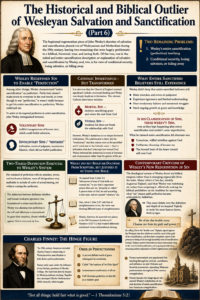
Wesley Redefined Sin to Enable “Perfection”
Among other things, Wesley characterized “entire sanctification” as perfection. Perfection doesn’t make sense to almost anyone in the real world, so even though it was “perfection,” it wasn’t really so because to get his entire sanctification to perfection, Wesley redefined sin. The redefinition of sin by Wesley predates him in the history of doctrine. His reading of Anglican moralists (Jeremy Taylor and William Law) and Eastern Fathers (Macarius and Ephrem) could be his source of this bifurcation. To arrive at his required perfection in entire sanctification, John Wesley distinguished between:
- Voluntary sins (willful transgressions of known law), which could forfeit salvation, and
- Involuntary sins / “mistakes” (infirmities, errors of judgment, unconscious failures), which did not forfeit justification.
It is also true that he Church of England retained significant Catholic structural thinking and Wesley was deeply Anglican in formation. The relevant Catholic inheritance includes:
- Mortal sin — destroys sanctifying grace and severs the soul from God
- Venial sin — weakens but does not break the relationship with God
Transformation of Categories of Sin
However, Wesley’s distinction is not simply borrowed Catholicism. The substructure is there, but his “involuntary” sins that remain even in the sanctified aren’t venial sins in the Catholic sense — they’re infirmities that don’t interrupt love toward God. Wesley was careful at least not to sound Catholic, and he reframed the distinction in terms of intention and consciousness rather than the gravity of the act itself. Wesley transformed the categories of sin, relocating the key distinction from the nature of the act (Catholic) to the orientation of the will and the degree of consciousness. Wesley didn’t deny that entire sanctified believers still:
- Make mistakes and errors in judgment
- Experience ignorance and limited understanding
- Have involuntary failures and emotional struggles
- Need ongoing growth in grace and knowledge
In his classification of sins, these weren’t sins, even as they kept happening after entire sanctification and couldn’t cause imperfection. What he claimed entire sanctification did eliminate was:
- Conscious, willful rebellion against God
- Deliberate choosing of known sin
- The inward bent of the heart toward self over God
Two-Tiered Definition Essential to Wesley’s System
This two-tiered definition of Wesley’s was essential to his whole system. His standard of perfection with its mistakes, errors, and involuntary failures, were all designations very malleable to include all sorts of actual sinning, yet without ruining the perfection. The distinction between deliberate rebellion and human weakness/ignorance was foundational to entire sanctification. Wesley was claiming that perfection is the will and affections so transformed by grace that conscious, chosen rebellion against God is overcome by love.
Wesley did not build his understanding of entire sanctification from scripture, but justified it by using the Bible. He argued from 1 John 3:9, “whosoever is born of God doth not commit sin,” to say that a regenerate person does not sin, “properly so-called.” A person born of God, he said according to this verse, did not commit “voluntary” sin. Also, when 1 John 5:17 said that all unrighteousness is sin, the verse was showing different types of unrighteousness. Mainly, however, he asserted two places in the Old Testament (Leviticus 4/Numbers 15:27-31) that treated differently intentional versus unintentional sinning.
Contemporary Criticism of Wesley’s New Redefinition of Sin
The theological system of Wesley drove his biblical exegesis rather than it emerging organically from the texts. Many critics of his day, notably Augustus Toplady, said that Wesley was redefining sin rather than exegeting it, effectively making the biblical prohibition on sin toothless by narrowing what “sin” meant until perfection became achievable by definition. This exact debate over the definition and depth of sin inspired Toplady to write his most famous hymn, Rock of Ages. The opening stanza provides a direct theological rebuttal to Wesley’s perfectionism:
Be of sin the double cure; Cleanse me from its guilt and power.
By calling Christ the “double cure,” Toplady argued against the Wesleyan idea that a believer could be cured of the guilt of sin at justification, and then later completely cured of the presence or being of sin through an earthly crisis of sanctification. Instead, Toplady asserted that believers must continuously cling to the cross for both justification and ongoing sanctification, remaining entirely dependent on Christ’s righteousness until death.
Charles Finney: The Hinge Figure
Oberlin Perfectionism
The 19th century American revivalist Charles Finney’s relationship to Wesleyan entire sanctification is both direct and transformative. Finney early came under the influence of Asa Mahan, president of Oberlin College, who had been directly shaped by Wesleyan holiness teaching. Together they developed Oberlin Perfectionism (1836 onward), which taught:
- A second definite work of grace subsequent to conversion
- Called “the baptism of the Holy Spirit” or “entire consecration”
- Resulting in power over sin and sustained victory in the Christian life
Where Wesley grounded entire sanctification in divine infusion of love, Finney grounded it in total consecration of the will. For Finney, the second work was essentially the moment when the believer stops holding anything back from God, a complete surrender of self-interest.
Finney’s Second-Tier Experience
Finney made the second tier experience activistic rather than receptive — you yield, you consecrate, you claim. He connected the second work directly to revival power — the sanctified/Spirit-baptized minister would now become effective in winning souls. The second blessing is no longer primarily about the interior purity of the soul (à Kempis, Fénelon) but about ministerial and evangelistic effectiveness. Holiness becomes instrumental to revival.
Finney’s revival methodology also embedded experiential expectations structurally:
- The anxious bench — a public, visible, crisis moment of decision
- The expectation of immediate, datable conversion experiences
- Public testimony as confirmation and consolidation of the experience
This is Phoebe Palmer’s structure applied to conversion itself: the public act partly constitutes the spiritual reality. And it trains audiences to expect discrete, experiential, datable transactions with God — not just for salvation, but for every subsequent spiritual advance.
D. L. Moody: The Popularizer
Moody Embraced the Wesleyan Two Tiers
Moody’s relationship to this stream from Wesleyan doctrine is personal and dateable. In 1871, following the Chicago fire and a sense of spiritual powerlessness, Moody received what he described as an overwhelming experience of the Holy Spirit — he was flooded with the love of God, had to ask God to “stay His hand,” and came away with dramatically increased power in preaching and evangelism.
Moody described this in the language available to him — “fulness of the Spirit,” “anointing,” “power from on high” — drawn directly from the Wesleyan movement vocabulary of his day. He had been pressed toward this experience by two Free Methodist women (Sarah Cooke and Auntie Cook) who embodied the Wesleyan-Holiness tradition directly, and whose prayers for him preceded the experience.
Moody Second Blessing Theology
Moody was not a systematic theologian and deliberately avoided sectarian Holiness vocabulary. He did not use “entire sanctification” or “second blessing” publicly because he didn’t want to divide his interdenominational audiences. But structurally he taught:
- Christians can live in spiritual powerlessness despite genuine conversion
- There is a definite experience of the Spirit’s fullness available to believers
- This experience transforms evangelistic effectiveness
- It is received by consecration, prayer, and faith — volitional categories straight from Finney
Moody thus laundered the Wesleyan-Holiness second-blessing doctrine through interdenominational revivalist packaging. The structure remained; the sectarian vocabulary was dropped. This move is enormously important because it made the doctrine transmissible to Baptists, Presbyterians, and Congregationalists who would have rejected explicit Wesleyan framing.
R. A. Torrey: The Theologian of the Anointing
Torrey is the most important figure in this chain for understanding how the doctrine reached fundamentalism, because he gave it systematic theological form that was explicitly non-Wesleyan in vocabulary while being structurally identical.
Torrey’s Doctrine
Torrey worked directly under Moody at the Moody Bible Institute and became its first superintendent. His key books — The Baptism with the Holy Spirit and The Holy Spirit: Who He Is and What He Does — became foundational texts for fundamentalist pneumatology.
Torrey taught:
- The baptism of the Holy Spirit is distinct from and subsequent to conversion
- It is not the same as regeneration
- It is specifically for power in service — particularly witnessing and soul-winning
- It is received by: (1) being a believer, (2) full surrender/consecration, (3) asking in faith
- It may be accompanied by definite, conscious experience — though Torrey carefully avoided requiring tongues
Enduement with Power
Torrey explicitly distanced himself from Wesleyan “entire sanctification” language. He insisted the baptism was not primarily about cleansing from inward sin but about enduement with power. This is the Keswick distinction: Spirit-filling for power, not for purity. Structurally, the two-stage schema is identical:
- Stage 1: Conversion/regeneration
- Stage 2: A definite subsequent work of the Spirit that transforms the believer’s effectiveness
And the epistemology is identical: it must be consciously received, deliberately sought, and can be identified as having occurred. Torrey embedded this in the Moody Bible Institute curriculum — meaning it became standard teaching for the generation of fundamentalist pastors and evangelists trained there.
The Keswick Connection Through Torrey
Torrey was deeply connected to the Keswick Convention network centered in Keswick, England, which taught “the higher life” — Spirit-filling for power and sustained victory. Keswick was itself a refinement of Wesleyan-Holiness doctrine:
- Replace “entire sanctification” with “Spirit-filling”
- Replace “eradication of the sin nature” with “counteraction/suppression” of the flesh
- Keep the two-stage structure, the crisis experience, and the experiential epistemology
Keswick teaching flooded into fundamentalism through Torrey, A. J. Gordon, F. B. Meyer, and the Niagara Bible Conference network — the very conferences that produced the original Fundamentals documents. The experiential pneumatology was thus baked into the fundamentalist movement from its institutional beginning.
Dallas Theological Seminary and Lewis Sperry Chafer
He That Is Spiritual
Lewis Sperry Chafer was directly mentored by D. L. Moody and deeply shaped by Torrey and the Keswick tradition. Before founding Dallas Theological Seminary (DTS), he wrote He That Is Spiritual (1918), which is essentially a systematic exposition of Keswick pneumatology:
- The believer can live in one of two conditions: carnal or spiritual
- The filling of the Spirit is a definite experience, distinct from salvation
- The carnal Christian is genuinely saved but living in defeat
- The Spirit-filled life is entered by surrender, confession, and faith — an identifiable transaction
Chafer’s carnal Christian doctrine is structurally the Wesleyan two-stage schema with the labels changed:
- Regenerate but carnal = justified but not entirely sanctified
- Spirit-filled = the second work’s functional equivalent
The critical difference Chafer introduced (and DTS institutionalized) was the permanent security of the carnal Christian — he is truly saved even in carnality. This was aimed directly at Wesleyan perfectionism’s implication that one could lose salvation by losing entire sanctification. But the two-stage experiential structure was kept intact. This took the original Wesleyan movement doctrine in a new direction, actually redefining or shaping eternal security doctrine into something unique.
Chafer’s Systematic Theology
Chafer wrote a multi-volume Systematic Theology that gave fundamentalist/dispensationalist Christianity a complete pneumatological vocabulary that:
- Maintained the experiential two-stage expectation
- Divorced it from Wesleyan perfectionist language
- Made it safe for a soteriological category of eternal security
- But kept the practical revivalist epistemology: you can tell if someone is Spirit-filled by their effectiveness in ministry, particularly soul-winning
DTS graduates carried this pneumatology into independent Baptist, Bible church, and fundamentalist Presbyterian contexts across the 20th century.
An Aside on the Loss of Salvation Feature of Wesleyan Doctrine As It Relates to Chafer
John Wesley also believed someone could lose salvation or fall away. It made logical sense in accordance with loss of regeneration after Anglican baptismal regeneration at infant sprinkling. Someone who received initial sanctification without the further entire sanctification also would lose salvation. Then, if someone departed, which he could, from the Wesleyan entire sanctification, he too would fall way from salvation. Just like Wesleyans and Methodists and most of their descendants dropped baptismal regeneration and infant sprinkling, a large portion of evangelicals added “once saved, always saved.”
A large segment of 19th century revivalism, which became mainstream evangelicalism, minus Wesleyans, Methodists, and then finally Charismatics, pressed the security of the believer in increasingly absolute, simple, albeit different terms than the biblican and historical doctrine of eternal security. Wesley’s two-tiers, which started with initial and entire sanctification, alone remained. However, in an almost caricature of eternal security, proponents provided memorable, simple formulations demanded, they thought, by their pastoral and evangelistic contexts, such as:
- “Once saved, always saved”
- “A child of God cannot be lost”
- “God will never cast out His own”
These formulations isolated one aspect of historical and biblical doctrine — divine preservation — while severing it from its twin, the expected outcome of human perseverance, overcoming, or abiding (remaining) as the evidence and instrument of that preservation. This created what might be called security without perseverance — the assurance component without the self-examination one. It was anti-Wesleyan polemic hardened into a pastoral formula.
Chafer’s Specific Contribution and Its Novelty
The Carnal Christian Doctrine as the Engine
As established earlier, Chafer’s doctrine of the carnal Christian taught that a genuinely regenerate believer could live indefinitely in a state indistinguishable from unregenerate life — worldly, unfruitful, devoid of evident grace — and remain genuinely saved. This was new. It was somehow a mixture of two disparate influences from Chafer’s past. It required a fundamental reframing of what salvation produces.
Historic, true biblical and evangelical regeneration necessarily produces new affections, new desires, and genuine if imperfect holiness. The regenerate person is a new creation — not a reformed version of the old, but a qualitatively different being. The regenerate person, being truly new, will evidence that newness. Chafer cut this connection by saying:
- Salvation is a legal/positional transaction — justification, adoption, eternal life as present possession
- These positional realities are entirely secure regardless of experiential condition
- Sanctification is subsequent and optional in terms of its experiential realization — you can be saved without being Spirit-filled
- The carnal Christian has all the positional benefits of salvation with none of the experiential evidence
Reinterpretation of Passages
This required Chafer to reinterpret nearly every New Testament passage that might connect evidence of life with assurance of salvation — particularly in 1 John, the Sermon on the Mount, and the Pauline ethical imperatives. His exegetical move was consistently to relocate these passages to either the Jewish kingdom program or the Spirit-filled tier of Christian life, not to Christianity as such.
Chafer’s unique kind of dispensationalism provided the hermeneutical machinery for this reinterpretation:
- Kingdom passages (Matthew 5–7, much of the Synoptics) applied to Israel and the future kingdom, not the church
- Judgment passages applied to rewards at the Bema seat, not salvation
- Warning passages (Hebrews, James) reinterpreted as addressed to the carnal tier or to Jewish Christians under the old economy
This systematically disarmed the New Testament’s actual teaching of perseverance, overcoming, and abiding. Every passage that in historic biblical theology connected ongoing obedience with salvation security was reassigned to a different dispensational category, leaving the positional security of the believer untouchable by behavioral evidence. The result was a doctrine of eternal security that:
- Had no necessary connection to ongoing faith — faith at the moment of conversion was sufficient
- Had no necessary connection to repentance — confession restored fellowship, not salvation
- Had no necessary connection to perseverance — the carnal Christian is a permanent theological category
- Was verified by a past experience — the moment of “accepting Christ,” however that was documented
The “Once Saved, Always Saved” Formula and Its Genealogy Emerges
The phrase “once saved, always saved” as a popular slogan crystallized in the late 19th and early 20th century popular revivalist tradition all within a Wesleyan trajectory, but a new coalition of evangelicalism, which then especially included Billy Sunday too. Sunday, the flamboyant revivalist and Moody heir, preached eternal security in aggressively simple terms designed for mass consumption and as a direct counter to Wesleyan revivalism’s emphasis on maintaining salvation. The formula served an evangelistic and competitive function — come to Christ, and unlike what the Methodists tell you, you can never lose it.
The simplicity was strategic. But the simplification carried a cost. It evacuated the whole counsel of the historical and biblical doctrine of eternal security. Closely connected was the emergence of an “accepting Christ” formula — itself a product of the same revivalist tradition — as the basis of assurance. In the popularized revivalist tradition, assurance increasingly collapsed to a past transaction, the moment you “accepted Christ,” “prayed the prayer,” or “walked the aisle,” a fundamental epistemological shift.
Assurance no longer was an inference from the ongoing evidence of regenerating grace, but a recollection of a past event. The question “Am I saved?” is answered not by self-examination but by memory: “Did I pray the prayer? Yes. Then I am saved.” Chafer gave this popular move systematic theological grounding. The positional doctrine of eternal life as a present, irrevocable possession meant that the question of salvation was a once-decided matter, not an ongoing inquiry.
A Sample Twist of Scripture and Christ’s Teaching
Matthew 13 is a very apt passage to show how each of those in the Wesleyan two-tier framework, reformatted into late 19th and early 20th century revivalism, twisted what Jesus taught to give a pragmatic false assurance to unbelievers. Wesleyans and others also still use Matthew 13 in this matter to evolve their updated view of Wesley’s entire sanctification. It is a precise exegetical-historical question that cuts to the absolute center of how the Wesleyan two-tier tradition and its descendants inverted the plain meaning of the text to protect its theological system. Before tracing the inversion, the text must be read on its own terms.
What the Parable Actually Says
In Matthew 13:3–23, Jesus describes four soils:
- The hard path — seed eaten by birds; the Word is heard and immediately taken away; no comprehension, no response
- The rocky ground — seed springs up quickly but has no root; receives the Word with joy, but when tribulation or persecution comes, immediately falls away (skandalizetai — is scandalized, offended, caused to stumble)
- The thorny ground — seed is choked by thorns; the Word is heard but the cares of the world and the deceitfulness of riches choke it and it proves unfruitful
- The good soil — seed bears fruit, thirty, sixty, a hundredfold
The rocky and thorny soils represent people whose reception of the Word was real at some level. They were not simply ignorant, but they failed to produce the fruit that demonstrates genuine regenerating grace. The parable was inherently cautionary. Do not assume that your initial reception, your joy, your apparent growth is sufficient evidence of genuine conversion. Root, depth, endurance, and fruit are the marks of the true hearer.
How the Inversion Happened: The Revivalist Pressure on the Text
The revivalist tradition created structural pressure on this parable from the early 19th century onward. The reason is straightforward. If three soils represent unconverted people and only one represents the converted, then the revivalist system faces a devastating problem. For instance, if the rocky ground person, who received the Word with joy, showed apparent initial response, and then endured for a time, is not converted, then many of the people who “got saved” at revival meetings may not be saved.
The joy and initial response that revivalists pointed to as evidence of conversion is explicitly identified by Jesus as compatible with non-conversion. The counting-of-decisions metric is unreliable. This is theologically catastrophic for the revivalist enterprise. The parable, on its plain reading, is a warning against exactly the kind of assurance the revivalist tradition was building its system on.
The Carnal Christian Rescue Operation
The solution that emerged was to reassign the rocky and thorny soils to the category of genuine but carnal Christians. Under this reading:
- Soil 1 (hard path) → unconverted, never responds
- Soil 2 (rocky) → converted but backslidden/fallen away (carnal Christian)
- Soil 3 (thorny) → converted but worldly and unfruitful (carnal Christian)
- Soil 4 (good) → converted and Spirit-filled (the revivalist ideal)
Three soils now represent some form of converted person, and only one represents the unconverted. Chafer provided the systematic theological infrastructure that made this reading seem not just plausible but necessary. Chafer’s doctrine of the two natures of the believer — the old nature and the new nature, permanently coexisting in the regenerate person — provided the framework. This meant that any level of worldliness, unfruitfulness, or apparent spiritual deadness was compatible with genuine regeneration. The two-nature doctrine explicitly permits unfruitful regeneration. Therefore the rocky and thorny ground must be saved people.
Moody’s Evangelistic Imperative
Moody’s approach to the parable was shaped entirely by his evangelistic and pastoral practice. He needed:
- People to come forward at meetings
- Those who came forward to be assured of their salvation
- Those who fell away to have a category that preserved their salvation
The rocky and thorny soils became pastoral categories for follow-up work rather than warnings about false conversion. The person who made a decision and then fell back into worldliness was not a false convert — he was a backslider needing revival.
Torrey’s Theological Refinement
Torrey, more systematic than Moody, explicitly taught the perseverance of the believer’s position while acknowledging the possibility of the believer’s experiential failure. His treatment of the parable in his Bible study materials reflects this:
- The rocky and thorny grounds are genuine believers in an experiential deficit
- The solution is the baptism/filling of the Holy Spirit — the second work that produces the rootedness and fruitfulness the good soil represents
- The parable becomes not a warning about false conversion but a motivation for seeking the second work
This is a remarkable transformation: the parable of the soils, which Jesus gave as a warning about the inadequacy of superficial response, becomes in Torrey’s hands an advertisement for the Spirit-filled life as the solution to the rocky and thorny conditions.
The Keswick Reading
The Keswick movement’s interpretation followed naturally from its two-tier Christianity:
- Tier 1: Converted but living in defeat — the rocky and thorny grounds
- Tier 2: Converted and Spirit-filled, living in victory — the good soil
The Keswick reading made the parable a description of two types of Christians — the defeated and the victorious — and the convention’s purpose was to move people from tiers 1 and 2 to tier 2 through consecration and faith. This reading required the rocky and thorny soils to be genuine believers, because the entire Keswick enterprise was built on the premise that genuine believers could live in persistent defeat and needed a second work to bring them into fruitfulness.
Billy Sunday’s Populist Simplification
Sunday’s treatment was characteristically blunt and devoid of exegetical nuance. His revival preaching used the parable essentially as:
- An illustration of why you need to get saved (soil 1)
- An illustration of why revival is needed for backsliders (soils 2 and 3)
- An illustration of what the Spirit-filled life looks like (soil 4)
A biblical question — which soil are you, and how do you know? — was effectively abolished. The question became: have you made a decision? If not, do so now. If yes but you’re living like soils 2 or 3, rededicate now.
The two-tier Christian reading, which started with Wesley’s initial and then entire sanctification, changes the question the parable is answering: instead of “why do most hearers not bear fruit?” the question becomes “what are the different types of Christians and how do you move up the ladder?” This is a category error so fundamental it constitutes a different text.
More to Come