Part One Part Two Part Three Part Four Part Five
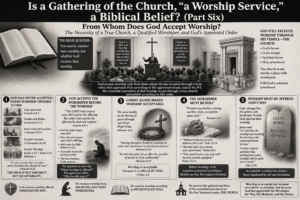 From Whom Does God Accept Worship? The Necessity of a True Church, a Qualified Worshiper, and God’s Appointed Order
The assembled church is the New Testament (NT) temple, and its gathered praise is a unique priestly offering to God. A next logical question is not just what worship is, but whom God receives as worshipers. God accepts worship only from those whom He has accepted through Christ, when they approach Him according to His appointed means, and, in the NT, the corporate expression of that worship occurs through a true church assembled according to His order.
The question then is not simply whether someone worships, but whether God accepts that worship. Scripture does not present worship as automatically acceptable because someone offers it sincerely. Men may worship. They may sacrifice, sing, or pray. Yet God Himself regulates and determines what He will receive.
God Has Never Accepted Every Worship Offered to Him
Cain and Abel
The Bible distinguishes between worship merely rendered and that which God accepts. The difference does not rest upon human emotion, intention, or sincerity. It depends upon whether the worshiper and the worship conform to God’s revealed will. The first example appears immediately after the fall of man. Cain and Abel both brought offerings unto the Lord. Both offered something. Both approached God. Yet God did not receive both offerings.
Genesis 4:4-5 says:
And the LORD had respect unto Abel and to his offering:
But unto Cain and to his offering he had not respect.
The difference was not that Cain offered nothing. He worshiped. He brought an offering. Yet God rejected it. Scripture does not portray God as saying, “At least Cain worshiped.” God did not commend the effort while overlooking the manner. God rejected worship that did not come from faith and obedience. Hebrews 11:4 explains:
By faith Abel offered unto God a more excellent sacrifice than Cain. . . .
Nadab and Abihu
Abel’s worship was accepted because Abel approached God according to God’s revealed will. The same principle appears throughout scripture. Nadab and Abihu were priests. They held a position appointed by God. Yet they offered strange fire before the Lord, which He had not commanded them. Their worship was not accepted. Leviticus 10:1-2 says:
And Nadab and Abihu, the sons of Aaron, took either of them his censer, and put fire therein. . . . and offered strange fire before the LORD, which he commanded them not. And there went out fire from the LORD, and devoured them.
King Saul and Uzziah
They worshiped and served. They offered incense. But God did not accept it. Saul also learned this lesson. He offered a sacrifice when God had not appointed him to do so. Samuel told him:
To obey is better than sacrifice, and to hearken than the fat of rams.”
The problem was not that sacrifice had no value. God Himself commanded sacrifices. The problem was that Saul offered a sacrifice contrary to God’s command. Uzziah provides another example. He entered the temple and burned incense before the Lord. He desired to worship. Yet God had appointed the priests, not the king, to perform that service.
2 Chronicles 26:18 says:
It appertaineth not unto thee, Uzziah, to burn incense unto the LORD, but to the priests the sons of Aaron. . . .
Israel’s Worship
Uzziah’s worship was rejected because he acted outside God’s appointed order. The prophets repeatedly condemned Israel’s worship when it departed from God’s will. Isaiah 1 describes a people bringing sacrifices, assemblies, prayers, and offerings. Yet God said (Isaiah1:13):
Bring no more vain oblations; incense is an abomination unto me. . . .
Amos (5:21) likewise declared:
I hate, I despise your feast days, and I will not smell in your solemn assemblies.
Malachi confronted Israel because they offered polluted sacrifices upon God’s altar. God never accepted worship simply because men offered it. The issue has never been whether worship occurred. The issue has always been whether God received it.
God Accepts the Worshiper Before the Worship
Genesis 4 establishes another important truth. God accepts the worshiper before He accepts the worship. Again, notice the order:
The LORD had respect unto Abel and to his offering:
But unto Cain and to his offering he had not respect.
God first had respect unto Abel. Then He had respect unto Abel’s offering. The person came before the sacrifice. Hebrews 11 explains that Abel came by faith. He did not merely bring the correct external offering. He approached God through faith in God’s promise. This principle continues throughout scripture.
God is not seeking merely religious actions. God seeks those who belong to Him. The Israelites often offered sacrifices while their hearts remained far from God. They performed religious acts while rejecting God’s authority. Their external worship could not replace genuine obedience. A sacrifice from an unbelieving and rebellious heart does not become acceptable because it is religious.
The worshiper matters. The heart matters. Faith matters. God does not merely examine the offering placed before Him. He examines the person who brings it. Therefore, the question is not only, “What worship is offered?” The question is first, “Who is offering it?”
Christ Alone Makes Worship Acceptable
The Great High Priest
The NT reveals why acceptable worship is possible for sinful men. Worship becomes acceptable through Jesus Christ. The book of Hebrews repeatedly calls believers to approach God. Yet every approach depends upon Christ. Hebrews 4:16 says:
Let us therefore come boldly unto the throne of grace. . . .
We come because we have a great High Priest. Hebrews 7 teaches that Christ possesses an unchangeable priesthood. He alone brings His people into God’s presence. Hebrews 9 explains that Christ entered once into the holy place by His own blood. Hebrews 10 declares:
Having therefore, brethren, boldness to enter into the holiest by the blood of Jesus. . . .
The Worthiness of Christ
The believer does not approach God based upon his own worthiness. He approaches through the worthiness of Christ. This also explains the sacrifices believers offer. Hebrews 13:15 says:
By him therefore let us offer the sacrifice of praise to God continually, that is, the fruit of our lips giving thanks to his name.
The sacrifice of praise is acceptable because it is offered “by him.” Christ is the mediator of acceptable worship. This connects with 1 Peter 2:5:
Ye also, as lively stones, are built up a spiritual house, an holy priesthood, to offer up spiritual sacrifices, acceptable to God by Jesus Christ.
The sacrifices are spiritual. The priesthood is spiritual. Yet their acceptance still depends upon Jesus Christ. Men do not make worship acceptable by their sincerity. Christ makes worship acceptable by His mediation.
The Worshiper Must Be Holy
Acceptable Worshiper
God not only requires an acceptable sacrifice. He requires an acceptable worshiper. Romans 12:1 says:
I beseech you therefore, brethren, by the mercies of God, that ye present your bodies a living sacrifice, holy, acceptable unto God.
The believer’s entire life becomes worship. Yet that life must be holy. God does not separate worship from obedience. Hebrews 12:14 states:
Follow peace with all men, and holiness, without which no man shall see the Lord.
Holiness is not optional. It is necessary. Psalm 24 asks:
Who shall ascend into the hill of the LORD? or who shall stand in his holy place?
Clean Hands and a Pure Heart
The answer describes a person with clean hands and a pure heart. Psalm 15 asks the same question:
LORD, who shall abide in thy tabernacle? who shall dwell in thy holy hill?
Again, the answer concerns character and obedience. God’s presence is not approached carelessly. Isaiah 6 demonstrates the same truth. Isaiah saw the glory of God and immediately recognized his uncleanness. Before Isaiah served as a prophet, his lips had to be cleansed. The pattern is consistent. Before worship, God requires a cleansed worshiper. Before service, God requires holiness.
Worship Must Be Offered God’s Way
How Someone Worships
God determines not only who worships, but also how he offers that worship. Scripture repeatedly warns against unauthorized worship. Cain brought an offering. Nadab and Abihu offered incense. Israel worshiped before the golden calf. Jeroboam established a false system of worship in Israel. Uzziah burned incense. Each example teaches the same lesson. Man does not determine the acceptable manner of worship. God does. Jesus confronted this same issue when He quoted Isaiah:
This people draweth nigh unto me with their mouth, and honoureth me with their lips; but their heart is far from me.
Then Jesus said:
But in vain they do worship me, teaching for doctrines the commandments of men.
Vain Worship
Jesus was not saying that they were not worshiping. They were, but their worship was vain. Why? Instead of scriptural worship, they worshiped according to man’s traditions. Therefore, acceptable worship requires both the right object and the right manner. Jesus informed the woman at the well (John 4:24):
God is a Spirit: and they that worship him must worship him in spirit and in truth.
Worship must be spiritual; that is, sincere. But worship must also be according to truth. Truth comes from God. God’s Word reveals His will. Acceptable worship has always been regulated by divine revelation. From Genesis to Revelation, the pattern remains unchanged. God receives those whom He accepts through His appointed means. He receives worship offered through the mediator He provided. Therefore, the Lord receives worship from those who approach Him in holiness. He receives it offered in accordance with His revealed order.
The greatest question is not whether men worship. The greatest question is whether God receives that worship.
More to Come