Part One Part Two Part Three Part Four
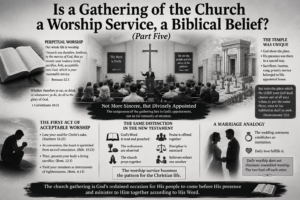 Romans 12:1 plainly teaches that the believer’s whole life is worship:
I beseech you therefore, brethren, by the mercies of God, that ye present your bodies a living sacrifice, holy, acceptable unto God, which is your reasonable service.
The living sacrifice is perpetual worship. The dead sacrifice was one time and finished; not the living one. Likewise, the Apostle Paul writes in 1 Corinthians 10:31:
Whether therefore ye eat, or drink, or whatsoever ye do, do all to the glory of God.
Every act of obedience glorifies God, and a true believer may perform every lawful vocation unto the Lord, including every prayer, every act of holiness or thanksgiving, and every work of faith. All are worship in a broad biblical sense.
The First Act of Acceptable Worship
For perpetual worship to begin, a person first offers his soul to God. Jesus says, “Whosoever will lose his life for my sake shall find it” (Matthew 16:25, cf. Mark 8:36, Luke 9:24, 17:33). “Life” is psuche in Greek, that is, “soul.” When one loses his soul to God, God restores it or converts it (Psalm 23:2, 19:7). This is when the heart, which is the soul, is sprinkled from an evil conscience at that point of conversion (Hebrews 10:23), without which, the person, instead, loses his soul to eternal ruin.
A person cannot offer his body as a living sacrifice in perpetual worship without first offering his soul to God. When he does, however, he receives the mercies of God that make him a child of God, a brother or sister, as described in Romans 12:1. The offering doesn’t stop there. He then keeps offering himself, which is also to yield his members as instruments of righteousness (Romans 6:13).
The question, then, is not whether perpetual yielding or obedience is worship. It is. The question is whether scripture recognizes another category of worship that belongs uniquely to God’s appointed dwelling place. It does.
The Temple Was Not Merely a Place Where Worshipers Gathered
Israel worshiped God everywhere. Abraham, Isaac, and Jacob worshiped. David worshiped while fleeing Saul. Daniel worshiped in Babylon. Yet the temple still occupied a unique place for worship. Why? Because God had chosen to place His name there.
Deuteronomy repeatedly emphasizes: “the place which the LORD your God shall choose” (12:18, 14:24-25, 16:6-7, 17:8, 15, 26:2). The temple was not merely another location where believers happened to worship. It was God’s appointed dwelling among His covenant people. That made what occurred there unique.
The Difference Was God’s Presence and Appointment
The sacrifices offered at the temple were not better because the worshipers were more spiritual there. They were different because God had instituted them. Likewise, burning incense, the morning sacrifice, the evening sacrifice, the priestly blessing, the Levitical singing, and the feast observances were all worship. But they belonged uniquely to God’s house.
Someone in Israel could worship God at all times and everywhere, but he couldn’t do what God regulated only for His temple service. God instituted the temple for something even more sacred than the worship of everyday life. This also related to the proximity of God’s special presence. Moses worshiped God constantly, but God commanded him to take off his sandals as he drew near to the burning bush. Why? God was everywhere, but He was uniquely at the burning bush.
No Israelite could say, “I worship God while tending my sheep, therefore I need not bring my sacrifice to Jerusalem.” That would have been false reasoning. Why? Not because tending sheep was not worship. It was. But because God had appointed another worship that belonged only to His house.
The Same Distinction Exists in the New Testament (NT)
Every believer worships continually. But the assembled church performs covenantal worship. That is, worship that belongs to God’s covenant people assembled before His presence according to His prescribed order.
It is analogous to this in the Old Testament (OT). Every Israelite prayed. Not every Israelite burned incense. Every Israelite praised God. Not every Israelite offered the morning sacrifice. Every Israelite served God. Not every Israelite ministered before the sanctuary. The latter belonged to the institution God had established.
The church service is not necessarily more sincere. Nor is it automatically more heartfelt. Someone may worship God more fervently on Tuesday morning than on Sunday morning. That is not the issue. The issue is that Sunday’s assembly is the occasion God has ordained for His gathered priesthood to minister before Him. Its uniqueness lies not in the intensity of emotion but in divine appointment. Exactly as the temple did.
A Marriage Analogy
A husband should love his wife continually: every conversation, every kindness, and every sacrifice expresses love. Yet the marriage covenant itself remains unique. One does not argue, “I loved my wife on Tuesday, therefore the wedding ceremony meant nothing.” The ceremony established an institution. The daily love fulfills it. Likewise, daily worship does not eliminate assembled worship. The two feed off each other in that corporate worship governs individual worship and individual worship prepares corporate worship.
The NT never presents the church gathering as one devotional option among many. The assembly is where Christ, through His Word, shapes the lives of His people. When the church gathers: God’s Word is publicly read and preached, the ordinances are observed, the church prays together and then offers praise together, discipline is exercised when necessary, and the saints mutually exhort one another. All of these means of grace shape the believer’s life outside the assembly. In other words, the worship service becomes the pattern for the Christian life.
The believer does not invent his own worship during the week. He lives according to what Christ teaches through His church. This is one reason Paul calls the church “the house of God…the pillar and ground of the truth” (1 Timothy 3:15). The church guards the truth that governs individual worship.
A Lord’s Supper Demonstration
Every meal should be eaten with thanksgiving. Every meal glorifies God. Yet the Lord’s Supper is not merely another thankful meal. It is covenantal, institutional, and ecclesiastical. It belongs to the gathered church.
No one argues, “I thank God every time I eat, therefore the Lord’s Supper is unnecessary.” The two belong to different categories. The same reasoning applies to congregational praise.
The OT Itself Distinguished These Categories
This point is often overlooked. David worshiped privately. He wrote many Psalms alone. Yet David still appointed Levites. He organized choirs, established courses, prescribed instruments, and arranged continual praise before the sanctuary. Why?
If all worship were simply individual devotion, none of this would have been necessary. The elaborate organization demonstrates that God regarded temple worship as a distinct ministry.
The Church’s Assembly Is the Highest Expression of Worship Because It Is the Fullest Expression of God’s Dwelling
This is where the argument culminates. The church gathered is not merely many Christians worshiping at the same time. It is God’s temple assembled, His household gathered, and His priesthood ministering together.
It is Christ walking in the midst of the candlesticks. It is the body acting corporately. No individual Christian, however devoted, can do alone what the assembled church does together. That is why Hebrews does not merely exhort believers to praise God individually. It exhorts “us” to “offer the sacrifice of praise to God.” Peter does not merely describe individual Christians as living stones in isolation; they are “built up a spiritual house” to offer spiritual sacrifices. The corporate reality is essential to the offering.
All of life is worship in the sense that every act of obedient service is offered to God. Yet the assembled church performs a unique covenantal and priestly worship that cannot be reduced to the ordinary worship of daily life because God Himself has appointed His gathered temple as the place where His redeemed priesthood corporately offers spiritual sacrifices before His presence. That distinction preserves both truths. It avoids diminishing Romans 12:1 into something less than continual worship, while also preserving the unique glory of the church’s assembly as the NT fulfillment of the temple and its ordained worship.
The Meaning of Psallō: Making Melody unto the Lord
Psallō
When Paul commands believers to be “singing and making melody in your heart to the Lord” (Ephesians 5:19), he uses the participle ψάλλοντες (psallontes), from the verb ψάλλω (psallō). A significant question is not merely how psallō is performed, but to whom it is directed.
The history of the usage of psallō demonstrates both continuity and development. In early classical Greek, psallō referred to plucking or twanging the strings of a bow or a musical instrument. The emphasis lay upon the physical action of plucking. Over time, however, its usage changed, with a greater association with sacred music: singing praise to God, whether accompanied by an instrument or not. The emphasis had shifted from the mechanical act of plucking to the worshipful act of praising.
Development of Meaning and Pattern
The Greek translation of the Hebrew OT later repeatedly employs psallō to translate Hebrew expressions for praising God with music. Whether the Hebrew text speaks of singing unto the LORD, making melody before Him, or praising His name with instruments, psallō regularly appears as the appropriate Greek equivalent. The word in the vocabulary of first-century Judaism correlated to temple worship. It did not describe secular entertainment. It belonged to the praise of God’s covenant people.
The NT uses psallō only a handful of times, yet every occurrence harmonizes with this established pattern. Paul writes in Romans 15:9:
For this cause I will confess to thee among the Gentiles, and sing unto thy name.
Here psallō appears in a quotation from Psalm 18. The direction could not be clearer. The praise is offered unto Thy name. Christ is declaring that the Gentiles shall glorify God by singing praise to Him. The audience is God Himself. James likewise writes (5:13):
Is any merry? let him sing psalms.
The context concerns the believer’s response to God’s providence. Just as the afflicted believer prays to God, the joyful believer sings praise to God. Prayer and praise stand side by side as corresponding acts of devotion. No reader imagines that James instructs the cheerful Christian to entertain others. The praise naturally ascends to the One who bestowed the blessing.
Word Correlates to Singing to God
Paul’s usage in 1 Corinthians 14:15 likewise deserves attention:
I will pray with the spirit, and I will pray with the understanding also: I will sing with the spirit, and I will sing with the understanding also.
Again, Paul closely associates singing with prayer. Both are expressions of worship offered in the assembly. His concern is not to redirect the music toward the congregation but to ensure that both prayer and praise proceed with spiritual sincerity and intelligent understanding. Just as prayer is offered to God with both spirit and understanding, so also is the singing.
With all the above in mind, consider again Ephesians 5:19:
Speaking to yourselves in psalms and hymns and spiritual songs, singing and making melody in your heart to the Lord.
The participle translated “making melody” is ψάλλοντες. He does not merely command believers to psallō. He specifies the object or direction of that melody: “to the Lord.” Whatever discussion may arise concerning the precise force of “speaking to yourselves,” the participle itself is unmistakably directed toward Christ. The melody belongs to Him.
Mechanics Secondary to Direction or Object
In some discussions of psallō, people often stress its mechanics. Was an instrument originally implied? Does the word require instrumental accompaniment? Did its meaning evolve beyond its earliest etymology? Such questions have their place, but they are secondary to Paul’s own emphasis. His concern is not the mechanics of plucking but direction. The church makes melody to the Lord.
Indeed, this harmonizes perfectly with the entire biblical theology of worship already established throughout this series. The OT Levites sang before the LORD. The Psalms repeatedly command God’s people to sing unto Him. Hebrews describes congregational praise as “the sacrifice of praise to God.”
Peter identifies believers as a holy priesthood offering spiritual sacrifices acceptable to God through Jesus Christ. Paul’s use of psallō fits seamlessly within this unbroken pattern. The NT does not redefine sacred praise as entertainment, performance, or merely mutual instruction. It continues to present it as an offering brought into the presence of God.
The Offering to God Edifies
This understanding also explains why congregational singing inevitably edifies the saints without making them its principal audience. Every faithful act of worship strengthens the worshiper. Prayer offered to God deepens the faith of those who hear it. Public reading of scripture instructs the congregation while honoring the God who gave His Word.
The preaching of the Word is directed to the congregation as God’s appointed means of instruction, but even preaching is ultimately performed before God and for His glory. Singing, however, differs in that scripture consistently identifies its direct object. The praise ascends to God even while its truth fills the minds and hearts of His people.
The church, therefore, should resist every tendency to evaluate its music primarily by its horizontal effects. To ask first whether people enjoy it, whether it attracts visitors, whether it creates the desired emotional atmosphere, or whether it conforms to prevailing cultural tastes is to begin with the wrong audience. The only question always is whether this praise is worthy to be offered before the throne of God. If it pleases Him, it will accomplish every purpose He has ordained, including the instruction, encouragement, and strengthening of His people.
The NT’s use of psallō confirms what the whole of scripture has consistently taught. Congregational singing is not principally manward but Godward. It is one of the church’s priestly sacrifices, offered through Jesus Christ to the Father. Because it is worship, it edifies. It does not become worship because it edifies. The church’s songs rise first to heaven, and in God’s gracious design their blessings then return upon the congregation that has offered them.
More to Come