Part One Part Two Part Three Part Four Part Five Part Six Part Seven Part Eight Part Nine Part Ten Part Eleven Part Twelve Part Thirteen Part Fourteen Part Fifteen Part Sixteen
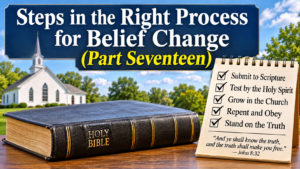 Navigating belief change requires more than personal preference or cultural trends. It demands total submission to the Holy Spirit working through Scripture. Believers actively discern God’s will not through isolated inward impressions, but by subjecting every proposed shift to the clear, authoritative standard of the written Word. When the Spirit exposes error, He drives individuals and churches toward genuine biblical reformation rather than reckless accommodation.
Authentic spiritual progress moves believers toward deeper conformity to Jesus Christ within the accountability of a church. Church leaders and members must actively cultivate humility, test every teaching against the whole counsel of God, and practice open accountability when correcting past missteps. True faithfulness demands both the courage to repent when Scripture exposes error and the strength to stand firm upon the truth of God’s Word.
The Ministry of the Holy Spirit in Biblical Change
The Holy Spirit does not compete with Scripture as another authority. He is the divine Author of Scripture, and His ministry does not lead people away from the truth He has revealed. The Spirit works through the Word to expose error, convince of truth, renew the mind, and produce obedience. Many “blame” the Holy Spirit for a change from a previously Scriptural position. 1 Corinthians 2:12–13 say:
Now we have received, not the spirit of the world, but the spirit which is of God; that we might know the things that are freely given to us of God. Which things also we speak, not in the words which man’s wisdom teacheth, but which the Holy Ghost teacheth; comparing spiritual things with spiritual.
Paul contrasts the spirit of the world with the Spirit who is of God. Men do not discover God’s will through the world’s wisdom. The Spirit reveals that. The Spirit does not authorize a person to disregard the written Word because he claims an inward impression, a special leading, or a powerful experience.
A person might also sincerely believe that the Spirit is leading him to change. Sincerity, however, does not establish the source of that impression. The claim must be tested. If the proposed change contradicts Scripture, it is not the Holy Spirit’s work. The Spirit of truth does not lead someone to reject the truth He gave.
The Spirit also works in the believer to receive and obey the Word. A person can have the words of Scripture while resisting what they say. He may know the right interpretation and still refuse to submit. Lack of information is not the problem. It is a heart unwilling to obey. Biblical change requires more than an intellectual adjustment. It requires a willingness to do what Scripture says, when it says it.
The Place of the Church in Belief Change
God did not establish the Christian life as an isolated effort in which every individual determines truth for himself. He established churches, gave them qualified leaders, and entrusted them with the responsibility to teach and uphold the truth. 1 Timothy 3:15 identifies the church as “the church of the living God, the pillar and ground of the truth.” The church does not create truth, and it does not have authority to change truth. It is responsible for upholding and proclaiming it. Its leaders must teach the Word, protect the congregation from error, and help believers grow in their understanding and practice of the truth.
Ephesians 4:11–16 describes Christ’s provision for the church:
And he gave some, apostles; and some, prophets; and some, evangelists; and some, pastors and teachers; For the perfecting of the saints, for the work of the ministry, for the edifying of the body of Christ: Till we all come in the unity of the faith, and of the knowledge of the Son of God, unto a perfect man, unto the measure of the stature of the fulness of Christ: That we henceforth be no more children, tossed to and fro, and carried about with every wind of doctrine, by the sleight of men, and cunning craftiness, whereby they lie in wait to deceive; But speaking the truth in love, may grow up into him in all things, which is the head, even Christ: From whom the whole body fitly joined together and compacted by that which every joint supplieth, according to the effectual working in the measure of every part, maketh increase of the body unto the edifying of itself in love.
Christ provides ministry to bring His people to maturity and stability in the faith. The goal is not continual novelty or an endless succession of new positions. It is growth into Christ, unity in the faith, and protection from doctrinal instability and deception.
This passage also shows why the leaders do not hide a proposed change from the church. Believers need to understand what is being taught and why. They must be able to examine a claim in light of Scripture. Pastors should welcome honest biblical examination rather than treat it as a threat to their authority. Church leaders have authority, but it is ministerial. They serve Christ and His Word, not standing above either.
No church is infallible. A congregation can hold an error, and its leaders can make mistakes. That is why churches must remain under Scripture. The answer to error in a church is not establishing authority independent of the Bible. A church brings matters to the Word of God as its final authority.
Biblical Reformation Is Not Departure
Biblical reformation occurs when the Word of God exposes error and believers submit to its correction. It may require a substantial change. It may overturn a long-standing tradition, correct a mistaken interpretation, or restore a neglected doctrine or practice. The magnitude of the change does not make it wrong. What matters is whether Scripture requires it.
Departure from the faith works in the opposite direction. It begins with either a denial of a doctrine, alteration of a biblical practice, or accommodation to a worldly idea. It can be just a small adjustment that does not immediately seem consequential. But when a change rests on something other than Scripture, it can lead to further changes that undermine the truth.
The distinction between reformation and departure is often not obvious to the people making the change. Someone may sincerely believe he is improving a church or correcting a problem. Sincerity and good intentions, however, can’t provide a guarantee of truth or guard against drift. A person must examine the teaching, the reasons, the process, and the consequences in the light of God’s Word.
Galatians 1:8–9 show how seriously Paul regarded departure from the gospel. He did not treat tweaking the message — at all — as acceptable. The gospel was not open to that, whether by a later teacher, an influential leader, or a religious movement. The message here is that the church must guard the truth it has received rather than permitting a different message to replace it.
A person should not assume he is right because of either changing or not changing. Both the new position and the old one must answer to Scripture.
The Purpose of Change Is Greater Faithfulness to Christ
The purpose of biblical change is not to make a person appear progressive, independent, courageous, or intellectually sophisticated. Nor is it to preserve a reputation for consistency. The purpose is greater conformity to Jesus Christ through obedience to the Word of God. Romans 8:29 identifies God’s purpose for believers as conformity to the image of His Son. Romans 12:2 describes the believer’s transformation through the renewing of the mind. Together, these passages show that biblical change is part of God’s work in making His people like Christ.
That purpose should govern the entire process. When Scripture exposes an error, the believer should not defend it because he has held it for a long time. When Scripture establishes a truth, he should not surrender it because the surrounding culture has moved in another direction. He should not make a change to gain acceptance, avoid criticism, attract people, or preserve an institution. He should seek to obey God.
The right process for belief change is therefore not a way to justify whatever someone already wants to do. It is a way of submitting every belief and practice to the authority of God. Biblical reformation changes what is wrong because Scripture requires it. Faithfulness refuses to change what is right because Scripture has established it.
The next and final post will address the response that this process requires from believers and churches: humility when Scripture corrects them, repentance when they have departed from it, accountability in the church, and perseverance in the truth.
Humility, Repentance, Accountability, and Perseverance
The right process for belief change ends with a responsibility that applies to every believer and every church. When Scripture requires change, they must change. When Scripture has already established the truth, they must stand firm. Neither stubbornness nor instability is faithfulness. Faithfulness means submission to God in both circumstances.
The preceding posts have considered the recognition of error, the authority of Scripture, the examination of a proposed change, the reasons people change, the responsibility to explain changes, accountability, the whole counsel of God, and the consequences that follow from a change in belief. They have also considered the cultural transformation of professing Christianity as an example of change that often occurred without an adequate biblical process.
The conclusion is not that Christians should resist change. It is that they should resist change that does not proceed from Scripture. They should also resist the pride that refuses to change when Scripture exposes error. The same submission to God that requires a believer to stand firm in truth also requires him to repent when he has been wrong.
Humility Before the Word of God
The first necessary attitude is humility. A person who approaches Scripture as though he already knows everything will not respond properly when the Bible corrects him. He may search for passages that support his position while avoiding those that challenge it. He may explain away plain statements, appeal to respected teachers, or accuse those who question him of causing division. Such a person does not submit to Scripture. He uses Scripture to defend himself.
James 1:21–22 says:
Wherefore lay apart all filthiness and superfluity of naughtiness, and receive with meekness the engrafted word, which is able to save your souls. But be ye doers of the word, and not hearers only, deceiving your own selves.
James connects receiving the Word with meekness and doing what it says. A true believer approaches Scripture open to correction. He must not merely hear the Word, agree with its authority, or speak favorably about its teaching. He must obey it.
Humility does not mean that a believer should be uncertain about everything. Scripture gives sufficient grounds for confidence in what God has revealed. A humble person can hold a settled conviction and defend it firmly. His humility is not uncertainty about God’s truth. It is a willingness to acknowledge that his own understanding may need correction. Some people call a refusal to compromise humility. Others call a refusal to reconsider an established position faithfulness. However, a person is humble when he submits to what God says, whether that submission confirms his former position or requires him to abandon it.
The believer should therefore approach every proposed change with a willingness to learn, but not with an assumption that the new position is better. He should be teachable before Scripture and discerning toward every claim made in its name.
More to Come