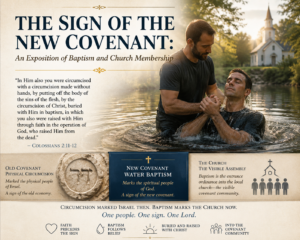
 The Warning Against Philosophy and the Shift in Covenants
Believers must carefully watch for false teachings. Paul warns the Colossian church in Colossians 2:8, to avoid philosophy and vain deceit. They must reject empty human traditions. Instead, they must follow Jesus Christ, who holds all supreme authority. In the Old Testament, God used physical circumcision. This circumcision acted as an entrance sign, which marked physical birth into Israel. However, the New Covenant has a spiritual entry. God now gathers a spiritual people. This spiritual nation is the church. Therefore, New Covenant membership requires a spiritual birth.
Physical circumcision served a specific role. It brought individuals into a national covenant, but it did not guarantee an internal change. This physical mark belonged to the old economy. The nation of Israel was a physical entity that required a physical boundary line: circumcision in the flesh. However, the church is a distinct assembly. It consists only of true believers. Therefore, the entrance sign must change. It must reflect a spiritual reality. This change occurs when a person believes in Jesus Christ. A new sign then marks this transition. That sign is water baptism.
Under the Old Covenant, physical circumcision visibly identified a person with the covenant nation of Israel. Under the New Covenant, baptism visibly identifies a believer with the new covenant people of God. Since the New Testament churches are the visible assemblies of that covenant people, baptism necessarily functions as the entrance ordinance into the local church.
The Circumcision of Christ and Heart Transformation
In Colossians 2:11, Paul describes this internal transformation. Believers receive a circumcision made without hands. The Greek New Testament uses a specific phrase here. It calls this work περιτομῇ ἀχειροποιήτῳ. This spiritual cutting removes the body of sins. Paul calls this the circumcision of Christ. Consequently, this internal work changes the human heart. God no longer uses a physical mark. He does not define His new people by fleshly cuts. Instead, He demands a real spiritual change. Therefore, spiritual circumcision completely replaces physical circumcision. This work of the Holy Spirit qualifies a person for church membership.
The old covenant community had a mixed membership. It included both believers and unbelievers. Every physical descendant of Abraham entered the covenant. Physical circumcision sealed this physical relationship. But the New Covenant is completely different. It contains only those who know the Lord and requires that every member possesses a circumcised heart. This heart transformation is the primary reality. The church must reflect this purity. It must include only regenerate individuals. Therefore, the sign of entry must follow faith. It cannot precede personal faith.
The Abrahamic Pattern: Faith Precedes the Sign
Romans 4:9-11 helps to understand this pattern. Paul discusses Abraham in this great passage. Abraham received the sign of circumcision. Crucially, he received it after he believed. Scripture states that faith was reckoned to him for righteousness. He was still uncircumcised when God justified him. Therefore, circumcision was a seal of pre-existing righteousness. It sealed the faith which he had yet, being uncircumcised. This sequence is highly significant for Baptists. Circumcision did not grant Abraham faith. It merely testified to a faith he already possessed.
These Romans 4 verses support the believer’s baptism position. Abraham is the father of all who believe. He is the father of those who have faith. He is not the father of physical infants who lack faith. Therefore, covenant signs belong only to believers. In the New Covenant, the sign is water baptism. Baptism cannot be given to infants. Infants do not possess personal faith. They cannot display a pre-existing righteousness. Thus, baptism must follow an explicit profession of faith. It seals a spiritual reality already present in the soul.
The Outward Symbol of Inward Burial
How do we display this inner change openly? Paul links this reality to water baptism in Colossians 2:12. Water baptism buries the believer with Christ. The Greek text uses a precise phrase. It calls this συνταφέντες αὐτῷ ἐν τῷ βαπτίσματι. Baptism acts as the outward sign. It shows our inward spiritual burial. Furthermore, we rise to new life through faith. This faith is the operation of God. The Greek phrase is πίστεως τῆς ἐνεργείας τοῦ θεοῦ. Thus, baptism is never for infants. It requires active, personal faith. Baptism outwardly marks our entry into the church, which is local and visible.
The text mentions the operation of God, which indicates that God works during salvation. He grants new life to the dead soul. Then, the believer submits to water baptism. The immersion under water represents or symbolizes a real burial. The emergence from water then represents or symbolizes a real resurrection. This physical act mirrors the spiritual circumcision. It shows that the old man died and that a new man lives. Therefore, each true church requires this visual testimony. It serves as the physical gateway to covenant membership.
Visual Boundaries and Church Identity
Physical circumcision initiated ancient Israelis into their physical nation. Water baptism initiates believers into the local church. The parallel is clear and consistent. The old sign required physical birth. The new sign requires spiritual birth. This spiritual birth must manifest itself. It manifests itself through a public confession. Baptism is that public confession. It says to the world that a person belongs to Christ. It tells the congregation that a new member has arrived. Therefore, the church uses baptism to define its borders. It separates the church from the world.
In C. H. Spurgeon’s sermon, “Christian Baptism,” preached on April 9, 1861, on Colossians 2:12, and later published in The Metropolitan Tabernacle Pulpit, Vol. 7, he says:
Baptism is the mark of distinction between the Church and the world. It very beautifully sets forth the death of the baptized person to the world. Professedly, he is no longer of the world; he is buried to it, and he rises again to a new life. No symbol could be more significant. In the immersion of a believer, there seems to me to be a wondrous setting forth of the burial of the Christian to all the world in the burial of Christ Jesus.
A few paragraphs later, Spurgeon explicitly connects baptism with entering the visible church:
I never dreamed of entering the Church except by Christ’s own way, and I wish that all other believers were led to make a serious point of commencing their visible connection with the Church by the ordinance which symbolizes death to the world, burial with Christ, and resurrection to newness of life.
Grammatical Exegesis of 1 Corinthians 12:13
1 Corinthians 12:13 is central to the debate (read this series for some background). It says that by one Spirit are we all baptized into one body. Many commentators misunderstand this phrase. They claim it refers only to an invisible baptism, saying that the Holy Spirit is the administrator. They believe this baptism places people into a universal, mystical body. However, Baptist expositors offer a better explanation. Based upon a strict grammatical argument, this verse actually describes water baptism.
The phrase “by one Spirit” uses the Greek preposition ἐν. The Greek text reads ἐν ἑνὶ πνεύματι. ἐν signifies the sphere or instrument. The Holy Spirit is the element or the source of unity. He is not the personal administrator of the baptism. Alternatively, the Holy Spirit directs the believer to water baptism. The phrase into one body refers to an assembly, so it means we enter a true assembly through baptism.
The Local Assembly as Christ’s Visible Body
The Greek verb for baptized is ἐβαπτίσθημεν. This is an aorist passive verb. In the New Testament, baptism regularly means water immersion. We should not change its meaning without a compelling reason. The context of Corinth involves water baptism and church order. Paul is discussing the church at Corinth. He is not talking about an invisible, abstract body. The church is a visible, organized assembly. It requires a visible, physical entrance. Therefore, being baptized into one body means entering a true church. Water baptism is the physical means of this entry.
The New Testament uses the word body to describe a congregation. The church at Corinth was Christ’s body. Paul tells them that they are the body of Christ. He does not refer to a mystical entity. Since the body is local, then the entrance must be local. To join a church, you must submit to an outward ordinance. That outward ordinance is water baptism. Therefore, 1 Corinthians 12:13 supports water baptism as the door to membership.
Harmonizing the Pauline Epistles
This interpretation maintains perfect harmony with Colossians. In Colossians 2, Paul unites spiritual circumcision and baptism. In 1 Corinthians 12, Paul unites the Spirit and the body. The Holy Spirit convicts the sinner. He circumcises the human heart. Then, the Spirit leads the believer to water baptism. Through water baptism, the believer joins the local body. The physical act reflects the spiritual work. The church remains pure and unified. It consists of people who share the same Spirit. They have all passed through the same waters.
Both passages reveal the active role of faith. Colossians 2:12 mentions faith in the operation of God. Romans 4:11 mentions the righteousness of faith. 1 Corinthians 12:13 assumes a common submission to Christ. None of these verses allow for infant baptism. Infants cannot exercise faith in God’s operation. They cannot possess the righteousness of faith. They cannot consciously join a local body by one Spirit. Therefore, New Covenant signs demand conscious faith. Baptism is the active expression of that faith. It connects the believer to a visible church.
Spiritual Resurrection and a Gathered Community
Colossians 2:13 completes the picture. Paul emphasizes our new life here. God has quickened us together with Christ. The Greek text uses the verb συνεζωοποίησεν. We were completely dead in our sins. We were dead in the uncircumcision of our flesh. However, God has forgiven us all our trespasses. This spiritual resurrection binds us to Jesus. Because we bind ourselves to Jesus, we also join His visible body. The church is this visible body. Therefore, water baptism serves as the physical gateway.
This structural parallel explains the Baptist view of church membership. Ancient Israel had a physical sign for a physical covenant. The church has a physical sign for a spiritual covenant. The physical sign must follow the spiritual reality. In the Old Covenant, birth came first, then circumcision. In the New Covenant, spiritual rebirth comes first, then baptism. This sequence protects the nature of the church. It keeps the church distinct from the world. It ensures that members are true followers of Jesus Christ.
Separation from Society and Objective Order
The pattern changes how the believer views society. The old covenant was a national covenant. It merged church and state into one entity. Every citizen was a member of the covenant. Physical circumcision maintained this national identity. But Christ’s kingdom is not of this world. The church is a gathered community. It is called out from the nations. It requires a voluntary commitment. Water baptism is the personal act of commitment. It marks the separation from the world. It declares allegiance to King Jesus.
God did not leave church entry to subjective feelings. He established a clear, objective standard. That standard is water baptism. When a person is baptized, he joins a specific body, submitting to its leadership and accountability. They then take their place in the ministry of the tangible body. This provides order and clarity to the church. It prevents confusion about who belongs to the body. Thus, 1 Corinthians 12:13 reinforces local church order.
Summation of the Baptismal Theology
Therefore, Colossians 2:8-13 provides a comprehensive theology of baptism. It warns against human philosophy. It points to the sufficiency of Jesus Christ and explains the spiritual circumcision of the heart. Furthermore, it connects this inner change to the outward water. Implicitly, it shows that baptism replaces circumcision as the covenant sign. However, it demands personal faith from every candidate, which excludes infants from the ordinance. It establishes baptism as the doorway to church membership. Each true church stands as a city on a hill.
In conclusion, the scriptures present a beautiful, consistent model. Romans 4 shows that signs follow faith. Colossians 2 shows that baptism replaces circumcision. 1 Corinthians 12 shows that baptism places us into the local body. Together, these texts prove our main thesis. Water baptism is the modern means of church membership. It functions just like circumcision functioned in ancient Israel. It is the physical boundary of God’s covenant people. Let the church guard this holy entry and honor the patterns of scripture.
Exposing the Philosophy of Infant Baptism
We must expand on the concept of philosophy in Colossians 2:8. Paul warns against traditions of men. These traditions often distort God’s ordained patterns. Pedobaptists often use human logic to justify infant baptism. They claim that since infants entered Israel, infants must enter the church. But this logic ignores Paul’s strict warning. It relies on human philosophy rather than Christ’s words. Christ establishes His church on regenerate membership. We must not let human tradition override this biblical truth. We must look only to the word of God.
The sufficiency of Christ is the core theme of Colossians. Paul states that in Him dwelleth all the fulness of the Godhead. The Greek text reads κατοικεῖ πᾶν τὸ πλήρωμα τῆς θεότητος. Because Christ is fully sufficient, we need no other rituals. We do not need physical circumcision to be complete. We are complete in Him. This completeness is manifested outwardly through His ordained means. That means is water baptism. Baptism shows a believer’s complete identification with Christ. It shows that he needs nothing outside of His work. It proclaims His total victory.
Liberty from Old Covenant Ordinances
Paul then uses the powerful image of ‘blotting out the handwriting of ordinances’ in Colossians 2:14. The law had a record of debt against every man. It condemned him because of his disobedience. But Christ took it out of the way. He nailed it to His cross. This means the old covenant system is finished. Its physical requirements are no longer binding. A new spiritual body has arisen. This new body requires a new sign of identity.
This new sign must reflect the spiritual liberty we have in Christ. Physical circumcision was a yoke of bondage for Gentiles. It required them to keep the whole physical law. But baptism is a sign of freedom. It celebrates our release from the law’s condemnation. It proclaims that sins are fully forgiven. This forgiveness is available to all who believe. Therefore, baptism is a joyful declaration. It is the public witness of a cleared conscience. It announces that the believer belongs to the new creation.
Better Promises and Regenerate Standards
The new covenant brings a better promise. It brings the permanent indwelling of the Holy Spirit. This indwelling Spirit changes one’s desires. He causes him to walk in God’s statutes. This internal power was missing in the old covenant nation. Most Israelis lacked a circumcised heart. They constantly rebelled against God’s commands. But the church is built on better promises. It is built on a transformed people. Baptism symbolizes this beautiful internal reality.
Therefore, each true church must be careful to preserve this standard. If a church baptizes infants, it brings unregenerate people into the church. This dilutes the spiritual nature of the body. It turns the church into a worldly institution. It replicates the failure of the old covenant model. A church must resist this practice firmly. It must ensure that every member has experienced the circumcision of Christ. It must require a credible profession of faith. Only then can a church administer the water of baptism.
The Ekklesia as a Tangible Assembly
The Greek word for church is ἐκκλησία, which means “assembly.” An assembly must be physical and local to assemble. An invisible universal concept doesn’t assemble. Therefore, the primary focus of the New Testament is the local church. When Paul wrote to the Corinthians, he wrote to a specific assembly. Their unity was local, and their baptism was local. This grammatical reality guides how one should view 1 Corinthians 12:13.
If 1 Corinthians 12:13 describes water baptism, it establishes local church authority. The local church administers the ordinance of baptism. Through this administration, the church adds members to itself. This matches the pattern in Acts 2:41, which states: Then they that gladly received his word were baptized: and the same day there were added unto them about three thousand souls.
The Pattern and Execution of Acts 2:41
Notice the precise chronological and institutional order of this verse. First, the people heard the gospel message preached by Peter. Second, they experienced a work of the Holy Spirit and “gladly received” that message with active, personal faith. Only after this internal regeneration did they submit to the physical waters of baptism.
Consequently, this physical act resulted in a definitive, measurable action: they were immediately “added unto them.” The assembly in Jerusalem did not leave its membership rolls to abstract assumptions. Rather, they used water baptism as the objective, visible mechanism to count and add these three thousand souls to their number. This clear institutional sequence perfectly mirrors the shift from the physical lineage of Abraham to the spiritual lineage of the church. Just as physical circumcision placed a numeric boundary around the nation of Israel, water baptism acted as the physical means of entering church membership on the day of Pentecost.
Safeguarding Order and Pastoral Oversight
This sequence is logical and necessary for church order. Without a clear entrance sign, membership becomes meaningless. Anyone could claim to be a member of Christ’s body. There would be no accountability or discipline. But God is a God of order, not confusion. He gave a clear physical sign to mark the boundary. That sign is water baptism that separates the insider from the outsider. It allows pastors to shepherd a defined flock and the flock to know its own members.
Contrast this with the old covenant boundary. In Israel, a male child was circumcised on the eighth day. He had no choice in the matter and did not understand the covenant. He did not possess saving faith at that moment. His membership was purely a matter of physical descent. He was an Israeli by birth. But in the kingdom of Christ, membership is a matter of spiritual descent. A person is born again by the Word of God. This spiritual birth must precede the covenant sign.
Circumcision as an Authenticating Seal
Romans 4 confirms this theological sequence perfectly. Paul argues that Abraham’s faith came first. This faith was counted for righteousness. The sign followed as a confirmation. When someone reverses this order, he destroys Paul’s argument. Infant baptism reverses this order completely. It places the sign before faith, presuming a relationship that does not yet exist and creating a false sense of security for the child. This is a dangerous spiritual error. Instead, true churches follow Abraham’s pattern of faith first.
Furthermore, Paul states that Abraham received circumcision as a seal. A seal authenticates a document or a reality. It proves that the reality is genuine. If there is no reality, the seal is a lie. For an infant, there is no faith to seal. Therefore, infant baptism is a meaningless seal. It seals nothing but a physical act. But for a believer, baptism is a true seal. It authenticates the believer’s public profession of faith. It confirms his union with Jesus Christ as a true and valid witness.
Cognitive Understanding and Candidates for Baptism
The Greek text of Colossians 2:12 says πίστεως τῆς ἐνεργείας τοῦ θεοῦ. This shows that faith is directed toward God’s working. The believer trusts that God raised Christ from the dead. He trusts that God will also raise him. This requires cognitive understanding. It requires a heart that moves toward God. An infant cannot perform this mental and spiritual act. He cannot focus a faith on God’s historical operation. Therefore, an infant is not a candidate for true water baptism. Baptism requires active faith.
Covenanted Fellowship and Shared Foundations
When a believer has this active faith, baptism becomes powerful. It is not a saving work itself, but a means of obedience and identification. It publically links the believer to Christ’s death and resurrection. The believer says to the church, I am dead to sin. I am alive to God. The church replies, We receive you into our fellowship. We recognize your faith as genuine. This mutual agreement forms the basis of local church membership. It creates a bonded community of true disciples.
This community is what Paul describes in 1 Corinthians 12. The body has many members, yet it is one body. Every member has a role to play. Every member is necessary for the health of the whole. This organic unity requires a shared foundation. That foundation is the one Spirit and the one baptism. The unity becomes visible, a visible group of people who have all submitted to the same Lord, who have all entered through the same door.
Practical Unity
The Apostle Paul corrects divisions within a specific congregation. He tells that congregation that it should not be divided. The members all share the same entrance experience. They were all baptized into that one local body. This argument loses its practical force if it refers to an invisible concept. An invisible baptism does not solve visible divisions in Corinth. But a shared physical baptism reminds church members of their mutual commitment. It calls them to local unity.
The exegetical evidence is clear. Colossians 2 connects spiritual circumcision with water baptism. Romans 4 shows that signs must follow personal faith. 1 Corinthians 12 shows that baptism enters a person into the body. All of these texts point to a single conclusion. Water baptism is the objective means of church membership, replacing circumcision as the covenant sign and defining the borders of the New Covenant community. This guards the purity of Christ’s church.
Conclusion
Historic Baptists have consistently understood believer’s baptism to be the visible covenant sign of the New Covenant and the prerequisite for membership in Christ’s visible churches. While they did not ordinarily use the expression “covenant membership” as a technical term, they repeatedly taught that baptism visibly identifies the regenerate believer with the covenant people of God and serves as the necessary antecedent to reception into the local church.
Let true churches remain faithful to this biblical pattern. They must reject the philosophical errors of human tradition and must preach a gospel that demands repentance and faith. Those churches must administer baptism only to those who profess Christ and must receive them into church membership with joy. This honors the design of the New Covenant. It fulfills the commands of our Lord Jesus Christ. It protects the church for future generations. May God grant churches and their members the grace to stand firm on His holy Word.
I love how James 2 (Faith without works is dead) relates so well to Romans 4. James 2 is the justification (before men) of an already justified (before God) man. Before baptism a person must be justified before God (faith) and then subsequently through their works and baptism justified before men.