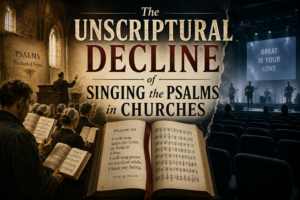
 As I grew up in an independent Baptist church, not only did we not sing the psalms; I never heard of doing it. It never even occurred to me that a church should sing the psalms. I hate to report this. During my Bible college and seminary years, no one mentioned psalm singing. It was not only not a concern, but it never came on my radar. On rare occasions, someone would put a chorus-like psalm, or part of a psalm to verse, but we never saw this as “psalm-singing.” Should churches sing psalms, and if so, why did they stop?
The history of singing Psalms in Bible-believing churches is a journey from total dominance to near-total displacement. For the vast majority of Christian history, the Book of Psalms was not just a resource for reading. It was the definitive, undisputed hymnal of the Church. The transition away from this historic practice in the 19th century represents one of the most radical shifts in the history of Christian worship. For the first 1,800 years of the Church, singing the actual words of scripture was the foundational standard of public worship.
Early History of Psalm Singing by the Church
The first church and the first churches naturally sang the psalms, as seen in Matthew 26:30 and Colossians 3:16. Historically, Athanasius, Jerome, and Augustine wrote extensively about the central role of the Psalter in daily worship. In the second century, Tertullian wrote in The Apology, concerning singing at the love feast:
Each is asked to stand forth and sing to God as he is able, whether from the Holy Scriptures [the biblical Psalms] or from his own clean heart (de proprio ingenio).
Evidence exists that groups separate from the state church sang psalms: the Donatists, the Waldenses, and the Anabaptists.
Roman Catholic inquisitors hunting the Waldenses frequently noted that they could identify them because even their uneducated peasants, weavers, and shoemakers would constantly sing the Psalms in their native tongue while working. The Waldenses were fierce defenders of metric Psalmody. The Ausbund and other Anabaptist songbooks contain numerous metrical Psalms. Anabaptists favored specific Psalms of distress, persecution, and deliverance (such as Psalm 79, which laments the defilement of God’s sanctuary, or Psalm 130).
When the Reformation exploded in the 16th century, Reformed leaders sought to put the songbook back into the hands of ordinary believers in their own languages. Because Hebrew poetic structures do not easily translate into singable Western music, the Reformers created metrical psalms, translating the exact meaning of the biblical text into rhyming verses with steady meters (like Common Meter, 8.6.8.6). This birthed legendary collections such as the Genevan Psalter (1562) in French, the Sternhold and Hopkins (1562) in English, and the Ainsworth Psalter (1612), which the Pilgrims brought with them on the Mayflower.
A Shift Away From Psalm Singing
Watts
A shift from singing the inspired words of scripture to singing “hymns of human composure” culminated in the 19th century due to a convergence of theological, cultural, and musical shifts. One influence was Isaac Watts, the 17th-18th century English congregational hymn-writer. Watts argued that the Old Testament Psalms were too dark, legally rigid, and didn’t explicitly mention Christ or New Testament realities. He published The Psalms of David Imitated in the Language of the New Testament (1719).
Watts, however, did not translate the Psalms; he Christianized them. For example, where Psalm 72 mentioned “Solomon,” Watts rewrote it to say “Jesus shall reign where’er the sun.” This broke a sort of barrier related to the psalms, which resulted in a downward trend. Once churches accepted his modified “imitations,” the door swung wide open for completely original text and eliminating the singing of the actual psalms themselves.
Revivalism of the 19th Century
Nineteenth-century revivalism, what some call “the second great awakening,” fundamentally altered the goal of church music. Worship shifted from a primary focus on corporate, objective praise directed toward God to an emphasis on evangelistic appeal, individual conversion, and emotional experience. The raw, repetitive “camp-meeting” songs and later the “Gospel Songs” of the late 19th century, popularized by figures like Ira Sankey and Dwight L. Moody, were catchy, had sentimental refrains, and were easily memorized by mass crowds. The stately, demanding metrical Psalms then felt archaic and rigid by comparison.
Also, hymn writers like Charles Wesley, John Newton, and later Victorian composers introduced fresh, lively melodies, varied time signatures, and rich harmonies. Many churches simply grew tired of singing the same 150 texts to a very limited pool of repetitive meters. The complete triumph of the modern hymn and contemporary worship song over the Psalter has persisted into the 21st century for several reasons.
The late 19th and 20th centuries saw the rise of massive religious publishing houses, followed by the contemporary Christian music (CCM) industry. Hymnals, and later digital licensing platforms, were built around newly copyrighted music and popular anthems, leaving little institutional momentum for public-domain, historical Psalters.
Abandoning Regulative Principle of Worship
Historically, Bible-believing churches adhered to the Regulative Principle of Worship, which holds that corporate worship should only include elements explicitly commanded in scripture (e.g., “singing psalms”). As churches transitioned to the Normative Principle (if the Bible doesn’t forbid it, and it edifies, we can do it), the theological necessity of prioritizing the biblical Psalter vanished.
Consumerism
Roughly one-third of the Book of Psalms consists of laments, cries of grief, profound suffering, spiritual dryness, and even imprecation, calling for God’s justice against enemies. Modern Western church culture heavily prioritizes therapeutic comfort, upbeat celebration, and positive emotional reinforcement. The raw, unfiltered reality of the Psalms does not fit easily into a highly curated consumer worship environment. Psalm singing wasn’t totally lost to churches, but the broader evangelical world largely forgot its original songbook.
Continuation of Psalm Singing
Strict Baptists
In England during the nineteenth century, the Strict Baptists, “strict” referring to their practice of strict close communion, viewed original human compositions that focused on human emotion as spiritually shallow. They continued to heavily utilize standard hymnbooks that deliberately paired original hymns with the Spirit of the Psalms. They strongly advocated singing the Psalms because they believed the Old Testament prayers of David accurately captured the deep, often painful “spiritual exercises” and trials of a true believer’s soul, something they felt modern, upbeat choruses completely ignored.
Spurgeon and Metropolitan Tabernacle
The Metropolitan Tabernacle sang the Psalms, and they still do today. When Charles Spurgeon became pastor of New Park Street Chapel, which later grew into the Metropolitan Tabernacle, the congregation was juggling multiple songbooks. To fix this, Spurgeon compiled “Our Own Hymn Book” in 1866. He structured the book to mirror the biblical layout of scripture, dividing it into two distinct halves: The Spirit of the Psalms (Numbers 1–150): The first 150 entries in the book were entirely metrical translations or paraphrases of the 150 biblical Psalms. The Hymns (Numbers 151–1,000+): The rest of the book consisted of traditional theological hymns.
Every Sunday service at the Tabernacle featured a mix of both. An observer tracking the Tabernacle’s services in the 19th century noted that Spurgeon would frequently open a service by saying, “Let us sing joyfully the 48th Psalm,” or reading aloud Isaac Watts’ famous metric version of Psalm 72, “Jesus shall reign where’er the sun.” To guide the mass crowd of over 5,000 people, the Tabernacle relied on a precentor, a song leader, who stood on the platform next to Spurgeon. The precentor would strike the pitch with his voice, and the entire congregation would sing a cappella.
The Singing of Psalms
Scripture teaches psalm singing. The New Testament provides actual examples of psalm singing. Through history, churches sang psalms. Below is the text of a psalm (Psalm 109) that our church sang this last Sunday in our Psalter, from which we sing Sunday morning and evening every week to the Lord. You would never sing such a text in a hymn, a text that God still desires to hear sung to Him, if you sang only from a hymnbook, and not a Psalter.
Psalm 109
C.M. Suggested tunes: Bangor
O thou the God of all my praise,
do thou not hold thy peace;
For mouths of wicked men to speak
against me do not cease:
The mouths of vile deceitful men
against me opened be;
And with a false and lying tongue
they have accused me.
They did beset me round about
with words of hateful spite;
And though to them no cause I gave,
against me they did fight.
They for my love became my foes,
but I me set to pray.
Evil for good, hatred for love,
to me they did repay.
Set thou the wicked over him;
and upon his right hand
Give thou his greatest enemy,
ev’n Satan, leave to stand.
And when by thee he shall be judged,
let him condemned be;
And let his pray’r be turned to sin,
when he shall call on thee.
Few be his days, and in his room
his charge another take.
His children let be fatherless,
his wife a widow make.
His children let be vagabonds,
and beg continually;
And from their places desolate
seek bread for their supply.
Let covetous extortioners
catch all he hath away:
Of all for which he laboured hath
let strangers make a prey.
Let there be none to pity him,
let there be none at all
That on his children fatherless
will let his mercy fall.
Let his posterity from earth
cut off for ever be,
And in the foll’wing age their name
be blotted out by thee.
Let GOD his father’s wickedness
still to remembrance call;
And never let his mother’s sin
be blotted out at all.
But let them all before the LORD
appear continually,
That he may wholly from the earth
cut off their memory.
Because he mercy minded not,
but persecuted still
The poor and needy, that he might
the broken-hearted kill.
As he in cursing pleasure took,
so let it to him fall;
As he delighted not to bless,
so bless him not at all.
As cursing he like clothes put on,
into his bowels so,
Like water, and into his bones,
like oil, down let it go.
Like to the garment let it be
which doth himself array,
And for a girdle, wherewith he
is girt about alway.
From GOD let this be their reward
that en’mies are to me,
And their reward that speak against
my soul maliciously.
But do thou, for thine own name’s sake,
O GOD the Lord, for me:
Sith good and sweet thy mercy is,
from trouble set me free.
For I am poor and indigent,
afflicted sore am I,
My heart within me also is
wounded exceedingly.
I pass like a declining shade,
am like the locust tossed:
My knees through fasting weakened are,
my flesh hath fatness lost.
I also am a vile reproach
unto them made to be;
And they that did upon me look
did shake their heads at me.
O do thou help and succour me,
who art my God and LORD:
And, for thy tender mercy’s sake,
safety to me afford:
That thereby they may know that this
is thy almighty hand;
And that thou, LORD, hast done the same,
they may well understand.
Although they curse with spite, yet, Lord,
bless thou with loving voice:
Let them ashamed be when they rise;
thy servant let rejoice.
Let thou mine adversaries all
with shame be clothed over;
And let their own confusion
them, as a mantle, cover.
But as for me, I with my mouth
will greatly praise the LORD;
And I among the multitude
his praises will record.
For he shall stand at his right hand
who is in poverty,
To save him from all those that would
condemn his soul to die.
I love singing Psalm 109.
Psalm 109 is why I wrote this. Our Trinity Hymnal, Baptist edition, does have psalms in it that are like Psalm 109. We sang this on Wednesday for instance: https://www.youtube.com/watch?v=KXbrKAaecIo
Have memorized about 30 Psalms to sing, but most are just 2-3 verses except for Psalm 23.
We had a small church in a home and we had about 100 psalms with music based on OT and NT verses. I enjoyed them much, as also the hymns.
Tom
Good to see discussion of and interest in singing Psalms. I do not believe in Exclusive Psalmody, but I think most Baptists in the United States have gone in an opposite extreme to some sort of Exclusive Hymnody — hardly anyone even consciously thinks of singing Psalms. (And some of the words of modern songs has really gone downhill.)
Thanks.
Thanks Robert!
My story is about the same as yours, Bro. Brandenburg. I grew up in Baptist churches and not one of them ever sang a Psalm that I can recall. I am ashamed to this day that it took me so long to “see” the word “psalms” in the Ephesians and Colossians passages. I do not recall what means God used to help me “see” that word, but from then on I’ve wanted to sing more and more Psalms, and I’ve learned a few. I bought some hymnals / psalters and have tried to learn more. I wish it had been part of my heritage, but I can learn now and move forward in obedience to a part of God’s Word I previously skipped right over. Since God wants us to sing His Psalms, certainly we should want to do so for Him. It’s the least we can do.
I agree Bro. Chapman. Totally agree.
Free 1650 Scottish Psalter app, with examples of hearing people sing it in case someone doesn’t know much about how to sing music:
https://psalterapp.com/
It is sobering to think that either Christ prays John 17 for us if we are believers, or, as the perfect Man singing the Psalms in the synagogue, He prays Psalm 109 against us if we are unconverted.