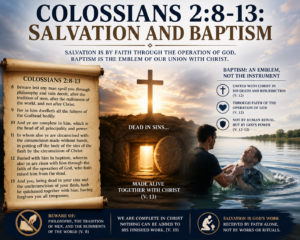
 Roman Catholicism uses Colossians 2:8–13 to grant saving power to baptism. Specifically, Catholic theologians treat baptism in these verses as New Testament circumcision. Yet, the Apostle Paul does nothing of the kind. Instead, he argues the exact opposite. I reflected on this reality over the last couple of days.
My thoughts began after I watched a professing former Baptist explain his conversion to Roman Catholicism. He claimed this passage was key to his shift. Unfortunately, he sat alone and spoke without any pushback. His presentation remained completely unconvincing. Indeed, these verses say the opposite of his claims. The strong Roman Catholic argument depends entirely on the apparent authority of their Church. Consequently, it is not a valid argument.
Here is the text of these verses:
8 Beware lest any man spoil you through philosophy and vain deceit, after the tradition of men, after the rudiments of the world, and not after Christ.
9 For in him dwelleth all the fulness of the Godhead bodily.
10 And ye are complete in him, which is the head of all principality and power:
11 In whom also ye are circumcised with the circumcision made without hands, in putting off the body of the sins of the flesh by the circumcision of Christ:
12 Buried with him in baptism, wherein also ye are risen with him through the faith of the operation of God, who hath raised him from the dead.
13 And you, being dead in your sins and the uncircumcision of your flesh, hath he quickened together with him, having forgiven you all trespasses;
The Colossian Error Frames the Whole Passage
In verse 8, Paul warns against “philosophy,” “the tradition of men,” and “the rudiments of the world.” These terms describe a dangerous syncretism. This false system combined Jewish ceremonialism, self-imposed asceticism, and angel-veneration. Furthermore, the Colossian heretics demanded these additions to reach spiritual fullness. In contrast, Paul declares that believers are already “complete in him” (v. 10). Paul does not teach that water baptism replaces fleshly circumcision as a mechanism of salvation. Indeed, such an idea would gut his entire argument. He firmly maintains that nobody can add anything to our completeness in Christ.
“The Circumcision Made Without Hands” — ἀχειροποιήτῳ
The phrase “circumcision made without hands” translates the Greek περιτομῇ ἀχειροποιήτῳ. Notably, Paul does not simply say “ye are circumcised.” He adds the crucial qualifier ἀχειροποίητος, which means “not made by hand.” Elsewhere, Paul consistently uses this word-family to highlight a spiritual, divinely wrought reality. He sets this reality against actions that human hands perform (2 Cor. 5:1; Mark 14:58; Acts 7:48). Therefore, this qualifier removes the circumcision of verse 11 from the category of physical rites. Water baptism belongs to that physical category.
Moreover, the Apostle means the inward stripping away of the old sinful nature. This regeneration constitutes the true “putting off of the body of the sins of the flesh.” It does not mean an external ordinance. Thus, human ministers do not administer this reality with their hands. This fact directly answers the Catholic claim. They claim baptism simply replaces old covenant circumcision for infants. However, Paul’s specific qualifier completely excludes a hand-administered rite from verse 11.
“Buried With Him in Baptism” — a Subordinate Participle, Not the Main Verb
The word “buried” translates συνταφέντες, an aorist passive participle. Grammatically, this participle remains subordinate to the main thought from verse 11. It merely describes the mode of spiritual circumcision. Specifically, it pictures this reality as a burial. It does not cause the transformation. Instead, baptism functions as an emblem of our union with Christ’s death. Romans 6 uses this same imagery. Consequently, the water only pictures an accomplished reality. The rite itself does not accomplish salvation.
“Through the Faith of the Operation of God” — the Instrumental Phrase That Settles It
This grammatical detail marks the decisive point. Here, the main verb is “ye are risen” (συνηγέρθητε). Paul plainly states the means of this resurrection. We rise “through the faith of the operation of God.” In Greek, the preposition διά with the genitive marks the instrumental cause. Paul could have written “through baptism” if he viewed water as the saving instrument. However, he did not do so.
Instead, Paul names faith as the true instrument of resurrection. He merely pictures this reality through the image of baptism. If the physical rite conferred regeneration, this clause would be unnecessary. Furthermore, it would be deeply misleading. Therefore, Paul inserts this phrase as a safeguard. It prevents us from viewing baptism as anything more than an emblem. We receive the actual work through faith alone.
Verse 13 — The Quickening Is God’s Unilateral Act, and Water Is Never Mentioned
Consider the phrase “hath he quickened together with him.” In this clause, the verb συνεζωοποίησεν features God as the subject. The sinner, dead in trespasses, serves as the direct object. Consequently, the grammar leaves no room for human ritual. Ritual performance cannot serve as the hinge of the action. Rather, Paul describes a sovereign divine action. This matches his theology in Ephesians 2, where grace saves believers. Remarkably, Paul never mentions baptism in verse 13. We would expect water here if it caused new life. Instead, the narrative moves straight from death in sin to God’s unilateral quickening and forgiveness.
The Circumcision-of-Christ Imagery and Its Bearing on Infant Sprinkling as a Saving Sign
The phrase “the circumcision of Christ” identifies the true circumcision. Christ accomplished this work in His death. Subsequently, God applies it during regeneration through faith. Therefore, it does not apply to an infant who cannot believe. We cannot base this doctrine on the eighth-day rite of Genesis 17. Old covenant circumcision was a physical sign. Moreover, priests applied it to an infant’s flesh without requiring personal faith.
In contrast, the “circumcision made without hands” signifies something opposite. It removes “the body of the sins of the flesh.” Verse 12 ties this moral event directly to faith. It stems from the finished “operation of God.” Thus, the grammar provides no ground for transferring the physical sign to infants today. We cannot call either external rite a saving act. According to Paul, the true saving act is the circumcision “made without hands.” Sinners receive it “through the faith of the operation of God.” Baptism remains an ordained picture, not a cause.
Summary of the Grammar of Colossians 2:8-13
- ἀχειροποιήτῳ — This term excludes hand-administered rites, including water baptism, from the immediate context.
- συνταφέντες — This subordinate participle presents baptism as a descriptive emblem rather than an independent cause.
- διὰ τῆς πίστεως τῆς ἐνεργείας τοῦ Θεοῦ — This phrase identifies faith, not the ritual, as the instrument of resurrection.
- συνεζωοποίησεν (v. 13) — This verb describes God’s unilateral quickening and omits any mention of water.
In summary, these points form the grammatical backbone of the text. They show baptism as an emblem of an accomplished salvation. Grace through faith accomplishes this work. Therefore, the passage does not present a saving substitute for circumcision. It provides no warrant for infant sprinkling.
Answering the Roman Catholic Viewpoint
On Faith and Sacrament as Complementary, Not Competing
The Roman Catholic case collapses the distinction between faith and rite. However, Paul explicitly draws this distinction. Verse 12 reads:
Buried with him in baptism, wherein also ye are risen with him through the faith of the operation of God, who hath raised him from the dead.
The phrase “through the faith” forms an instrumental construction. Specifically, it names the means of our resurrection with Christ. Paul could have named water as a co-instrument alongside faith here. This clause represents the natural place for that claim. Yet, he did not write “through baptism and faith.“
Instead, Paul isolated the instrument as “the operation of God” received “through the faith.” Consequently, reading water into this clause adds to the text. Paul deliberately left it out during his most precise moment. Galatians 2:16 displays the same construction elsewhere:
a man is not justified by the works of the law, but by the faith of Jesus Christ. . . . that we might be justified by the faith of Christ, and not by the works of the law.
Clearly, Paul follows a consistent pattern. He names faith as a sufficient instrument whenever people feel tempted to add physical works.
On ἀχειροποιήτῳ As Merely “Typological,” not Exclusionary
The Catholic reading requires a flexible interpretation of “made without hands.” They try to distinguish Christ’s circumcision from Moses’s rite without excluding baptism. However, Paul’s usage elsewhere destroys this argument. In 2 Corinthians 5:1, he contrasts our earthly house with a heavenly house “not made with hands.” Similarly, Mark 14:58 records a contrast between a physical temple and one “made without hands.“
In both instances, the phrase establishes a strict category distinction. It separates the physical from the spiritual. It does not merely signal a superior agent using physical means. Furthermore, Paul directly opposed the physical circumcision of the Judaizers. His qualifier shows that the new circumcision belongs to a completely different category. Therefore, reading a physical rite back into the verse violates Paul’s intentional choice of words.
On the Participle as “Coincident and Constitutive”
Grammatically, συνταφέντες remains a subordinate aorist passive participle. Its natural function is to describe accompanying circumstances. Thus, it does not establish a rival center of causation. Even if we grant a coincident-aorist reading, the text still qualifies the action. It specifies that the rising happens “through the faith of the operation of God.“
Ultimately, overlapping imagery cannot overturn the stated instrument. The text simply pairs the picture with the spiritual reality. Romans 6:4 displays this exact pattern:
Therefore we are buried with him by baptism into death: that like as Christ was raised up from the dead by the glory of the Father, even so we also should walk in newness of life.
We walk in newness of life through resurrection power. As a result, Romans 6:11 anchors this reality “through Jesus Christ our Lord.” The water rite does not confer it.
On Verse 13’s Silence about Water
The Roman Catholic argument treats Paul’s silence as simple continuity. However, this claim merely dresses up an argument from silence. Verse 13 underscores the true source of action:
And you, being dead in your sins and the uncircumcision of your flesh, hath he quickened together with him, having forgiven you all trespasses.
God acts as the subject, while the dead sinner acts as the object. Consequently, the passage emphasizes life and forgiveness. If this matches the action of verse 12, then faith governs it as well. Therefore, Paul’s silence confirms that water lacks operative power. He would not omit the actual cause of salvation at the summit of his argument.
On Household Baptism and Infants of the Household
Colossians 3:20 gives a clear command:
Children, obey your parents in all things: for this is well pleasing unto the Lord.
This exhortation targets children who can hear and obey instructions. Thus, it does not prove the presence of infants. Moreover, nothing in the household-baptism texts proves that infants received the rite (Acts 16:15, 16:33; 1 Cor. 1:16). Those passages record entire households believing and experiencing baptism together. Accordingly, they describe professing adults and believing dependents. Infants can’t and don’t believe.
Meanwhile, Paul explicitly defines the true circumcision. It effects the “putting off of the body of the sins of the flesh.” We receive it “through the faith of the operation of God.” An infant cannot exercise this instrumental faith. Therefore, Catholics build a doctrine on an absence rather than on explicit text.
On the Authority of Continuous Sacramental Practice
Paul’s warning in verse 8 provides the definitive answer to church tradition:
Beware lest any man spoil you through philosophy and vain deceit, after the tradition of men, after the rudiments of the world, and not after Christ.
Later ecclesiastical practice cannot supply an instrumental cause that the apostle omitted. Paul explicitly assigned this cause to faith alone. Furthermore, the text remains clear at the decisive point. It names its own instrument. Consequently, this stated instrument settles the question against outside traditions.
Conclusion
In conclusion, these arguments converge on a single grammatical fact. Paul supplies this fact himself. He never names water as a co-instrument of salvation. Instead, he isolates “the faith of the operation of God” (Colossians 2:12). Moreover, he completely omits water when describing the moment of quickening (v. 13).
The Roman Catholic case must force an artificial compatibility between faith and sacrament. They must soften “made without hands” into mere typology. Additionally, they treat a subordinate participle as a primary cause, read meaning into silence, and infer infants without textual evidence. Finally, they appeal to a tradition that verse 8 explicitly condemns.
Ultimately, each Roman Catholic argument requires adding to the text. In contrast, the credobaptist reading requires no additions because the text states its own instrument. Colossians 2:8–13 teaches baptism as an emblem of a salvation already accomplished by grace through faith. It does not cause salvation, nor does it apply to individuals who cannot believe.
Dear Bro Brandenburg,
Thank you for the study of Colossians 2.
If I update the web version of my anti-baptismal regeneration book (faithsaves.net/baptismal-regeneration/)
I at this point would include the following as a note on Colossians 2:12. Would you agree with this, or tweak or change some of it? Thank you.
Colossians 2:11-12 is sometimes alleged to equate baptism and spiritual circumcision, but there is no proof that it does so—the spiritual circumcision “without hands” of v. 11 is specifically contrasted with the literal circumcision of the body, not to baptism (compare Ephesians 2:11). As indicated above, baptism is very much an act performed with one’s hands, while spiritual circumcision or regeneration is “without hands.”
The only potentially reasonable attempt at proof in the entirety of Scripture for the affirmation that spiritual circumcision is baptism would be the assertion that the participle “buried with” (suntaphentes) in Colossians 2:12 is dependent upon the verb “ye are circumcised” (perietmethete) in Colossians 2:11. However, the passage does not definitively equate the two actions or make them identical. The fact that two things are related—as are receiving a new heart in spiritual circumcision and the outward testimony or picture of regeneration in baptism—does not establish an identify between the two. Suntaphentes could be an example of an aorist participle of subsequent action (cf. 132, 142-146, Syntax of the Moods and Tenses in New Testament Greek, Earnest Burton. Chicago, IL: University of Chicago Press, 1923-1925; pg. 614 n. 2, Greek Grammar Beyond the Basics, Wallace), or Paul could be viewing the perietmethete and suntaphentes as simple snapshot actions that took place in the past and are closely associated, so that, although the (possibly telic) participle could be considered as loosely temporally simultaneous with the verb grammatically, none the less the simple snapshot nature of the aorist tense could allow for an earlier spiritual circumcision followed by an outward testimony to that fact in baptism (cf. Acts 25:13 and the relationship of the participle “salute/greet,” aspasamenoi, to the verb “came,” katentesan, or 1 Peter 3:18 and the relation of the participle “made alive,” zoapoiethes, to the verb “suffered,” epathe; also 1 Timothy 1:12; Acts 10:3; 11:13). In context, Paul proves that believers are complete in Christ (2:10). They are spiritually circumcised (2:11) and baptized as the outward evidence of regeneration (2:12), forgiven (2:13-14) and free from legal ordinances (2:14-15). Since they are complete in Christ and are identified with Him (2:10-15), they are not to return to Jewish ceremonialism (2:16ff.). Believers are spiritually united to Christ and spiritually circumcised before they are symbolically buried and raised with Christ in baptism. Paul’s argument does not require either baptismal regeneration or the equation of spiritual circumcision and baptism in Colossians 2.
Furthermore, those who are buried with Christ in baptism in Colossians 2:12 are believers, people who have already had their sins forgiven, not infants who are supposedly baptized as an alleged counterpart to circumcision in Israel. They are people who have already have faith, as Colossians 2:12 itself affirms. They had received Christ (v. 6) and had all their trespasses forgiven (v. 13), and Paul rejoiced in their steadfast faith (v. 5). Paul longed to see them “that their hearts might be comforted, being knit together in love, and unto all riches of the full assurance of understanding” (v. 2). Infants would not have their hearts knit together in love and have the riches of the full assurance of understanding if Paul came to see them. They do not even know their right hands from their left (Jonah 4:11)—how could they have “the full assurance of understanding” concerning the deep truths of the gospel? Those baptized in Colossians 2:12 were old enough to choose to celebrate Jewish holy days and feast days or to refrain from doing so. They were not to allow anyone to judge them based on their choice (v. 16). They were also to refuse to listen to the beguiling words of false teachers (v. 4, 18). The commands of Colossians chapter two are ridiculous if applied to infants. Colossians 2:12 speaks of those who have already been spiritually circumcised, who have already become believers, being immersed in baptism. It gives no support at all to infant baptism, nor does it establish any equivalence between the Jewish ceremony of circumcision and the church ordinance of believer’s immersion.
Furthermore, history does not support an argument for infant baptism from circumcision. “There is a silence in the early patristic references to infant baptism concerning the analogy between circumcision and baptism… . [N]ot until the mid-third century that this analogy first occurs as an argument for infant baptism. Furthermore, the citing of Colossians 2:11-12 does not occur in this connection until the mid-fourth century” (“Colossians 2:11-12: The Circumcision/Baptism Analogy, and Infant Baptism,” J. P. T. Hunt. Tyndale Bulletin 41.2 (1990) 227-244).
It’s pretty good. It is long and hard to follow though. It’s hard to stay with something so long with no breaks. Is this a footnote?
Yes, a footnote, and a rather technical one.
Thanks.