 Because of the dominance of Roman Catholicism, during the medieval times or the Middle Ages, antisemitism spread all over Europe. This came because Roman Catholics did not teach the Bible. Week upon week, they celebrated the Mass, which revolved around the brutal torture of Jesus and His mistreatment by a crowd of Jews. Catholics weren’t reading and studying the whole Bible. They didn’t receive the context of the isolated event of Jesus’ death within the Old Testament, the rest of the Four Gospels, and the Epistles.
With the invention of the printing press in 1440 came the exponential publication and spread of the whole Bible, Genesis to Revelation. More than anything, the mass distribution of the Bible led to the Protestant Reformation. When someone could read all of scripture, he saw that Jews were the heroes of the Old Testament. Characters – Abraham, Joseph, Moses, Joshua, Deborah, Hannah, Ruth, Samuel, David, Isaiah, Jeremiah, Daniel – became household names. The Bible became people’s media, especially the English, for hundreds of years.
Not a Conspiracy, But Actually Mainstream
When you read English literature, you saw and heard these names, which parents then gave to their children. English Protestants, Puritans, and Baptists did not hate the Jews. They loved the Jews. Their writers named their characters, and their parents named their children after these Jewish figures. With more Bible reading, teaching, and preaching came a massive rise in literal interpretation in contrast to the allegorical and figurative interpretations of Roman Catholicism. You can see this in the literature.
As a primary reason and in a major way, I write this post to combat the idea that Zionism among the English and in the United States came from a 19th-century systematization of premillennialism, that is, dispensationalist theology. It was not a Jewish conspiracy, the work of the Rothschilds through C. I. Scofield and his reference Bible. Zionism wasn’t new-fangled. It proceeded from a high view of scripture, which undergirded the rise of the power of the United States in the world, which came from the blessing of God on the biblical viewpoint of its people.
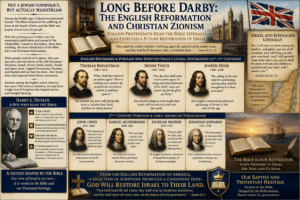
Long before Darby and Scofield, leading English Protestant theologians consistently interpreted biblical prophecies concerning Israel literally and expected a future national restoration of the Jewish people to their land. A tremendous evidence of this is the acceptance of Zionism in the United States. That was long the culture of the United States. Israel became a nation in 1948. Consider the president of the United States in 1948, Harry Truman, had read through the entire Bible by the time he was fourteen years of age.
Harry Truman
Biographers and archives from the Harry S. Truman Library & Museum document several ways his childhood reading directly drove this monumentous decision:
The “Cyrus the Great” Parallel
As a boy reading the Old Testament, Truman was deeply moved by the story of King Cyrus of Persia, who in 538 BC permitted the exiled Jewish people to return to Jerusalem and rebuild their temple. Truman explicitly viewed himself through this biblical lens. After leaving office, when a group of Jewish leaders praised him for helping found Israel, Truman famously declared, “I am Cyrus.”
Belief in Covenant and Prophecy
Truman’s Baptist upbringing and rigorous scripture reading left him highly familiar with biblical prophecies regarding a Jewish return to Zion. Alongside his close aide Clark Clifford, Truman referenced Old Testament verses detailing God’s promise of the land as an “everlasting possession” to the descendants of Abraham.
Empathy for the Displaced
Having memorized passages like Psalm 137 (“By the rivers of Babylon, there we sat down, yea, we wept, when we remembered Zion”), Truman possessed an immediate, lifelong empathy for the Jewish plight. In the wake of the Holocaust, he viewed the creation of a Jewish homeland not just as a political maneuver, but as a moral necessity to right a historical wrong.
A “Pilgrim” Mentality
Truman viewed the Zionist movement similarly to the journey of America’s Pilgrim fathers and western pioneers. His reading of the Exodus story gave him a foundational baseline to respect a people seeking freedom from persecution to build a society based on the laws of Moses. By leaning on his childhood scriptural foundations rather than the statecraft advice of his cabinet, Truman ordered the official de facto recognition of Israel just 11 minutes after it declared independence, making the United States the first nation to do so.
Thomas Brightman
Many early Protestants, Puritans, and Baptists supported the literal, physical return of the Jewish people to Palestine, termed “Jewish Restorationism” or proto-Christian Zionism, which rapidly took root among early British and American Puritans, theologians, and scholars in the late 16th and 17th centuries. Thomas Brightman wrote in Latin in 1585, Apocalypsis Apocalypseos (A Revelation of the Revelation), and published posthumously in English in 1615. He rejected allegorical interpretation, insisting that the physical return of the Jews was an absolute certainty guaranteed by scripture:
What, shall they return to Jerusalem again? There is nothing more certain: the prophets do everywhere confirm it and beat upon it.
He detailed the physical reclamation of the land in his commentary on the Book of Daniel and Revelation:
They shall repair to their own country. . . They shall dwell in their own country. . . . They shall inhabit all the parts of the Land, as before. . . . They shall live in safety. . . . They shall continue in it for ever.
Henry Finch
The World’s Great Restouration
In 1624, Puritan Henry Finch, also a knighted English lawyer and politician, wrote The World’s Great Resouration, or, the Calling of the Jewes. Finch established a strict rule of biblical hermeneutics, insisting that biblical references to “Israel” and “Jerusalem” must be interpreted literally as referring to the actual physical descendants of Jacob:
Where Israel, Judah, Zion, Jerusalem, &c. are named in this argument, the Holy Ghost meaneth not the spiritual Israel, or Church of God collected of the Gentiles, no nor of the Jews and Gentiles both (for each of these have their promises severally and apart) but Israel properly descended out of Jacob’s loins.
Contra Spiritual Metaphors and Predicting Restored Jewish Nation
Finch rejected the idea that prophecies of returning to the land were merely spiritual metaphors for salvation:
The same judgement is to be made of their returning to their land and ancient seats, the conquest of their foes, the fruitfulness of their soil, the glorious Church they shall erect in the land itself of Judah, their bearing rule far and near. These and such like are not allegories, setting forth in terrene similitudes or deliverance through Christ (whereof those were types and figures) but meant really and literally of the Jews.
He wrote that scripture predicted the political supremacy of a restored Jewish nation:
We need not be afraid to aver and maintain, that one day they shall come to Jerusalem again; be Kings and chief Monarchs of the Earth; sway and govern all, for the glory of Christ that shall shine amongst them.
Joseph Mede
A brilliant scholar, fellow of Christ’s College, Cambridge, Joseph Mede wrote Clavis Apocalyptica (The Key of the Revelation) in 1627. Mede argued that the diaspora would end in a miraculous physical gathering. He wrote in his Works (specifically in his letters and discourses on the apocalypse):
I have always been of the opinion. . . . that the calling of the Jews shall be outstanding, and that they shall be brought back to their own land of Judea, and there establish a Christian Commonwealth, before the end of the world.
John Owen
One of the most prominent and intellectually towering of the English Puritan theologians, John Owen served as the chaplain to Oliver Cromwell and Vice-Chancellor of Oxford University. Owen was a major force in framing English congregationalism, drafting the preface to the Savoy Declaration (1658) which explicitly highlighted the expectation of the future calling of the Jews. In his sermons and theological treatises, Owen argued that the geopolitical and spiritual shift of the latter days would begin explicitly with the Jewish nation:
. . . . of the raising up a kingdom unto the Lord Jesus Christ in this world. . . . it is either expressed, or clearly intimated, that the beginning of it must be with the Jews.
Owen argued that the physical descendants of Abraham would be restored and “re-grafted” into their own covenantal position:
. . . . the Jews shall be brought in, with the fullness of the Gentiles, into the Christian church, the apostle expressly tells us they shall be ‘grafted again into their own olive tree.’
Samuel Rutherford
An eminent Scottish Presbyterian theologian, a commissioner to the Westminster Assembly, and author of the famous political tract Lex, Rex, Samuel Rutherford was deeply moved by the prospect of the physical and spiritual reunion of the Jewish people. In a famous 1635 letter written from Anwoth, Scotland, Rutherford expressed such a passionate longing to witness the physical and spiritual restoration of the Jewish people that he claimed he would willingly delay his own entry into heaven to see it:
O to see the sight, next to Christ’s Coming in the clouds, the most joyful! our elder brethren the Jews and Christ fall upon one another’s necks and kiss each other. . . . Oh what joy and what glory would I judge it, if my heaven should be suspended till I might be a witness of Christ’s last marriage love on earth; when he shall take in the Elder Sister, the Jews, and the fullness of the Gentiles.
Increase Mather
In his 1669 work, The Mystery of Israel’s Salvation, Explained and Applied, the influential Puritan minister and sixth president of Harvard College, Increase Mather, argued passionately for the literal restoration and conversion of the Jewish people. He endeavored to show through his studies of the Bible that the scriptural promises of land and salvation made to ethnic Israel were still physically and geographically valid. In his sermons and treatise, Mather established several key ideas on “Jewish Zionism” (restorationism), using literal interpretation to combat replacement theology.
Mather’s Contrast with Mainly Roman Catholic Theology
Mather opened by stating that the expectation of a physical, national restoration of the Jews was gaining rapid traction and consensus across the Christian world:
That there shall be a general conversion of the Tribes of Israel is a truth which in some measure hath been known and believed in all ages of the Church of God, since the Apostles’ days . . . Only in these late days, these things have obtained credit much more universally than heretofore.
He fiercely resisted the tendency of other Christian theologians to allegorize the “Promised Land” as merely meaning “Heaven” or “the Church”:
Why should we unnecessarily refuse literal interpretations? . . . . I can see no ground for refusing to believe that God may yet do wonderful things for the Jewish people.
Physical Return of Jews to Palestine
Mather explicitly argued that the Jewish people would physically return to the geography of Palestine:
Will the Jewish nation be gathered together again from all the regions of the world and from all the nations of the earth among which they have been dispersed? Will they come to and dwell in Canaan and all the lands promised to Abraham, and will Jerusalem be rebuilt? We believe that these events will transpire.
Jewish Return Before Their Conversion
One of Mather’s most notable theological assertions was that the Jews would return to Palestine before their spiritual conversion to Christianity.
I might show you by scriptural evidence that the Jews will probably first be gathered in an unconverted state, though humbled, and will afterwards be taught to look to Him whom they have pierced, through much tribulation.
He argued that the physical return to the land would occur as a geopolitical and historical event first, stating that it would be: “. . . . after the Israelites shall be returned to their own Land again. . . .” that the Spirit of God would ultimately be poured out upon them to bring about their conversion. Mather believed that before this physical reclamation of the land could be fully realized, the ruling geopolitical empires of his day—most notably the Ottoman Empire (“the Turk”) and the Papacy (“the Pope”)—would have to fall to clear the path:
Before this salvation of Israel be accomplished, the Pope and Turk shall be overthrown and destroyed.
Jonathan Edwards
Most Prominent American Theologian
Jonathan Edwards (1703–1758), the most prominent 18th-century American theologian, strongly affirmed a future national conversion of the Jews (ethnic Israel) to Christianity, linked in his writings to their return to and restoration in the land of Canaan as part of God’s eschatological plan. This aligns with a broader Christian tradition of interpreting Old Testament promises (e.g., to Abraham) and New Testament passages such as Romans 11 as pointing to a literal future for national Israel, including territorial restoration, either before or during a glorious millennial period. Edwards expressed these views in sermons, notes, and theological writings, particularly:
- History of the Work of Redemption (a series of sermons compiled posthumously; also referenced in related eschatological notes).
- Notes on the Apocalypse and Blank Bible (private biblical annotations, published in Apocalyptic Writings, Vol. 5 of The Works of Jonathan Edwards).
- Other references appear in his overall corpus, including discussions of Romans 11 and Old Testament prophecies.
History of the Work of Redemption and Commentary on Hosea
On the certainty of national conversion and its link to restoration, in a History of the Work of Redemption, Edwards wrote:
Nothing is more certainly foretold than this national conversion of the Jews is in the eleventh chapter of Romans. And there are also many passages of the Old Testament that cannot be interpreted in any other sense… Besides the prophecies of the calling of the Jews, we have a remarkable seal of the fulfillment of this great event in providence by a thing that is a kind of continual miracle, viz. the preserving them a distinct [nation] when in such a dispersed condition for above sixteen hundred years.
He connects this to prophecies in Hosea (e.g., Hosea 1:11) about Judah and the ten tribes being reunited as one people in the land, as in the days of David and Solomon. Explicitly on restoration to the land in his commentary on Hosea, he wrote:
And it is the more evident, that the Jews will return to their own land again, because they never have yet possessed one quarter of that land, which was so often promised them, from the Red Sea to the river Euphrates (Exod. 23:31; Gen. 15:18; Deut. 11:24; Josh. 1:4). . . . And besides, that was not a fulfillment of the promise, because they did not possess it, though they made the nations of it tributary.
Edwards’s Blank Bible
Edwards argues the land’s central geographic position makes it ideal for the future spread of the gospel from a restored Israel. From his Blank Bible notes (as cited in analyses of his work):
. . . . not only shall the spiritual state of the Jews be hereafter restored, but their external state as a nation in their own land . . . . shall be restored by [Christ].” (Analogizing individual resurrection to national restoration.)
These ideas appear in the context of his postmillennial hope for a future of “glorious times” for New Testament saints, in which the conversion of the Jews brings “life from the dead” to the Gentiles (Romans 11:12, 15). He saw the Jews’ ongoing distinct identity despite dispersion as providential evidence.
More to Come
Thank you for this collection of quotations. I found it encouraging to read. I think some theologians present a revised (untrue) history just like some politicians do. Books and other historical records prove both types of revisers/rewriters of history to be either deceived or deceiving or both. Thanks!
You are welcome!