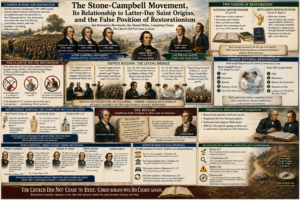
 An early competition over dueling visions of Christian restoration is one of the most underappreciated intersections in American religious history, even the entire history of the United States itself. Now called the Restorationist Movement, it started as a shared cultural milieu and with a pivotal figure, Sydney Rigdom, who served as the living bridge between these two different religious worlds. Both Churches of Christ (COC) preachers and the Latter Day Saints (LDS), the Mormons, however, historically argued that they alone were the true church, that all denominations were human inventions without divine sanction.
The COC especially pointed out that instrumental music in worship was a damning innovation, that infant baptism was invalid, and that only believers immersed by a properly constituted congregation of the New Testament pattern were genuinely saved. They were functionally arguing that the entire sweep of Christian history from roughly the second and third century onward had produced nothing but false churches, and that the movement begun by Stone and the Campbells in the early 19th century was the first genuine expression of New Testament Christianity since the apostolic age.
The two differ in their Restorationism in that COC lacks the LDS element of requiring a heavenly re-authorization of priesthood authority to fix it. But if virtually every Christian community for seventeen centuries was invalid, that all iterations of Christianity were essentially false, then what meaningful sense does it make to say the church never fully apostatized? The people may have called themselves Christians, the Bible may have remained available, but if their ordinances were invalid, their authority illegitimate, and their doctrines corrupted, this is total apostasy denied by many places in the New Testament.
No Total Apostasy, But Perpetuity of True Churches
Matthew 16:18-19 is the bedrock anti-apostasy text. Jesus tells Peter:
Upon this rock I will build my church, and the gates of hell shall not prevail against it.
He then grants the keys of the kingdom, with binding and loosing authority. The plain reading is that Christ is here promising the indestructibility of his church, that no force, internal or external, can utterly extinguish it. If the church fell into total apostasy requiring a complete external restoration, as both the Campbellites and Mormons in different ways claimed, then the gates of hell did prevail, at least temporarily, which flatly contradicts Christ’s promise.
Jesus later promised in Matthew 28:20, “Lo, I am with you always, even unto the end of the age,” which intensifies the Matthew 16:18-19 guarantee. Christ is not promising merely to return to a restored church — He promises continuous, unbroken presence with his church through the entire age. A total apostasy would require a period during which Christ’s presence was effectively absent from any true church on earth, which strains this promise severely.
Then the Apostle Paul writes in Ephesians 3:21, “Unto him be glory in the church by Christ Jesus throughout all ages, world without end.” This is perhaps the most sweeping of the anti-apostasy texts. Paul is ascribing to God glory in the church across every age without exception. This implies the church’s continuous, visible existence as the vessel of God’s glory in history. A total apostasy would mean there was no such vessel for centuries — that God was, in some era, not being glorified in the church because the church had ceased to exist in any meaningful form. Much more could be said here.
The Context: A Nation Hungry for Restoration
To understand the connections then in the Restorationist Movement between COC and LDS, one must first understand the religious atmosphere of the early American republic. What many now refer to as the Second Great Awakening (roughly 1790–1840) produced an extraordinary ferment on the frontier. The Restoration Movement, also known as the Stone-Campbell Movement, began in the early 1800s under the leadership of Barton W. Stone, Thomas Campbell, and Alexander Campbell — all of whom originally began their work in Presbyterian churches.
Independently and simultaneously, Joseph Smith was also inaugurating what would become the LDS movement. These were not coincidental parallels. They emerged from the same anxious cultural soil: a frontier population deeply suspicious of Eastern ecclesiastical establishments, hungry for religious certainty, and drawn to the idea that Christianity had been corrupted and needed to be restored to its original purity.
Restorationism professed to seek a return of 19th-century Christianity to its original New Testament state, claiming to eschew traditional church creeds for the Bible alone. These religious innovators believed the preceding eighteen centuries of Christianity had corrupted the true church of the first century. This same conviction — that the ancient church had been lost and must be recovered — animated Joseph Smith’s prophetic project as well, though he would take it in a dramatically bigger break from previous professing Christendom.
Barton Stone: The Revivalist Catalyst
Barton Stone was ordained a Presbyterian minister in 1798, though he was more Arminian than Calvinist in his views and stressed primitive Christian thought and practice. He was preacher at Cane Ridge Church, near Paris, Kentucky, when it became the center of the “Great Revival of 1801.” The Cane Ridge Revival is significant far beyond its immediate context. Attracting an estimated 20,000 people, Stone was one of eighteen Presbyterian ministers, along with a number of Baptist and Methodist preachers, who preached to the participants.
What happened at Cane Ridge was unusual: so-called “spiritual gifts” manifested openly — speaking in tongues, visions, physical prostrations. In 1804, Stone joined with five other Presbyterian ministers to declare their independence from the Presbyterian Church and their intention to restore Christ’s original church to the earth. They called themselves “Christians” or the “Christian Church” to signify their intention apparently to live out the pure original “church of Christ.”
These Presbyterian leaders rejected the creeds of traditional Christianity, preached a “simple” Christian life, and believed that their efforts to restore the primitive church would hasten the coming of the Millennium and Christ’s Kingdom on earth. Barton Stone was the first among them to have problems with the doctrine of the Trinity due to his rationalistic approach to interpreting the Bible. He was initially vague in his doctrine of the dual natures of Christ and the incarnation, so was accused of Arianism, the denial of the divinity of Christ.
Barton Stone Dovetails with Joseph Smith
The rejection of Trinitarian orthodoxy by Barton Stone is noteworthy, because it places him in a theological space that is closer to early LDS theology than to mainline Protestantism, though the resemblance is suggestive rather than causal. By the latter, I mean that the similarity between Stone’s Arian-leaning views and certain early Mormon theological positions, such as the LDS rejection of classical Trinitarian doctrine and its distinctive understanding of the Father and Son as separate beings, is real and observable. However, that similarity alone does not necessarily prove that one caused or produced the other.
Except for the attestation in scripture that Satan works in and through the “doctrine of demons,” Stone’s theology does not seem to be the direct source that Joseph Smith drew from for his LDS teaching. There is no documented evidence that Smith read Stone’s writings, sat under his preaching, or consciously adapted his ideas. The parallel between Stone and Joseph Smith does reflect their shared cultural and intellectual environment.
Both Stone and Smith were reacting against the same inherited Calvinist-Presbyterian orthodoxy, both were shaped by frontier revivalism, and both were asking similar questions about whether the creeds of the early church councils (particularly Nicaea) were faithful to the New Testament. These two very influential leaders one should notice arrived at the same historical moment at similar conclusions. They wrestled with the same tradition, the same texts, and the same cultural pressures and environment. To say they were not interrelated seems irresponsible. They both fed off the same causation.
Thomas and Alexander Campbell: The Rational Restorationists
Where Stone was experiential and revivalistic, the Campbells were systematic and rationalistic. The Campbell wing of the movement is said to begin with Thomas Campbell’s publication in 1809 in Washington County, Pennsylvania, of The Declaration and Address of the Christian Association of Washington. Thomas Campbell’s document articulated a principle that would define the movement: the church should be unified on the basis of the New Testament alone, stripping away all post-apostolic creeds and traditions.
Alexander Campbell sharpened and popularized his father’s vision. Campbell took a rational approach to reading the Bible, emphasizing the New Testament, and began by advocating reform among the Baptists. Alexander published two influential journals — The Christian Baptist and later The Millennial Harbinger — through which he promoted a scientific, evidence-based method of biblical interpretation. Alexander Campbell published The Christian Baptist and The Millennial Harbinger, while Barton Stone published The Christian Messenger. Both men routinely published the contributions of persons whose positions differed radically from their own.
When Alexander Campbell met Barton Stone in 1824, the two men found that they shared many goals and ideals. On January 1, 1832, Stone’s “Christians” and Campbell’s “Disciples” united, forming a powerful 19th-century movement that grew from about 25,000 members in 1832 to nearly 200,000 members in 1861.
Sidney Rigdon: The Living Bridge
Here the story becomes extraordinary, because the connection between the Stone-Campbell Movement and the Latter Day Saints is not merely ideological — it is personal, biographical, and organizational. The linchpin is Sidney Rigdon.
Rigdon engaged in lengthy discussions with Campbell and Walter Scott, with both men joining the Disciples of Christ movement associated with Campbell. Rigdon became one of the most powerful preachers in the Western Reserve region of Ohio — a region that had become a stronghold of Campbellite restorationism.
However, Rigdon diverged from Campbell on a crucial point. Campbell declared that the miraculous work of the Holy Ghost was “confined to the apostolic age, and to only a portion of the saints who lived in that age.” Rigdon, however, sought “to convince influential persons that, along with the primitive gospel, supernatural gifts and miracles ought to be restored.” This is enormously significant: Rigdon was a Campbellite who believed Campbell had not gone far enough. He wanted not merely a rational restoration of New Testament doctrine, but a charismatic, experiential restoration of New Testament power.
The Break for Rigdon
Throughout his early ministry, Rigdon kept looking for the pure New Testament church that practiced laying on of hands for the gift of the Holy Ghost and healing the sick. Drawn to Alexander Campbell and Walter Scott, fellow ministers with similar views, Rigdon associated with leading members of the Mahoning Baptist Association, the forerunner of the restorationist Disciples of Christ movement. In 1826 he became the pastor of a Grand River Association congregation in Mentor, Ohio. In 1830, however, Rigdon broke with Campbell and Scott.
The break was catalyzed by the arrival of LDS missionaries. In early September 1830, Rigdon’s associate Parley P. Pratt was baptized into the COC founded by Joseph Smith. In Fayette, New York, Smith initially called his congregation the Church of Christ on April 6, 1830. He later renamed it The Church of Jesus Christ of Latter-day Saints. In October, Pratt and Ziba Peterson began a mission to preach to the American Indians. They visited Rigdon and his wife, Phoebe, in Ohio. Rigdon read the Book of Mormon in fourteen days, proclaimed its truthfulness, and was baptized into the LDS on November 14, 1830, in Mentor, Ohio.
LDS Started under Joseph Smith and COC Preacher, Sydney Rigdon
The scale of Rigdon’s defection from Campbellism into early Mormonism cannot be overstated. He proceeded to convert hundreds of members of his Ohio congregations. Rigdon’s followers who were attracted to Smith’s message were at least double the New York and Pennsylvania membership to begin with, but within a few months, the newly merged church’s population in Ohio reached upwards of one thousand members. Most of them had been members of the various congregations of Disciples under Rigdon’s bishopric in the Kirtland area and had followed him out of Campbell’s movement.
Rigdon, who had long preached a Restoration of the true church, converted to the new movement, bringing along over a hundred followers. Rigdon’s conversion dramatically swelled the ranks of the new organization. In short, former Campbellites constituted an early majority of the LDS church’s membership, which was mainly then from Ohio.
Two Visions of Restoration: Rational vs. Revelatory
The Campbells and Joseph Smith each called what they were doing a “restoration.” Joseph Smith and Sidney Rigdon each sought restorations that were charismatic and experiential — revelational restorationism. Alexander Campbell was noted for his “rational restorationism.” This idea said the beliefs were concrete facts rather than abstract truths. Campbell advocated a scientific method to understanding the teachings of the book. He theorized that by relying only on the facts, Christians could come to a unity of agreement.
Both Campbell and Smith were searching for the primordial beginning of Christianity: Campbell looking back to the Christian church described in the New Testament epistles, and Smith looking even further back to the time of Adam and Eve as the first Christians. Campbell took a rational approach to reading the Bible, emphasizing the New Testament; Smith took a revelatory approach to reading both Old and New Testaments, and added new scriptures.
This distinction — rationalism vs. revelatory authority — is the essential fault line between the two movements. For Campbell, one could approach the Bible in a rational and reasonable manner to get the necessary truth for restoration. For Smith and Rigdon, the Bible was not complete for this restoration. The church had been entirely corrupted, and heavenly authority had to be re-granted through new revelation and angelic visitation, which Smith claimed to receive. Restorationism, however, was a vital, fundamental foundation for both the COC and the LDS.
Campbell’s Attack on Smith
The rivalry between the two simultaneous factions of restorationism was not just theological — it was competitive and personal. Campbell recognized immediately that Smith’s movement was drawing away his own followers. Campbell took an especially dim view of Joseph Smith and his movement, offering more scathing denunciations of Smith than any other religious leader of the era.
Campbell’s first exposition of the Book of Mormon was published in The Millennial Harbinger in February 1831 and later republished in Boston in 1832 under the title Delusions, thus meriting the distinction of becoming the first anti-Mormon book. He didn’t profess to the similarities in origins and doctrine. In it, Campbell argued that the Book of Mormon was a transparent fraud that addressed every contemporary theological controversy of the day — slavery, infant baptism, free masonry — as if by a suspicious convenience.
Both Alexander Campbell and Joseph Smith called their movements restorations, the foundation upon which each was built on that ground. Campbell said the nerve of his objection was that Smith had gone beyond sola scriptura, claiming new scriptures, new apostles, and continuing revelation. Even though they had this common origin and mixing of early leaders, Campbell portrayed Smith as the very corruption of Christianity that his own movement existed to oppose. Both though repudiated the promises or guarantees that Jesus and Paul said and wrote on the perpetuity of the church.
Common Baptismal Regeneration
The doctrine of Baptismal Regeneration — specifically the belief that baptism is the instrumental point at which a person receives the “remission of sins” — is one of the strongest historical and theological links between the Stone-Campbell movement (COC) and the Latter Day Saint (LDS) movement. This connection is not merely coincidental; it was forged through shared leaders, geographic proximity in Ohio, and a common “Restorationist” culture that dominated the American frontier in the 1820s and 1830s.
In the late 1820s, Walter Scott and Alexander Campbell began preaching that baptism was not just a symbol of a prior salvation, but the actual formal moment of pardon. Scott developed a “Five-Finger Exercise” for children and converts: 1. Faith, 2. Repentance, 3. Baptism, 4. Remission of Sins, 5. Gift of the Holy Spirit. Joseph Smith’s early revelations, particularly in the Book of Mormon and later the Doctrine and Covenants, mirrored this sequence almost exactly. Smith taught that baptism by immersion was required for the remission of sins and was a prerequisite for the laying on of hands to receive the Holy Ghost.
When Sydney Rigdon converted to LDS, he did not just join alone, but he brought nearly his entire congregation. Historians note that the influx of Rigdon’s followers, who were already steeped in Stone-Campbell “Restorationism,” provided the LDS movement with a ready-made theological vocabulary and a focus on baptismal necessity that differentiated it from other frontier churches. Both groups COC and LDS replaced prevailing salvation doctrine of Baptists and evangelicals with a concrete, physical act: the moment you are lowered into the water, your sins are legally and spiritually washed away.
Theological Parallels and Divergences
Beyond the organizational connections, there are structural theological parallels worth observing. They had differences, but I want to emphasize the shared themes, because they are so obvious. Both rejected post-apostolic creeds and councils as corruptions of primitive Christianity. Even though biblical or true Christianity always embraced scripture alone as the final authority, the final arbiter for true doctrine and practice, it also rejected what became known as nuda scriptura.
The biblical rejection of nuda scriptura by true churches, the idea that we should ignore all teachers, history, and creeds, linked to the commitment and the belief that God uses the institution of the church to preserve truth, even when churches are fallible. Nuda scriptura is common ground for Campbell, Stone, Smith, and Ridgon. The COC is one of the most nuda scriptura organizations in the religious history and in defiance of the true biblical understanding of sola scriptura. All of the restorationists in this story states some kind of nuda scriptura.
Thomas Campbell and Nuda Scriptura
From The Declaration and Address (1809), the founding document of the Campbell movement — arguably the clearest articulation of nuda scriptura ever published in American Christianity, Campbell wrote:
The Church of Christ upon earth is essentially, intentionally, and constitutionally one. . . . Nothing ought to be inculcated upon Christians as articles of faith; nor required of them as terms of communion, but what is expressly taught and enjoined upon them in the word of God.
Thomas Campbell’s formula was memorably compressed into the slogan that became the movement’s watchword: “Where the Bible speaks, we speak; where the Bible is silent, we are silent.” This is nuda scriptura in its purest and most uncompromising form. Silence of scripture is not permission — it is prohibition. This is not the historical or biblical view of Christian doctrine.
Alexander Campbell
Alexander was more aggressive than his father in pressing the nuda scriptura principle. From The Christian Baptist (1823), his inaugural editorial:
I have endeavored to read the scriptures as though no one had read them before me, and I am as much on my guard against reading them today through the medium of my own views yesterday, as I am against being influenced by any foreign name, authority, or system whatever.
Alexander is claiming to approach the Bible with no mediating tradition whatsoever, not even his own prior conclusions. It is the epistemological ideal of nuda scriptura taken to its logical extreme. He explicitly attacked the very idea of creeds as inherently divisive and presumptuous:
Creeds and confessions of faith are the real authors of most of the divisions which have torn the Christian world asunder. . . . They are the real schismatics who have torn the seamless coat of Christ.
Barton Stone
Stone was slightly less systematic than Alexander Campbell but equally emphatic. From Stone’s autobiography and letters, on creeds he writes:
The Bible alone is, and must be, the religion of Protestants. Let us throw off the yoke of human traditions and the arm of flesh, and take the naked Bible as our guide.
The phrase “naked Bible” is essentially a direct translation of nuda scriptura into plain English, and Stone used it repeatedly. He wrote further:
We are not personally acquainted with any people on earth who have taken the Bible alone as their creed and discipline… We have attempted this, and the attempt has cost us much.
Sidney Rigdon
Rigdon’s pre-Mormon statements are less extensively preserved in his own words than those of Stone and the Campbells, but his Campbellite commitments are well documented. From his preaching in the Western Reserve period, as recorded by contemporaries and historians of the early Disciples movement:
We take the Bible, and the Bible alone, as the rule of our faith and practice. We acknowledge no creed but Christ, no book but the Bible, no name but Christian.
This formula — “No creed but Christ, no book but the Bible, no name but Christian” — was a widespread Campbellite slogan that Rigdon used consistently in his Ohio preaching, and multiple contemporaneous accounts confirm he made it central to his ministry. Historian Amos Hayden, writing in Early History of the Disciples in the Western Reserve (1875), records Rigdon as one of the most effective preachers of this platform in northern Ohio, drawing large crowds precisely on the strength of this anti-creedal, Bible-alone message.
What makes Rigdon’s case so historically fascinating is that this was the man who then converted to a movement that added scripture to the Bible. His transition from nuda scriptura to the LDS acceptance of the Book of Mormon, the Doctrine and Covenants, and continuing revelation represents one of the most dramatic personal theological reversals of the 19th century. He went from “no book but the Bible” to accepting new books of scripture within the span of weeks in 1830 — which is one reason Campbell viewed his former colleague’s conversion with such particular contempt and suspicion.
Joseph Smith
From the Pearl of Great Price, Joseph Smith — History 1:19, Joseph Smith recorded his account of his first vision (1820):
I was answered that I must join none of them, for they were all wrong; and the Personage who addressed me said that all their creeds were an abomination in his sight.
This is the claim, mirroring the statements and dogmatism of the Campbells, Stone, and Rigdon, taking the trajectory then that all existing creedal Christianity is abominable. The next turn from nuda scriptura was that, contrary to creeds and confessions, new divine revelation is the only remedy. Nuda scriptura neatly provided for Smith’s restorationism the launching point of LDS and other such groups in American history.
Placed side by side, these statements reveal something striking. Thomas Campbell, Alexander Campbell, Barton Stone, and the early Rigdon are all saying essentially one thing: the Bible alone, without addition or subtraction, interpreted by honest rational minds, is sufficient to restore the church. Their enemy is creed and confession, any human authority. Nuda scriptura became the basis for restorationism: “We’re just using the Bible.” When in fact, these men presented their own unique view, a private interpretation of sorts, that contradicted previous, established doctrine from the Bible itself.
Scriptural Rejection of Nuda Scriptura
The Juxtaposition of Set Doctrine with Growth, Correction, and Transformation
Be not conformed to this world: but be ye transformed by the renewing of your mind.
More to Come
In recent days Michael Heiser has endorsed the nuda scriptura, naming his podcast “The Naked Bible Podcast.” He frequently provided polemics against understanding the Bible from church history and historical theology for a rationalistic perspective of his liberal education. Interestingly, his theology also aligns in many ways with Mormonism, especially the polytheistic ideas.
Hi Heath,
I believe that heresy is a division or faction that divided or divides off the trail or path of truth already established. How was it established? By the Lord’s institutions. This is part of the teaching of scripture. A heresy divides off the established teaching of scripture by true churches. Nuda scriptura tends toward private interpretation. It also is prey to spiritualizing, allegorizing, and other forms of a subjective approach to scripture.