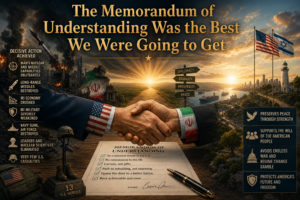
 Please do not give me lectures about “staying in my lane,” and the like. One of the reasons I write this blog is to write about anything or whatever I want. That doesn’t mean I should write about anything that I want, but I can. Just like I can and should pray in and on everything, I can write about anything. So, here it is on the subject of the recent MOU, that is, Memorandum of Understanding, those fourteen points toward an end to the United States military conflict with Iran.
As I see it, several different, disparate groups criticize the MOU. I might miss one or more, but they are Israel itself, Israel supporters or advocates, many Jews, hawkish conservatives, the Islamic Republic of Iran (IRI), left and right, who want to divide the United States from Israel, almost all leftists who will criticize anything, with or without the MOU, almost all the media, and the rest of the Democrats who want to make everything Trump does look bad. I think Israel still supports Trump, because he did more than anyone else would have done. Many in Israel against the MOU still support him. They want more from the United States (U.S.) on this.
I have a lot of historical perspective from my analysis that the MOU was the best we were going to get out of the combined total of activity this year related to Iran. Whoever attacks this decision by President Trump needs to do more than take potshots. They should state what they expect him to do and provide evidence for why their idea is better. In other words, it is not enough to say, “Finish the job,” or other ambiguous statements like that, which may sound tough.
Misinformation
Much of the disapproval I’ve heard for the MOU arises from either misinformation, misrepresentation, lies, or misinterpretations of the MOU. Sometimes it starts with a question that repeats the falsehood, treating it as if it were the truth. Some might say this is because Trump and his administration do not communicate clearly. I don’t think so. Instead, it comes from untruthful leaks and then from the media in opposition to Trump.
To start, I believe we’ve got to judge this year with Iran based on the good that did happen, not what we wish could or might have happened. There are so many positives if you believe in a Christian worldview. Most, I don’t think, would criticize Trump if he did nothing. It is only because he did anything that they now have anything negative to say. This MOU is the best one could expect to get for the following reasons.
One, the MOU will fulfill the objectives for the United States military conflict with Iran.
First, the U.S. obliterated the nuclear bomb or missile capacity of Iran, setting Iran back for years. Second, they destroyed their long-range missiles and the capacity to make more of those. Third, they crushed the IRI economy, making it very much more difficult to replenish what they lost and then to fund their proxies. Fourth, the U.S. severely weakened the IRI military as a threat.
Two, in addition to the MOU, the United States military did bonus work.
First, the U.S. sank the entire IRI Navy and destroyed all of its air force. Second, it also killed both the leaders of the IRI and their replacements, and their nuclear scientists. I’m sure they did more than what I either know or can remember as I write this.
Three, the United States lost very few casualties.
At the time of this writing, the United States military lost thirteen people. For the size of this entire operation, these are very few.
Four, no one could guarantee successful regime change, even if the United States chose to send in ground troops.
The United States spent eight years in Iraq (2003-2011) and twenty years in Afghanistan (2001-2021). While the 2003 US-led invasion of Iraq successfully overthrew Saddam Hussein’s dictatorship, the broader goal of regime change failed to bring long-term stability or a consolidated democracy. The intervention dismantled existing state institutions and triggered a violent civil war, leaving Iraq politically fragile. After a 20-year international intervention in Afghanistan and a nation-building effort aimed at establishing a stable, democratic government, the Taliban — the original target of the 2001 invasion — regained full control of the country.
No one could know whether a regime change might succeed in Iran. Based on the experience of Iraq and Afghanistan, the best answer is “no.” Like when the American colonies brought regime change by fighting their own war for independence, the people of Iran must fight for their own. The desire for liberty must begin with the Iranian people, if they want it, not with American soldiers.
Five, something further than the MOU must come from the support of the American people, and it’s not there.
Israel wants more from the U.S., but this is not the will of the American people. To accomplish anything more than what the U.S. did in this conflict with Iran would necessitate many ground troops. The cost would be incalculably high, not proportional to the benefit to either Israel or the United States.
Six, the United States isn’t giving anything to the IRI in the MOU.
The U.S. could return the IRI to certain pre-conflict conditions. The Strait of Hormuz closed during the conflict. It would reopen. The IRI could sell its oil as it did before. One of the more controversial points is the potential availability of investment money from Arab nations for rebuilding. This isn’t enough money to rebuild what Iran lost in the conflict. Also, the IRI could keep its remaining short-range missiles. These are the things that many reasonable people don’t like in the MOU. They speculate on the outcome of these. None of them, however, is an existential threat to the United States.
The U.S. doesn’t give the IRI anything. The memorandum allows outside investment for rebuilding. All of this is essentially a carrot in the negotiations, in contrast to many sticks.
Maybe the MOU won’t work. Perhaps Hezbollah fires missiles into Israel. Maybe the IRI decides to charge tolls for passing through the Strait of Hormuz or even disallows passage altogether. If so, the United States could start bombing targets again and further block the Strait.
Seven, the repercussions of an ongoing war are unpopular in the United States and might give more political power to the left or at least more of it.
I contend the internal enemy of the left in the United States is bigger than the external enemy of Iran. That would cause more damage to the whole country. This could undo far more good things than anything gained by going further in the conflict with Iran.
In general, Greg, I wouldn’t post your comment, because you gave no substantive reply to this post. I decided to publish it, because your writing is the level of opposition. Nothing. Less or worse than nothing. A true conservative wouldn’t call someone a fool. This is very serious in the Bible. He would provide a conservative answer. I don’t expect it from you, but I’m going to give you an opportunity before I delete what you wrote here.
Did not age well.
Goean,
I believe it was still the best we were going to get. Just saying it doesn’t age well is not any kind of analysis. Is the alternative that we’re doing a ground attack of Iran? I don’t think so. It’s still the best opportunity, all things considered, for the Iran situation to work. The story is not over yet.