I am writing this post as an aside from the series – “The Historical and Biblical Outlier of Wesleyan Salvation and Sanctification” – and especially part 8, which showed how this corrupted the gospel in all of evangelicalism. The series has 8 parts so far: Part One, Part Two, Part Three, Part Four, Part Five, Part Six, Part Seven, and Part Eight. Some might think I exaggerated or am attempting something extreme to get clicks or attention. No. What I wrote was true. Everyone needs to acknowledge the truth: the biblical and historical truth.
People went to number eight in the series. I saw that. However, when I linked to and provided it on my Facebook page, it received almost zero likes or shares. This doesn’t surprise me. Part of it is that many readers are caught up in the delusion of the two-tiered salvation scheme, starting with Wesley and feeding into all of evangelicalism. It conveniently became most of evangelicalism, which includes fundamentalism. Men still preach it themselves and promote those who do. So, people don’t want to touch that with a ten-foot pole, and the adherents continue in the gospel-corrupting error of it.
This post will address the reality of the corruption of the Wesleyan two-tiered framework in greater depth.
*************************************
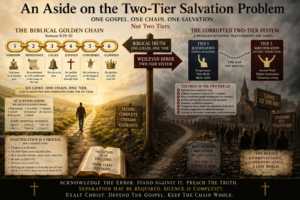 Golden Chain of Salvation
Scripture does not reveal a two-tiered salvation scheme. If the two-tiered system did start with Wesley and then spread like bacteria or a virus all over evangelicalism and fundamentalism, then it began with his initial and entire sanctification viewpoint. In my presentation so far, I’ve said that along the way, the two tiers mutated in varied ways but still kept corrupting the gospel. Is there any semblance of two tiers in the biblical doctrine of salvation? Does scripture teach this?
A good place to start the examination is Romans 8:29-30, with the golden chain of salvation:
For whom he did foreknow, he also did predestinate to be conformed to the image of his Son, that he might be the firstborn among many brethren. Moreover whom he did predestinate, them he also called: and whom he called, them he also justified: and whom he justified, them he also glorified.
These six verses provide six links of the chain: (1) foreknow, (2) predestinate, (3) called, (4) justified, (5) conformed to the image of His Son, and (6) glorified. Every salvation has these six links in the chain. God guarantees and completes every one of them. He foreknows, He predestinates, He calls, He conforms to the image of the Son, He justifies, and He glorifies. Salvation is of the LORD.
Further Elaboration about One Tier, Not Two
During a person’s lifetime, whom God saves, He calls, justifies, conforms, and glorifies. Foreknowing and predestinating occurred in eternity past. Then, anyone God justifies, He first calls, and whoever He glorifies, He first justifies. Someone may say that those are tiers. No, they are links in one chain. They come in one package. All of them will and do occur.
Scripture focuses on justification at the moment of salvation. At that moment of justification, a person receives everything that he will get through salvation. He needs no second tier. With justification, he will immediately begin in a practical way to conform to the image of Jesus Christ. The moment he dies, God glorifies him. Glorification does not happen in this lifetime, but in the next. Because God predestinates the one justified to conform to Jesus Christ, He will. No second tier is necessary for that. It will always occur. The guarantee to conform to the image of the Son means that the justified person will overcome or persevere in the faith.
Everything at Justification and then Sanctification as a Process
The very instance of justification by faith in Jesus Christ, God also regenerates, indwells, redeems, reconciles, sanctifies, adopts, and converts the justified individual. He immediately receives every spiritual blessing in Christ Jesus (Eph 1:3), becomes a partaker of the divine nature (2 Pet 1:4), gets the reservation of his inheritance in heaven (1 Pet 1:4), obtains all things that pertain to life and godliness (2 Pet 1:3), escapes the corruption that is in the world by lust (2 Pet 1:4), and lacks nothing in anything spiritual (1 Cor 1:7). Wesley’s framework effectively shifts assurance from God’s completed saving work to the believer’s attainment or maintenance of a second stage.
Sanctification is not a crisis event that occurs in a single moment of dedication, that second tier, after justification. It is a process that starts right the moment that God justifies a person by grace through faith in Christ. The Holy Spirit is a Person. At the same point of someone’s justification, he receives the entire Person of the Holy Spirit. He never gets more of Him and never needs to call the Holy Spirit down. The Holy Spirit seals that justified person (Eph 1:13). Fruit of the Spirit is love (Gal 5:22), and nothing can separate a truly justified person from the love of God, which is in Christ Jesus his Lord (Romans 8:39).
The Corruption of the Two-Tier Framework
The two-tiered framework, concocted by Wesley, changes everything that I just explained. It results in many different perversions of true salvation and sanctification. It is a scourge on Christianity, evangelicalism, and fundamentalism. It creates a system of spiritual haves and have-nots, which does not exist. For justification, everyone receives “like precious faith” from God (2 Pet 1:1). No one gets a different dose or variety of saving faith.
Wesley’s two-tiered scheme morphed into many different types. In the end, it resulted in churches full of unconverted people, but who think they are converted. The two-tiered doctrine of salvation vindicates and continues to vindicate the pragmatism of the church growth movement, which sped the pace of the corruption of the gospel. This changed the nature, culture, vibe, way, and manner of Christianity and the church. Either the elimination of repentance or the purposeful change in its definition proceeded from this movement. It would require another long series to explain the horrific results of this corrupt system.
Are men so invested in this two-tiered scheme that they abide within it? To start, godly, biblical men need to acknowledge this doctrine as a problem, stand against it and reject it, and confess all the extra, very serious problems that proceed from it. Eradication would require separation, and men either accept it or don’t consider it bad enough for separation. It will continue and even get worse without admitting this error and then preaching against it.
In my view, this series is a root cause analysis of “the issue” in fundamental churches. Most of their other problems are downstream of the Wesleyan gospel corruptions. The struggle is that “fundamental religion” acts as a kind of Trojan horse. It can sound right, seem right, and look right on the surface, but inwardly there is no authentic spiritual life. Like the Israelites bringing the Ark of God into their camp after their first defeat by the Philistines in 1 Samuel 4:1–5 (with great excitement and shouting) only to experience a greater defeat in verses 10–11, fundamental religion can impart a false sense of security. It takes time, study, and experience to first understand the problem and then discern whether it exists in your church. My guess is that the regenerate in churches heavily influenced by one of the Wesleyan errors will suspect something is wrong long before they are able to accurately identify it. Your series provides a helpful guide for those people.
Hi Benjamin,
I appreciate the words and I fully agree. This series has not gotten attention, even when I publish it, it doesn’t. Churches and pastors would rather hang on to this tradition than expose it, change, and separate from it. It is humbling to find out. For me, I knew something was wrong in college and grad school, didn’t know what it was, just knew it was wrong. Did not get any help. None. The best I got was knowing that Spirit bapism occurred historically in Acts, so it couldn’t be what Hyles and Rice were saying when they came to Maranatha. No one said anything though to help. It was part of the Hyles philosophy of not criticizing the preacher or touching the Lord’s anointed. Very convenient.
Very early in pastoring, I figured out what was right. It came from expository preaching and studying in depth scripture. Then we did our series on sanctification on the Word of Truth conference. I read Revival and Revivalism by Ian Murray. This is the first time I’ve written on the historical aspect in this depth or great depth.
You are exactly right that this is major, if not the most pivotal trap in American history. It closely relates to other issues related to modernism, but even that probably relates to this because a lack of conversion would not allow to discern it. There is also pragmatism that goes back to the halfway covenant of the Congregational Church in the Massachusetts Bay Colony. That led to the deadness of the Northeast from which they never recovered, then the effects of that liberalism on the Ivy League schools.
As far as what most greatly affects independent Baptists, probably this, but you also get the Ivy League, scholarship, naturalism, that wants to please intelligensia or academia.
Thanks again! Maybe you helped bring attention to this.