Part One Part Two Part Three Part Four Part Five Part Six Part Seven
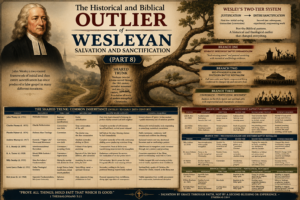 John Wesley’s two-tiered framework of initial and then entire sanctification has since produced a false gospel in many different iterations. It mutated into various versions, forking off like branches from the root or trunk of Wesleyan theology. So far in the previous parts (seven), I covered three of these iterations. These are by no means all. Before I start dealing with individual branches, I believe it would be easier to understand all this by looking at a chart or table that illustrates what happened.
It is actually hard to show what happened through the effects of Wesley’s theology because it spread and infiltrated all of professing Christianity. In many ways, it became modern-day evangelicalism. I think an honest observer can see that the changes did not proceed from the Bible, but from the outside religious effects of this Wesleyan two-tier system. This changed everything. I mean everything. A return to scriptural belief and practice requires acknowledgement of and then repentance from this.
The Two-Tier Schema: Shared Trunk and Three Branches
Wesley’s two-stage soteriology — an initial saving transaction followed by a subsequent, experiential, empowering work — did not terminate in any single tradition. It produced a common trunk through the nineteenth-century revivalist movement, then diverged into three major branches that still define the shape of much of American Protestant and evangelical spirituality.
The Shared Trunk
The first table below shows the common inheritance from Wesley through the early twentieth century, which was then shared by all three branches below. These are major figures in the history of American evangelicalism who provide its history.
| Person | Movement | First tier | Second tier | Second work content | Evidence required |
| John Wesley (d. 1791) | Methodist Holiness | Baptism/ conversion (justification) | Entire sanctification | Pure love; heart cleansed of inbeing sin; perfect charity toward God and neighbor | Inward witness of Spirit + loving conduct + public testimony; loss of salvation possible |
| Charles Finney (d. 1875) | Oberlin Perfectionism | Conversion/new birth | Total consecration of the will | Complete surrender of self-interest; no self held back; revival power released | Measurable revival results; souls responding to preaching; numerical conversions |
| Phoebe Palmer (d. 1874) | Holiness altar theology | Conversion | The shorter way, the altar consecration | Self laid on the altar; blessing claimed by faith immediately; entire sanctification now | Public testimony — testimony itself sustains and confirms the blessing received |
| Andrew Murray (d. 1917) | Keswick / “higher life” devotional movement | Conversion; new birth | Absolute surrender; abiding in Christ | Complete surrender of the will; continuous abiding union producing victorious living | Sustained victory over sin; devotional literature read as confirming a pattern of holiness |
| D. L. Moody (d. 1899) | Interdenominational revivalism | Conversion / accepting Christ | Fullness of the Spirit; anointing | Consecration; flood of divine love; transforming empowerment for evangelistic work | Effectiveness in evangelism: souls converted through one’s ministry and preaching |
| R. A. Torrey (d. 1928) | Moody Bible Institute / Keswick | Conversion/ regeneration | Baptism of the Holy Spirit (distinct, after salvation) | Enduement with power for service; not eradication of sin but power over it | Conscious experience of the filling; power in witnessing; souls won to Christ |
| Billy Sunday (d. 1935) | Mass revivalism/ fundamentalism | Hitting the sawdust trail; decision for Christ | Anointing for service; living for God | Full surrender; Spirit’s power for holy living and effective soul-winning witness | Visible changed life; soul-winning activity; revival results; separation from worldliness |
| Lewis Sperry Chafer (d. 1952) | Dallas Theological Seminary | Accept Christ as Savior (justification; eternal security absolute) | Spirit-filling; carnal → spiritual Christian | Surrender; walking in the Spirit; positional blessings experientially realized | Spiritual fruit; quality of Christian life; witness for Christ; rewards at the Bema seat |
| Bob Jones Sr. (d. 1968) | Separatist fundamentalism; Bob Jones University | Salvation decision | Holy, separated living; yieldedness to God | Personal separation from worldliness; doing right regardless of consequence | Visible separation from worldly amusement and compromise; institutional discipline |
Branch One — Separatist Independent Baptist Fundamentalism
So-called “soul-winning power” and pastoral anointing are the second-tier content of this branch, with numerical and feelings evidence as confirmation.
| Person | Movement | First tier | Second tier | Second work content | Evidence required |
| John R. Rice (d. 1980) | Fundamentalist revivalism; Sword of the Lord | Sinner’s prayer; accept Jesus as Savior | Fullness of the Spirit for soul-winning power | Total surrender; Spirit-empowered witness to the lost; revival empowerment | Number of souls saved through one’s witness; revival fruit; evangelistic fruitfulness |
| Jack Hyles (d. 2001) | IB revivalism; Hammond model; Hyles-Anderson | Sinner’s prayer; salvation decision | Fresh oil; pastoral anointing; Meet the Holy Spirit | Felt preaching power; holy living; prayer; Spirit’s daily presence and sensitivity | Anointed preaching quality; bus ministry numbers; felt pulpit anointing; revival results |
Branch Two — Neo-Evangelicalism and Southern Baptist Revivalism
The same structure was carried into mainstream, interdenominational, and denominational evangelicalism.
| Person | Movement | First tier | Second tier | Second work content | Evidence required |
| Billy Graham (d. 2018) | Neo-evangelicalism; mass crusade evangelism | Decision for Christ; coming forward at the crusade | Full surrender; growth as a “committed” Christian | Yielding the whole life to Christ; counseling and discipleship after the decision | Changed life; church involvement; ongoing commitment tracked by follow-up counselors |
| W. A. Criswell / Adrian Rogers (d. 2002 / 2005) | Southern Baptist Convention revivalism | Salvation decision; believer’s baptism | Surrendered, Spirit-filled service | Full-time dedication; surrender to God’s call; empowered preaching and soul-winning | Baptisms and conversions; church growth statistics; effectiveness of revival preaching |
Branch Three — Charismatic and Neo-Charismatic Movements
The structure radicalized: tongues as required physical evidence, then multiplied into continuous fresh impartation.
| Person | Movement | First tier | Second tier | Second work content | Evidence required |
| Oral Roberts (d. 2009) | Healing revivalism; charismatic bridge | Salvation / accepting Christ | Baptism of the Holy Spirit; healing anointing | Faith for healing and miracles; Spirit’s power made visible in physical signs | Physical healing, miracles witnessed; speaking in tongues; crusade attendance and offerings |
| Kenneth Hagin (d. 2003) | Word of Faith movement | Salvation / new birth | Spirit-baptism with tongues; “positive confession” | Speaking in tongues as initial evidence; faith-confession releasing God’s promises | Tongues as a required sign; material and physical results of confessed faith claims |
| Bill Johnson / Bethel, Hillsong network (contemporary) | Neo-Charismatic; “presence” and impartation culture | Salvation: initial encounter with God | Continuous fresh impartation; “more” of the Spirit; signs and wonders | Ongoing encounters in worship; impartation from anointed leaders; supernatural manifestation | Felt presence in worship moments; manifestations (shaking, weeping, prophecy); testimonies of signs |
All three branches retain the identical invariant grammar inherited from the trunk — a first-tier deficit, a second-tier experiential transaction, and a community-verified evidence requirement — while differing in vocabulary, ecclesiastical culture, and the specific content assigned to the second tier. The differences between a Hyles soul-winning sermon, a Graham crusade decision, and a Bethel worship encounter are differences of style and packaging more than of underlying theological structure.
Changing the Nature of the Doctrine of Salvation
What you see in the above table seems so normal in American evangelicalism that you may not see anything wrong. So what is wrong? It dumbs down salvation. Biblical salvation occurs in one tier. There are not two of these. This proceeded from Wesley’s initial and entire sanctification, dividing it into at least two and really more than two. By splitting salvation into two tiers, the Wesleyan framework minimized the first tier, which is actually the only tier, into something less than biblical salvation.
The first tier is and should be all of salvation. By removing biblical elements of a true gospel from the first tier and moving them into the second and additional tiers, the Wesleyan system corrupted the gospel. The later iterations, as recounted in the above table, accepted and embraced the framework. Wesley required more than one tier for salvation. Others kept the deficiencies of the first tier, but dropped the requirement of the second and subsequent tiers. They still preach the necessity of these succeeding tiers without requiring them for salvation.
The later iterations of the Wesleyan framework very often now guarantee further iterations. They use means to produce subsequent experiences, which serve as a self-fulfilling prophecy of future salvation. Techniques simulate feelings and a relationship with God. The devices for marking salvation in succeeding tiers are the instruments and theory of modern pop music. Leaders create a cheap, superficial experience with an ultimate bait and switch. People buy what they sell and call it salvation.
The Irony at the Center
The full irony of what developed out of and from Wesley includes the following: The “once saved, always saved” tradition, by severing eternal security from overcoming (Revelation 2-3) and abiding or remaining (John 15), created a pastoral situation that required the continuous importation of Wesleyan-Holiness second-experience categories to manage the consequences.
Because you cannot tell from behavioral evidence whether someone is saved (Chafer’s carnal Christian doctrine), and because assurance rests on a past transaction that may be dimly remembered or dubiously made, the system must continuously offer subsequent experiences — rededication, Spirit-filling, revival, fresh anointing, meeting the Holy Spirit — to address the deficit.
Incompatible Engines
These subsequent experiences are offered as assurance-restoring or vitality-restoring events — not as salvation itself, because “once saved, always saved.” But functionally, they serve the same role that served the Wesleyan second blessing: they are the experiential confirmation that one’s Christian profession is genuine and vital. The revivalist fundamentalist tradition thus runs on two incompatible engines simultaneously:
- A Chafer-style positional security that makes behavioral evidence irrelevant to the question of salvation
- A Wesleyan-Holiness experiential epistemology that makes felt experience and observable results the practical basis of assurance and effective Christian life
Neither engine alone can run the system. The positional doctrine handles the soteriological question; the experiential doctrine handles the pastoral and motivational question. Together they produce a tradition that is simultaneously immune to assurance-threatening self-examination (because once saved, always saved) and perpetually hungry for new experiences (because the positional doctrine produces no felt reality and no behavioral transformation by itself).
This is the theological structure of revivalist fundamentalism — and it is, at bottom, the unresolved tension between Chafer’s novel eternal security and the Wesleyan experiential inheritance that neither tradition was willing to acknowledge or surrender.
The Rededication Culture
The rededication call — standard in independent Baptist revivalism — is the practical acknowledgment that Chafer’s system generates nominal Christianity at scale. The revivalist circuit — Rice, Hyles, and their successors — was perpetually calling already-professing Christians to:
- “Rededicate their lives to Christ”
- “Come back to God”
- “Surrender fully to the Spirit”
This is structurally the Wesleyan second blessing in revivalist (professing to be Baptist) dress:
- First crisis: conversion/justification
- Subsequent crisis(es): rededication/Spirit-filling/revival
And it carries the same implicit epistemology: the person who has never rededicated, who has never had a revival experience, whose life shows no evident change — they may be saved (Chafer’s carnal Christian), but their assurance rests on an increasingly thin foundation.
The Unacknowledged Irony
The deepest irony is that independent Baptist fundamentalism — which defined itself in opposition to Pentecostalism, the Holiness movement, and anything smacking of Catholic or mystical religion — carried forward the essential structure of Wesleyan-Catholic mystical pneumatology intact:
- A second, definite, experiential work of the Spirit beyond conversion
- Received by total consecration/surrender
- Known by inward sense and outward effectiveness
- Capable of being lost through sin or neglect
- Communally verified by observable spiritual results
- Theologically central to genuine Christian ministry
The vocabulary changed at every stage — entire sanctification → second blessing → Spirit-baptism → Spirit-filling → the anointing → fresh oil — but the grammar remained constant. Wesley received it from the Catholic mystics; Finney democratized and activized it; Moody laundered it into interdenominational acceptability; Torrey systematized it for fundamentalists; Chafer dispensationalized it; Rice weaponized it for soul-winning; Hyles institutionalized it as the complete pastoral theology.
The Catholic mystical tradition’s insistence that genuine Christianity involves a felt, transformative, second-order experience of God — beyond mere doctrinal assent — traveled from the 14th-century Rhineland mystics through Teresa of Ávila and Fénelon, through Wesley’s Oxford Holy Club readings, across the Atlantic through Finney’s camp meetings, into Moody’s Chicago tabernacle, through Torrey’s Bible institute lectures, into Chafer’s systematic theology, down to a Hammond Indiana bus worker rejoicing that he led someone to Christ — and calling it something entirely different at every step.
More to Come
Brother Brandenburg, this is a very good series, both historically and practically. Many people do not realize that the Holiness movement is a mirror of Wesleyanism, and many Baptists do not realize how much we became infected with the errors of Wesleyanism through revivalism and fundamentalism. I have a lot of respect for John R. Rice, but it is a simple matter of fact that he was one of the prime movers of promoting these poor theological issues among independent Baptists.
On a side note, I have never studied closely, but have often wondered, to what extent Charles Wesley agreed with his brother on many of these theological issues. Mostly, I suppose, but to me many of his hymns seem to be more biblical than John’s theology.
Brother Vaughn,
Thanks for reading. I think this is hitting deaf ears mainly…still. I wonder if people are reading this. Lots of people are coming to the blog — about 4,000 a day on average, more or less. But, are they getting this? I don’t know. On Charles Wesley, I’ve noticed the same thing, becasue even our Trinity Hymnal, Baptist Edition, has Wesley Hymns, as if maybe he was more in line with Whitefield than Wesley in that group of frinds in the UK.
Thanks again!