Part One Part Two Part Three Part Four Part Five Part Six
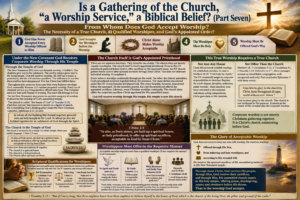 From Whom Does God Accept Worship? The Necessity of a True Church, a Qualified Worshiper, and God’s Appointed Order
1. God Has Never Accepted Every Worship Offered to Him
2. God Accepts the Worshiper Before the Worship
3. Christ Alone Makes Worship Acceptable
4. The Worshiper Must Be Holy
5. Worship Must Be Offered God’s Way
Under the New Covenant God Receives Corporate Worship Through His Temple
Through the Temple of God
The New Testament (NT) does not diminish worship. It fulfills it. The shadows give way to the substance. The earthly temple gives way to the living temple. God still receives worship. He still has a house, a priesthood, and He still receives sacrifices. The difference is not that these realities have disappeared. It is that Christ has fulfilled them.
Throughout this series we have seen that every believer worships God continually. Romans 12:1 teaches perpetual worship. Every act of obedient service is a living sacrifice offered unto God. The Christian need not wait until Sunday to worship. His entire life belongs to God. Yet the New Testament also preserves another category of worship. It preserves the worship of God’s assembled temple.
The church is called “the house of God” (1 Timothy 3:15). Paul does not use that expression merely as a figure of speech. He is describing God’s dwelling place under the New Covenant. Likewise, Ephesians 2:21-22 says:
In whom all the building fitly framed together groweth unto an holy temple in the Lord: In whom ye also are builded together for an habitation of God through the Spirit.
The Church Is the Temple of God
The church is not merely like a temple. It is God’s temple. Peter uses similar language. 1 Peter 2:5 says:
Ye also, as lively stones, are built up a spiritual house, an holy priesthood, to offer up spiritual sacrifices, acceptable to God by Jesus Christ.
Notice how these descriptions fit together.
- The church is a spiritual house.
- The church is a holy priesthood.
- The church offers spiritual sacrifices.
The Church Itself Is God’s Appointed Priesthood
These are not separate doctrines. They describe one reality. The church does not merely contain worshipers. The church itself is God’s appointed priesthood. Even as the OT priesthood gathered before God to offer sacrifices in His appointed house, the NT church gathers before God to offer spiritual sacrifices through Jesus Christ. This does not eliminate individual worship. It completes it.
Every believer worships continually throughout the week. Yet when the church assembles, God’s priesthood ministers together before His presence. The same distinction existed under the OT. Every Israelite worshiped God. Not every Israelite, however, ministered before the sanctuary.
All the Israelites prayed, but only the priesthood offered the appointed sacrifices. Likewise, every Christian worships continually. The church alone offers the corporate sacrifices Christ appointed for His assembled house. God still receives worship through His temple. His temple is now His church.
This True Worship Requires a True Church
Not Just Any House
This question naturally follows. If God appointed a house, does any gathering become that house? Scripture answers no. Christ did not merely establish meetings. He established churches. Jesus said in Matthew 16:18: “I will build my church.” He did not promise to build religious associations. He promised to build His church.
The NT consistently assigns its corporate responsibilities to churches. Baptism belongs to churches. The Lord’s Supper belongs to churches. Discipline belongs to churches. Ordination belongs to churches. Public worship belongs to churches. These ministries were never entrusted to disconnected individuals acting independently. Christ gave them to His churches.
Not Other Than the Church
Matthew 18 places discipline within the authority of the church. 1 Corinthians 5:13 commands the church to remove the wicked person from among themselves. 1 Corinthians 11 regulates the Lord’s Supper within the assembled congregation. 1 Timothy 3:15 calls the church “the house of God.” Hebrews 13:17 commands believers to obey those who rule over them and watch for their souls. These passages assume an identifiable congregation with recognized authority. Paul concludes Ephesians 3 with these words:
Unto him be glory in the church by Christ Jesus throughout all ages, world without end. Amen.
God receives glory in the church. The church is not incidental to His purpose. It stands at the center of His revealed plan for corporate worship. This follows the OT pattern exactly. God did not authorize every place to become His sanctuary. He appointed His house, regulated its worship, appointed its priesthood, and received its sacrifices. Likewise, Christ has appointed His churches. If the church is God’s house, then the worship belonging to God’s house belongs to the church He established. Corporate worship is not merely Christians gathering together. It is Christ’s church ministering before God.
Scriptural Qualifications for Worshipers
A worshiper must meet qualifications. Conversion alone does not remove every qualification. The believer must also walk with God. The NT repeatedly joins worship with holiness. The Lord’s Supper illustrates this principle. Paul commands believers in 1 Corinthians 11:28: “But let a man examine himself.” Self-examination precedes participation.
The worshiper must judge himself before approaching God’s table. This does not teach sinless perfection. It teaches holy self-government. The believer approaches God with repentance, faith, and a clear conscience. Church discipline teaches the same lesson. A church excludes an unrepentant member because open rebellion contradicts the holiness required of God’s house. God’s priesthood must pursue holiness. Peter calls believers “an holy priesthood.” The priesthood itself reflects God’s character. The principle reaches back into the Psalms. Psalm 24:3 asks:
Who shall ascend into the hill of the LORD?
The answer is (Ps 24:4):
He that hath clean hands, and a pure heart.
The same truth appears in Psalm 15. God never separated worship from holiness. Neither should we. This truth avoids two opposite errors. One, it rejects sacerdotalism. No human priest makes worship acceptable. Christ alone does that. Two, it also rejects individualism. No believer approaches God on his own terms. Every worshiper remains accountable to Christ and to His revealed order.
Worshippers Must Offer in the Requisite Manner
Acceptable worship requires more than a qualified worshiper. It also requires the manner God commands. God never leaves worship to human preference. He regulates it by His Word. Jesus said true worshipers worship the Father “in spirit and in truth.” Truth is not merely sincerity. Truth is God’s revelation.
Faith also characterizes acceptable worship. Hebrews declares (11:6): “Without faith it is impossible to please him.” Faith submits to God’s Word. It does not invent new forms of worship. Scripture also requires reverence. Hebrews 12:28 says:
Wherefore we receiving a kingdom which cannot be moved, let us have grace, whereby we may serve God acceptably with reverence and godly fear.
Notice the language. The writer speaks of serving God acceptably. Acceptability is not assumed. It requires grace, reverence, and godly fear. Paul likewise commands that worship proceed “decently and in order.” Both love and understanding govern worship. Paul refused unintelligible speech in the assembly because God’s worship must edify according to His revealed purpose. Everything in the assembly reflects God’s holy character. Acceptable worship does not happen accidentally; neither does it arise from creativity. It proceeds from obedient faith.
The Glory of Acceptable Worship
What worship does God actually receive? The answer is not found in popular opinion. Neither is it found in religious tradition. It is found in Scripture. God does not receive every act men call worship. He receives worship:
- Offered through His Son,
- From believing and holy worshipers, and
- According to His revealed will.
He receives the spiritual sacrifices of His assembled priesthood in His New Testament temple. The issue has never been merely whether people sing, pray, preach, or assemble. The issue is whether God receives what they offer.
From Cain until today, God has remained the One who determines acceptable worship. He has never surrendered that authority to men. The believer, therefore, approaches God humbly. He comes through Christ alone and worships according to God’s Word. He joins himself faithfully to Christ’s church. There, with God’s redeemed priesthood, he offers spiritual sacrifices acceptable to God by Jesus Christ.
The glory of worship is not that man has found a way to approach God, but is that God has provided the only way sinful men may come before Him. Through Jesus Christ, God receives His people; through Him, God receives their sacrifices; and through Him, His assembled church stands as His holy temple, offering praise, thanksgiving, prayer, and obedience before His throne. That is the worship God accepts.
More to Come
Just here once again to say I’m glad to see the “More To Come” label, and to plug for this project to grow into a published book targeted at correcting this major weakness in most Independent Baptists’ view of ecclesiology. Keep it coming!
Thanks Adam! I’m pretty sure that I’m losing people’s attention spans, which in a major way results from the kind of high tech, constant noise contemporary approach with kids, teens, and main auditorium. They know people have short attention spans, so they create a situation that is tight, moves, and keeps their attention non-stop with showy type of graphics, film, large screens, and sound. Those people can’t read an eight part series. They need a fifteen to sixty second podcast or reel.
The major reason the church is in such a mess today is that it has embraced a humanistic approach to Christianity. Man has become the center, and God is treated as the means by which man may achieve happiness, success, fulfillment, and his own lofty goals. In practice, it becomes the deification of man, for God exists to serve man’s purposes rather than man existing to glorify God.
But Scripture turns that philosophy completely upside down. Man is not the end; God is. We were created to glorify and honor the Lord in all that we are and all that we do: “Whether therefore ye eat, or drink, or whatsoever ye do, do all to the glory of God” (1 Corinthians 10:31). Yet men exalt their own wisdom, ambitions, methods, and accomplishments because they think too highly of themselves (Romans 12:3).
Even worship has become a humanistic endeavor. The question is too often, What did I get out of it? Did I enjoy it? Did it move me? Did it make me feel good? But biblical worship does not begin with man’s feelings, but rather it begins with God’s worthiness.
True worship flows from a heart that loves God, and love for God produces obedience to God: “If ye love me, keep my commandments” (John 14:15). The man who truly desires to worship God will therefore desire, above everything else, to hear the words of God, believe the words of God, and do the words of God.
The great need of the church is not to discover better ways to make men happy. It is to return to the purpose for which man was created: to humble himself before his Creator, exalt the Lord Jesus Christ, hear His words, obey His words, and do all things for the glory of God.
Tom