Part One Part Two Part Three Part Four Part Five Part Six Part Seven
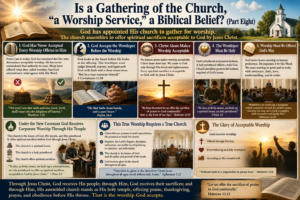 Corporate Worship Governs Individual Worship
The New Testament (NT) never presents the church gathering as one devotional option among many. The assembly is where Christ, through His Word, shapes the lives of His people. When the church gathers, it publicly reads God’s Word, preaches it, observes the ordinances, prays together, offers praise together, exercises discipline when necessary, and its members mutually exhort one another. All of these means of grace then proceed to shape each church member’s life outside the assembly.
In other words, the worship service becomes the pattern for the Christian life. The believer does not invent his own worship during the week. He lives according to what Christ teaches through His church. This is one reason Paul calls the church “the house of God. . . . the pillar and ground of the truth” (1 Timothy 3:15). The church guards the truth that governs individual worship.
Also, Individual Worship Prepares One for Corporate Worship
The relationship also works the other direction. The corporate worship of the Lord’s churches assumes believers have already walked with God during the week. Consider Israel. The worshiper did not spend six days serving idols and then appear at the temple expecting God to accept his worship. The sacrifices assumed repentance. The worshiper prepared himself; likewise under the New Covenant.
A church member spends his week praying, confessing sin, meditating upon scripture, giving thanks, serving Christ, loving his family, and pursuing holiness. Then he comes into the assembly already living as a priest. Corporate worship is not intended to manufacture spirituality out of spiritual neglect. Rather, it gathers together those who have been walking with God all week.
Corporate Worship Corrects Individual Worship
A believer left to himself will drift, develop blind spots. live inconsistently, and even grow cold. The weekly assembly continually reorients him. He hears God’s Word, confesses God’s truth, sings God’s praise, prays with God’s people, and remembers Christ’s death in the Lord’s Supper. The church repeatedly restores proper perspective to realign a worshiper to God. The corporate worship of a true church, therefore, acts like a compass, continually resetting the believer toward God.
Individual Worship Gives Sincerity to Corporate Worship
The opposite danger also exists. A church can have beautiful liturgy, sound doctrine, reverent music, faithful preaching, and yet be filled with spiritually cold people. Israel often experienced exactly this. Isaiah wrote (29:13),
This people draw near me with their mouth. . . . but have removed their heart far from me.
The problem was not the institution. It was the worshipers. Even true corporate worship in and through a church cannot replace personal communion with God. It presupposes it. The healthiest assemblies consist of believers who have already been worshiping God throughout the week.
Corporate Worship Is the Summit of Weekly Worship
Mountain climbing can illustrate an important point about true worship of God. The climb itself matters. Every step matters. But reaching the summit provides something the individual steps cannot. Each day’s worship prepares the believer to ascend with God’s people before His throne. The assembly becomes the weekly culmination of continual worship. Then, having worshiped together, the church scatters into the world to continue serving Christ. The rhythm is beautiful. Life prepares for the Lord’s Day. The Lord’s Day strengthens life. Neither exists independently.
The Old Testament (OT) temple illustrated this beautifully. An Israelite worshiped every day. He feared God, taught his children, prayed, obeyed the Law; yet he also came to Jerusalem. The temple did not replace daily worship. Neither did daily worship eliminate temple worship. Each completed the other. The same pattern continues in the church.
The Assembly Gives a Corporate Reality That Individuals Cannot Produce
Assembled Singing Praises to God
There is something else that cannot happen privately. One believer cannot be a congregation, observe church discipline, partake of the Lord’s Supper as the church, fulfill the “one another” commands alone, or offer the united praise of Christ’s assembled body. It is highly unlikely that a professing, individual believer will sing at home who doesn’t sing to God with His congregation. Even if he did, that singing doesn’t replace congregational singing, even as Jesus Himself sang with the church (Matthew 26:30, Mark 14:26, Hebrews 2:12).
Corporate worship therefore produces something qualitatively different from private worship. Not because the individual believer is absent from God during the week, but because Christ has constituted His church as one body. The body worships in ways the individual member cannot. When someone forsakes the assembling together (Hebrews 10:25), he also forsakes the things the church assembles to do. “Singing and making melody in your heart to the Lord” (Ephesians 5:19) has the plural “your.” Like the gathered saints “speak to themselves” (or among themselves), they are singing and making melody the same.
Extending the Assembly into Daily Life
Individual worship extends the assembly into daily life. Corporate worship does not end when the benediction is pronounced. The gathered church disperses. Each member carries what occurred in the assembly into the home, the workplace, the neighborhood, and the world. The truths confessed become truths lived. The praise offered on Sunday becomes thankful hearts on Monday. The preached Word becomes practiced obedience. The sacrifice of praise offered corporately becomes the continual sacrifice of holy living.
This is where Hebrews 13 is instructive. Immediately after speaking of “the sacrifice of praise to God continually” (v. 15), the writer adds (v. 16):
But to do good and to communicate forget not: for with such sacrifices God is well pleased.
The writer moves seamlessly from the church’s praise to the believer’s daily acts of love and generosity. He does not confuse them, nor does he separate them. Both are sacrifices pleasing to God, but they are not identical. The sacrifice of praise belongs especially to the gathered priesthood, while doing good and sharing extend the believer’s priestly service into everyday life. Individual worship and corporate worship are not rivals but complements: one sustains the believer’s daily walk, and the other renews, governs, and culminates that walk in the worship of God’s assembled temple.
An Illegitimate Response to a Legitimate Concern
The rejection of the idea that the church assembly is a worship service can arise from a genuine concern: much that has been called “worship” is fleshly entertainment, emotional manipulation, or an attempt to manufacture an experience attributed to the Holy Spirit. But the biblical answer to counterfeit worship is not to deny that the assembly is worship. It is to recover God’s definition of worship, God’s audience, God’s order, and God’s prescribed means.
A Perversion of Worship Does Not Mean the Genuine Thing Does Not Exist
The abuse of preaching shouldn’t result in rejecting preaching itself as part of the church. The perversion of prayer in church doesn’t mean the end of corporate praying. Just because a member violates the Lord’s Supper does not presuppose eliminating it as a church ordinance. When a preacher manipulates scripture, this doesn’t mean that the church stops using the BIble.
Therefore, if churches have corrupted the assembly through entertainment, emotionalism, manipulation, sensuality, or counterfeit manifestations, the biblical response is to distinguish true worship from false worship, not to remove worship from the assembly. The existence of counterfeit worship actually also presupposes something being counterfeited.
Scripture Itself Calls the Assembled Church God’s House and Temple
A church cannot simply resolve the problem of corrupt worship by saying, “The church meeting isn’t a worship service; Christians worship in their daily lives.” Paul says (1 Timothy 3:15):
But if I tarry long, that thou mayest know how thou oughtest to behave thyself in the house of God, which is the church of the living God, the pillar and ground of the truth.
The church is not merely a collection of individuals who happen to worship God simultaneously. It is God’s house. Peter says (1 Peter 2:5:
Ye also, as lively stones, are built up a spiritual house, an holy priesthood, to offer up spiritual sacrifices, acceptable to God by Jesus Christ.
The individual believer is a living stone, but the stones are built up into a house. That distinction is essential. The question is therefore not merely, “Does the individual Christian worship God every day?” Of course he does. The question is: What does God do with His people when He builds them together into His spiritual house? Peter answers: they become a priesthood offering spiritual sacrifices. That is corporate worship. Individual believers are not built up a holy priesthood without being built up a spiritual house.
The Old Testament establishes that individual worship and temple worship were not interchangeable
OT saints worshiped God outside the tabernacle and temple. Abraham built altars. Jacob worshiped God. David prayed and praised God in private. Daniel prayed in Babylon. Yet none of this eliminated the temple. Why not? Because God had appointed special corporate worship in His dwelling place. An Israelite could not say:
I worship God every day in my house, therefore I don’t need to participate in the worship God appointed at His house.
That would not have been spirituality. It would have been disobedience. The temple did not exist because Israelites otherwise never worshiped God. It existed because God had appointed a particular corporate institution and particular priestly service. That gives us the biblical category needed for the New Testament.
The NT Does Not Abolish the Category of Corporate Temple Worship
The major mistake is to assume that because Christ fulfilled the Old Testament ceremonial system, He therefore abolished the category of corporate temple worship. He did not. The form changes. The substance and fulfillment arrive. The animal sacrifice gives way to spiritual sacrifices. The Levitical priesthood gives way to a holy priesthood of believers. The earthly sanctuary gives way to the spiritual house. But worship does not disappear. This is precisely what Hebrews 13:15 demonstrates:
By him therefore let us offer the sacrifice of praise to God continually, that is, the fruit of our lips giving thanks to his name.
The writer of Hebrews spent his entire book explaining the fulfillment of the temple, priesthood, sacrifices, and covenant. Then he says:
Let us offer.
He does not say that sacrifice has disappeared. He says the sacrifice has changed. And he identifies it as:
the sacrifice of praise to God.
That is not merely an individual’s private devotional life. It is priestly terminology applied to New Testament believers.
Therefore, “Worship” Cannot Be Defined Merely As Anything a Christian Does for God
Too Broad a Definition of Worship
This is where the broad definition of worship can become so broad that it destroys an important biblical distinction. Yes, Romans 12:1 teaches: “present your bodies a living sacrifice, holy, acceptable unto God, which is your reasonable service.” Yes, everything is to be done to God’s glory: “whatsoever ye do, do all to the glory of God” (1 Corinthians 10:31). But that does not mean that every act of service is the same kind of worship. If it did, the biblical distinction between temple service, priestly service, sacrifices, public assembly, private devotion, and ordinary obedience would disappear.
The Bible itself does not make those categories disappear. The question is not:
Is everything a Christian does for God’s glory worship in some broad sense?
It is. The question is:
Has God appointed particular worship for His assembled people that is distinct from the believer’s ordinary life of obedience?
Narrowing the Definition
The answer is yes. The assembly is special because God appointed it, not because the people make it emotionally special. This distinction is especially important in responding to the abuse of “worship.” True worship does not become worship because the music produces chills, people raise their hands, people cry, the atmosphere becomes intense, the congregation becomes emotionally excited, someone says he “felt the Spirit,” or the service seems powerful. None of those things establishes worship.
God establishes worship. The question is not: “Did we experience something?” The question is: “Did we offer to God what He appointed, in the manner He appointed, with the heart He requires?” That completely changes the discussion. It takes worship out of the realm of subjective experience and puts it under biblical authority.
John 4:24 Does Not Make Worship Subjective
Jesus says:
God is a Spirit: and they that worship him must worship him in spirit and in truth.
This passage is sometimes used to make worship principally about an inward spiritual experience.
But Jesus does not say:
Worship Him according to what feels spiritual to you.
He says: “in spirit and in truth.” Truth is objective. God determines what is true worship. Therefore, the opposite of counterfeit worship is not “personal preference.” The opposite is truth-governed worship.
True Worship and True Spirituality
The Holy Spirit does not need to be, and should not be, impersonated through humanly manufactured experiences. A church can produce an experience through music, repetition, lighting, volume, emotional narratives, psychological manipulation, musical crescendos, personality, and crowd dynamics. Then someone can call the resulting emotional response “the moving of the Holy Spirit.” But Scripture gives us a better test.
The Spirit works through the truth. In John 16:13, Christ says the Spirit would guide into truth. In 1 Corinthians 14:33:
For God is not the author of confusion, but of peace.
And the entire context of 1 Corinthians 14 is about regulating the assembly so that what occurs is intelligible, orderly, and edifying. So the answer to counterfeit spirituality is not: “There is no worship service.” It is: “Let the worship service be governed by truth rather than manufactured experience.”
1 Corinthians 14 Presupposes an Assembled Worshiping Church
Paul repeatedly describes the church when it is come together. Verse 26:
How is it then, brethren? when ye come together, every one of you hath a psalm, hath a doctrine. . . .
He then regulates what happens in that assembly. Why? Because the church is doing something together before God.
Paul concludes:
Let all things be done unto edifying.
Notice what he does not say. He does not say: “Since the meeting is not worship, make it useful.” Rather, he regulates what takes place in the assembly. Edification governs the order of the assembly, but it does not necessarily define the ultimate purpose of every activity within it. This distinction is critical. “Let all things be done unto edifying” does not make edification the ultimate purpose of singing
This directly addresses the music question. If 1 Corinthians 14:26 is made the definition of the purpose of congregational singing, then singing becomes primarily horizontal. But Ephesians 5:19 says: “singing and making melody in your heart to the Lord.” Colossians 3:16 says: “singing with grace in your hearts to the Lord.” Hebrews 13:15 says: “the sacrifice of praise to God.” The pattern is unmistakable. Edification is a God-ordained result of worship, not a replacement for worship. God’s people are edified precisely because they are worshiping God according to truth.
The Distinction Between Audience and Effect Resolves Much Confusion
This may be the simplest formulation. A song can be heard by the congregation, understood by it, enjoyed by it, and be instructive and encouraging to it while nevertheless being offered to God.
Psalm 40:3 provides the perfect example:
he hath put a new song in my mouth, even praise unto our God: many shall see it, and fear. . . .
The people see. God receives the praise. That is exactly the distinction needed. Who hears the worship is not the same as whom the worship addresses. Psallō reinforces this distinction. Ephesians 5:19 uses psallō: “singing and making melody in your heart to the Lord.” The word’s development from the idea of plucking or making melody into its established biblical use for singing praise does not turn the action into congregational entertainment. Paul tells us the object.
To the Lord.
That is why an argument that singing is primarily for edification cannot overturn the explicit direction of the text. The church may be edified by the singing. But the church is not therefore the primary recipient of the singing.
The “Not a Worship Service” Reaction Commits a Category Error
The reasoning often proceeds like this: much contemporary “worship” is corrupt, is entertainment, is subjective, and is emotionally manipulative; therefore, the church gathering should not be called a worship service. Even though the first four observations may be substantially correct, the conclusion does not follow.
The proper conclusion is: much of what is called worship is not acceptable worship. That is a radically different conclusion. Scripture itself teaches that God rejects worship. Cain worshiped. Nadab and Abihu performed religious service. Israel repeatedly worshiped falsely. The Pharisees worshiped vainly. The Samaritans worshiped ignorantly. Jesus said (Matthew 15:9):
But in vain they do worship me, teaching for doctrines the commandments of men.
Notice the remarkable point: Jesus calls it worship. It is simply vain worship. Therefore, the existence of false worship proves the importance of distinguishing true worship from false worship. It does not prove that worship is absent.
God Does Not Accept Worship Merely Because the Worshiper Calls It Worship
The biblical question is never merely: “Did they worship?” The question is: “Did God accept the worship?” Cain’s offering was religious. Nadab and Abihu’s service was religious. Israel’s worship could be religious. Yet God could reject it.
That means true worship requires the right God, the right worshiper, the right relationship to God, the right means, the right authority, and the right heart. Thus, rejecting “worship” as a category because people abuse it misses the actual biblical problem. The problem is unacceptable worship. Once the assembly is no longer regarded as God’s worship, the standard can quietly shift.
The question becomes: “What does our church enjoy?” Then: “What makes people feel engaged?” Then: “What helps people connect?” Then: “What attracts visitors?” Then: “What creates an atmosphere?” Eventually the congregation itself becomes the functional audience. But once the assembly is understood as God’s temple and the congregation as His priesthood, the controlling question becomes: “What does God accept?” That is a radically different starting point.
More to Come