Home » Kent Brandenburg » Is a Gathering of the Church, “a Worship Service,” a Biblical Belief? (Part Nine)

Is a Gathering of the Church, “a Worship Service,” a Biblical Belief? (Part Nine)

Part One     Part Two     Part Three     Part Four     Part Five     Part Six     Part Seven     Part Eight
Biblical worship should be reverent, joyful, solemn, heartfelt, sincere, spiritually alive, orderly, truthful, and God-centered. Psalm 95 says both “O come, let us sing unto the LORD” (v. 1) and “O come, let us worship and bow down” (v. 6). The two belong together. Biblical worship can manifest tremendous joy without becoming entertainment. It can entail profound emotion without reducing to emotionalism, spiritual vitality without involving a counterfeit manifestation. It can edify without becoming man-centered, and be beautiful without also being a performance.

When worship turns into entertainment, which corrupts it by personal taste, emotional manipulation, ecstasy, pragmatism, man-centeredness, and worldliness, the answer then isn’t to worship less.  Instead, it is reverent, God-centered worship according to biblical authority, obedience, truth, genuine spiritual affection, and the scriptural work of the Holy Spirit through the Word of God.  The answer is not to say that music isn’t worship, but to look to the Bible to understand worship and then do it acceptably to God.

The Alternative Is the Assembly Must Be Worship

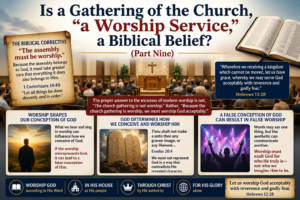
The biblical corrective is therefore not “the assembly is not worship” but “the assembly must be worship.” Because the assembly belongs to God, it must take greater care that everything it does also belongs to Him.  Paul’s words in 1 Corinthians 14:40 provide the fitting principle: “Let all things be done decently and in order.” That is not the language of an entertainment event. It is the language of a holy assembly. And Hebrews 12:28 supplies the theological response:

Wherefore we receiving a kingdom which cannot be moved, let us have grace, whereby we may serve God acceptably with reverence and godly fear.

That is the proper answer to the excesses of modern worship, not: “The church gathering is not worship.”  Rather, “Because the church gathering is worship, we must worship God acceptably.” The reaction against entertainment, ecstasy, pragmatism, and counterfeit spirituality is understandable and, in many cases, necessary. But the biblical response is not to abandon the category of corporate worship. It is to recover God’s worship on God’s terms, in God’s house, by God’s people, according to God’s Word, through Christ, and for God’s glory.

Worship Does Not Merely Express a Preexisting Conception of God; It Can Shape That Conception

What a person repeatedly hears and sings in worship can influence how he conceives of God. If God is repeatedly presented through an aesthetic that communicates casualness, sensuality, entertainment, self-indulgence, emotional excitement, or theatrical spectacle, the worshiper can begin to associate those qualities with God Himself. The danger is not simply: “I prefer this kind of music.” It becomes: “This is what God is like.” And if the God imagined through worship does not correspond to the God revealed in scripture, the worshiper is no longer worshiping the true God as He has revealed Himself.

The second commandment establishes the principle. The prohibition of images of God is especially relevant (Exodus 20:4):

Thou shalt not make unto thee any graven image, or any likeness. . . .

Why is that prohibition so serious? Because God determines how men conceive and worship Him, not men. Israel could not make a golden calf and say: “We still worship Jehovah; this is simply our preferred way of representing Him.” The problem was not merely that the calf was an idol instead of Jehovah. The representation itself communicated a false conception of God. They said (Exodus 32:4):

These be thy gods, O Israel, which brought thee up out of the land of Egypt.

They were attempting to worship the true God through a false representation of Him. That is an extremely important principle for thinking about worship. It is possible to retain the name of the true God while representing Him falsely.

A False Conception of God Can Result in False Worship

This is why idolatry is more profound than merely bowing before a statue. An idol is a false conception of God. Paul describes the Gentiles as those who “changed the glory of the uncorruptible God into an image made like to corruptible man” (Romans 1:23). Notice the movement:

God’s true glory → human conception → altered representation

They didn’t merely stop thinking about God. They changed their conception of Him. And then they worshiped according to that altered conception. That is how and why the issue of musical expression can become theological.

Music is not literally a graven image, but it can function as a representation. A musical environment can establish an imaginative world in which the worshiper experiences God as majestic or casual, holy or sensual, transcendent or immanent, sovereign or therapeutic, fearful or familiar, glorious or entertaining, and worthy of awe or useful for personal emotional gratification.

The words may say one thing while the entire aesthetic experience suggests another. That is where the question becomes serious. A song might say “Holy, holy, holy” while everything about its presentation encourages the worshiper to think:  “God exists primarily to make me feel good.” The verbal proposition can be orthodox while the conception of God communicated by the worship experience becomes defective.

This Helps Explain Why “The Words Are Biblical” Is Not Enough

Someone might say “the lyrics are doctrinally sound, therefore the music is acceptable,” but worship is not merely the recitation of propositions. The Bible itself speaks of worship as: “the beauty of holiness” (Psalm 29:2) and “reverence and godly fear” (Hebrews 12:28). The question is therefore not merely whether the words are true. It is also whether the whole act of worship appropriately expresses the truth it represents.

If the words teach God’s transcendence, holiness, majesty, sovereignty, and glory, but the musical and experiential environment continually communicates intimacy understood as casualness, entertainment, sensuality, or self-centered emotional gratification, there is a theological incongruity. This is why worship can actually teach a false doctrine of God without putting false words in the lyrics.

Danger When Human Experience Becomes the Interpretive Key

Conceiving of God

Suppose someone says: “I know this is good worship because I feel close to God when we sing it.” The question becomes: “Which God are you feeling close to?”  It is a necessary question. The people of Israel experienced God’s presence around the golden calf. They were engaging their emotions and said they were worshiping. Yet they had created a false representation of God. The emotional authenticity of the experience did not make the worship true.  Subjective experience cannot authenticate worship.  A person may sincerely say: “I love God.” But that sincerity doesn’t answer: Which God?

Paul warns about people receiving “another Jesus. . . . or another gospel” (2 Corinthians 11:4). The adjective “another” is crucial.  A person can use Christian terminology while having a distorted object.  Likewise, someone can say “God” while conceiving God according to human preferences rather than divine revelation. True worship requires the true God, not merely sincere religious feeling.  Therefore, worship has to begin with God’s self-revelation

True worshipers don’t start with “What kind of God do I want?”  They start with: “Who has God revealed Himself to be?” He is holy, glorious, majestic, sovereign, merciful, righteous, transcendent, near, loving, wrathful against sin, and worthy of fear, joy, and praise. The worship of God must correspond to God as He actually is, not God as the worshiper would prefer Him to be. Psalm 29:2 says:

Give unto the LORD the glory due unto his name; worship the LORD in the beauty of holiness.

The worshiper is not being told to create his own aesthetic experience. He is told to worship in the beauty of holiness. The beauty belongs to holiness. The holiness belongs to God. Therefore, the objective character of God provides the standard toward which worship is directed. Worship cannot be aesthetically indifferent to the character of God.

The First Commandment

The First Commandment says: “Thou shalt have no other gods before me” (Exodus 20:3). That does not merely prohibit worshiping Baal instead of Jehovah. It also establishes that God determines who He is and how He is to be worshiped. The most dangerous idol may therefore be one that retains the name “God.” A worshiper can reject paganism and still construct a God who is therapeutic rather than sovereign, casual rather than holy, entertaining rather than glorious, emotionally satisfying rather than truth-governed, and centered on human experience rather than divine glory.

That God may have the right name, but he is not the God revealed in scripture.  Musical expression in worship is not merely a neutral container for religious words. Because worship forms and expresses the worshiper’s conception of God, the character of the musical expression matters.  If music is selected according to human appetite and repeatedly cultivates a conception of God inconsistent with His revealed holiness, majesty, glory, reverence, and truth, it teaches a worshiper to imagine and worship a God different from the God who has revealed Himself in scripture.

Christian Imagination

Through Aesthetic Forms

Worship is not only about the propositional content of words; the forms through which truth is communicated also affect how that truth is apprehended and felt.  Aesthetic forms communicate and therefore should be governed by biblical truth. Scripture itself provides the archetype for Christian imagination—not merely in its content, but also in its form.  The Bible communicates through narrative, poetry, prophecy, metaphor, imagery, and other literary forms.

The Bible does not merely tell us facts about God. It teaches us how to see God. The psalms, for instance, don’t merely provide propositions such as God is holy.  They cause us to contemplate His holiness. Psalms don’t merely tell us God is great. They summon us to “Great is the LORD, and greatly to be praised.”  Not only do the psalms say that God is majestic. They give us language and imagery in which God’s people contemplate His majesty. So Christian worship engages the imagination. And if worship engages the imagination, then the aesthetic forms used in worship matter.

Scripture Is Also Inspired in the Way God Communicated Truth

Musical expression can contribute to the imaginative conception through which a worshiper apprehends the God about and to which he sings. If a worshiper repeatedly encounters God through an aesthetic environment communicating casualness, sensuality, entertainment, theatricality, emotional manipulation, or self-expression, then there is a danger that these qualities become associated with the worshiper’s conception of God. The question eventually becomes: What kind of God does this worship teach people to imagine? That is much less superficial than “Do you like this music?”

God inspired scripture not merely in its bare propositions but in the way He chose to communicate those truths. The aesthetic forms scripture uses should also regulate the aesthetic forms Christians employ in worship. They should be fitting; that is, the contemporary musical or artistic expression should correspond appropriately to the meaning being communicated.

Since God Himself chose particular forms to communicate His truth, form is not irrelevant to meaning. The question becomes: Does the form fit the truth?  That is an objective question, even if answering it in particular cases requires wisdom and judgment.  The question isn’t necessarily:  “Is this chord sinful?” It is: “Is this musical expression fitting for the truth it claims to communicate and the God it says it worships?”

Distinguishing True Affection from Physical Stimulation

Musical Forms Often Manipulate Appetites, Not Engage Imagination

One must distinguish worship that moves from understanding through imagination toward genuine spiritual affection from worship that seeks to produce immediate physical or emotional effects through manipulation. Scripture’s own artistic forms respect human rationality and engage the imagination rather than simply manipulating appetites. There is a difference between truth producing affection and technique producing sensation. The first is worship. The second counterfeits worship.

Suppose the congregation sings “Holy, holy, holy,” and the musical environment produces an overwhelming emotional experience. Then someone says: “I really felt God’s presence.” That, however, doesn’t establish that the Holy Spirit produced the experience. What did produce it?  Did the truth of God’s holiness cause the regenerate mind to contemplate God’s holiness and respond with appropriate affection? Or did the musical form manipulate the physical and emotional faculties into an intense experience that was then interpreted as God’s presence?

This is not saying that emotion is bad. Rather, genuine spiritual affection should arise from apprehension of the object of worship rather than being manufactured through techniques designed to produce a desired effect.  The former is sincere or true, and the latter is a counterfeit, which will produce an idol.

Modern Worship Subtly Changing the Object of Worship

Modern worship can subtly change the object. It begins with “God,” but can become “my experience of God.” Eventually the experience itself becomes the evidence that God is present. Then the worshiper isn’t primarily seeking God as He has revealed Himself. He is seeking a particular experience associated with God. The musical style becomes the mechanism for producing that experience. And the congregation learns: “When we have this sound, this progression, this build, this atmosphere, we feel God.” At that point, the danger is no longer merely bad musical taste. It is theological.

The worshiper can end up worshiping his imagination of God. This is where the second commandment also applies. The golden calf is not simply an example of someone who chose the wrong religion. Aaron said: “To morrow is a feast to the LORD” (Exodus 32:5). The calf was being incorporated into Israel’s attempted worship of the LORD. That is terrifying. They did not necessarily think: “Let’s stop worshiping Jehovah and become pagans.” They attempted to worship Jehovah through a representation that falsified His nature.

That means orthodox terminology does not guarantee orthodox worship. A congregation can sing: God is holy, God is glorious, Christ is Lord, and Jesus is King, and nevertheless cultivate through its aesthetic forms an understanding of God that contradicts those truths. That is why the whole communicative act matters.

More to Come


Leave a comment

Your email address will not be published. Required fields are marked *